Magna Concursos

Foram encontradas 35 questões.

3333977 Ano: 2024
Disciplina: Inglês (Língua Inglesa)
Banca: FUNDEP
Orgão: Pref. Montes Claros-MG
Provas:
Learning goals, which are referred to in version 3 of the BNCC as abilities, are intended to list the basic knowledge to be acquired by students, and to serve as a reference for drafting and updating the regional, state and municipal curricula.
[…]
Enunciado 3786019-1


Available at: https://www.britishcouncil.org.br/sites/default/files/leitura_critica_bncc_-_en_-_v4_final.pdf. [Fragment]. Accessed on May 6, 2024.
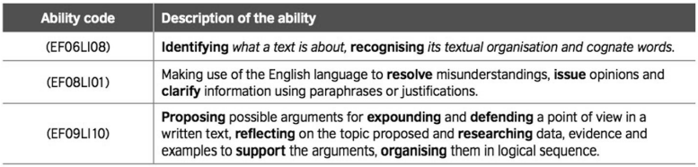
To develop the BNCC ability of identifying what a text is about and recognising its textual organization and cognate words, English teachers are recommended to exploit different textual genres in the language classroom. Examples of such texts range from a menu, a text message or a poem to a book review.
To develop the BNCC ability EF06LI08, which includes identifying what a text is about, an English teacher should make use of
 

Provas

Questão presente nas seguintes provas
3333976 Ano: 2024
Disciplina: Inglês (Língua Inglesa)
Banca: FUNDEP
Orgão: Pref. Montes Claros-MG
Provas:

Read the following text to answer the question.

By Leo Selivan

In this article, informed by the Lexical Approach, I reflect on grammar instruction in the classroom […]. I consider the problems with ‘traditional’ grammar teaching before arguing that what we actually need is more grammar input as well as showing how lexis can provide necessary ‘crutches’ for the learner.

Lexis = vocabulary + grammar

The shift in ELT from grammar to lexis mirrors a similar change in the attitude of linguists. In the past linguists were preoccupied with the grammar of language; however the advances in corpus linguistics have pushed lexis to the forefront. The term ‘lexis’, which was traditionally used by linguists, is a common word these days and frequently used even in textbooks.

Why use a technical term borrowed from the realm of linguistics instead of the word ‘vocabulary’? Quite simply because vocabulary is typically seen as individual words (often presented in lists) whereas lexis is a somewhat wider concept and consists of collocations, chunks and formulaic expressions. It also includes certain patterns that were traditionally associated with the grammar of a language, e.g. If I were you…, I haven’t seen you for ages etc.

Recognising certain grammar structures as lexical items means that they can be introduced much earlier, without structural analysis or elaboration. Indeed, since the concept of notions and functions made its way into language teaching, particularly as Communicative Language Teaching (CLT) gained prominence, some structures associated with grammar started to be taught lexically (or functionally). I’d like to is not taught as ‹the conditional› but as a chunk expressing desire. Similarly many other ‹traditional› grammar items can be introduced lexically relatively early on.


Less grammar or more grammar?

You are, no doubt, all familiar with students who on one hand seem to know the ‘rules’ of grammar but still fail to produce grammatically correct sentences when speaking or, on the other, sound unnatural and foreign-like even when their sentences are grammatically correct. Michael Lewis, who might be considered the founder of the Lexical Approach, once claimed that there was no direct relationship between the knowledge of grammar and speaking. In contrast, the knowledge of formulaic language has been shown by research to have a significant bearing on the natural language production.

Furthermore, certain grammar rules are practically impossible to learn. Dave Willis cites the grammar of orientation (which includes the notoriously difficult present perfect and the uses of certain modal verbs) as particularly resistant to teaching. The only way to grasp their meaning is through continuous exposure and use.

Finally, even the most authoritative English grammars never claim to provide a comprehensive description of all the grammar, hence the word ‘introduction’ often used in their titles (for instance, Huddleston & Pullum’s A Student’s Introduction to English Grammar or Halliday’s An Introduction to Functional Grammar).

If grammarians do not even attempt to address all areas of grammar, how can we, practitioners, cover all the aspects of grammar in our teaching, especially if all we seem to focus on is a limited selection of discrete items, comprised mostly of tenses and a handful of modal verbs? It would seem that we need to expose our students to a lot of naturally occurring language and frequently draw their attention to various grammar points as they arise.

For example, while teaching the expression fall asleep / be asleep you can ask your students:

• Don’t make any noise – she’s fallen asleep.

• Don’t make any noise – she’s asleep.

What does’s stand for in each of these cases (is or has)?

One of the fathers of the Communicative Language Teaching Henry Widdowson advocated using lexical items as a starting point and then ‘showing how they need to be grammatically modified to be communicatively effective’ (1990:95). For example, when exploring a text with your students, you may come across a sentence like this:

They’ve been married for seven years.

You can ask your students: When did they get married? How should you change the sentence if the couple you are talking about is no longer married?

The above demonstrates how the teacher should be constantly on the ball and take every opportunity to draw students’ attention to grammar. Such short but frequent ‘grammar spots’ will help to slowly raise students’ awareness and build their understanding of the English grammar system.

[…]

Conclusion

So is there room for grammar instruction in the classroom? Certainly yes. But the grammar practice should always start with the exploitation of lexical items. Exposing students to a lot of natural and contextualised examples will offer a lexical way into the grammar of the language.

To sum up, grammar should play some role in language teaching but should not occupy a big part of class time. Instead grammar should be delivered in small but frequent portions. Students should be encouraged to collect a lot of examples of a particular structure before being invited to analyse it. Hence, analysis should be preceded by synthesis.

Lastly, language practitioners should bear in mind that grammar acquisition is an incremental process which requires frequent focus and refocus on the items already studied.

Available at: https://www.teachingenglish.org.uk/professionaldevelopment/teachers/knowing-subject/articles/grammar-vs-lexisor-grammar-through. Accessed on: April 29, 2024.

Which sentence does not refer to lexis?
 

Provas

Questão presente nas seguintes provas
3333975 Ano: 2024
Disciplina: Inglês (Língua Inglesa)
Banca: FUNDEP
Orgão: Pref. Montes Claros-MG
Provas:

Read the following text to answer the question.

By Leo Selivan

In this article, informed by the Lexical Approach, I reflect on grammar instruction in the classroom […]. I consider the problems with ‘traditional’ grammar teaching before arguing that what we actually need is more grammar input as well as showing how lexis can provide necessary ‘crutches’ for the learner.

Lexis = vocabulary + grammar

The shift in ELT from grammar to lexis mirrors a similar change in the attitude of linguists. In the past linguists were preoccupied with the grammar of language; however the advances in corpus linguistics have pushed lexis to the forefront. The term ‘lexis’, which was traditionally used by linguists, is a common word these days and frequently used even in textbooks.

Why use a technical term borrowed from the realm of linguistics instead of the word ‘vocabulary’? Quite simply because vocabulary is typically seen as individual words (often presented in lists) whereas lexis is a somewhat wider concept and consists of collocations, chunks and formulaic expressions. It also includes certain patterns that were traditionally associated with the grammar of a language, e.g. If I were you…, I haven’t seen you for ages etc.

Recognising certain grammar structures as lexical items means that they can be introduced much earlier, without structural analysis or elaboration. Indeed, since the concept of notions and functions made its way into language teaching, particularly as Communicative Language Teaching (CLT) gained prominence, some structures associated with grammar started to be taught lexically (or functionally). I’d like to is not taught as ‹the conditional› but as a chunk expressing desire. Similarly many other ‹traditional› grammar items can be introduced lexically relatively early on.


Less grammar or more grammar?

You are, no doubt, all familiar with students who on one hand seem to know the ‘rules’ of grammar but still fail to produce grammatically correct sentences when speaking or, on the other, sound unnatural and foreign-like even when their sentences are grammatically correct. Michael Lewis, who might be considered the founder of the Lexical Approach, once claimed that there was no direct relationship between the knowledge of grammar and speaking. In contrast, the knowledge of formulaic language has been shown by research to have a significant bearing on the natural language production.

Furthermore, certain grammar rules are practically impossible to learn. Dave Willis cites the grammar of orientation (which includes the notoriously difficult present perfect and the uses of certain modal verbs) as particularly resistant to teaching. The only way to grasp their meaning is through continuous exposure and use.

Finally, even the most authoritative English grammars never claim to provide a comprehensive description of all the grammar, hence the word ‘introduction’ often used in their titles (for instance, Huddleston & Pullum’s A Student’s Introduction to English Grammar or Halliday’s An Introduction to Functional Grammar).

If grammarians do not even attempt to address all areas of grammar, how can we, practitioners, cover all the aspects of grammar in our teaching, especially if all we seem to focus on is a limited selection of discrete items, comprised mostly of tenses and a handful of modal verbs? It would seem that we need to expose our students to a lot of naturally occurring language and frequently draw their attention to various grammar points as they arise.

For example, while teaching the expression fall asleep / be asleep you can ask your students:

• Don’t make any noise – she’s fallen asleep.

• Don’t make any noise – she’s asleep.

What does’s stand for in each of these cases (is or has)?

One of the fathers of the Communicative Language Teaching Henry Widdowson advocated using lexical items as a starting point and then ‘showing how they need to be grammatically modified to be communicatively effective’ (1990:95). For example, when exploring a text with your students, you may come across a sentence like this:

They’ve been married for seven years.

You can ask your students: When did they get married? How should you change the sentence if the couple you are talking about is no longer married?

The above demonstrates how the teacher should be constantly on the ball and take every opportunity to draw students’ attention to grammar. Such short but frequent ‘grammar spots’ will help to slowly raise students’ awareness and build their understanding of the English grammar system.

[…]

Conclusion

So is there room for grammar instruction in the classroom? Certainly yes. But the grammar practice should always start with the exploitation of lexical items. Exposing students to a lot of natural and contextualised examples will offer a lexical way into the grammar of the language.

To sum up, grammar should play some role in language teaching but should not occupy a big part of class time. Instead grammar should be delivered in small but frequent portions. Students should be encouraged to collect a lot of examples of a particular structure before being invited to analyse it. Hence, analysis should be preceded by synthesis.

Lastly, language practitioners should bear in mind that grammar acquisition is an incremental process which requires frequent focus and refocus on the items already studied.

Available at: https://www.teachingenglish.org.uk/professionaldevelopment/teachers/knowing-subject/articles/grammar-vs-lexisor-grammar-through. Accessed on: April 29, 2024.

The conjunction whereas in “Quite simply because vocabulary is typically seen as individual words (often presented in lists) whereas lexis is a somewhat wider concept and consists of collocations, chunks and formulaic expressions.” is closest in meaning to
 

Provas

Questão presente nas seguintes provas
3333974 Ano: 2024
Disciplina: Inglês (Língua Inglesa)
Banca: FUNDEP
Orgão: Pref. Montes Claros-MG
Provas:

Read the following text to answer the question.

By Leo Selivan

In this article, informed by the Lexical Approach, I reflect on grammar instruction in the classroom […]. I consider the problems with ‘traditional’ grammar teaching before arguing that what we actually need is more grammar input as well as showing how lexis can provide necessary ‘crutches’ for the learner.

Lexis = vocabulary + grammar

The shift in ELT from grammar to lexis mirrors a similar change in the attitude of linguists. In the past linguists were preoccupied with the grammar of language; however the advances in corpus linguistics have pushed lexis to the forefront. The term ‘lexis’, which was traditionally used by linguists, is a common word these days and frequently used even in textbooks.

Why use a technical term borrowed from the realm of linguistics instead of the word ‘vocabulary’? Quite simply because vocabulary is typically seen as individual words (often presented in lists) whereas lexis is a somewhat wider concept and consists of collocations, chunks and formulaic expressions. It also includes certain patterns that were traditionally associated with the grammar of a language, e.g. If I were you…, I haven’t seen you for ages etc.

Recognising certain grammar structures as lexical items means that they can be introduced much earlier, without structural analysis or elaboration. Indeed, since the concept of notions and functions made its way into language teaching, particularly as Communicative Language Teaching (CLT) gained prominence, some structures associated with grammar started to be taught lexically (or functionally). I’d like to is not taught as ‹the conditional› but as a chunk expressing desire. Similarly many other ‹traditional› grammar items can be introduced lexically relatively early on.


Less grammar or more grammar?

You are, no doubt, all familiar with students who on one hand seem to know the ‘rules’ of grammar but still fail to produce grammatically correct sentences when speaking or, on the other, sound unnatural and foreign-like even when their sentences are grammatically correct. Michael Lewis, who might be considered the founder of the Lexical Approach, once claimed that there was no direct relationship between the knowledge of grammar and speaking. In contrast, the knowledge of formulaic language has been shown by research to have a significant bearing on the natural language production.

Furthermore, certain grammar rules are practically impossible to learn. Dave Willis cites the grammar of orientation (which includes the notoriously difficult present perfect and the uses of certain modal verbs) as particularly resistant to teaching. The only way to grasp their meaning is through continuous exposure and use.

Finally, even the most authoritative English grammars never claim to provide a comprehensive description of all the grammar, hence the word ‘introduction’ often used in their titles (for instance, Huddleston & Pullum’s A Student’s Introduction to English Grammar or Halliday’s An Introduction to Functional Grammar).

If grammarians do not even attempt to address all areas of grammar, how can we, practitioners, cover all the aspects of grammar in our teaching, especially if all we seem to focus on is a limited selection of discrete items, comprised mostly of tenses and a handful of modal verbs? It would seem that we need to expose our students to a lot of naturally occurring language and frequently draw their attention to various grammar points as they arise.

For example, while teaching the expression fall asleep / be asleep you can ask your students:

• Don’t make any noise – she’s fallen asleep.

• Don’t make any noise – she’s asleep.

What does’s stand for in each of these cases (is or has)?

One of the fathers of the Communicative Language Teaching Henry Widdowson advocated using lexical items as a starting point and then ‘showing how they need to be grammatically modified to be communicatively effective’ (1990:95). For example, when exploring a text with your students, you may come across a sentence like this:

They’ve been married for seven years.

You can ask your students: When did they get married? How should you change the sentence if the couple you are talking about is no longer married?

The above demonstrates how the teacher should be constantly on the ball and take every opportunity to draw students’ attention to grammar. Such short but frequent ‘grammar spots’ will help to slowly raise students’ awareness and build their understanding of the English grammar system.

[…]

Conclusion

So is there room for grammar instruction in the classroom? Certainly yes. But the grammar practice should always start with the exploitation of lexical items. Exposing students to a lot of natural and contextualised examples will offer a lexical way into the grammar of the language.

To sum up, grammar should play some role in language teaching but should not occupy a big part of class time. Instead grammar should be delivered in small but frequent portions. Students should be encouraged to collect a lot of examples of a particular structure before being invited to analyse it. Hence, analysis should be preceded by synthesis.

Lastly, language practitioners should bear in mind that grammar acquisition is an incremental process which requires frequent focus and refocus on the items already studied.

Available at: https://www.teachingenglish.org.uk/professionaldevelopment/teachers/knowing-subject/articles/grammar-vs-lexisor-grammar-through. Accessed on: April 29, 2024.

The author states that research findings have demonstrated that
 

Provas

Questão presente nas seguintes provas
3333973 Ano: 2024
Disciplina: Inglês (Língua Inglesa)
Banca: FUNDEP
Orgão: Pref. Montes Claros-MG
Provas:

Read the following text to answer the question.

By Leo Selivan

In this article, informed by the Lexical Approach, I reflect on grammar instruction in the classroom […]. I consider the problems with ‘traditional’ grammar teaching before arguing that what we actually need is more grammar input as well as showing how lexis can provide necessary ‘crutches’ for the learner.

Lexis = vocabulary + grammar

The shift in ELT from grammar to lexis mirrors a similar change in the attitude of linguists. In the past linguists were preoccupied with the grammar of language; however the advances in corpus linguistics have pushed lexis to the forefront. The term ‘lexis’, which was traditionally used by linguists, is a common word these days and frequently used even in textbooks.

Why use a technical term borrowed from the realm of linguistics instead of the word ‘vocabulary’? Quite simply because vocabulary is typically seen as individual words (often presented in lists) whereas lexis is a somewhat wider concept and consists of collocations, chunks and formulaic expressions. It also includes certain patterns that were traditionally associated with the grammar of a language, e.g. If I were you…, I haven’t seen you for ages etc.

Recognising certain grammar structures as lexical items means that they can be introduced much earlier, without structural analysis or elaboration. Indeed, since the concept of notions and functions made its way into language teaching, particularly as Communicative Language Teaching (CLT) gained prominence, some structures associated with grammar started to be taught lexically (or functionally). I’d like to is not taught as ‹the conditional› but as a chunk expressing desire. Similarly many other ‹traditional› grammar items can be introduced lexically relatively early on.


Less grammar or more grammar?

You are, no doubt, all familiar with students who on one hand seem to know the ‘rules’ of grammar but still fail to produce grammatically correct sentences when speaking or, on the other, sound unnatural and foreign-like even when their sentences are grammatically correct. Michael Lewis, who might be considered the founder of the Lexical Approach, once claimed that there was no direct relationship between the knowledge of grammar and speaking. In contrast, the knowledge of formulaic language has been shown by research to have a significant bearing on the natural language production.

Furthermore, certain grammar rules are practically impossible to learn. Dave Willis cites the grammar of orientation (which includes the notoriously difficult present perfect and the uses of certain modal verbs) as particularly resistant to teaching. The only way to grasp their meaning is through continuous exposure and use.

Finally, even the most authoritative English grammars never claim to provide a comprehensive description of all the grammar, hence the word ‘introduction’ often used in their titles (for instance, Huddleston & Pullum’s A Student’s Introduction to English Grammar or Halliday’s An Introduction to Functional Grammar).

If grammarians do not even attempt to address all areas of grammar, how can we, practitioners, cover all the aspects of grammar in our teaching, especially if all we seem to focus on is a limited selection of discrete items, comprised mostly of tenses and a handful of modal verbs? It would seem that we need to expose our students to a lot of naturally occurring language and frequently draw their attention to various grammar points as they arise.

For example, while teaching the expression fall asleep / be asleep you can ask your students:

• Don’t make any noise – she’s fallen asleep.

• Don’t make any noise – she’s asleep.

What does’s stand for in each of these cases (is or has)?

One of the fathers of the Communicative Language Teaching Henry Widdowson advocated using lexical items as a starting point and then ‘showing how they need to be grammatically modified to be communicatively effective’ (1990:95). For example, when exploring a text with your students, you may come across a sentence like this:

They’ve been married for seven years.

You can ask your students: When did they get married? How should you change the sentence if the couple you are talking about is no longer married?

The above demonstrates how the teacher should be constantly on the ball and take every opportunity to draw students’ attention to grammar. Such short but frequent ‘grammar spots’ will help to slowly raise students’ awareness and build their understanding of the English grammar system.

[…]

Conclusion

So is there room for grammar instruction in the classroom? Certainly yes. But the grammar practice should always start with the exploitation of lexical items. Exposing students to a lot of natural and contextualised examples will offer a lexical way into the grammar of the language.

To sum up, grammar should play some role in language teaching but should not occupy a big part of class time. Instead grammar should be delivered in small but frequent portions. Students should be encouraged to collect a lot of examples of a particular structure before being invited to analyse it. Hence, analysis should be preceded by synthesis.

Lastly, language practitioners should bear in mind that grammar acquisition is an incremental process which requires frequent focus and refocus on the items already studied.

Available at: https://www.teachingenglish.org.uk/professionaldevelopment/teachers/knowing-subject/articles/grammar-vs-lexisor-grammar-through. Accessed on: April 29, 2024.

As far as grammar instruction is considered, the author of this text, who is a teacher, contends that
 

Provas

Questão presente nas seguintes provas
3333972 Ano: 2024
Disciplina: Inglês (Língua Inglesa)
Banca: FUNDEP
Orgão: Pref. Montes Claros-MG
Provas:

Empowering language learning through assessment

By Liying Cheng & Janna Fox
Introduction

Like you, we are teachers. We both began our careers teaching English to students ______ first languages were not English. We taught many of these students in Asia, the Middle East, Africa, and North America, navigating our way through the teaching, learning, and assessment of our students with little guidance from theory or resources. Over the years, we became increasingly sensitive to the negative influence and consequences of ill-considered assessment and testing practices. Although we could increasingly find resources on language teaching methods, strategies, and techniques, very few of these resources provided systematic and coherent support for our day-to-day assessment practices. There were no ready answers to our questions in the research literature either – researchers tended to write for other researchers, and their findings, although interesting, were not readily applicable in our classrooms. Years later, our long-term interest in assessment led us to teaching courses to pre-service and in-service teachers: helping them to support their students’ learning through sound assessment practices. This thread has centrally run through our work. Again, we searched for resources that could answer the questions and address the issues arising in the classroom; we realised that the narrow scope of resources on classroom assessment rarely moved beyond test design and test analysis, and was more appropriate for large-scale testing than for on-going classroom assessment.

In the present educational climate, we are continually faced with complex assessment issues. For example, there is a great deal of discussion now about alignment as a guiding principle for high quality assessment: that is, the degree of agreement amongst standards, curriculum, learning outcomes, assessment tasks (including tests), and instruction. Alignment, validity, reliability, fairness, consequences, and practicality are viewed as central aspects of assessment practice that supports learning.

The alignment of learning goals, assessment, and classroom activity
Enunciado 3786014-1

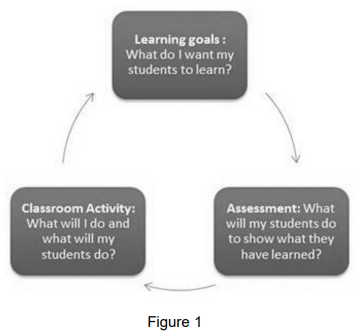
Figure 1 depicts assessment practices three-dimensionally and asks us as teachers to revisit our own classroom practices. Think about what it means to us in achieving instructional goals through teaching and assessment. In the center of this triangle is our students’ learning. The first question we need to ask relates to the learning goals we have for our students: What do I want my students to learn? What do I want them to know, value, and / or be able to do as an outcome of my teaching? Moving to the next question in Figure 1, on assessment, we need to ask how we will monitor and evaluate learning – or what information is essential in order to determine whether our students have met or exceeded the required expectations: What will my students do to show what they have learned? Given the evidence that we plan to collect during a course, we then need to identify the actual classroom activities that will support our students’ learning and development: What will I do as a teacher, and what will my students do as learners?

Assessment serves as the key to check on learning, providing essential information to teachers. This is an on-going, iterative, and cyclical way of supporting learners through assessment and teaching. In this sense, teaching and assessment are one integral and interconnected process. Teachers need to constantly ask themselves: Have my students learned? And how well have they progressed as a result of my assessment practices?


Assessment of, as, and for learning

For teachers to support student learning through assessment, teachers need to engage themselves as well as their students in the discussion of assessment of learning, assessment for learning, and assessment as learning. We argue that it is inaccurate to view assessment only as judgments on learner progress at the conclusion of a unit of teaching and learning. Rather, it should also be viewed as a way of obtaining evidence for where students are in reaching their learning goals and what they need in order to progress towards these goals. Assessment as learning puts the focus on the students themselves taking responsibility for their own learning through self and peer-assessment, monitoring their own progress toward their goals and employing strategies for achieving them. We know that alignment and assessment of, for, and as learning ultimately empower our students’ language development.


Available at: https://www.onestopenglish.com/methodology-theworld-of-elt/applied-linguistics-empowering-language-learningthrough-assessment/555928.article. Accessed on: April 29, 2024.
The conjunction although in “Although we could increasingly find resources on language teaching methods, strategies, and techniques, very few of these resources provided systematic and coherent support for our day-to-day assessment practices.” is closest in meaning to
 

Provas

Questão presente nas seguintes provas
3333971 Ano: 2024
Disciplina: Inglês (Língua Inglesa)
Banca: FUNDEP
Orgão: Pref. Montes Claros-MG
Provas:

Empowering language learning through assessment


By Liying Cheng & Janna Fox
Introduction

Like you, we are teachers. We both began our careers teaching English to students ______ first languages were not English. We taught many of these students in Asia, the Middle East, Africa, and North America, navigating our way through the teaching, learning, and assessment of our students with little guidance from theory or resources. Over the years, we became increasingly sensitive to the negative influence and consequences of ill-considered assessment and testing practices. Although we could increasingly find resources on language teaching methods, strategies, and techniques, very few of these resources provided systematic and coherent support for our day-to-day assessment practices. There were no ready answers to our questions in the research literature either – researchers tended to write for other researchers, and their findings, although interesting, were not readily applicable in our classrooms. Years later, our long-term interest in assessment led us to teaching courses to pre-service and in-service teachers: helping them to support their students’ learning through sound assessment practices. This thread has centrally run through our work. Again, we searched for resources that could answer the questions and address the issues arising in the classroom; we realised that the narrow scope of resources on classroom assessment rarely moved beyond test design and test analysis, and was more appropriate for large-scale testing than for on-going classroom assessment.

In the present educational climate, we are continually faced with complex assessment issues. For example, there is a great deal of discussion now about alignment as a guiding principle for high quality assessment: that is, the degree of agreement amongst standards, curriculum, learning outcomes, assessment tasks (including tests), and instruction. Alignment, validity, reliability, fairness, consequences, and practicality are viewed as central aspects of assessment practice that supports learning.

The alignment of learning goals, assessment, and classroom activity
Enunciado 3786013-1

Figure 1 depicts assessment practices three-dimensionally and asks us as teachers to revisit our own classroom practices. Think about what it means to us in achieving instructional goals through teaching and assessment. In the center of this triangle is our students’ learning. The first question we need to ask relates to the learning goals we have for our students: What do I want my students to learn? What do I want them to know, value, and / or be able to do as an outcome of my teaching? Moving to the next question in Figure 1, on assessment, we need to ask how we will monitor and evaluate learning – or what information is essential in order to determine whether our students have met or exceeded the required expectations: What will my students do to show what they have learned? Given the evidence that we plan to collect during a course, we then need to identify the actual classroom activities that will support our students’ learning and development: What will I do as a teacher, and what will my students do as learners?

Assessment serves as the key to check on learning, providing essential information to teachers. This is an on-going, iterative, and cyclical way of supporting learners through assessment and teaching. In this sense, teaching and assessment are one integral and interconnected process. Teachers need to constantly ask themselves: Have my students learned? And how well have they progressed as a result of my assessment practices?


Assessment of, as, and for learning

For teachers to support student learning through assessment, teachers need to engage themselves as well as their students in the discussion of assessment of learning, assessment for learning, and assessment as learning. We argue that it is inaccurate to view assessment only as judgments on learner progress at the conclusion of a unit of teaching and learning. Rather, it should also be viewed as a way of obtaining evidence for where students are in reaching their learning goals and what they need in order to progress towards these goals. Assessment as learning puts the focus on the students themselves taking responsibility for their own learning through self and peer-assessment, monitoring their own progress toward their goals and employing strategies for achieving them. We know that alignment and assessment of, for, and as learning ultimately empower our students’ language development.


Available at: https://www.onestopenglish.com/methodology-theworld-of-elt/applied-linguistics-empowering-language-learningthrough-assessment/555928.article. Accessed on: April 29, 2024.
The authors state that “Alignment, validity, reliability, fairness, consequences, and practicality are viewed as central aspects of assessment practice that supports learning.”.
The word reliability is closest in meaning to
 

Provas

Questão presente nas seguintes provas
3333970 Ano: 2024
Disciplina: Inglês (Língua Inglesa)
Banca: FUNDEP
Orgão: Pref. Montes Claros-MG
Provas:

Empowering language learning through assessment


By Liying Cheng & Janna Fox
Introduction

Like you, we are teachers. We both began our careers teaching English to students ______ first languages were not English. We taught many of these students in Asia, the Middle East, Africa, and North America, navigating our way through the teaching, learning, and assessment of our students with little guidance from theory or resources. Over the years, we became increasingly sensitive to the negative influence and consequences of ill-considered assessment and testing practices. Although we could increasingly find resources on language teaching methods, strategies, and techniques, very few of these resources provided systematic and coherent support for our day-to-day assessment practices. There were no ready answers to our questions in the research literature either – researchers tended to write for other researchers, and their findings, although interesting, were not readily applicable in our classrooms. Years later, our long-term interest in assessment led us to teaching courses to pre-service and in-service teachers: helping them to support their students’ learning through sound assessment practices. This thread has centrally run through our work. Again, we searched for resources that could answer the questions and address the issues arising in the classroom; we realised that the narrow scope of resources on classroom assessment rarely moved beyond test design and test analysis, and was more appropriate for large-scale testing than for on-going classroom assessment.

In the present educational climate, we are continually faced with complex assessment issues. For example, there is a great deal of discussion now about alignment as a guiding principle for high quality assessment: that is, the degree of agreement amongst standards, curriculum, learning outcomes, assessment tasks (including tests), and instruction. Alignment, validity, reliability, fairness, consequences, and practicality are viewed as central aspects of assessment practice that supports learning.

The alignment of learning goals, assessment, and classroom activity
Enunciado 3786012-1

Figure 1 depicts assessment practices three-dimensionally and asks us as teachers to revisit our own classroom practices. Think about what it means to us in achieving instructional goals through teaching and assessment. In the center of this triangle is our students’ learning. The first question we need to ask relates to the learning goals we have for our students: What do I want my students to learn? What do I want them to know, value, and / or be able to do as an outcome of my teaching? Moving to the next question in Figure 1, on assessment, we need to ask how we will monitor and evaluate learning – or what information is essential in order to determine whether our students have met or exceeded the required expectations: What will my students do to show what they have learned? Given the evidence that we plan to collect during a course, we then need to identify the actual classroom activities that will support our students’ learning and development: What will I do as a teacher, and what will my students do as learners?

Assessment serves as the key to check on learning, providing essential information to teachers. This is an on-going, iterative, and cyclical way of supporting learners through assessment and teaching. In this sense, teaching and assessment are one integral and interconnected process. Teachers need to constantly ask themselves: Have my students learned? And how well have they progressed as a result of my assessment practices?


Assessment of, as, and for learning

For teachers to support student learning through assessment, teachers need to engage themselves as well as their students in the discussion of assessment of learning, assessment for learning, and assessment as learning. We argue that it is inaccurate to view assessment only as judgments on learner progress at the conclusion of a unit of teaching and learning. Rather, it should also be viewed as a way of obtaining evidence for where students are in reaching their learning goals and what they need in order to progress towards these goals. Assessment as learning puts the focus on the students themselves taking responsibility for their own learning through self and peer-assessment, monitoring their own progress toward their goals and employing strategies for achieving them. We know that alignment and assessment of, for, and as learning ultimately empower our students’ language development.


Available at: https://www.onestopenglish.com/methodology-theworld-of-elt/applied-linguistics-empowering-language-learningthrough-assessment/555928.article. Accessed on: April 29, 2024.
The correct relative pronoun to complete the sentence: “Like you, we are teachers. We both began our careers teaching English to students ______ first languages were not English.” is
 

Provas

Questão presente nas seguintes provas
3333969 Ano: 2024
Disciplina: Inglês (Língua Inglesa)
Banca: FUNDEP
Orgão: Pref. Montes Claros-MG
Provas:

Empowering language learning through assessment


By Liying Cheng & Janna Fox
Introduction

Like you, we are teachers. We both began our careers teaching English to students ______ first languages were not English. We taught many of these students in Asia, the Middle East, Africa, and North America, navigating our way through the teaching, learning, and assessment of our students with little guidance from theory or resources. Over the years, we became increasingly sensitive to the negative influence and consequences of ill-considered assessment and testing practices. Although we could increasingly find resources on language teaching methods, strategies, and techniques, very few of these resources provided systematic and coherent support for our day-to-day assessment practices. There were no ready answers to our questions in the research literature either – researchers tended to write for other researchers, and their findings, although interesting, were not readily applicable in our classrooms. Years later, our long-term interest in assessment led us to teaching courses to pre-service and in-service teachers: helping them to support their students’ learning through sound assessment practices. This thread has centrally run through our work. Again, we searched for resources that could answer the questions and address the issues arising in the classroom; we realised that the narrow scope of resources on classroom assessment rarely moved beyond test design and test analysis, and was more appropriate for large-scale testing than for on-going classroom assessment.

In the present educational climate, we are continually faced with complex assessment issues. For example, there is a great deal of discussion now about alignment as a guiding principle for high quality assessment: that is, the degree of agreement amongst standards, curriculum, learning outcomes, assessment tasks (including tests), and instruction. Alignment, validity, reliability, fairness, consequences, and practicality are viewed as central aspects of assessment practice that supports learning.

The alignment of learning goals, assessment, and classroom activity
Enunciado 3786011-1

Figure 1 depicts assessment practices three-dimensionally and asks us as teachers to revisit our own classroom practices. Think about what it means to us in achieving instructional goals through teaching and assessment. In the center of this triangle is our students’ learning. The first question we need to ask relates to the learning goals we have for our students: What do I want my students to learn? What do I want them to know, value, and / or be able to do as an outcome of my teaching? Moving to the next question in Figure 1, on assessment, we need to ask how we will monitor and evaluate learning – or what information is essential in order to determine whether our students have met or exceeded the required expectations: What will my students do to show what they have learned? Given the evidence that we plan to collect during a course, we then need to identify the actual classroom activities that will support our students’ learning and development: What will I do as a teacher, and what will my students do as learners?

Assessment serves as the key to check on learning, providing essential information to teachers. This is an on-going, iterative, and cyclical way of supporting learners through assessment and teaching. In this sense, teaching and assessment are one integral and interconnected process. Teachers need to constantly ask themselves: Have my students learned? And how well have they progressed as a result of my assessment practices?


Assessment of, as, and for learning

For teachers to support student learning through assessment, teachers need to engage themselves as well as their students in the discussion of assessment of learning, assessment for learning, and assessment as learning. We argue that it is inaccurate to view assessment only as judgments on learner progress at the conclusion of a unit of teaching and learning. Rather, it should also be viewed as a way of obtaining evidence for where students are in reaching their learning goals and what they need in order to progress towards these goals. Assessment as learning puts the focus on the students themselves taking responsibility for their own learning through self and peer-assessment, monitoring their own progress toward their goals and employing strategies for achieving them. We know that alignment and assessment of, for, and as learning ultimately empower our students’ language development.


Available at: https://www.onestopenglish.com/methodology-theworld-of-elt/applied-linguistics-empowering-language-learningthrough-assessment/555928.article. Accessed on: April 29, 2024.
According to the authors, ensuring that students’ learning is effectively supported mainly involves
 

Provas

Questão presente nas seguintes provas
3333968 Ano: 2024
Disciplina: Inglês (Língua Inglesa)
Banca: FUNDEP
Orgão: Pref. Montes Claros-MG
Provas:

Empowering language learning through assessment


By Liying Cheng & Janna Fox
Introduction

Like you, we are teachers. We both began our careers teaching English to students ______ first languages were not English. We taught many of these students in Asia, the Middle East, Africa, and North America, navigating our way through the teaching, learning, and assessment of our students with little guidance from theory or resources. Over the years, we became increasingly sensitive to the negative influence and consequences of ill-considered assessment and testing practices. Although we could increasingly find resources on language teaching methods, strategies, and techniques, very few of these resources provided systematic and coherent support for our day-to-day assessment practices. There were no ready answers to our questions in the research literature either – researchers tended to write for other researchers, and their findings, although interesting, were not readily applicable in our classrooms. Years later, our long-term interest in assessment led us to teaching courses to pre-service and in-service teachers: helping them to support their students’ learning through sound assessment practices. This thread has centrally run through our work. Again, we searched for resources that could answer the questions and address the issues arising in the classroom; we realised that the narrow scope of resources on classroom assessment rarely moved beyond test design and test analysis, and was more appropriate for large-scale testing than for on-going classroom assessment.

In the present educational climate, we are continually faced with complex assessment issues. For example, there is a great deal of discussion now about alignment as a guiding principle for high quality assessment: that is, the degree of agreement amongst standards, curriculum, learning outcomes, assessment tasks (including tests), and instruction. Alignment, validity, reliability, fairness, consequences, and practicality are viewed as central aspects of assessment practice that supports learning.

The alignment of learning goals, assessment, and classroom activity
Enunciado 3786010-1

Figure 1 depicts assessment practices three-dimensionally and asks us as teachers to revisit our own classroom practices. Think about what it means to us in achieving instructional goals through teaching and assessment. In the center of this triangle is our students’ learning. The first question we need to ask relates to the learning goals we have for our students: What do I want my students to learn? What do I want them to know, value, and / or be able to do as an outcome of my teaching? Moving to the next question in Figure 1, on assessment, we need to ask how we will monitor and evaluate learning – or what information is essential in order to determine whether our students have met or exceeded the required expectations: What will my students do to show what they have learned? Given the evidence that we plan to collect during a course, we then need to identify the actual classroom activities that will support our students’ learning and development: What will I do as a teacher, and what will my students do as learners?

Assessment serves as the key to check on learning, providing essential information to teachers. This is an on-going, iterative, and cyclical way of supporting learners through assessment and teaching. In this sense, teaching and assessment are one integral and interconnected process. Teachers need to constantly ask themselves: Have my students learned? And how well have they progressed as a result of my assessment practices?


Assessment of, as, and for learning

For teachers to support student learning through assessment, teachers need to engage themselves as well as their students in the discussion of assessment of learning, assessment for learning, and assessment as learning. We argue that it is inaccurate to view assessment only as judgments on learner progress at the conclusion of a unit of teaching and learning. Rather, it should also be viewed as a way of obtaining evidence for where students are in reaching their learning goals and what they need in order to progress towards these goals. Assessment as learning puts the focus on the students themselves taking responsibility for their own learning through self and peer-assessment, monitoring their own progress toward their goals and employing strategies for achieving them. We know that alignment and assessment of, for, and as learning ultimately empower our students’ language development.


Available at: https://www.onestopenglish.com/methodology-theworld-of-elt/applied-linguistics-empowering-language-learningthrough-assessment/555928.article. Accessed on: April 29, 2024.
The authors of the text claim that assessment serves as a fundamental tool for
 

Provas

Questão presente nas seguintes provas