Foram encontradas 40 questões.
Segundo a Lei de Diretrizes e Bases da Educação Nacional (LDBEN) nº 9.394/1996, que define e
regulariza a organização da educação brasileira com base nos princípios presentes na Constituição, o
Estado deve oferecer obrigatoriamente educação escolar pública e gratuita a todos os cidadãos brasileiros.
Assim, assinale abaixo a alternativa que correspondente às etapas da Educação Básica brasileira, que
segundo a referida Lei devem ser obrigatoriamente ofertadas pelo Estado:
Provas
Questão presente nas seguintes provas

Sobre as diretrizes previstas no art. 2º do Plano Nacional de Educação (2014-2024), aprovado pela Lei nº
13.005, de 25 de junho de 2014, objetivando cumprir com o disposto do art. 214 da Constituição Federal
de 1988, assinale a alternativa que não está alinhada ao que pressupõe o plano:
Provas
Questão presente nas seguintes provas
Considerando o direito à educação e o dever de educar, previstos na Lei de Diretrizes e Bases da Educação
Nacional (LDBEN) nº 9.394/1996, o dever do Estado com a educação escolar pública será efetivado
mediante a garantia de:
Provas
Questão presente nas seguintes provas
What Is Linguistic Diversity?
What is language diversity? Language diversity, or linguistic diversity, is a broad term used to
describe the differences between different languages and the ways that people communicate with each
other. Language is one of the features of humanity that sets the species apart from others on Earth, as far
as scientists are aware. Languages are necessarily systematic, meaning that they are bound by rules. This
mechanism has been instrumental in allowing humans to communicate with each other and form complex
cultures and civilizations. Understanding what linguistic diversity is, how it applies on a worldwide scale,
and how it applies in education can help create a more thorough and lasting understanding of the study of
culture in general and the place of language in human life. [...]
Examples of Linguistic Diversity
In terms of variety of languages, there are many examples of linguistic diversity around the world.
Linguistic diversity is sometimes measured using a language diversity index, of which there are several.
These tools examine the likelihood of two given people in a country or region speaking the same native
language. If virtually everyone in a country speaks the same language, the diversity index will approach 0.
If there is a very high degree of native language diversity, the index will approach 1. Countries with a low
diversity index include Britain, Brazil, Australia, and Japan, all of which have an index score of 0.2 or less.
Diversity is also quite low in the U.S., hovering somewhere between 0.2 and 0.4. Countries with a very
high diversity index include South Africa (which has 11 official languages), India, and Papua New Guinea.
All of these countries have an index score of 0.8 or higher.
High levels of linguistic diversity often indicate that a country has one or more of the following:
• A very large population
• Many ethnic groups
• Many historical and current trade routes
• A history of being colonized
• Many mountains and other isolating geographical features
Countries deal with high levels of linguistic diversity in different ways. In some places, a single
language emerges as the lingua franca or common language. In other places, languages are combined to
form pidgins and creoles, usually in places where people had to learn to communicate very quickly.
One small island called South Goulburn, located off the coast of Australia, has an unusual way of
dealing with and maintaining linguistic diversity. On that island, the population of around 500 people keep
nine languages alive and thriving. Many of those are indigenous Australian languages with very few
speakers. On South Goulburn, it is considered somewhat taboo to speak a second language, as languages
are closely bound up with personal and cultural identity. Everyone on the island understands some or all
12
of the nine languages, but speak only their own, expecting others to respond in their own languages. This
is a phenomenon called receptive multilingualism.
Disponível em: study.com/learn/lesson/linguisticdiversity.html#:~:text=Language%20diversity%2C%20or%20linguistic%20diversity,far%20as%20scientists%20are%20aw
I – Países com baixa diversidade linguística apresentam índice de diversidade linguística próximo de zero. II – O texto cita uma ilha onde nove línguas são faladas. Neste local, um habitante inicia um diálogo em sua língua e espera-se que o seu interlocutor responda usando seu próprio idioma, que é diferente da língua do habitante que começa a conversa. III – Países que foram colonizados podem apresentar alto grau de diversidade linguística, que é o caso do Brasil.
Provas
Questão presente nas seguintes provas
What Is Linguistic Diversity?
What is language diversity? Language diversity, or linguistic diversity, is a broad term used to
describe the differences between different languages and the ways that people communicate with each
other. Language is one of the features of humanity that sets the species apart from others on Earth, as far
as scientists are aware. Languages are necessarily systematic, meaning that they are bound by rules. This
mechanism has been instrumental in allowing humans to communicate with each other and form complex
cultures and civilizations. Understanding what linguistic diversity is, how it applies on a worldwide scale,
and how it applies in education can help create a more thorough and lasting understanding of the study of
culture in general and the place of language in human life. [...]
Examples of Linguistic Diversity
In terms of variety of languages, there are many examples of linguistic diversity around the world.
Linguistic diversity is sometimes measured using a language diversity index, of which there are several.
These tools examine the likelihood of two given people in a country or region speaking the same native
language. If virtually everyone in a country speaks the same language, the diversity index will approach 0.
If there is a very high degree of native language diversity, the index will approach 1. Countries with a low
diversity index include Britain, Brazil, Australia, and Japan, all of which have an index score of 0.2 or less.
Diversity is also quite low in the U.S., hovering somewhere between 0.2 and 0.4. Countries with a very
high diversity index include South Africa (which has 11 official languages), India, and Papua New Guinea.
All of these countries have an index score of 0.8 or higher.
High levels of linguistic diversity often indicate that a country has one or more of the following:
• A very large population
• Many ethnic groups
• Many historical and current trade routes
• A history of being colonized
• Many mountains and other isolating geographical features
Countries deal with high levels of linguistic diversity in different ways. In some places, a single
language emerges as the lingua franca or common language. In other places, languages are combined to
form pidgins and creoles, usually in places where people had to learn to communicate very quickly.
One small island called South Goulburn, located off the coast of Australia, has an unusual way of
dealing with and maintaining linguistic diversity. On that island, the population of around 500 people keep
nine languages alive and thriving. Many of those are indigenous Australian languages with very few
speakers. On South Goulburn, it is considered somewhat taboo to speak a second language, as languages
are closely bound up with personal and cultural identity. Everyone on the island understands some or all
12
of the nine languages, but speak only their own, expecting others to respond in their own languages. This
is a phenomenon called receptive multilingualism.
Disponível em: study.com/learn/lesson/linguisticdiversity.html#:~:text=Language%20diversity%2C%20or%20linguistic%20diversity,far%20as%20scientists%20are%20aw
Provas
Questão presente nas seguintes provas
What Is Linguistic Diversity?
What is language diversity? Language diversity, or linguistic diversity, is a broad term used to
describe the differences between different languages and the ways that people communicate with each
other. Language is one of the features of humanity that sets the species apart from others on Earth, as far
as scientists are aware. Languages are necessarily systematic, meaning that they are bound by rules. This
mechanism has been instrumental in allowing humans to communicate with each other and form complex
cultures and civilizations. Understanding what linguistic diversity is, how it applies on a worldwide scale,
and how it applies in education can help create a more thorough and lasting understanding of the study of
culture in general and the place of language in human life. [...]
Examples of Linguistic Diversity
In terms of variety of languages, there are many examples of linguistic diversity around the world.
Linguistic diversity is sometimes measured using a language diversity index, of which there are several.
These tools examine the likelihood of two given people in a country or region speaking the same native
language. If virtually everyone in a country speaks the same language, the diversity index will approach 0.
If there is a very high degree of native language diversity, the index will approach 1. Countries with a low
diversity index include Britain, Brazil, Australia, and Japan, all of which have an index score of 0.2 or less.
Diversity is also quite low in the U.S., hovering somewhere between 0.2 and 0.4. Countries with a very
high diversity index include South Africa (which has 11 official languages), India, and Papua New Guinea.
All of these countries have an index score of 0.8 or higher.
High levels of linguistic diversity often indicate that a country has one or more of the following:
• A very large population
• Many ethnic groups
• Many historical and current trade routes
• A history of being colonized
• Many mountains and other isolating geographical features
Countries deal with high levels of linguistic diversity in different ways. In some places, a single
language emerges as the lingua franca or common language. In other places, languages are combined to
form pidgins and creoles, usually in places where people had to learn to communicate very quickly.
One small island called South Goulburn, located off the coast of Australia, has an unusual way of
dealing with and maintaining linguistic diversity. On that island, the population of around 500 people keep
nine languages alive and thriving. Many of those are indigenous Australian languages with very few
speakers. On South Goulburn, it is considered somewhat taboo to speak a second language, as languages
are closely bound up with personal and cultural identity. Everyone on the island understands some or all
12
of the nine languages, but speak only their own, expecting others to respond in their own languages. This
is a phenomenon called receptive multilingualism.
Disponível em: study.com/learn/lesson/linguisticdiversity.html#:~:text=Language%20diversity%2C%20or%20linguistic%20diversity,far%20as%20scientists%20are%20aw
Provas
Questão presente nas seguintes provas
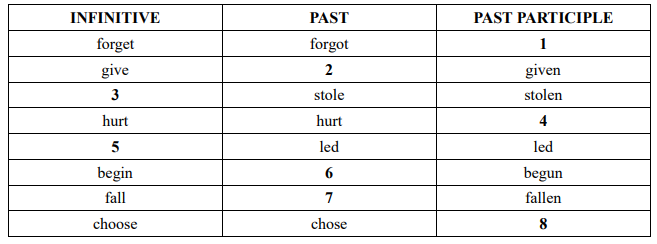
Assinale a alternativa que completa a tabela abaixo com a forma verbal correta:
Provas
Questão presente nas seguintes provas
Assinale a alternativa que completa o período abaixo com coesão e coerência:
The marketing director from our factory in New York has not arrived yet, …
The marketing director from our factory in New York has not arrived yet, …
Provas
Questão presente nas seguintes provas
Assinale a alternativa incorreta quanto ao uso das “if-clauses”:
Provas
Questão presente nas seguintes provas
Marque a alternativa que estabeleça a correspondência correta entre discurso direto e indireto entre as
orações:
Provas
Questão presente nas seguintes provas
Cadernos
Caderno Container