Foram encontradas 40 questões.
Disciplina: Inglês (Língua Inglesa)
Banca: UFMT
Orgão: Pref. Tangará Serra-MT

(Available in: https://slideplayer.com/slide/4486178/. Access in 01/04/2019)
In the text, the expression The end goal means
Provas

Disciplina: Inglês (Língua Inglesa)
Banca: UFMT
Orgão: Pref. Tangará Serra-MT

(Available in: https://slideplayer.com/slide/4486178/. Access in 01/04/2019)
In the United States, ASL - American Sign Language – is the language of the Deaf people, just like LIBRAS is in Brazil. According to the slide, when studying English the deaf student should learn
Provas
Disciplina: Inglês (Língua Inglesa)
Banca: UFMT
Orgão: Pref. Tangará Serra-MT
N STUDENT ENGAGEMENT IN WHOLE-CLASS ORAL
INTERACTION: FROM CLASSROOM DISCOURSE AND
SOCIOCULTURAL ASPECTS TO IMPLICATIONS FOR
LANGUAGE LEARNING!
Douglas Altamiro Consolo
Abstract
This article reports on a study on classroom interaction in an EFL context in Brazil. The study, of an ethnographic nature, analyses recorded lessons, interviews and questionnaires answered by the students. The social rules governing classroom interaction usually determine an asy mmetrical relationship between the teacher and the students, though itmay be possible, according to the data obtained, to create an atmosphere of co-operation in which interaction may occur within less asymmetrical verbal patterns. This atmosphere,
determined by linguistic, pedagogical, psychological and social factors, favours student language production. The data suggest connections between the students" views of classroom language learning, their engagementin classroom discourse, and possible implications for (foreign) language development. Keywords: classroom research; EFL; interaction
(CONSOLO, D.A. On Student Engagement in whole-class oral interaction: from classroom discourse and sociocultural aspects to implications for language learning. Ilha do Desterro. Florianópolis, n.41, p.041-060, jul./dez. 2001.)
According to this abstract, it is correct to say that in his study Consolo
Provas
Disciplina: Inglês (Língua Inglesa)
Banca: UFMT
Orgão: Pref. Tangará Serra-MT
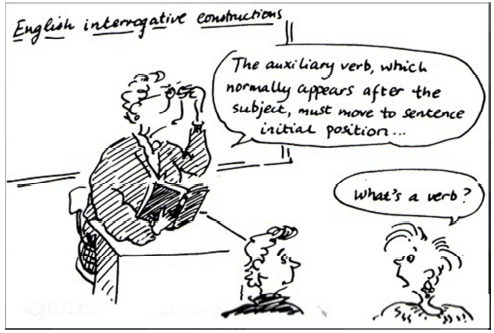
(Available in https://lingualgames.wordpress.com/article/10-key-principles-for-designing-video-27mkxqba7b13d-2/. Access in 12/30/2018)
This comic strip brings up some important aspects related to the teaching of a foreign language. Mark the sentence that reflects one of them.
Provas
Disciplina: Inglês (Língua Inglesa)
Banca: UFMT
Orgão: Pref. Tangará Serra-MT
[...]Although teacher's beliefs about English may sometimes represent stereotypical impressions, these beliefs do nevertheless express realities which may influence classroom practices. In a study of the beliefs of English language teachers in Hong Kong (Richards, Tung, and Ng 1991), English teachers whose first language was Chinese felt that English has more grammar rules than Chinese, although they did not feel English had a larger vocabulary or was more flexible in terms of communication. Hartzell (1988) comments on perceptions of English by Chinese in Taiwan, and observes that English often strikes Chinese learners as being an illogical language. [...] (RICHARDS, J. C.; LOCKHART, C. Reflective teaching in Second Language Classrooms. England: C.U.P.,2012)
Judge the following statements according to the construction of reference in the text.
I - In which may influence, which refers to realities.
II - In whose first language, whose refers to Chinese.
III - In they did not feel, they refers to Richards, Tung, and Ng.
It is correct what is said in
Provas
Disciplina: Inglês (Língua Inglesa)
Banca: UFMT
Orgão: Pref. Tangará Serra-MT
[...]Although teacher's beliefs about English may sometimes represent stereotypical impressions, these beliefs do nevertheless express realities which may influence classroom practices. In a study of the beliefs of English language teachers in Hong Kong (Richards, Tung, and Ng 1991), English teachers whose first language was Chinese felt that English has more grammar rules than Chinese, although they did not feel English had a larger vocabulary or was more flexible in terms of communication. Hartzell (1988) comments on perceptions of English by Chinese in Taiwan, and observes that English often strikes Chinese learners as being an illogical language. [...] (RICHARDS, J. C.; LOCKHART, C. Reflective teaching in Second Language Classrooms. England: C.U.P.,2012)
Considering the linguistics aspects of the text, mark the correct statement.
Provas
Disciplina: Inglês (Língua Inglesa)
Banca: UFMT
Orgão: Pref. Tangará Serra-MT
Dictionaries and Language Teaching
A Virtual Issue
Introduction
Perhaps the most prominent use of dictionaries has been to aid in the difficult process of language learning and teaching. To familiarize the language teaching community with research on the use of dictionaries in language learning and teaching, I present to you a virtual thematic issue devoted to this theme.
Dictionaries are mostly about words, and so vocabulary acquisition is a major topic in lexicography. This is in line with the recent lexical turn in language teaching, which takes on board the commonsensical assumption that vocabulary knowledge is the most essential component of knowing a language. The studies presented below show that looking up words in a dictionary is a very effective way of expanding your lexical repertoire, both in the context of typical classroom activities and text reading. Quite a few studies focus on learning collocation: an aspect of vocabulary knowledge that is difficult, elusive, and seriously neglected until quite recently. Another important aspect where dictionaries can help is writing in the foreign language, and this theme is also heavily represented in the selection of readings below, as is the issue of the role of Li in SLA.
I hope that the present virtual issue will be of interest to researchers in (second) language acquisition, as well as to language teachers.
(LEW, R. https://academic.oup.com/ijl/pages/dictionariesand language teaching. Access in 12/29/2018)
This text is a message from Robert Lew, from the Oxford Academic Journal, written to introduce a thematic issue related to teaching and the use of dictionary. In the message, Lew
Provas
Leia a tira abaixo. Malvados

(Disponível em www.malvados.com.br. Acesso em 03/01/2019.)
Em relação ao uso dos recursos da língua visando ao efeito de sentido, analise as afirmativas a seguir.
I - Nos dois primeiros quadrinhos, o autor recorre à antonímia para sugerir uma relação contraditória entre duas situações que aparentemente se opõem
II - A retirada do artigo definido que se antepõe aos substantivos bem e mal não compromete o sentido da tira.
III - No último recorte de fala, último quadrinho, o jogo estabelecido entre a locução adverbial de modo Ainda bem e a locução adverbial de lugar do lado do bem provoca um efeito de ironia em relação à hipocrisia do ser humano.
IV - No recorte de fala O bem mata e oculta o cadáver do mal, são usadas orações coordenadas dispostas de modo a sugerir a ideia de uma sequência de ações praticadas pelo mal.
V - Os vocábulos bem e mal são empregados no sentido monossêmico nos três quadrinhos que compõem a tira.
Está correto o que se afirma em
Provas
A lebre e a tartaruga
Lúcia Tulchinski
A lebre vivia a se gabar de que era o mais veloz de todos os animais. Até o dia em que encontrou a tartaruga.
– Eu tenho certeza de que, se apostarmos uma corrida, serei a vencedora – desafiou a tartaruga. A lebre caiu na gargalhada.
– Uma corrida? Eu e você? Essa é boa!
– Por acaso você está com medo de perder? – perguntou a tartaruga.
– É mais fácil um leão cacarejar do que eu perder uma corrida para você – respondeu a lebre.
No dia seguinte a raposa foi escolhida para ser a juíza da prova. Bastou dar o sinal da largada para a lebre disparar na frente a toda velocidade. A tartaruga não se abalou e continuou na disputa. A lebre estava tão certa da vitória que resolveu tirar uma soneca. “Se aquela molenga passar na minha frente, é só correr um pouco que eu a ultrapasso”, pensou.
A lebre dormiu tanto que não percebeu quando a tartaruga, em sua marcha vagarosa e constante, passou. Quando acordou, continuou a correr com ares de vencedora. Mas, para sua surpresa, a tartaruga, que não descansara um só minuto, cruzou a linha de chegada em primeiro lugar.
Desse dia em diante, a lebre tornou-se o alvo das chacotas da floresta. Quando dizia que era o animal mais veloz, todos lembravam-na de uma certa tartaruga...
Moral: Quem segue devagar e com constância sempre chega na frente.
(Disponível em: http://confabulandocomfabulas.blogspot.com/2012/08/a-lebre-e-tartaruga.html. Acesso em 12 de janeiro de 2019.)
Analise as afirmativas a seguir referentes ao texto acima.
I - Nessa fábula, a autora recorre à paráfrase como estratégia discursiva.
II - A personificação é usada como recurso de expressividade.
III - A lebre e a tartaruga representam, respectivamente, perseverança e arrogância.
IV - Nessa fábula, o foco narrativo se desenvolve em terceira pessoa.
Está correto o que se afirma em
Provas
A lebre e a tartaruga
Lúcia Tulchinski
A lebre vivia a se gabar de que era o mais veloz de todos os animais. Até o dia em que encontrou a tartaruga.
– Eu tenho certeza de que, se apostarmos uma corrida, serei a vencedora – desafiou a tartaruga. A lebre caiu na gargalhada.
– Uma corrida? Eu e você? Essa é boa!
– Por acaso você está com medo de perder? – perguntou a tartaruga.
– É mais fácil um leão cacarejar do que eu perder uma corrida para você – respondeu a lebre.
No dia seguinte a raposa foi escolhida para ser a juíza da prova. Bastou dar o sinal da largada para a lebre disparar na frente a toda velocidade. A tartaruga não se abalou e continuou na disputa. A lebre estava tão certa da vitória que resolveu tirar uma soneca. “Se aquela molenga passar na minha frente, é só correr um pouco que eu a ultrapasso”, pensou.
A lebre dormiu tanto que não percebeu quando a tartaruga, em sua marcha vagarosa e constante, passou. Quando acordou, continuou a correr com ares de vencedora. Mas, para sua surpresa, a tartaruga, que não descansara um só minuto, cruzou a linha de chegada em primeiro lugar.
Desse dia em diante, a lebre tornou-se o alvo das chacotas da floresta. Quando dizia que era o animal mais veloz, todos lembravam-na de uma certa tartaruga...
Moral: Quem segue devagar e com constância sempre chega na frente.
(Disponível em: http://confabulandocomfabulas.blogspot.com/2012/08/a-lebre-e-tartaruga.html. Acesso em 12 de janeiro de 2019.)
Sobre recursos gramaticais usados, visando à construção de sentido do texto, marque a afirmativa correta.
Provas
Caderno Container