Foram encontradas 40 questões.
TEXT V-
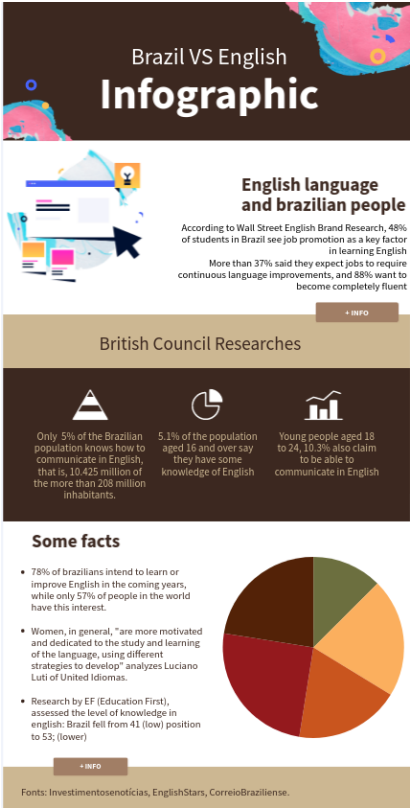
(by Cecismoura – May 28, 2021)
Available from: https://view.genial.ly/60b17af8a30a0b0d332783d4/interactive-content-infografico-english-vs-brazil. Accessed on January 10th, 2022.
Answer questions 38 to 40 according to TEXT V.
Based on the meanings in Text V,
Provas

TEXT V-
(by Cecismoura – May 28, 2021)
Available from: https://view.genial.ly/60b17af8a30a0b0d332783d4/interactive-content-infografico-english-vs-brazil. Accessed on January 10th, 2022.
Answer questions 38 to 40 according to TEXT V.
Based on Text V, analyze the following sentences and check True (T) or False (F):
b
( ) Continuous language improvement is a requirement of most Brazilian jobs.
( ) Young people in Brazil believe they manage to communicate in English.
( ) Brazilians' knowledge of English has increased lately.
b
Choose the alternative with the CORRECT sequence:
Provas
TEXT V-
(by Cecismoura – May 28, 2021)
Available from: https://view.genial.ly/60b17af8a30a0b0d332783d4/interactive-content-infografico-english-vs-brazil. Accessed on January 10th, 2022.
Answer questions 38 to 40 according to TEXT V.
In agreement with the infographic, we may state that
Provas
TEXT IV - Text for questions 36 to 37.
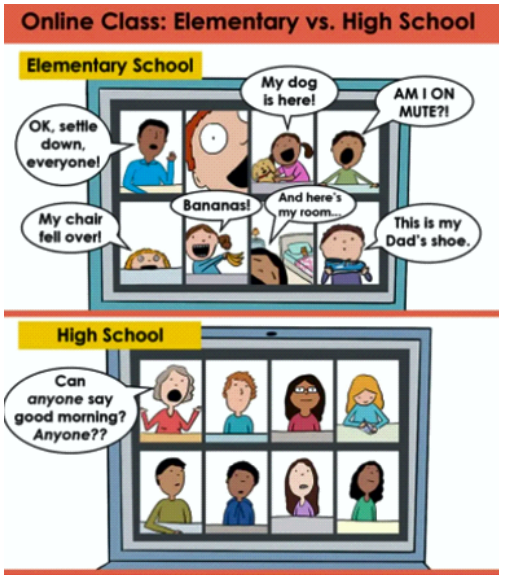
A tale of two zooms (by Adrienne)
September 17, 2020
Elementary school teachers: Stop talking!
High school teachers: Please someone talk!
Available from: https://www.hedgerhumor.com/a-tale-of-two-zooms/. Accessed on January 10th, 2022.
In the sentence “Stop talking”, the -ing form after stop was used to indicate that an action should no longer continue. As it happens with the verb stop, some other verbs have a different meaning, depending on whether they are followed by an -ing form or to + infinitive.
Choose the option that best suits this rule:
Provas
TEXT IV - Text for questions 36 to 37.
A tale of two zooms (by Adrienne)
September 17, 2020
Elementary school teachers: Stop talking!
High school teachers: Please someone talk!
Available from: https://www.hedgerhumor.com/a-tale-of-two-zooms/. Accessed on January 10th, 2022.
The comic strip expresses
Provas
TEXT III -
My experience: one of the advantages of online tools is that they allow teachers and students to exercise their creativity
Cicinato do Carmo, English teacher that also works with initial and continuing education of teachers in Rio de Janeiro
Sept 20, 2021

I have been an English teacher for about 30 years. During this period, in addition to working in the classroom, both in the public and private sectors, I have also been working with training, education and development of English language teachers at Troika – in continuing and initial education. At the moment, I coordinate an English program in Rio de Janeiro with teachers from kindergarten to high school, and I guide undergraduate interns that will be English teachers.
Lyrics Training - Students are very fond of Lyrics Training. I've had experiences with students from elementary school to high school, each one has its specificity, its degree of difficulty and requirement. For example, high school students are very fond of challenges. For example, they really enjoy it when they select a more challenging level where they need to be quicker with answers. And even more so when they decide to organize themselves into groups and compete with each other singing songs.
Youglish - Youglish is very interesting for vocabulary reinforcement in context, when we are exploring a particular word, which offers greater difficulty in understanding, contextualization and use. In addition to the pronunciation, it manages to bring, through videos and other resources, the context of use of that term. Sometimes teaching only the meaning of a word can give the wrong impression that it can be used in different contexts, but there are subtle meanings that need a more concrete communicative element so that the student can perceive its use.
Wordwall - Wordwall offers a bank with different game format options for the same content. One can create an activity, for example, with specific vocabulary of farm animals, and the website offers game possibilities based on that vocabulary list, such as memory game, train, cards, pac man, spin the wheel. The activities are geared towards secondary education. With the older ones, from the moment they are more used to the platform, we can open up for them to choose the type of game they prefer to do that activity.
Mentimeter - I use Mentimeter for preparing presentations. It's like PowerPoint, only interactive. It is a presentation tool filled with interactive elements with viewers. For example, if I have a question about the subject of the class, I present it on the slide and a code will appear. Then, by cell phone, students access and respond. And those answers can create a word cloud instantly, in real time. From there, we can move towards a discussion. I like to use the tool for warm up activities. For example, I ask “What did you have for breakfast today?”; and, based on the answers (milk, tea), we warm up with a discussion and then move on to the content of the class.
ISLCollective - ISL Collective is very good for creating class material. It is an activity repository that is organized into interactive video sessions, PowerPoint and vocabulary or grammar worksheets. We teachers create content and feed the platform. You can search and use ready-made materials, or do something more customized, as it allows us to change and adapt these materials. It makes a copy of the original content with all rights reserved and assigned, but one can customize, delete or add something to the activity.
Gamilab - It is an educational game bank, which allows us to create very simple games, and whose platform is similar to mobile and video games. It has more gamification elements than many others we use, such as elements of the dynamics, mechanics and components that are part of the gamification process (difficulty level progression, challenges and rewards), with a well-described narrative.
One of the possibilities for creation is a mountain bike competition. As the runner walks the race path, golden boxes with questions (multiple choice) appear that must be answered in order for the player to win prizes. It is a competition like a video game, with great appeal for our students.
It is possible to create games for all levels, from kindergarten on, and it can be used both on computer and mobile. The games can be created individually or collaboratively – there is the ability to add collaborators, so that students can organize themselves into groups, each one at home, develop a game and present it to the class. They can send the link of the game they have created and everyone plays.
Live Worksheets - Live Worksheets website also makes it possible to create interactive exercises. We can create, for example, an exercise of connecting (matching), which can be done on the screen of the computer or cell phone itself, which makes it easier for the student as well.
These platforms are all free and students don't need to have an account, we can just use the link. The only thing is that, if I want to create some activity that can be measured later, I need everyone to be registered and to log in to the platform. Gamilab, ISL Collective and Live Worksheets, for example, generate a report and I can find out which students participated and what difficulties were encountered in relation to the score generated by each one of them.
Adapted from: https://www.inglesnasescolas.org/en/experience/my-experience-one-of-the-advantages-of-online-tools-is-that-they-allow-teachers-andstudents-to-exercise-their-creativity/. Accessed on January 15 , 2022. th
Answer questions 32 to 35 according to TEXT III.
In the sentence “As the runner walks the race path, golden boxes with questions (multiple choice) appear that must be answered in order for the player to win prizes”, the modal verb expresses
Provas
- Gramática - Língua InglesaAdjetivos | AdjectivesComparativo e superlativo de adjetivos | Comparative and superlative
TEXT III -
My experience: one of the advantages of online tools is that they allow teachers and students to exercise their creativity
Cicinato do Carmo, English teacher that also works with initial and continuing education of teachers in Rio de Janeiro
Sept 20, 2021
I have been an English teacher for about 30 years. During this period, in addition to working in the classroom, both in the public and private sectors, I have also been working with training, education and development of English language teachers at Troika – in continuing and initial education. At the moment, I coordinate an English program in Rio de Janeiro with teachers from kindergarten to high school, and I guide undergraduate interns that will be English teachers.
Lyrics Training - Students are very fond of Lyrics Training. I've had experiences with students from elementary school to high school, each one has its specificity, its degree of difficulty and requirement. For example, high school students are very fond of challenges. For example, they really enjoy it when they select a more challenging level where they need to be quicker with answers. And even more so when they decide to organize themselves into groups and compete with each other singing songs.
Youglish - Youglish is very interesting for vocabulary reinforcement in context, when we are exploring a particular word, which offers greater difficulty in understanding, contextualization and use. In addition to the pronunciation, it manages to bring, through videos and other resources, the context of use of that term. Sometimes teaching only the meaning of a word can give the wrong impression that it can be used in different contexts, but there are subtle meanings that need a more concrete communicative element so that the student can perceive its use.
Wordwall - Wordwall offers a bank with different game format options for the same content. One can create an activity, for example, with specific vocabulary of farm animals, and the website offers game possibilities based on that vocabulary list, such as memory game, train, cards, pac man, spin the wheel. The activities are geared towards secondary education. With the older ones, from the moment they are more used to the platform, we can open up for them to choose the type of game they prefer to do that activity.
Mentimeter - I use Mentimeter for preparing presentations. It's like PowerPoint, only interactive. It is a presentation tool filled with interactive elements with viewers. For example, if I have a question about the subject of the class, I present it on the slide and a code will appear. Then, by cell phone, students access and respond. And those answers can create a word cloud instantly, in real time. From there, we can move towards a discussion. I like to use the tool for warm up activities. For example, I ask “What did you have for breakfast today?”; and, based on the answers (milk, tea), we warm up with a discussion and then move on to the content of the class.
ISLCollective - ISL Collective is very good for creating class material. It is an activity repository that is organized into interactive video sessions, PowerPoint and vocabulary or grammar worksheets. We teachers create content and feed the platform. You can search and use ready-made materials, or do something more customized, as it allows us to change and adapt these materials. It makes a copy of the original content with all rights reserved and assigned, but one can customize, delete or add something to the activity.
Gamilab - It is an educational game bank, which allows us to create very simple games, and whose platform is similar to mobile and video games. It has more gamification elements than many others we use, such as elements of the dynamics, mechanics and components that are part of the gamification process (difficulty level progression, challenges and rewards), with a well-described narrative.
One of the possibilities for creation is a mountain bike competition. As the runner walks the race path, golden boxes with questions (multiple choice) appear that must be answered in order for the player to win prizes. It is a competition like a video game, with great appeal for our students.
It is possible to create games for all levels, from kindergarten on, and it can be used both on computer and mobile. The games can be created individually or collaboratively – there is the ability to add collaborators, so that students can organize themselves into groups, each one at home, develop a game and present it to the class. They can send the link of the game they have created and everyone plays.
Live Worksheets - Live Worksheets website also makes it possible to create interactive exercises. We can create, for example, an exercise of connecting (matching), which can be done on the screen of the computer or cell phone itself, which makes it easier for the student as well.
These platforms are all free and students don't need to have an account, we can just use the link. The only thing is that, if I want to create some activity that can be measured later, I need everyone to be registered and to log in to the platform. Gamilab, ISL Collective and Live Worksheets, for example, generate a report and I can find out which students participated and what difficulties were encountered in relation to the score generated by each one of them.
Adapted from: https://www.inglesnasescolas.org/en/experience/my-experience-one-of-the-advantages-of-online-tools-is-that-they-allow-teachers-andstudents-to-exercise-their-creativity/. Accessed on January 15 , 2022. th
Answer questions 32 to 35 according to TEXT III.
Choose the option that best defines the phenomenon that occurred in the sentences below:
“For example, they really enjoy it when they select a more challenging level where they need to be quicker with answers.”
“[…] which offers greater difficulty in understanding, contextualization and use.”
“[…] but there are subtle meanings that need a more concrete communicative element
[…].” “With the older ones [...].”
“[…] which makes it easier for the student as well.”
Provas
TEXT III -
My experience: one of the advantages of online tools is that they allow teachers and students to exercise their creativity
Cicinato do Carmo, English teacher that also works with initial and continuing education of teachers in Rio de Janeiro
Sept 20, 2021
I have been an English teacher for about 30 years. During this period, in addition to working in the classroom, both in the public and private sectors, I have also been working with training, education and development of English language teachers at Troika – in continuing and initial education. At the moment, I coordinate an English program in Rio de Janeiro with teachers from kindergarten to high school, and I guide undergraduate interns that will be English teachers.
Lyrics Training - Students are very fond of Lyrics Training. I've had experiences with students from elementary school to high school, each one has its specificity, its degree of difficulty and requirement. For example, high school students are very fond of challenges. For example, they really enjoy it when they select a more challenging level where they need to be quicker with answers. And even more so when they decide to organize themselves into groups and compete with each other singing songs.
Youglish - Youglish is very interesting for vocabulary reinforcement in context, when we are exploring a particular word, which offers greater difficulty in understanding, contextualization and use. In addition to the pronunciation, it manages to bring, through videos and other resources, the context of use of that term. Sometimes teaching only the meaning of a word can give the wrong impression that it can be used in different contexts, but there are subtle meanings that need a more concrete communicative element so that the student can perceive its use.
Wordwall - Wordwall offers a bank with different game format options for the same content. One can create an activity, for example, with specific vocabulary of farm animals, and the website offers game possibilities based on that vocabulary list, such as memory game, train, cards, pac man, spin the wheel. The activities are geared towards secondary education. With the older ones, from the moment they are more used to the platform, we can open up for them to choose the type of game they prefer to do that activity.
Mentimeter - I use Mentimeter for preparing presentations. It's like PowerPoint, only interactive. It is a presentation tool filled with interactive elements with viewers. For example, if I have a question about the subject of the class, I present it on the slide and a code will appear. Then, by cell phone, students access and respond. And those answers can create a word cloud instantly, in real time. From there, we can move towards a discussion. I like to use the tool for warm up activities. For example, I ask “What did you have for breakfast today?”; and, based on the answers (milk, tea), we warm up with a discussion and then move on to the content of the class.
ISLCollective - ISL Collective is very good for creating class material. It is an activity repository that is organized into interactive video sessions, PowerPoint and vocabulary or grammar worksheets. We teachers create content and feed the platform. You can search and use ready-made materials, or do something more customized, as it allows us to change and adapt these materials. It makes a copy of the original content with all rights reserved and assigned, but one can customize, delete or add something to the activity.
Gamilab - It is an educational game bank, which allows us to create very simple games, and whose platform is similar to mobile and video games. It has more gamification elements than many others we use, such as elements of the dynamics, mechanics and components that are part of the gamification process (difficulty level progression, challenges and rewards), with a well-described narrative.
One of the possibilities for creation is a mountain bike competition. As the runner walks the race path, golden boxes with questions (multiple choice) appear that must be answered in order for the player to win prizes. It is a competition like a video game, with great appeal for our students.
It is possible to create games for all levels, from kindergarten on, and it can be used both on computer and mobile. The games can be created individually or collaboratively – there is the ability to add collaborators, so that students can organize themselves into groups, each one at home, develop a game and present it to the class. They can send the link of the game they have created and everyone plays.
Live Worksheets - Live Worksheets website also makes it possible to create interactive exercises. We can create, for example, an exercise of connecting (matching), which can be done on the screen of the computer or cell phone itself, which makes it easier for the student as well.
These platforms are all free and students don't need to have an account, we can just use the link. The only thing is that, if I want to create some activity that can be measured later, I need everyone to be registered and to log in to the platform. Gamilab, ISL Collective and Live Worksheets, for example, generate a report and I can find out which students participated and what difficulties were encountered in relation to the score generated by each one of them.
Adapted from: https://www.inglesnasescolas.org/en/experience/my-experience-one-of-the-advantages-of-online-tools-is-that-they-allow-teachers-andstudents-to-exercise-their-creativity/. Accessed on January 15 , 2022. th
Answer questions 32 to 35 according to TEXT III.
In agreement with Text III, we may infer that
Provas
TEXT III -
My experience: one of the advantages of online tools is that they allow teachers and students to exercise their creativity
Cicinato do Carmo, English teacher that also works with initial and continuing education of teachers in Rio de Janeiro
Sept 20, 2021
I have been an English teacher for about 30 years. During this period, in addition to working in the classroom, both in the public and private sectors, I have also been working with training, education and development of English language teachers at Troika – in continuing and initial education. At the moment, I coordinate an English program in Rio de Janeiro with teachers from kindergarten to high school, and I guide undergraduate interns that will be English teachers.
Lyrics Training - Students are very fond of Lyrics Training. I've had experiences with students from elementary school to high school, each one has its specificity, its degree of difficulty and requirement. For example, high school students are very fond of challenges. For example, they really enjoy it when they select a more challenging level where they need to be quicker with answers. And even more so when they decide to organize themselves into groups and compete with each other singing songs.
Youglish - Youglish is very interesting for vocabulary reinforcement in context, when we are exploring a particular word, which offers greater difficulty in understanding, contextualization and use. In addition to the pronunciation, it manages to bring, through videos and other resources, the context of use of that term. Sometimes teaching only the meaning of a word can give the wrong impression that it can be used in different contexts, but there are subtle meanings that need a more concrete communicative element so that the student can perceive its use.
Wordwall - Wordwall offers a bank with different game format options for the same content. One can create an activity, for example, with specific vocabulary of farm animals, and the website offers game possibilities based on that vocabulary list, such as memory game, train, cards, pac man, spin the wheel. The activities are geared towards secondary education. With the older ones, from the moment they are more used to the platform, we can open up for them to choose the type of game they prefer to do that activity.
Mentimeter - I use Mentimeter for preparing presentations. It's like PowerPoint, only interactive. It is a presentation tool filled with interactive elements with viewers. For example, if I have a question about the subject of the class, I present it on the slide and a code will appear. Then, by cell phone, students access and respond. And those answers can create a word cloud instantly, in real time. From there, we can move towards a discussion. I like to use the tool for warm up activities. For example, I ask “What did you have for breakfast today?”; and, based on the answers (milk, tea), we warm up with a discussion and then move on to the content of the class.
ISLCollective - ISL Collective is very good for creating class material. It is an activity repository that is organized into interactive video sessions, PowerPoint and vocabulary or grammar worksheets. We teachers create content and feed the platform. You can search and use ready-made materials, or do something more customized, as it allows us to change and adapt these materials. It makes a copy of the original content with all rights reserved and assigned, but one can customize, delete or add something to the activity.
Gamilab - It is an educational game bank, which allows us to create very simple games, and whose platform is similar to mobile and video games. It has more gamification elements than many others we use, such as elements of the dynamics, mechanics and components that are part of the gamification process (difficulty level progression, challenges and rewards), with a well-described narrative.
One of the possibilities for creation is a mountain bike competition. As the runner walks the race path, golden boxes with questions (multiple choice) appear that must be answered in order for the player to win prizes. It is a competition like a video game, with great appeal for our students.
It is possible to create games for all levels, from kindergarten on, and it can be used both on computer and mobile. The games can be created individually or collaboratively – there is the ability to add collaborators, so that students can organize themselves into groups, each one at home, develop a game and present it to the class. They can send the link of the game they have created and everyone plays.
Live Worksheets - Live Worksheets website also makes it possible to create interactive exercises. We can create, for example, an exercise of connecting (matching), which can be done on the screen of the computer or cell phone itself, which makes it easier for the student as well.
These platforms are all free and students don't need to have an account, we can just use the link. The only thing is that, if I want to create some activity that can be measured later, I need everyone to be registered and to log in to the platform. Gamilab, ISL Collective and Live Worksheets, for example, generate a report and I can find out which students participated and what difficulties were encountered in relation to the score generated by each one of them.
Adapted from: https://www.inglesnasescolas.org/en/experience/my-experience-one-of-the-advantages-of-online-tools-is-that-they-allow-teachers-andstudents-to-exercise-their-creativity/. Accessed on January 15 , 2022. th
Answer questions 32 to 35 according to TEXT III.
To Cicinato do Carmo, online tools foster both teachers and students' creativity. Among these tools, based on Text III, the following ones require teachers to guide their use:
Provas
TEXT II - Text for questions 29 to 31.
The challenges of learning English skills and the integration of social media and video conferencing tools to help ESL learners coping with the challenges during COVID-19 pandemic: a literature review
Yong Hua Ying, Winson Eng Wei Siang, Maslawati Mohamad
Abstract
During the COVID-19 pandemic, the abrupt closures of all learning institutions have caused English as a Second Language (ESL) learners to have significant difficulties learning the English language especially for speaking skills. Speaking is one of the most important skills to learn because it is the primary mode of communication around the world. However, the majority of ESL learners are still trying to improve their English speaking abilities. Since the implementation of the COVID-19 lockdowns, e-learning has been a well-known solution all over the world. Learners and educators need more time to adjust to online teaching and learning because most of them are exploring new technical innovations and strategies to be used in the classroom. As a result, this study includes a literature review on the challenges ESL learners encounter in learning speaking skills, as well as the use of social media and video conferencing tools to teach speaking skills. Lack of motivation and self-confidence, fear, hesitation, and limited vocabulary are some of the challenges faced by ESL learners. Hence, it is vital to determine the technology intervention used in teaching and developing speaking skills among these learners based on previous study. During the COVID-19 pandemic, some of the interventions in teaching speaking skills included utilizing social media and video conferencing applications like Facebook, WhatsApp, and others for online teaching and learning. Educators of ESL might then pick the ones that would work best in their particular classroom.
Keywords: E-Learning, Learning of Language Skills, Social Media, Video Conferencing Tools, COVID-19 Pandemic
Adapted from: https://www.scirp.org/journal/paperinformation.aspx?paperid=110450. Accessed on January 20th, 2022.
The words however, since and hence belong, respectively, to the following word classes
Provas
Caderno Container