Foram encontradas 40 questões.
Disciplina: Inglês (Língua Inglesa)
Banca: Consulplan
Orgão: Pref. Vermelho Novo-MG
If I were a boy
Even just for a day
I'd roll out of bed in the morning
And throw on what I wanted then go
Drink beer with the guys
And chase after girls
I'd kick it with who I wanted
And I'd never get confronted for it
'Cause they'd stick up for me
According to English grammar rules, the use of “were” instead of “was” in this sentence is explained by:
Provas

Disciplina: Inglês (Língua Inglesa)
Banca: Consulplan
Orgão: Pref. Vermelho Novo-MG
Observe the humorous image below, which plays with the idea of the forms of modal verbs in English:

(Available on: https://www.reddit.com/r/memes/. Accessed on: may 2025.)
The image presents “might” and “mould” as possible forms of “may”. Considering grammatical accuracy and the use of humor in language learning, the alternative that best explains the linguistic joke presented is:
Provas
Disciplina: Inglês (Língua Inglesa)
Banca: Consulplan
Orgão: Pref. Vermelho Novo-MG
Look at the event poster below:

(Available on: https://www.theo2.co.uk/events/. Accessed on: may 2025.)
The most appropriate reading strategy to locate specific information such as the event's date and venue is:
Provas
Disciplina: Inglês (Língua Inglesa)
Banca: Consulplan
Orgão: Pref. Vermelho Novo-MG
The teaching of a modern foreign language, preferably English, shall be offered from the sixth year of elementary school.
(Adapted from LDB, Art. 26, §5.)
According to the Brazilian Education Law, it is correct to state that:
Provas
Disciplina: Inglês (Língua Inglesa)
Banca: Consulplan
Orgão: Pref. Vermelho Novo-MG
Look at the comic strip below:

(Available on: https://blogger. Accessed on: may 2025.)
The image shows a person pulling hard on a door labeled “PUSH”, while others behind appear frustrated. Considering the meaning of the word on the sign and the person’s behavior, choose the best explanation for the situation.
Provas
Disciplina: Inglês (Língua Inglesa)
Banca: Consulplan
Orgão: Pref. Vermelho Novo-MG
Look at the comic strip below:
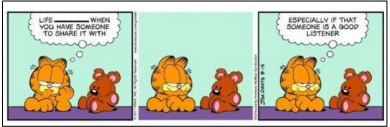
(Available on: https://militares.estrategia.com/. Accessed on: may 2025.)
According to the grammar rule, the alternative that contains the correct form of the adjective “easy” and explains its use is:
Provas
Disciplina: Inglês (Língua Inglesa)
Banca: Consulplan
Orgão: Pref. Vermelho Novo-MG
Marie Curie, née Maria Sklodowska, was born in Warsaw on November 7, 1867, the daughter of a secondary-school teacher. She received a general education in local schools and some scientific training from her father. She became involved in a students’ revolutionary organization and found it prudent to leave Warsaw, then in the part of Poland dominated by Russia, for Cracow, which at that time was under Austrian rule. In 1891, she went to Paris to continue her studies at the Sorbonne, where she obtained Licenciateships in Physics and the Mathematical Sciences. She met Pierre Curie, Professor in the School of Physics, in 1894 and in the following year they were married.
(Available on: https://www.nobelprize.org/prizes/. Accessed on: may 2025.)
The alternative that correctly identifies the meaning and function of the relative pronoun in bold is:
Provas
Disciplina: Inglês (Língua Inglesa)
Banca: Consulplan
Orgão: Pref. Vermelho Novo-MG
Observe the image below:
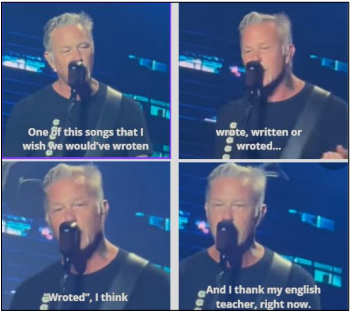
(Available on: https://www.youtube.com/ . Accessed on: may 2025. Adapted.)
The singer humorously misuses the past form of the irregular verb “to write”. The correct use of the irregular verb “to write” in the past participle form is:
Provas
Disciplina: Inglês (Língua Inglesa)
Banca: Consulplan
Orgão: Pref. Vermelho Novo-MG
Observe the image below:

(Available on: https://pt-static.z-dn.net/files/. Accessed on: may 2025.)
Based on the image showing the comparison of definite articles in French, Italian, Spanish, German, Portuguese, and English, which of the following statements about the use of articles in English is most accurate?
Provas
Disciplina: Inglês (Língua Inglesa)
Banca: Consulplan
Orgão: Pref. Vermelho Novo-MG
Lucas: I’m “going to” visit my grandmother this weekend. We’ve already bought the bus tickets.
Julia: That’s nice!
Lucas: Oh no, I forgot my umbrella. It looks like it’s “going to” rain soon.
Julia: Don’t worry. “I’ll” lend you mine.
Based on the conversation, the alternative that best explains the correct use of “going to” and “will” is:
Provas
Caderno Container