Foram encontradas 70 questões.
Disciplina: Inglês (Língua Inglesa)
Banca: AOCP
Orgão: Pref. Vitória Conquista-BA
Note: throughout the test, you are going to read an online article entitled Bing A.I. and the Dawn of the Post-Search Internet (written by Kyle Chayka), adapted from https://www.newyorker.com and accessed on 11 June 2023. The article is about Artificial Intelligence (A.I.) and it discusses ChatGPT.
All the questions of your test will refer to different parts and aspects of the article.
You, as an English language teacher, establishes that your group’s following communicative objective is to make predictions about the future. In order to achieve that, you decide to work with the article Bing A.I. and the Dawn of the Post-Search Internet to develop reading skills and also to work with the structure Future Simple with Will to make future predictions. After teaching and practicing the target language, you ask students to produce an infographic with future predictions on different areas. As far as assessment is concerned, all the alternatives below are accurate, EXCEPT
Provas

Disciplina: Inglês (Língua Inglesa)
Banca: AOCP
Orgão: Pref. Vitória Conquista-BA
Note: throughout the test, you are going to read an online article entitled Bing A.I. and the Dawn of the Post-Search Internet (written by Kyle Chayka), adapted from https://www.newyorker.com and accessed on 11 June 2023. The article is about Artificial Intelligence (A.I.) and it discusses ChatGPT.
All the questions of your test will refer to different parts and aspects of the article.
When discussing the typical sequence of an English language lesson, Scrivener (2011), proposes the following diagram:
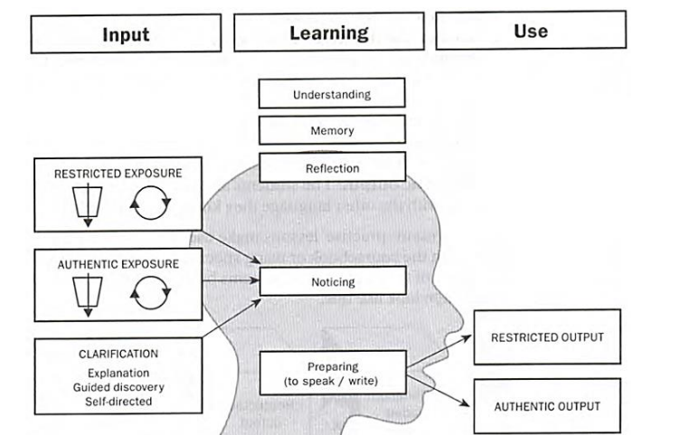
Source: Scrivener (2011, p. 159).
You, as an English language teacher, establishes that your group’s following communicative objective is to make predictions about the future. In order to achieve that, you decide to work with the article Bing A.I. and the Dawn of the Post-Search Internet to develop reading skills and also to work with the structure Future Simple with Will to make future predictions. Considering this classroom situation and Scrivener’s diagram, analyze the following statements.
I. The article functions as input material, once students are exposed to the target language, in this case, will for future predictions.
II. The teacher draws students’ attention to part of the text and asks students to find one prediction the author is making about the future. Students identify it. This step of the lesson is what Scrivener calls self-directed clarification in his diagram, once students work completely autonomously, without the teacher’s intervention.
III. The teacher draws students’ attention to other two model sentences of future prediction from the text. Then, the teacher asks questions such as Are we talking about a present, past or future situation?; How do you know it’s future?; So when we want to make a prediction about the future, what do we use?. This is what Scrivener calls, in his diagram, guided-discovery clarification and the questions used by the teacher are called concept-checking questions.
IV. The teacher carries out some drilling exercises to systematize the target language. Then, the teacher asks students to produce an infographic making predictions for the future. The first practice, the drilling exercises, is what Scrivener calls in his diagram authentic output, or freer practice, while the infographic is what he calls restricted output, or controlled practice.
It is completely accurate what is stated in
Provas
Disciplina: Inglês (Língua Inglesa)
Banca: AOCP
Orgão: Pref. Vitória Conquista-BA
Note: throughout the test, you are going to read an online article entitled Bing A.I. and the Dawn of the Post-Search Internet (written by Kyle Chayka), adapted from https://www.newyorker.com and accessed on 11 June 2023. The article is about Artificial Intelligence (A.I.) and it discusses ChatGPT.
All the questions of your test will refer to different parts and aspects of the article.
When setting up a task, the teacher has to consider and plan how to do a number of things: giving instructions, checking instructions, monitoring and giving feedback. You, an English language teacher, is setting up a reading task for the article Bing A.I. and the Dawn of the Post-Search Internet. Match the functions listed A – I with the examples of teachers’ language. There are three extra functions which you do NOT need to use.
Functions
A. Asking students to speculate and make predictions.
B. Checking instructions.
C. Giving feedback.
D. Correcting students.
E. Grouping students.
F. Personalizing.
G. Activating students’ schemata.
H. Giving instructions.
I. Prompting.
Examples of teachers’ language
( ) What do you know about ChatGPT?
( ) Now work with the classmate sitting next to you and compare your answers. Justify them using the text.
( ) Do you have to summarize the details of the text of just the main ideas?
( ) Now that we read the article, do you think you will use ChatGPT instead of Google Search? Why (not)?
( ) You summarized the main idea of your part of the text really well. Good job.
( ) You have to compare Google Search and ChatGPT, right? So, Google Search gives you lots of results and you choose what you need and ChatGPT…
Provas
Disciplina: Inglês (Língua Inglesa)
Banca: AOCP
Orgão: Pref. Vitória Conquista-BA
Note: throughout the test, you are going to read an online article entitled Bing A.I. and the Dawn of the Post-Search Internet (written by Kyle Chayka), adapted from https://www.newyorker.com and accessed on 11 June 2023. The article is about Artificial Intelligence (A.I.) and it discusses ChatGPT.
All the questions of your test will refer to different parts and aspects of the article.
You, as an English language teacher, decided to work with the article Bing A.I. and the Dawn of the Post-Search Internet with your students. The first reading task you ask students to complete is for them to understand just the main ideas, that is, the global message of the text. The reading skill being developed by doing this task is called
Provas
Disciplina: Inglês (Língua Inglesa)
Banca: AOCP
Orgão: Pref. Vitória Conquista-BA
Note: throughout the test, you are going to read an online article entitled Bing A.I. and the Dawn of the Post-Search Internet (written by Kyle Chayka), adapted from https://www.newyorker.com and accessed on 11 June 2023. The article is about Artificial Intelligence (A.I.) and it discusses ChatGPT.
All the questions of your test will refer to different parts and aspects of the article.
Read the final part of the article. Choose the alternative with the prepositions and verb forms which accurately complete the gaps, respectively.
_____ the meantime, non-automated text online will become an artisanal good, a product that we seek out for its unadulterated quality: instead _____ natural wine, “natural language.” On Tuesday, Google announced the release of its own A.I. chatbot. Called Bard—a more evocative and lofty title than Microsoft’s dry “A.I.-powered copilot”—it amounts to a broadside in the A.I. arms race among tech giants. But Google has conspicuously kept the chatbot separate _____ its signature product. “We think of Bard as complementary to Google Search,” one company executive told the Times. It’s a tacit acknowledgment of A.I.’s threat to the company’s current model. In its race to catch _____ with Microsoft, Google must try to avoid cannibalizing itself. Bing, however, is cheerily ushering us into the post-search future.
Provas
Disciplina: Inglês (Língua Inglesa)
Banca: AOCP
Orgão: Pref. Vitória Conquista-BA
Note: throughout the test, you are going to read an online article entitled Bing A.I. and the Dawn of the Post-Search Internet (written by Kyle Chayka), adapted from https://www.newyorker.com and accessed on 11 June 2023. The article is about Artificial Intelligence (A.I.) and it discusses ChatGPT.
All the questions of your test will refer to different parts and aspects of the article.
Read the fifth part of the article. Which of the underlined modal verbs is closest in meaning to the modal verb ‘may’ in the context of the text?
Speaking of fresh and reliable material, what happens when more and more of the material found online is generated by artificial intelligence? Last week, Google and Microsoft both announced a suite of A.I. tools for office workers, with applications that can compose new e-mails, reports, and slide decks or summarize existing ones. Similar tools must soon be invading other aspects of our digital lives. When the bot is generating material that workers used to produce, it will become difficult to determine which pieces of content in your in-box are meaningful; there will be no guarantee that any human labor or thought went into a given e-mail or report. We are all already bombarded by spam, mostly of a man-made variety. This will be a new kind of A.I.-generated spam on an unprecedented scale, much of it difficult to distinguish from content made by humans. Sooner than we think, content mills may be using A.I. to generate full articles, publicists may be using it to write press releases, and cooking sites might use it to devise recipes. These companies had better provide help for people to navigate the glut, but media companies will have fewer resources to devote to serving that need. In such a scenario, A.I. could solve the very problem that it creates: eventually, if tools like Bing A.I. cause the well of original material online to run dry, all that will be left is self-referential bots, dredging up a generic set of answers that machines created in the first place.
Provas
Disciplina: Inglês (Língua Inglesa)
Banca: AOCP
Orgão: Pref. Vitória Conquista-BA
Note: throughout the test, you are going to read an online article entitled Bing A.I. and the Dawn of the Post-Search Internet (written by Kyle Chayka), adapted from https://www.newyorker.com and accessed on 11 June 2023. The article is about Artificial Intelligence (A.I.) and it discusses ChatGPT.
All the questions of your test will refer to different parts and aspects of the article.
Read the fourth part of the article and analyze the statements I – IV.
So much of the current Web was designed around aggregation—lists of product recommendations on The Strategist, summaries of film reviews on Rotten Tomatoes, restaurant reviews on Yelp. What value will those sites have when A.I. can do the aggregation for us? If Google Search is an imperfect book index, telling us where to find the material we need, Bing A.I. is SparkNotes, allowing us to bypass the source material altogether. Users might simply “read” publications in the form of A.I. chat summaries, as if listening to a mechanized butler reciting newspaper headlines aloud. The paradox of A.I., though, is that it relies on the source material— the vast sea of information that other sites create—to generate its answers. For that reason, it’s easy to imagine a kind of vicious cycle caused by the widespread adoption of tools like Bing A.I. If users don’t have to visit sites directly anymore, then those sites’ business models, based on advertising and subscriptions, will collapse. But if those sites can no longer produce content then A.I. tools won’t have fresh, reliable material to digest and regurgitate.
I. The verb in the statement ‘So much of the current Web was designed around aggregation’ is in the passive voice.
II. In ‘What value will those sites have when A.I. can do the aggregation for us?’, ‘when’ is used to refer to place.
III. The conjunction ‘though’ in ‘The paradox of A.I., though, is that it relies on the source material’ expresses contrast.
IV. ‘If users don’t have to visit sites directly anymore, then those sites’ business models (…) will collapse’ is an example of a first conditional clause.
It is completely accurate what is stated in
Provas
Disciplina: Inglês (Língua Inglesa)
Banca: AOCP
Orgão: Pref. Vitória Conquista-BA
Note: throughout the test, you are going to read an online article entitled Bing A.I. and the Dawn of the Post-Search Internet (written by Kyle Chayka), adapted from https://www.newyorker.com and accessed on 11 June 2023. The article is about Artificial Intelligence (A.I.) and it discusses ChatGPT.
All the questions of your test will refer to different parts and aspects of the article.
Read the third part of the article. All the alternatives present accurate analyses of word formation of the underlined words, EXCEPT
Though tools like Bing A.I. promise extreme, almost unimaginable convenience for users, they are likely to be even worse for content creators than the search and social-media companies that have siphoned up the majority of digital-advertising dollars over the past decade. Bing A.I. does offer referrals to Web sites in the form of footnotes linking to URLs. But the URLs are intentionally unobtrusive, to minimize for users what one Microsoft staffer described to me as the “cognitive load” of having to click on and scroll through links. The other day, Mody demonstrated over video chat how she could ask Bing A.I. to find a good vegetarian recipe for dinner. The bot pulled up a Bon Appétit recipe for vegetarian lasagna and reprinted it in full within the chat. Then Mody asked it to list all of the ingredients and arrange them by grocery-store aisle—a request that no cooking Web site could hope to fulfill.
Provas
Disciplina: Inglês (Língua Inglesa)
Banca: AOCP
Orgão: Pref. Vitória Conquista-BA
Note: throughout the test, you are going to read an online article entitled Bing A.I. and the Dawn of the Post-Search Internet (written by Kyle Chayka), adapted from https://www.newyorker.com and accessed on 11 June 2023. The article is about Artificial Intelligence (A.I.) and it discusses ChatGPT.
All the questions of your test will refer to different parts and aspects of the article.
Read the second part of the article. What do we learn from the experience of using ChatGPT?
Bing A.I., which I’ve had the chance to test-drive in recent weeks, is essentially ChatGPT hooked up to Microsoft’s search directory. Using it is like talking to a very powerful librarian whose purview is the breadth of the Internet. The old search experience is almost second nature to today’s Internet users: enter relevant keywords into Google, press Enter, and sift through the list of links that show up on the results page. Then click through to find the info you’re looking for. If you don’t find it, perhaps return to the Google Search page and tinker with your keywords to try again. With Bing A.I., Web sites are the source material, not the destination, and results are produced through what Danzico called a “co-creation process” between user and bot. I asked it which toaster Wirecutter recommended, and within a few seconds, and without ever leaving the Bing A.I. page, I had a digest of reputable devices. The chatbot wouldn’t tell me precisely which one to buy, however. “I can’t make decisions for you because I’m not a human,” it said.
In some ways, a Bing A.I. user has more agency than a user of Google Search. You communicate not in isolated keywords but in straightforward sentences, and you can narrow or refine your query results by asking the machine follow-ups. If you request an itinerary for a trip to Iceland, for instance, and then ask, “What time does the sun set there?” the bot will understand which “there” you’re referring to. But, in other ways, the Bing user is more limited and passive, encouraged to let the machine decide which information is worthwhile rather than doing any searching on their own. “It’s your travel guide, your bank, your confidante, your guide,” Danzico said. The “conversation mode” interface—a single chat box on top of a gentle color gradient—reflects that one-stop-shop objective. Where using Google Search sometimes feels like engineering the right equation to solve a problem, using Bing A.I. is a bit like a series of text-message conversations. It even punctuates answers with a smiling, blushing emoji: “I’m always happy to chat with you.  ,” it told me.
Provas
Disciplina: Inglês (Língua Inglesa)
Banca: AOCP
Orgão: Pref. Vitória Conquista-BA
Note: throughout the test, you are going to read an online article entitled Bing A.I. and the Dawn of the Post-Search Internet (written by Kyle Chayka), adapted from https://www.newyorker.com and accessed on 11 June 2023. The article is about Artificial Intelligence (A.I.) and it discusses ChatGPT.
All the questions of your test will refer to different parts and aspects of the article.
Read the initial part of the article. It is correct to state that
Around a year ago, I wrote a column about users’ growing frustration with Google Search, as automated summaries, sponsored content, and S.E.O.-tailored spam increasingly crowded out the kinds of useful Web site results that Googling was supposed to produce. Google’s search algorithm wasn’t directing us to the information that we wanted to find (for instance, in my case at the time, the elusive perfect toaster) so much as bombarding us with the half-baked recommendations of content mills. Yet Google Search has maintained its dominance partly out of habit and partly because no competing service has offered a viable alternative—until now. On February 7th, Microsoft began a beta launch of a version of its search engine, Bing, in the form of an A.I. chatbot, powered by GPT-4, the latest iteration of OpenAI’s large language model ChatGPT. Instead of directing users to external sites, the new Bing can simply generate its own answers to any query. Google considers the tool to be an existential threat to its core business, for good reason. At the end of last year, the Times reported that the company had declared a “code red.” Microsoft’s vice-president of design Liz Danzico, who helped to develop Bing A.I.’s interface, told me recently, “We’re in a post-search experience.”
Provas
Caderno Container