Foram encontradas 70 questões.
Deseja-se determinar as características de um material dielétrico perfeito não magnético que ocupa o semiplano z > 0. Em uma montagem experimental, aplicou-se uma onda plana normal à superfície do material. Em regime estacionário, obteve-se um padrão de onda estacionária no ar nas proximidades do material (z < 0). O gráfico do valor eficaz do módulo do campo elétrico no ar, E, em função de z, é mostrado na figura a seguir.
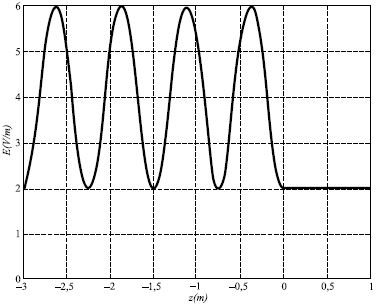
Considerando-se que a permissividade do ar é ε0 e que os meios sejam sem perdas, assinale a alternativa que apresenta, respectivamente, o módulo do coeficiente de reflexão e a permissividade \(\epsilon_d \ge \epsilon_0\) do dielétrico investigado.
Provas

O texto a seguir deve ser utilizado para responder à questão.
Why wireless?
The cost-effectiveness and flexibility of the wireless LANs of the 21st Century, as an alternative to traditional wired networks, are ideal for mobile workers. They allow access to real-time information and corporate resources almost anywhere a mobile worker may be located, and with the growing popularity of wireless “hotspots”, mobile workers can now connect to the Internet at airports, hotels, restaurants, and other public places. Within the last few years, access speeds for WLANs have started to approach those available for conventional wireline networks, making use of wireless networking practical for mainstream business and consumer purposes.
The benefits of wireless networks don’t end outside the office, because with wireless networking, “the air around us is the cable”. Even within modern enterprise offices, workstation mobility, for example using a laptop PC in a meeting room or changing a PC’s location due to organizational changes, is a fact of life. For those who need the flexibility to relocate a workstation, WLANs negate the need for frequent physical wiring changes. This is not just a convenience issue, as cabling changes can amount to a significant burden on already-stressed MIS [Management Information System] and IT [Information Technology] department resources, on top of the costs of the cables themselves. The result? Increased productivity as well as a more positive end-user experience.
(Extraído e adaptado de: http://www.verisign.com/static/005286.pdf)
Conforme o texto, o resultado advindo da política de implementação de redes wireless é:
Provas
O texto a seguir deve ser utilizado para responder à questão.
Why wireless?
The cost-effectiveness and flexibility of the wireless LANs of the 21st Century, as an alternative to traditional wired networks, are ideal for mobile workers. They allow access to real-time information and corporate resources almost anywhere a mobile worker may be located, and with the growing popularity of wireless “hotspots”, mobile workers can now connect to the Internet at airports, hotels, restaurants, and other public places. Within the last few years, access speeds for WLANs have started to approach those available for conventional wireline networks, making use of wireless networking practical for mainstream business and consumer purposes.
The benefits of wireless networks don’t end outside the office, because with wireless networking, “the air around us is the cable”. Even within modern enterprise offices, workstation mobility, for example using a laptop PC in a meeting room or changing a PC’s location due to organizational changes, is a fact of life. For those who need the flexibility to relocate a workstation, WLANs negate the need for frequent physical wiring changes. This is not just a convenience issue, as cabling changes can amount to a significant burden on already-stressed MIS [Management Information System] and IT [Information Technology] department resources, on top of the costs of the cables themselves. The result? Increased productivity as well as a more positive end-user experience.
(Extraído e adaptado de: http://www.verisign.com/static/005286.pdf)
De acordo com o texto, nas redes wireless, o cabo pode ser considerado como sendo
Provas
O texto a seguir deve ser utilizado para responder à questão.
Why wireless?
The cost-effectiveness and flexibility of the wireless LANs of the 21st Century, as an alternative to traditional wired networks, are ideal for mobile workers. They allow access to real-time information and corporate resources almost anywhere a mobile worker may be located, and with the growing popularity of wireless “hotspots”, mobile workers can now connect to the Internet at airports, hotels, restaurants, and other public places. Within the last few years, access speeds for WLANs have started to approach those available for conventional wireline networks, making use of wireless networking practical for mainstream business and consumer purposes.
The benefits of wireless networks don’t end outside the office, because with wireless networking, “the air around us is the cable”. Even within modern enterprise offices, workstation mobility, for example using a laptop PC in a meeting room or changing a PC’s location due to organizational changes, is a fact of life. For those who need the flexibility to relocate a workstation, WLANs negate the need for frequent physical wiring changes. This is not just a convenience issue, as cabling changes can amount to a significant burden on already-stressed MIS [Management Information System] and IT [Information Technology] department resources, on top of the costs of the cables themselves. The result? Increased productivity as well as a more positive end-user experience.
(Extraído e adaptado de: http://www.verisign.com/static/005286.pdf)
Na frase – The cost-effectiveness and flexibility of the wireless LANs of the 21st Century, as an alternative to traditional wired networks, are ideal for mobile workers.–, o termo cost-effectiveness tem o sentido de
Provas
O texto a seguir deve ser utilizado para responder à questão.
Risk identification is a systematic attempt to specify threats to the project plan (estimates, schedule, resource loading, etc.). By identifying known and predictable risks, the project manager takes a first step toward avoiding them when possible and controlling them when necessary.
There are two distinct types of risks for each of the categories that have been presented: generic risks and product-specific risks. Generic risks are a potential threat to every software project. Product-specific risks can only be identified by those with a clear understanding of the technology, the people, and the environment that is specific to the project at hand. To identify product-specific risks, the project plan and the software statement of scope are examined and an answer to the following question is developed: “What special characteristics of this product may threaten our project plan?”
(Extraído e adaptado de: Software Engineering – A
Practitioner's Approach, Roger S. Pressman, 4th Edition, McGraw-Hill, pg.134)
De acordo com o texto, para identificar riscos
Provas
O texto a seguir deve ser utilizado para responder à questão.
Risk identification is a systematic attempt to specify threats to the project plan (estimates, schedule, resource loading, etc.). By identifying known and predictable risks, the project manager takes a first step toward avoiding them when possible and controlling them when necessary.
There are two distinct types of risks for each of the categories that have been presented: generic risks and product-specific risks. Generic risks are a potential threat to every software project. Product-specific risks can only be identified by those with a clear understanding of the technology, the people, and the environment that is specific to the project at hand. To identify product-specific risks, the project plan and the software statement of scope are examined and an answer to the following question is developed: “What special characteristics of this product may threaten our project plan?”
(Extraído e adaptado de: Software Engineering – A
Practitioner's Approach, Roger S. Pressman, 4th Edition, McGraw-Hill, pg.134)
Segundo o texto, o gerente de um projeto, ao identificar riscos conhecidos e previsíveis,
Provas
Disciplina: Engenharia de Telecomunicações
Banca: VUNESP
Orgão: PRODEST-ES
A ANATEL regula a prestação do serviço de radiodifusão de sons e imagens e do serviço de retransmissão de televisão, tendo estabelecido a canalização para TV digital no Brasil. Em megahertz, a largura de faixa de cada canal digital em VHF e UHF é, correta e respectivamente,
Provas
O SNMP (Simple Network Management Protocol) usa o protocolo de transporte UDP em vez do TCP. Isso se deve, principalmente,
Provas
Disciplina: Engenharia de Telecomunicações
Banca: VUNESP
Orgão: PRODEST-ES
Com relação a ruídos e interferências em sistemas de comunicações, assinale a alternativa correta.
Provas
Assinale a alternativa correta.
Provas
Caderno Container