Foram encontradas 80 questões.
TEXT 9 Answer the questions from
according to the text 9.
MAFALDA: A CLASSIC COMIC STRIP FOR ANY AGE
A kid growing up in a Spanish speaking country in the 1970s and 80s was likely exposed to Mafalda, the comic creation of Argentinian Joaquín Salvador Lavado (also known as Quino). The comic ran in Argentinian papers between 1964 and 1973 and republished into little books that were widely read in Latin America. I loved reading it as a kid, but it wasn't until recently when I read, 10 Años con Mafalda (Tusquets Editores México, 2nd ed. 2009), that I truly appreciated its genius.
Mafalda is a precocious six-year old who worries about world peace and hates soup. She is surrounded by her quirky friends (Felipe, a smart kid who hates homework and tortures himself for his failings; Manolito, a capitalist kid always with a scheme; Susanita, a frivolous antifeminist; Miguelito, a dreamer and philosopher, and Libertad, a tiny kid named "Freedom") and family (her father who's bent on destroying the ants that eat his prized plants; Guille, her baby brother, fan of Bridgett Bardot; and her mother, a housewife).
The comic strip is a true original, but it has elements of early Peanuts (kids wise beyond their years contemplating existential conundrums), Calvin and Hobbes (smarty-pants kid with a huge imagination and skeptical of the world), and Doonesbury (biting social commentary). Quino managed to skewer politics and human nature in a funny and accessible way.
Although the political references are dated (Argentina was under military junta and the Cold War was pretty hot), Mafalda's concerns about political freedom and social inequities are still relevant today and her relationship with her parents are timeless. 10 Años con Mafalda is a treat for anyone. If you are learning or know Spanish, get it in the original. Otherwise, some of the small Mafalda books are available in English.
Available at: http://www.sylvialiuland.com/2012/01/mafalda-classic-cartoon-for-any-age.html. Access on: Feb. 27th 2022.
According to the text, what could be onsidered as the central theme of Mafalda's comic trips?
Provas

TEXT 10
Answer the questions from according to the text 10.
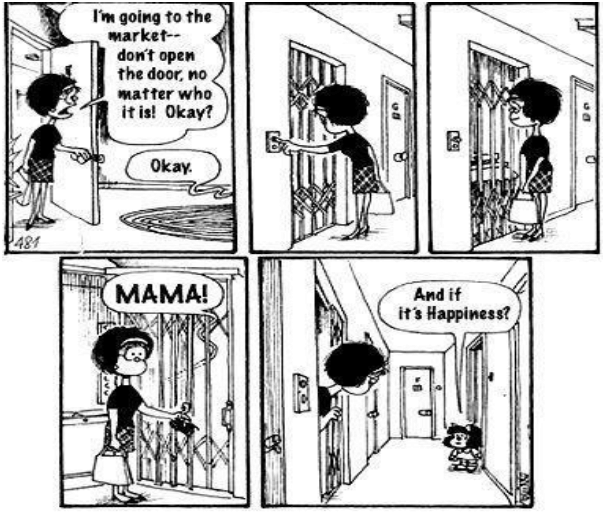
Available at: https://br.pinterest.com/pin/169307267213171064/. Access on: Feb. 27th 2022.
Based on the comic strip, it is possible to infer that:
Provas
TEXT 10
Answer the questions from according to the text 10.
Available at: https://br.pinterest.com/pin/169307267213171064/. Access on: Feb. 27th 2022.
Choose the only alternative in which all the words start with a silent letter:
Provas
TEXT 10
Answer the questions from according to the text 10.
Available at: https://br.pinterest.com/pin/169307267213171064/. Access on: Feb. 27th 2022.
All the words below could be considered as antonyms to the word “happiness”, except for:
Provas
TEXT 10
Answer the questions from according to the text 10.
Available at: https://br.pinterest.com/pin/169307267213171064/. Access on: Feb. 27th 2022.
In relation to the underlined letters of the word “happiness”, it is correct to say:
Provas
TEXT 9 Answer the questions from
according to the text 9.
MAFALDA: A CLASSIC COMIC STRIP FOR ANY AGE
A kid growing up in a Spanish speaking country in the 1970s and 80s was likely exposed to Mafalda, the comic creation of Argentinian Joaquín Salvador Lavado (also known as Quino). The comic ran in Argentinian papers between 1964 and 1973 and republished into little books that were widely read in Latin America. I loved reading it as a kid, but it wasn't until recently when I read, 10 Años con Mafalda (Tusquets Editores México, 2nd ed. 2009), that I truly appreciated its genius.
Mafalda is a precocious six-year old who worries about world peace and hates soup. She is surrounded by her quirky friends (Felipe, a smart kid who hates homework and tortures himself for his failings; Manolito, a capitalist kid always with a scheme; Susanita, a frivolous antifeminist; Miguelito, a dreamer and philosopher, and Libertad, a tiny kid named "Freedom") and family (her father who's bent on destroying the ants that eat his prized plants; Guille, her baby brother, fan of Bridgett Bardot; and her mother, a housewife).
The comic strip is a true original, but it has elements of early Peanuts (kids wise beyond their years contemplating existential conundrums), Calvin and Hobbes (smarty-pants kid with a huge imagination and skeptical of the world), and Doonesbury (biting social commentary). Quino managed to skewer politics and human nature in a funny and accessible way.
Although the political references are dated (Argentina was under military junta and the Cold War was pretty hot), Mafalda's concerns about political freedom and social inequities are still relevant today and her relationship with her parents are timeless. 10 Años con Mafalda is a treat for anyone. If you are learning or know Spanish, get it in the original. Otherwise, some of the small Mafalda books are available in English.
Available at: http://www.sylvialiuland.com/2012/01/mafalda-classic-cartoon-for-any-age.html. Access on: Feb. 27th 2022.
Read the following excerpt: “The comic ran in Argentinian papers between 1964 and 1973 and republished into little books that were widely read in Latin America. I loved reading it as a kid, but it wasn't until recently when I read, 10 Años con Mafalda (Tusquets Editores México, 2nd ed. 2009), that I truly appreciated its genius”. Respectively, the underlined words are:
Provas
TEXT 9 Answer the questions from
according to the text 9.
MAFALDA: A CLASSIC COMIC STRIP FOR ANY AGE
A kid growing up in a Spanish speaking country in the 1970s and 80s was likely exposed to Mafalda, the comic creation of Argentinian Joaquín Salvador Lavado (also known as Quino). The comic ran in Argentinian papers between 1964 and 1973 and republished into little books that were widely read in Latin America. I loved reading it as a kid, but it wasn't until recently when I read, 10 Años con Mafalda (Tusquets Editores México, 2nd ed. 2009), that I truly appreciated its genius.
Mafalda is a precocious six-year old who worries about world peace and hates soup. She is surrounded by her quirky friends (Felipe, a smart kid who hates homework and tortures himself for his failings; Manolito, a capitalist kid always with a scheme; Susanita, a frivolous antifeminist; Miguelito, a dreamer and philosopher, and Libertad, a tiny kid named "Freedom") and family (her father who's bent on destroying the ants that eat his prized plants; Guille, her baby brother, fan of Bridgett Bardot; and her mother, a housewife).
The comic strip is a true original, but it has elements of early Peanuts (kids wise beyond their years contemplating existential conundrums), Calvin and Hobbes (smarty-pants kid with a huge imagination and skeptical of the world), and Doonesbury (biting social commentary). Quino managed to skewer politics and human nature in a funny and accessible way.
Although the political references are dated (Argentina was under military junta and the Cold War was pretty hot), Mafalda's concerns about political freedom and social inequities are still relevant today and her relationship with her parents are timeless. 10 Años con Mafalda is a treat for anyone. If you are learning or know Spanish, get it in the original. Otherwise, some of the small Mafalda books are available in English.
Available at: http://www.sylvialiuland.com/2012/01/mafalda-classic-cartoon-for-any-age.html. Access on: Feb. 27th 2022.
In “Mafalda is a precocious six-year old who worries about world peace and hates soup”, the underlined word corresponds to:
Provas
TEXT 9
Answer the questions from
according to the text 9.
MAFALDA: A CLASSIC COMIC STRIP FOR ANY AGE
A kid growing up in a Spanish speaking country in the 1970s and 80s was likely exposed to Mafalda, the comic creation of Argentinian Joaquín Salvador Lavado (also known as Quino). The comic ran in Argentinian papers between 1964 and 1973 and republished into little books that were widely read in Latin America. I loved reading it as a kid, but it wasn't until recently when I read, 10 Años con Mafalda (Tusquets Editores México, 2nd ed. 2009), that I truly appreciated its genius.
Mafalda is a precocious six-year old who worries about world peace and hates soup. She is surrounded by her quirky friends (Felipe, a smart kid who hates homework and tortures himself for his failings; Manolito, a capitalist kid always with a scheme; Susanita, a frivolous antifeminist; Miguelito, a dreamer and philosopher, and Libertad, a tiny kid named "Freedom") and family (her father who's bent on destroying the ants that eat his prized plants; Guille, her baby brother, fan of Bridgett Bardot; and her mother, a housewife).
The comic strip is a true original, but it has elements of early Peanuts (kids wise beyond their years contemplating existential conundrums), Calvin and Hobbes (smarty-pants kid with a huge imagination and skeptical of the world), and Doonesbury (biting social commentary). Quino managed to skewer politics and human nature in a funny and accessible way.
Although the political references are dated (Argentina was under military junta and the Cold War was pretty hot), Mafalda's concerns about political freedom and social inequities are still relevant today and her relationship with her parents are timeless. 10 Años con Mafalda is a treat for anyone. If you are learning or know Spanish, get it in the original. Otherwise, some of the small Mafalda books are available in English.
Available at: http://www.sylvialiuland.com/2012/01/mafalda-classic-cartoon-for-any-age.html. Access on: Feb. 27th 2022.
In relation to the text, mark the correct alternative.
Provas
TEXT 8
Answer the question according to the text 8.

Available at: https://brainly.com.br/tarefa/41627789. Access on: Feb. 27th 2022.
The sentence “Don’t trash” is in:
Provas
TEXT 8
Answer the question according to the text 8.
Available at: https://brainly.com.br/tarefa/41627789. Access on: Feb. 27th 2022.
In relation to the text, consider the following statements:
I. The text’s purpose is to instruct, guide or explain to the reader an important topic for the community.
II. It is a narrative and informative text, as it reports a fact and conveys information about a certain topic.
III. It is a narrative of the main life facts of a real person, made by another person.
IV. There is both verbal and non-verbal language in the text.
V. The text’s purpose is to promote a product, service, or activity.
The correct statements are found in:
Provas
Caderno Container