Foram encontradas 60 questões.
Read the text to answer questions from.
Communicative Language Teaching (CLT) was a 1970s
reaction to much that had gone before, and has guiding
principles: first, language is not just patterns of grammar with
vocabulary items slotted in; it also involves language functions
such as inviting, agreeing and disagreeing, suggesting, etc.,
which students should learn how to perform using a variety
of language exponents (e.g. we can invite by saying “Would
you like to come to the cinema?’, ‘D’you fancy coming to the
cinema?’, ‘What about coming to the cinema?’, ‘How about a
film?’, ‘Are you on for a film?, etc). Students also need to be
aware of the need for appropriacy when talking and writing
to people in terms of the kind of language they use (formal,
informal, tentative, technical, etc). CLT is not just about the
language; it is actually about how it is used.
The second principle of Communicative Language
Teaching is that if students get enough exposure to language,
and opportunities for language use, and if they are motivated,
then language learning will take care of itself. Thus, CLT has a
lot in common with the acquisition view of language absorption.
As a result, the focus of much CLT has been on students
communicating real messages, and not just grammatically
controlled language. The deployment of many communicative
activities, where students use all and any language they know
to communicate, shows this aspect of CLT at work.
(Harmer, J. 1998. Adaptado)
Provas
Questão presente nas seguintes provas

- Interpretação de texto | Reading comprehension
- Gramática - Língua InglesaPalavras conectivas | Connective words
Read the text to answer questions from.
Communicative Language Teaching (CLT) was a 1970s
reaction to much that had gone before, and has guiding
principles: first, language is not just patterns of grammar with
vocabulary items slotted in; it also involves language functions
such as inviting, agreeing and disagreeing, suggesting, etc.,
which students should learn how to perform using a variety
of language exponents (e.g. we can invite by saying “Would
you like to come to the cinema?’, ‘D’you fancy coming to the
cinema?’, ‘What about coming to the cinema?’, ‘How about a
film?’, ‘Are you on for a film?, etc). Students also need to be
aware of the need for appropriacy when talking and writing
to people in terms of the kind of language they use (formal,
informal, tentative, technical, etc). CLT is not just about the
language; it is actually about how it is used.
The second principle of Communicative Language
Teaching is that if students get enough exposure to language,
and opportunities for language use, and if they are motivated,
then language learning will take care of itself. Thus, CLT has a
lot in common with the acquisition view of language absorption.
As a result, the focus of much CLT has been on students
communicating real messages, and not just grammatically
controlled language. The deployment of many communicative
activities, where students use all and any language they know
to communicate, shows this aspect of CLT at work.
(Harmer, J. 1998. Adaptado)
Provas
Questão presente nas seguintes provas
Read the text to answer question.
Different times, different methods
Current teaching practice is the direct result of the
acquisition-versus-learning debate. Also, both abstract theory
and practical techniques have been discussed, have gone
in and out of fashion, and have influenced what was and is
included in classrooms and teaching materials.
In the 1990s, for example, there was considerable
discussion about the Lexical Approach. In the 1970s, methods
such as the Silent Way were advocated, and although they
may not be used much any more – certainly not as they
were originally envisaged – still some of the techniques
they included have been incorporated into modern teaching
practice.
Amongst the plethora of ideas and techniques which
have been offered over the years, some trends have had, and
continue to have a significant impact on how languages are
taught today.
(HARMER, J. 1998. Adaptado.)
Provas
Questão presente nas seguintes provas
- Interpretação de texto | Reading comprehension
- Gramática - Língua InglesaPalavras conectivas | Connective words
Read the text to answer question.
Different times, different methods
Current teaching practice is the direct result of the
acquisition-versus-learning debate. Also, both abstract theory
and practical techniques have been discussed, have gone
in and out of fashion, and have influenced what was and is
included in classrooms and teaching materials.
In the 1990s, for example, there was considerable
discussion about the Lexical Approach. In the 1970s, methods
such as the Silent Way were advocated, and although they
may not be used much any more – certainly not as they
were originally envisaged – still some of the techniques
they included have been incorporated into modern teaching
practice.
Amongst the plethora of ideas and techniques which
have been offered over the years, some trends have had, and
continue to have a significant impact on how languages are
taught today.
(HARMER, J. 1998. Adaptado.)
Provas
Questão presente nas seguintes provas
Read the text to answer question.
Different times, different methods
Current teaching practice is the direct result of the
acquisition-versus-learning debate. Also, both abstract theory
and practical techniques have been discussed, have gone
in and out of fashion, and have influenced what was and is
included in classrooms and teaching materials.
In the 1990s, for example, there was considerable
discussion about the Lexical Approach. In the 1970s, methods
such as the Silent Way were advocated, and although they
may not be used much any more – certainly not as they
were originally envisaged – still some of the techniques
they included have been incorporated into modern teaching
practice.
Amongst the plethora of ideas and techniques which
have been offered over the years, some trends have had, and
continue to have a significant impact on how languages are
taught today.
(HARMER, J. 1998. Adaptado.)
Provas
Questão presente nas seguintes provas
Read the text to answer question.
Different times, different methods
Current teaching practice is the direct result of the
acquisition-versus-learning debate. Also, both abstract theory
and practical techniques have been discussed, have gone
in and out of fashion, and have influenced what was and is
included in classrooms and teaching materials.
In the 1990s, for example, there was considerable
discussion about the Lexical Approach. In the 1970s, methods
such as the Silent Way were advocated, and although they
may not be used much any more – certainly not as they
were originally envisaged – still some of the techniques
they included have been incorporated into modern teaching
practice.
Amongst the plethora of ideas and techniques which
have been offered over the years, some trends have had, and
continue to have a significant impact on how languages are
taught today.
(HARMER, J. 1998. Adaptado.)
Provas
Questão presente nas seguintes provas
Read the text to answer question.
Different times, different methods
Current teaching practice is the direct result of the
acquisition-versus-learning debate. Also, both abstract theory
and practical techniques have been discussed, have gone
in and out of fashion, and have influenced what was and is
included in classrooms and teaching materials.
In the 1990s, for example, there was considerable
discussion about the Lexical Approach. In the 1970s, methods
such as the Silent Way were advocated, and although they
may not be used much any more – certainly not as they
were originally envisaged – still some of the techniques
they included have been incorporated into modern teaching
practice.
Amongst the plethora of ideas and techniques which
have been offered over the years, some trends have had, and
continue to have a significant impact on how languages are
taught today.
(HARMER, J. 1998. Adaptado.)
Provas
Questão presente nas seguintes provas
Read the text to answer question.
Different times, different methods
Current teaching practice is the direct result of the
acquisition-versus-learning debate. Also, both abstract theory
and practical techniques have been discussed, have gone
in and out of fashion, and have influenced what was and is
included in classrooms and teaching materials.
In the 1990s, for example, there was considerable
discussion about the Lexical Approach. In the 1970s, methods
such as the Silent Way were advocated, and although they
may not be used much any more – certainly not as they
were originally envisaged – still some of the techniques
they included have been incorporated into modern teaching
practice.
Amongst the plethora of ideas and techniques which
have been offered over the years, some trends have had, and
continue to have a significant impact on how languages are
taught today.
(HARMER, J. 1998. Adaptado.)
Provas
Questão presente nas seguintes provas
Read the text to answer question.
Different times, different methods
Current teaching practice is the direct result of the
acquisition-versus-learning debate. Also, both abstract theory
and practical techniques have been discussed, have gone
in and out of fashion, and have influenced what was and is
included in classrooms and teaching materials.
In the 1990s, for example, there was considerable
discussion about the Lexical Approach. In the 1970s, methods
such as the Silent Way were advocated, and although they
may not be used much any more – certainly not as they
were originally envisaged – still some of the techniques
they included have been incorporated into modern teaching
practice.
Amongst the plethora of ideas and techniques which
have been offered over the years, some trends have had, and
continue to have a significant impact on how languages are
taught today.
(HARMER, J. 1998. Adaptado.)
Provas
Questão presente nas seguintes provas
Read the comic strip about Calvin (the boy) and Hobbes (the
tiger), and answer question.
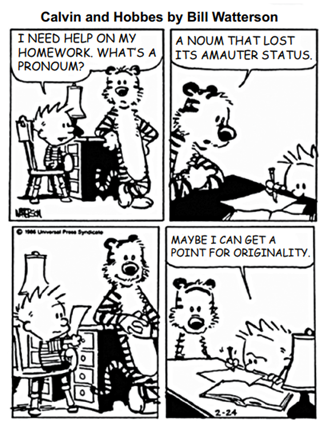
(https://www.gocomics.com/search/calvinandhobbes?utf8=%E2%9C%93&ter
ms=what+is+a+pronoun%3F)
Provas
Questão presente nas seguintes provas
Cadernos
Caderno Container