Foram encontradas 200 questões.
Is the blockchain audit trail in our near future?

https://www.leewayhertz.com/blockchain-technology-explained/
There are still many unknowns with respect to how blockchain will impact the audit and assurance profession, including the speed with which it will do so. Blockchain is already impacting Certified Public Accountant (CPA) auditors of those organizations using blockchain to record transactions and the rate of adoption is expected to continue to increase. However, in the immediate future, blockchain technology will not replace financial reporting and financial statement auditing. Financial statements reflect management assertions, including estimates, many of which cannot be easily summarized or calculated in a blockchain.
Furthermore, the process of an independent audit of financial statements enhances the trust that is crucial for the effective functioning of the capital markets system. Any erosion of this trust may damage an entity’s reputation, stock price and shareholder value, and can result in fines, penalties, or loss of assets. Users of financial statements expect CPA auditors to perform an independent audit of the financial statements using their professional skepticism. CPA auditors conclude whether they have obtained reasonable assurance that the financial statements of an entity, taken as a whole, are free from material misstatement, whether due to fraud or error. A blockchain is unlikely to replace these judgments by a financial statement auditor.
That said, CPA auditors need to monitor developments in blockchain technology—it will impact clients’ information technology systems. CPA auditors will need to be conversant with the basics of blockchain technology and work with experts to audit the complex technical risks associated with blockchain.
In addition, CPA auditors should be aware of opportunities to leverage their clients' adoption of blockchain technology to improve data gathering during the audit. They should also consider whether blockchain technology will allow them to create automated audit routines. The auditing profession must embrace and "lean in" to the opportunities and challenges from widespread blockchain adoption. CPA auditors and assurance providers are encouraged to monitor developments in blockchain technology because they have an opportunity to evolve, learn, and capitalize on their already proven ability to adapt to the needs of a rapidly changing business world.
(Adapted from https://www2.deloitte.com/za/en/pages/audit/articles/impact-of-blockchain-in-accounting.html)
The first sentence of the last paragraph offers a(n)
Provas

Is the blockchain audit trail in our near future?
https://www.leewayhertz.com/blockchain-technology-explained/
There are still many unknowns with respect to how blockchain will impact the audit and assurance profession, including the speed with which it will do so. Blockchain is already impacting Certified Public Accountant (CPA) auditors of those organizations using blockchain to record transactions and the rate of adoption is expected to continue to increase. However, in the immediate future, blockchain technology will not replace financial reporting and financial statement auditing. Financial statements reflect management assertions, including estimates, many of which cannot be easily summarized or calculated in a blockchain.
Furthermore, the process of an independent audit of financial statements enhances the trust that is crucial for the effective functioning of the capital markets system. Any erosion of this trust may damage an entity’s reputation, stock price and shareholder value, and can result in fines, penalties, or loss of assets. Users of financial statements expect CPA auditors to perform an independent audit of the financial statements using their professional skepticism. CPA auditors conclude whether they have obtained reasonable assurance that the financial statements of an entity, taken as a whole, are free from material misstatement, whether due to fraud or error. A blockchain is unlikely to replace these judgments by a financial statement auditor.
That said, CPA auditors need to monitor developments in blockchain technology—it will impact clients’ information technology systems. CPA auditors will need to be conversant with the basics of blockchain technology and work with experts to audit the complex technical risks associated with blockchain.
In addition, CPA auditors should be aware of opportunities to leverage their clients' adoption of blockchain technology to improve data gathering during the audit. They should also consider whether blockchain technology will allow them to create automated audit routines. The auditing profession must embrace and "lean in" to the opportunities and challenges from widespread blockchain adoption. CPA auditors and assurance providers are encouraged to monitor developments in blockchain technology because they have an opportunity to evolve, learn, and capitalize on their already proven ability to adapt to the needs of a rapidly changing business world.
(Adapted from https://www2.deloitte.com/za/en/pages/audit/articles/impact-of-blockchain-in-accounting.html)
“Furthermore” in “Furthermore, the process of an independent audit of financial statements enhances the trust” (2nd paragraph) can be replaced without change of meaning by
Provas
Is the blockchain audit trail in our near future?
https://www.leewayhertz.com/blockchain-technology-explained/
There are still many unknowns with respect to how blockchain will impact the audit and assurance profession, including the speed with which it will do so. Blockchain is already impacting Certified Public Accountant (CPA) auditors of those organizations using blockchain to record transactions and the rate of adoption is expected to continue to increase. However, in the immediate future, blockchain technology will not replace financial reporting and financial statement auditing. Financial statements reflect management assertions, including estimates, many of which cannot be easily summarized or calculated in a blockchain.
Furthermore, the process of an independent audit of financial statements enhances the trust that is crucial for the effective functioning of the capital markets system. Any erosion of this trust may damage an entity’s reputation, stock price and shareholder value, and can result in fines, penalties, or loss of assets. Users of financial statements expect CPA auditors to perform an independent audit of the financial statements using their professional skepticism. CPA auditors conclude whether they have obtained reasonable assurance that the financial statements of an entity, taken as a whole, are free from material misstatement, whether due to fraud or error. A blockchain is unlikely to replace these judgments by a financial statement auditor.
That said, CPA auditors need to monitor developments in blockchain technology—it will impact clients’ information technology systems. CPA auditors will need to be conversant with the basics of blockchain technology and work with experts to audit the complex technical risks associated with blockchain.
In addition, CPA auditors should be aware of opportunities to leverage their clients' adoption of blockchain technology to improve data gathering during the audit. They should also consider whether blockchain technology will allow them to create automated audit routines. The auditing profession must embrace and "lean in" to the opportunities and challenges from widespread blockchain adoption. CPA auditors and assurance providers are encouraged to monitor developments in blockchain technology because they have an opportunity to evolve, learn, and capitalize on their already proven ability to adapt to the needs of a rapidly changing business world.
(Adapted from https://www2.deloitte.com/za/en/pages/audit/articles/impact-of-blockchain-in-accounting.html)
The word “unlikely” in “A blockchain is unlikely to replace these judgments” (2nd paragraph) implies
Provas
Is the blockchain audit trail in our near future?
https://www.leewayhertz.com/blockchain-technology-explained/
There are still many unknowns with respect to how blockchain will impact the audit and assurance profession, including the speed with which it will do so. Blockchain is already impacting Certified Public Accountant (CPA) auditors of those organizations using blockchain to record transactions and the rate of adoption is expected to continue to increase. However, in the immediate future, blockchain technology will not replace financial reporting and financial statement auditing. Financial statements reflect management assertions, including estimates, many of which cannot be easily summarized or calculated in a blockchain.
Furthermore, the process of an independent audit of financial statements enhances the trust that is crucial for the effective functioning of the capital markets system. Any erosion of this trust may damage an entity’s reputation, stock price and shareholder value, and can result in fines, penalties, or loss of assets. Users of financial statements expect CPA auditors to perform an independent audit of the financial statements using their professional skepticism. CPA auditors conclude whether they have obtained reasonable assurance that the financial statements of an entity, taken as a whole, are free from material misstatement, whether due to fraud or error. A blockchain is unlikely to replace these judgments by a financial statement auditor.
That said, CPA auditors need to monitor developments in blockchain technology—it will impact clients’ information technology systems. CPA auditors will need to be conversant with the basics of blockchain technology and work with experts to audit the complex technical risks associated with blockchain.
In addition, CPA auditors should be aware of opportunities to leverage their clients' adoption of blockchain technology to improve data gathering during the audit. They should also consider whether blockchain technology will allow them to create automated audit routines. The auditing profession must embrace and "lean in" to the opportunities and challenges from widespread blockchain adoption. CPA auditors and assurance providers are encouraged to monitor developments in blockchain technology because they have an opportunity to evolve, learn, and capitalize on their already proven ability to adapt to the needs of a rapidly changing business world.
(Adapted from https://www2.deloitte.com/za/en/pages/audit/articles/impact-of-blockchain-in-accounting.html)
As regards the author’s opinion, analyse the assertions below.
I. Auditors should try to keep abreast of the latest developments in technology.
II. CPA auditors’ skepticism is an asset to the profession.
III. Those involved in auditing seems to be rather refractory to change.
Provas
Is the blockchain audit trail in our near future?
https://www.leewayhertz.com/blockchain-technology-explained/
There are still many unknowns with respect to how blockchain will impact the audit and assurance profession, including the speed with which it will do so. Blockchain is already impacting Certified Public Accountant (CPA) auditors of those organizations using blockchain to record transactions and the rate of adoption is expected to continue to increase. However, in the immediate future, blockchain technology will not replace financial reporting and financial statement auditing. Financial statements reflect management assertions, including estimates, many of which cannot be easily summarized or calculated in a blockchain.
Furthermore, the process of an independent audit of financial statements enhances the trust that is crucial for the effective functioning of the capital markets system. Any erosion of this trust may damage an entity’s reputation, stock price and shareholder value, and can result in fines, penalties, or loss of assets. Users of financial statements expect CPA auditors to perform an independent audit of the financial statements using their professional skepticism. CPA auditors conclude whether they have obtained reasonable assurance that the financial statements of an entity, taken as a whole, are free from material misstatement, whether due to fraud or error. A blockchain is unlikely to replace these judgments by a financial statement auditor.
That said, CPA auditors need to monitor developments in blockchain technology—it will impact clients’ information technology systems. CPA auditors will need to be conversant with the basics of blockchain technology and work with experts to audit the complex technical risks associated with blockchain.
In addition, CPA auditors should be aware of opportunities to leverage their clients' adoption of blockchain technology to improve data gathering during the audit. They should also consider whether blockchain technology will allow them to create automated audit routines. The auditing profession must embrace and "lean in" to the opportunities and challenges from widespread blockchain adoption. CPA auditors and assurance providers are encouraged to monitor developments in blockchain technology because they have an opportunity to evolve, learn, and capitalize on their already proven ability to adapt to the needs of a rapidly changing business world.
(Adapted from https://www2.deloitte.com/za/en/pages/audit/articles/impact-of-blockchain-in-accounting.html)
Based on the text, mark the statements below as True (T) or False (F).
( ) The effects of blockchain technology in auditing nowadays are quite clear.
( ) It will be necessary for CPA auditors to acquaint themselves with the fundamentals of blockchain and to team up with specialists to gauge technical hazards.
( ) The interest in blockchain technology is already dwindling.
The statements are, respectively
Provas
Os carros A, B, C e D ocupam quatro das seis vagas do estacionamento representado abaixo.

Sabe-se que os carros A e B estão em vagas vizinhas.
O número de maneiras diferentes em que os carros podem estar dispostos nesse estacionamento é igual a
Provas
Uma grandeza A é diretamente proporcional à grandeza B que, por sua vez, é inversamente proporcional ao quadrado da grandeza C.
Quando A = 12, tem-se B = 4 e C = 6.
Quando C = 4, o valor de A é
Provas
Sobre 3 conjuntos !$ A !$, !$ B !$ e !$ C !$, sabe-se que:
- !$ A !$ tem 16 elementos;
- !$ B !$ tem 24 elementos;
- !$ C !$ tem 18 elementos;
- !$ A \cap B !$ tem 5 elementos;
- !$ B \cap C !$ tem 7 elementos;
- !$ A \cap B \cap C !$ tem 3 elementos;
- !$ A - (B \cup C) !$ tem 8 elementos.
O número de elementos do conjunto !$ A \cup B \cup C !$ é igual a
Provas
A figura abaixo mostra uma faixa decorativa da época dos antigos romanos, na forma de uma linha poligonal com padrão determinado e desenhada no plano cartesiano.
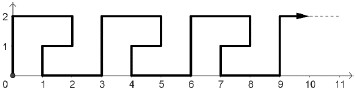
Sobre essa poligonal, a partir do ponto A(0, 0), foram percorridas 2023 unidades chegando-se ao ponto B.
O ponto B é:
Provas
Analise a frase a seguir.
“O conceito ‘bom’ tem muitos significados. Por exemplo, se um homem acertasse sua avó a uma boa distância, ele seria um bom atirador, mas não necessariamente um bom homem.”
Assinale a opção que apresenta uma característica da linguagem dessa frase.
Provas
Caderno Container