Foram encontradas 149 questões.
Em relação a processos de gerenciamento de projetos e a risco de auditoria, julgue o item que se segue.
Estimar os recursos das atividades é um dos processos da área de gerenciamento do tempo de projetos.
Provas

Em relação a processos de gerenciamento de projetos e a risco de auditoria, julgue o item que se segue.
Desenvolver a estrutura analítica do projeto (EAP), documento que formaliza o início do projeto, é um processo da área de integração de projetos, segundo o PMBok.
Provas
A partir das informações do texto precedente, julgue o item seguinte, considerando que, no espaço amostral de todos os usuários de planos de saúde no país, os usuários se distribuam igualmente entre os três tipos de planos mencionados.
Considere que, para um usuário de planos de saúde no país, selecionado ao acaso, seja nula a chance de ele ter seu plano cancelado unilateralmente pela operadora. Nesse caso, a probabilidade de ele ser usuário de um plano coletivo empresarial é de 50%.
Provas
A partir das informações do texto precedente, julgue o item seguinte, considerando que, no espaço amostral de todos os usuários de planos de saúde no país, os usuários se distribuam igualmente entre os três tipos de planos mencionados.
Considere que a probabilidade de o contrato de usuários do plano coletivo por adesão ser cancelado unilateralmente pela operadora seja de 3%. Nessa situação, selecionando-se um usuário ao acaso, a probabilidade de que o contrato desse usuário seja cancelado unilateralmente pela operadora será de 1%.
Provas
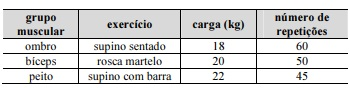
Suponha que, ao planejar uma série de exercícios de musculação para o mês, uma pessoa tenha organizado a tabela anterior. Com base nessa situação hipotética, julgue o item a seguir, considerando que somente sejam realizados os exercícios mencionados na tabela e desprezando eventuais perdas de tempo.
Se o tempo total de treino for dividido de forma proporcional à carga de cada exercício, então a pessoa ocupará 30% do tempo fazendo o exercício supino sentado.
Provas
Suponha que, ao planejar uma série de exercícios de musculação para o mês, uma pessoa tenha organizado a tabela anterior. Com base nessa situação hipotética, julgue o item a seguir, considerando que somente sejam realizados os exercícios mencionados na tabela e desprezando eventuais perdas de tempo.
Considerando-se que o tempo total de treino seja proporcional ao número de repetições, se a pessoa demorar 15 minutos fazendo o exercício supino com barra, então o tempo total de treino será superior a uma hora.
Provas
Suponha que, ao planejar uma série de exercícios de musculação para o mês, uma pessoa tenha organizado a tabela anterior. Com base nessa situação hipotética, julgue o item a seguir, considerando que somente sejam realizados os exercícios mencionados na tabela e desprezando eventuais perdas de tempo.
A partir dos dados da tabela, infere-se que as grandezas carga e número de repetições são, tecnicamente falando, inversamente proporcionais.
Provas
Disciplina: Inglês (Língua Inglesa)
Banca: CESPE / CEBRASPE
Orgão: SEPLAG-CE
Digital technology is everywhere, and it is changing the way citizens behave. From working patterns to the day-to-day services we use and the places we live, there is no aspect of modern life that remains untouched by digital tools and solutions. This represents both the biggest challenge and opportunity for public sector organizations as they seek to engage citizens and create future-proofed, sustainably-minded societies.
The public sector plays a key role in setting the sustainability agenda for society, including the approach to circularity and recycling. While private sector companies can greatly influence the successful achievement of sustainability targets, the public sector bears the responsibility for outlining how society can achieve these goals more broadly at both national and local levels. By embracing the same digital technologies that are transforming their citizens’ lives, public sector organizations can help pivot society towards a more sustainable tomorrow.
In addition, there has been a rise of smart cities and the circular economy. Urban areas account for 75% of global carbon dioxide emissions, and the 100 cities with the greatest footprints account for 18% of global emissions. But there are more than 70 cities worldwide pledging to become carbon neutral by 2050.
Public sector actors can fuel sustainable transformation by releasing capital to invest in sustainable city transformation projects and smart cities. By tapping into the value of data and green infrastructure, smart cities can combat climate risks and become more resilient to the many unexpected events of today’s increasingly unpredictable world. These cities can support the decoupling of resource use and environmental impacts by diffusing circular economy approaches to production and consumption.
Internet:<pulse.microsoft.com>
Based on the ideas presented in the previous text, as well as on its linguistic aspects, judge the following item.
The segment “more than”, in the last sentence of the third paragraph, can be correctly replaced with over than without changing the meaning of the text.
Provas
Disciplina: Inglês (Língua Inglesa)
Banca: CESPE / CEBRASPE
Orgão: SEPLAG-CE
Digital technology is everywhere, and it is changing the way citizens behave. From working patterns to the day-to-day services we use and the places we live, there is no aspect of modern life that remains untouched by digital tools and solutions. This represents both the biggest challenge and opportunity for public sector organizations as they seek to engage citizens and create future-proofed, sustainably-minded societies.
The public sector plays a key role in setting the sustainability agenda for society, including the approach to circularity and recycling. While private sector companies can greatly influence the successful achievement of sustainability targets, the public sector bears the responsibility for outlining how society can achieve these goals more broadly at both national and local levels. By embracing the same digital technologies that are transforming their citizens’ lives, public sector organizations can help pivot society towards a more sustainable tomorrow.
In addition, there has been a rise of smart cities and the circular economy. Urban areas account for 75% of global carbon dioxide emissions, and the 100 cities with the greatest footprints account for 18% of global emissions. But there are more than 70 cities worldwide pledging to become carbon neutral by 2050.
Public sector actors can fuel sustainable transformation by releasing capital to invest in sustainable city transformation projects and smart cities. By tapping into the value of data and green infrastructure, smart cities can combat climate risks and become more resilient to the many unexpected events of today’s increasingly unpredictable world. These cities can support the decoupling of resource use and environmental impacts by diffusing circular economy approaches to production and consumption.
Internet:<pulse.microsoft.com>
Based on the ideas presented in the previous text, as well as on its linguistic aspects, judge the following item.
Smart cities are sure to tackle climate risks and become more resistant to the many unpredictable events of the planet by tapping into the value of data and green infrastructure.
Provas
Disciplina: Inglês (Língua Inglesa)
Banca: CESPE / CEBRASPE
Orgão: SEPLAG-CE
Digital technology is everywhere, and it is changing the way citizens behave. From working patterns to the day-to-day services we use and the places we live, there is no aspect of modern life that remains untouched by digital tools and solutions. This represents both the biggest challenge and opportunity for public sector organizations as they seek to engage citizens and create future-proofed, sustainably-minded societies.
The public sector plays a key role in setting the sustainability agenda for society, including the approach to circularity and recycling. While private sector companies can greatly influence the successful achievement of sustainability targets, the public sector bears the responsibility for outlining how society can achieve these goals more broadly at both national and local levels. By embracing the same digital technologies that are transforming their citizens’ lives, public sector organizations can help pivot society towards a more sustainable tomorrow.
In addition, there has been a rise of smart cities and the circular economy. Urban areas account for 75% of global carbon dioxide emissions, and the 100 cities with the greatest footprints account for 18% of global emissions. But there are more than 70 cities worldwide pledging to become carbon neutral by 2050.
Public sector actors can fuel sustainable transformation by releasing capital to invest in sustainable city transformation projects and smart cities. By tapping into the value of data and green infrastructure, smart cities can combat climate risks and become more resilient to the many unexpected events of today’s increasingly unpredictable world. These cities can support the decoupling of resource use and environmental impacts by diffusing circular economy approaches to production and consumption.
Internet:<pulse.microsoft.com>
Based on the ideas presented in the previous text, as well as on its linguistic aspects, judge the following item.
The text indicates that, by investing in sustainable city transformation projects and smart cities, public sector actors can help cities become better prepared to face climate risks and unpredictable events.
Provas
Caderno Container