Foram encontradas 100 questões.
No diagrama abaixo, o retângulo maior representa o conjunto de todos os alunos do 1o ano de Engenharia de uma faculdade e as outras três figuras representam os conjuntos desses alunos que foram aprovados nas disciplinas de Cálculo 1, Cálculo 2 e Álgebra Linear.
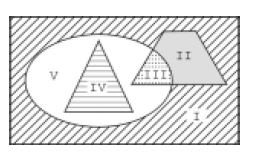
Cálculo 1 é pré-requisito para Cálculo 2, ou seja, um aluno só pode cursar Cálculo 2 se tiver sido aprovado em Cálculo 1. Além disso, sabe-se que nenhum aluno do 1º ano conseguiu ser aprovado ao mesmo tempo em Cálculo 2 e Álgebra Linear. A tabela abaixo mostra a situação de três alunos nessas três disciplinas:
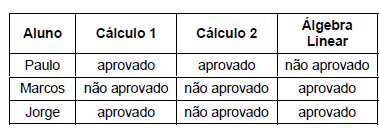
Associando cada um desses alunos à região do diagrama mais apropriada para representa-los, temos
Provas

O manual de garantia da qualidade de uma empresa diz que, se um cliente faz uma reclamação formal, então é aberto um processo interno e o departamento de qualidade é acionado. De acordo com essa afirmação, é correto concluir que
Provas
Cliente 1: André, Bruno e Cecília.
Cliente 2: Cecília, Débora e Evandro.
Cliente 3: André, Bruno e Evandro.
A partir dessas informações, pode-se concluir que
Provas
By Colum Lynch
Washington Post Staff Writer
UNITED NATIONS -- In the three weeks since the Indian Ocean tsunami ripped up coastlines in Asia and Africa, the United Nations has credited more than 40 governments, the World Bank and the Asian Development Bank with unprecedented pledges of assistance valued at nearly billion.
But a closer look at those commitments shows that hundreds of millions of dollars in those pledges had already been committed to development projects in the region. And as much as half of the offers are for interest-free loans, which the United Nations traditionally does not count as humanitarian aid.
The tsunami relief effort illustrates how large pledges of aid have historically yielded far less cash than was promised for humanitarian relief and recovery efforts. And it underscores why the United Nations – which asked for nearly billion to fund its tsunami relief and reconstruction efforts over the next six months – remains concerned that money may not be available to finance relief efforts, despite commitments made worldwide.
Over the past two years, the United Nations has faced a shortfall of billion in funding for relief operations and for rebuilding countries devastated by civil conflicts or natural disasters. In many cases, countries simply have not followed through on large public pledges of support.
U.N. officials and aid experts say that the challenge in accurately tallying aid pledges is that governments rarely explain whether their contributions consist of new money, loans or a repackaging of earlier announced development assistance meant to increase the apparent size of their donation.
"Governments have traditionally played political theater with aid pledges," said Shepard Forman, the director of New York University's Center on International Cooperation, who has studied aid disbursements. "There have been lots of smoke and mirrors in the amounts pledged by governments, and there is almost no way to track it."
Meanwhile, U.N. officials are left to thank nations for their generous assistance and promises, while at the same time drawing attention to the large gap between the pledges and the money currently available to fund relief operations.
O título que melhor caracteriza a mensagem do texto é
Provas
By Colum Lynch
Washington Post Staff Writer
UNITED NATIONS -- In the three weeks since the Indian Ocean tsunami ripped up coastlines in Asia and Africa, the United Nations has credited more than 40 governments, the World Bank and the Asian Development Bank with unprecedented pledges of assistance valued at nearly billion.
But a closer look at those commitments shows that hundreds of millions of dollars in those pledges had already been committed to development projects in the region. And as much as half of the offers are for interest-free loans, which the United Nations traditionally does not count as humanitarian aid.
The tsunami relief effort illustrates how large pledges of aid have historically yielded far less cash than was promised for humanitarian relief and recovery efforts. And it underscores why the United Nations – which asked for nearly billion to fund its tsunami relief and reconstruction efforts over the next six months – remains concerned that money may not be available to finance relief efforts, despite commitments made worldwide.
Over the past two years, the United Nations has faced a shortfall of billion in funding for relief operations and for rebuilding countries devastated by civil conflicts or natural disasters. In many cases, countries simply have not followed through on large public pledges of support.
U.N. officials and aid experts say that the challenge in accurately tallying aid pledges is that governments rarely explain whether their contributions consist of new money, loans or a repackaging of earlier announced development assistance meant to increase the apparent size of their donation.
"Governments have traditionally played political theater with aid pledges," said Shepard Forman, the director of New York University's Center on International Cooperation, who has studied aid disbursements. "There have been lots of smoke and mirrors in the amounts pledged by governments, and there is almost no way to track it."
Meanwhile, U.N. officials are left to thank nations for their generous assistance and promises, while at the same time drawing attention to the large gap between the pledges and the money currently available to fund relief operations.
De acordo com o texto,
Provas
By Colum Lynch
Washington Post Staff Writer
UNITED NATIONS -- In the three weeks since the Indian Ocean tsunami ripped up coastlines in Asia and Africa, the United Nations has credited more than 40 governments, the World Bank and the Asian Development Bank with unprecedented pledges of assistance valued at nearly billion.
But a closer look at those commitments shows that hundreds of millions of dollars in those pledges had already been committed to development projects in the region. And as much as half of the offers are for interest-free loans, which the United Nations traditionally does not count as humanitarian aid.
The tsunami relief effort illustrates how large pledges of aid have historically yielded far less cash than was promised for humanitarian relief and recovery efforts. And it underscores why the United Nations – which asked for nearly billion to fund its tsunami relief and reconstruction efforts over the next six months – remains concerned that money may not be available to finance relief efforts, despite commitments made worldwide.
Over the past two years, the United Nations has faced a shortfall of billion in funding for relief operations and for rebuilding countries devastated by civil conflicts or natural disasters. In many cases, countries simply have not followed through on large public pledges of support.
U.N. officials and aid experts say that the challenge in accurately tallying aid pledges is that governments rarely explain whether their contributions consist of new money, loans or a repackaging of earlier announced development assistance meant to increase the apparent size of their donation.
"Governments have traditionally played political theater with aid pledges," said Shepard Forman, the director of New York University's Center on International Cooperation, who has studied aid disbursements. "There have been lots of smoke and mirrors in the amounts pledged by governments, and there is almost no way to track it."
Meanwhile, U.N. officials are left to thank nations for their generous assistance and promises, while at the same time drawing attention to the large gap between the pledges and the money currently available to fund relief operations.
Segundo o texto,
Provas
By Colum Lynch
Washington Post Staff Writer
UNITED NATIONS -- In the three weeks since the Indian Ocean tsunami ripped up coastlines in Asia and Africa, the United Nations has credited more than 40 governments, the World Bank and the Asian Development Bank with unprecedented pledges of assistance valued at nearly billion.
But a closer look at those commitments shows that hundreds of millions of dollars in those pledges had already been committed to development projects in the region. And as much as half of the offers are for interest-free loans, which the United Nations traditionally does not count as humanitarian aid.
The tsunami relief effort illustrates how large pledges of aid have historically yielded far less cash than was promised for humanitarian relief and recovery efforts. And it underscores why the United Nations – which asked for nearly billion to fund its tsunami relief and reconstruction efforts over the next six months – remains concerned that money may not be available to finance relief efforts, despite commitments made worldwide.
Over the past two years, the United Nations has faced a shortfall of billion in funding for relief operations and for rebuilding countries devastated by civil conflicts or natural disasters. In many cases, countries simply have not followed through on large public pledges of support.
U.N. officials and aid experts say that the challenge in accurately tallying aid pledges is that governments rarely explain whether their contributions consist of new money, loans or a repackaging of earlier announced development assistance meant to increase the apparent size of their donation.
"Governments have traditionally played political theater with aid pledges," said Shepard Forman, the director of New York University's Center on International Cooperation, who has studied aid disbursements. "There have been lots of smoke and mirrors in the amounts pledged by governments, and there is almost no way to track it."
Meanwhile, U.N. officials are left to thank nations for their generous assistance and promises, while at the same time drawing attention to the large gap between the pledges and the money currently available to fund relief operations.
No texto, may not be available indica
Provas
By Colum Lynch
Washington Post Staff Writer
UNITED NATIONS -- In the three weeks since the Indian Ocean tsunami ripped up coastlines in Asia and Africa, the United Nations has credited more than 40 governments, the World Bank and the Asian Development Bank with unprecedented pledges of assistance valued at nearly billion.
But a closer look at those commitments shows that hundreds of millions of dollars in those pledges had already been committed to development projects in the region. And as much as half of the offers are for interest-free loans, which the United Nations traditionally does not count as humanitarian aid.
The tsunami relief effort illustrates how large pledges of aid have historically yielded far less cash than was promised for humanitarian relief and recovery efforts. And it underscores why the United Nations – which asked for nearly billion to fund its tsunami relief and reconstruction efforts over the next six months – remains concerned that money may not be available to finance relief efforts, despite commitments made worldwide.
Over the past two years, the United Nations has faced a shortfall of billion in funding for relief operations and for rebuilding countries devastated by civil conflicts or natural disasters. In many cases, countries simply have not followed through on large public pledges of support.
U.N. officials and aid experts say that the challenge in accurately tallying aid pledges is that governments rarely explain whether their contributions consist of new money, loans or a repackaging of earlier announced development assistance meant to increase the apparent size of their donation.
"Governments have traditionally played political theater with aid pledges," said Shepard Forman, the director of New York University's Center on International Cooperation, who has studied aid disbursements. "There have been lots of smoke and mirrors in the amounts pledged by governments, and there is almost no way to track it."
Meanwhile, U.N. officials are left to thank nations for their generous assistance and promises, while at the same time drawing attention to the large gap between the pledges and the money currently available to fund relief operations.
No texto, um sinônimo para nearly é
Provas
Três amigos decidiram organizar um desafio para definir qual deles era o melhor corredor. Seriam realizadas n corridas (n > 1), sendo atribuídos, em cada uma delas, p pontos para o primeiro colocado, q para o segundo e r para o terceiro, não havendo possibilidade de empate em qualquer colocação. Ao final do desafio, um dos amigos acumulou 45 pontos, outro 35 pontos e o último 11 pontos. Sendo p, q e r números inteiros e positivos, o valor de n é igual a
Provas
Juntam-se 64 cubos de madeira idênticos, de aresta 1 cm, formando um cubo maior, de aresta 4 cm. Em seguida, cada uma das seis faces do cubo maior é pintada. Após a secagem da tinta, separam-se novamente os 64 cubos menores e n deles são escolhidos, de maneira aleatória. O menor valor de n para que se possa afirmar com certeza que pelo menos um dos cubos sorteados não teve nenhuma de suas faces pintadas é
Provas
Caderno Container