Foram encontradas 691 questões.
Tabela TURFE
Considere um banco de dados relacional que contém uma única tabela, TURFE, cuja estrutura é exibida com sua instância, a seguir.
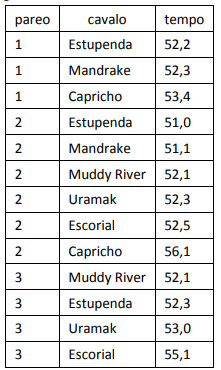
Com relação à tabela TURFE, descrita anteriormente, analise o comando SQL a seguir.
select
cavalo,
(select avg(tempo)
from TURFE t
where t.cavalo = TURFE.cavalo) media
from TURFE
O número de linhas do resultado produzido pela execução do comando acima, excetuada a linha de títulos, é:
Provas

Tabela TURFE
Considere um banco de dados relacional que contém uma única tabela, TURFE, cuja estrutura é exibida com sua instância, a seguir.
Analise o comando SQL a seguir.
select distinct cavalo
from TURFE
where not exists
(select *
from
(select t1.pareo, sum(1) xpto, t1.cavalo
from TURFE t1, TURFE t2
where t1.pareo = t2.pareo
and t2.tempo <= t1.tempo
group by t1.cavalo, t1.pareo) x
where TURFE.cavalo = x.cavalo
and x.xpto <> 2
)
Considerando-se a instância da tabela TURFE descrita anteriormente, a execução do comando acima exibe no resultado o(s) nome(s):
Provas
Tabela TURFE
Considere um banco de dados relacional que contém uma única tabela, TURFE, cuja estrutura é exibida com sua instância, a seguir.
Para cada páreo, ou corrida, são armazenados os nomes dos cavalos participantes e os respectivos tempos. A classificação de cada cavalo numa corrida segue a ordem crescente de tempo. Não há empates.
Com relação à tabela TURFE, descrita anteriormente, o comando SQL que exibe, para cada páreo, somente o cavalo que chegou em último lugar com o respectivo tempo é:
Provas
Um analista é contratado para analisar dados de volume de suco de laranja produzido em duas fábricas da mesma empresa.
Suponha que sejam medidos 16 lotes na fábrica A e 61 lotes na fábrica B, e que as médias amostrais tenham sido !$ \bar A = 104 !$ e !$ \bar B = 112 !$, com somas de desvios quadráticos em relação à média !$ S^2_A = 40.000 !$ e !$ S^2_B = 100.000 !$, respectivamente.
A chefia quer saber se uma fábrica tem menor variabilidade em relação à outra.
O teste a ser usado e o valor da sua estatística de teste são, respectivamente:
Provas
- Estatística DescritivaMedidas de Tendência CentralMédiasMédia AritméticaMédia Simples (Não Agrupados)
Considere um conjunto de dados com n = 10 observações, cujas nove primeiras observações são
7,6 4,1 8,8 4,2 5,1 7,4 8,8 5,9 3,1
Sabendo-se que a média amostral do conjunto completo é !$ \bar X !$ = 4,2, a amplitude dos dados é:
Provas
A chance de um evento que ocorre com probabilidade p é definida como c = p/(1-p).
Quando queremos entender a associação de um fator com um evento de interesse, em geral computamos a razão de chances, r = c_0/c_1, onde c_0 é a chance sem a exposição e c_1 é a chance com a exposição.
Suponha que um analista dispõe de um conjunto de dados binários Y = (Y_1,..., Y_n), com Y_i tomando valores em {0, 1} contendo o resultado de um teste de Covid-19 em n pacientes e que X = (X_1, ..., X_n) é um conjunto de covariáveis também binárias que indicam se o indivíduo foi (X_i = 1) ou não (X_i = 0) a uma festa nos últimos dez dias.
O analista quer determinar se a variável X está significativamente associada com o resultado do teste, Y.
Para tanto, ajusta um modelo de regressão logística utilizando Y como variável resposta, um termo de intercepto e X como covariável.
Ele obtém uma estimativa b0 para o intercepto, com erro padrão s0 e, para o coeficiente de X, uma estimativa b1 erro padrão s1.
O intervalo de confiança de 90% para a razão de chances é:
Provas
Here’s why we’ll never be able to build a brain in a computer
It’s easy to equate brains and computers – they’re both thinking machines, after all. But the comparison doesn’t really stand up to closer inspection, as Dr. Lisa Feldman Barrett reveals.
People often describe the brain as a computer, as if neurons are like hardware and the mind is software. But this metaphor is deeply flawed.
A computer is built from static parts, whereas your brain constantly rewires itself as you age and learn. A computer stores information in files that are retrieved exactly, but brains don’t store information in any literal sense. Your memory is a constant construction of electrical pulses and swirling chemicals, and the same remembrance can be reassembled in different ways at different times.
Brains also do something critical that computers today can’t. A computer can be trained with thousands of photographs to recognise a dandelion as a plant with green leaves and yellow petals. You, however, can look at a dandelion and understand that in different situations it belongs to different categories. A dandelion in your vegetable garden is a weed, but in a bouquet from your child it’s a delightful flower. A dandelion in a salad is food, but people also consume dandelions as herbal medicine.
In other words, your brain effortlessly categorises objects by their function, not just their physical form. Some scientists believe that this incredible ability of the brain, called ad hoc category construction, may be fundamental to the way brains work.
Also, unlike a computer, your brain isn’t a bunch of parts in an empty case. Your brain inhabits a body, a complex web of systems that include over 600 muscles in motion, internal organs, a heart that pumps 7,500 litres of blood per day, and dozens of hormones and other chemicals, all of which must be coordinated, continually, to digest food, excrete waste, provide energy and fight illness.[…]
If we want a computer that thinks, feels, sees or acts like us, it must regulate a body – or something like a body – with a complex collection of systems that it must keep in balance to continue operating, and with sensations to keep that regulation in check. Today’s computers don’t work this way, but perhaps some engineers can come up with something that’s enough like a body to provide this necessary ingredient.
For now, ‘brain as computer’ remains just a metaphor. Metaphors can be wonderful for explaining complex topics in simple terms, but they fail when people treat the metaphor as an explanation. Metaphors provide the illusion of knowledge.
(Adapted from https://www.sciencefocus.com/future-technology/ can-we-build-brain-computer/ Published:
24th October, 2021, retrieved on February 9th, 2022)
The passage in which the verb phrase indicates a necessity is:
Provas
Here’s why we’ll never be able to build a brain in a computer
It’s easy to equate brains and computers – they’re both thinking machines, after all. But the comparison doesn’t really stand up to closer inspection, as Dr. Lisa Feldman Barrett reveals.
People often describe the brain as a computer, as if neurons are like hardware and the mind is software. But this metaphor is deeply flawed.
A computer is built from static parts, whereas your brain constantly rewires itself as you age and learn. A computer stores information in files that are retrieved exactly, but brains don’t store information in any literal sense. Your memory is a constant construction of electrical pulses and swirling chemicals, and the same remembrance can be reassembled in different ways at different times.
Brains also do something critical that computers today can’t. A computer can be trained with thousands of photographs to recognise a dandelion as a plant with green leaves and yellow petals. You, however, can look at a dandelion and understand that in different situations it belongs to different categories. A dandelion in your vegetable garden is a weed, but in a bouquet from your child it’s a delightful flower. A dandelion in a salad is food, but people also consume dandelions as herbal medicine.
In other words, your brain effortlessly categorises objects by their function, not just their physical form. Some scientists believe that this incredible ability of the brain, called ad hoc category construction, may be fundamental to the way brains work.
Also, unlike a computer, your brain isn’t a bunch of parts in an empty case. Your brain inhabits a body, a complex web of systems that include over 600 muscles in motion, internal organs, a heart that pumps 7,500 litres of blood per day, and dozens of hormones and other chemicals, all of which must be coordinated, continually, to digest food, excrete waste, provide energy and fight illness.[…]
If we want a computer that thinks, feels, sees or acts like us, it must regulate a body – or something like a body – with a complex collection of systems that it must keep in balance to continue operating, and with sensations to keep that regulation in check. Today’s computers don’t work this way, but perhaps some engineers can come up with something that’s enough like a body to provide this necessary ingredient.
For now, ‘brain as computer’ remains just a metaphor. Metaphors can be wonderful for explaining complex topics in simple terms, but they fail when people treat the metaphor as an explanation. Metaphors provide the illusion of knowledge.
(Adapted from https://www.sciencefocus.com/future-technology/ can-we-build-brain-computer/ Published:
24th October, 2021, retrieved on February 9th, 2022)
“Whereas” in “A computer is built from static parts, whereas your brain constantly rewires itself as you age and learn” introduces a(n):
Provas
Here’s why we’ll never be able to build a brain in a computer
It’s easy to equate brains and computers – they’re both thinking machines, after all. But the comparison doesn’t really stand up to closer inspection, as Dr. Lisa Feldman Barrett reveals.
People often describe the brain as a computer, as if neurons are like hardware and the mind is software. But this metaphor is deeply flawed.
A computer is built from static parts, whereas your brain constantly rewires itself as you age and learn. A computer stores information in files that are retrieved exactly, but brains don’t store information in any literal sense. Your memory is a constant construction of electrical pulses and swirling chemicals, and the same remembrance can be reassembled in different ways at different times.
Brains also do something critical that computers today can’t. A computer can be trained with thousands of photographs to recognise a dandelion as a plant with green leaves and yellow petals. You, however, can look at a dandelion and understand that in different situations it belongs to different categories. A dandelion in your vegetable garden is a weed, but in a bouquet from your child it’s a delightful flower. A dandelion in a salad is food, but people also consume dandelions as herbal medicine.
In other words, your brain effortlessly categorises objects by their function, not just their physical form. Some scientists believe that this incredible ability of the brain, called ad hoc category construction, may be fundamental to the way brains work.
Also, unlike a computer, your brain isn’t a bunch of parts in an empty case. Your brain inhabits a body, a complex web of systems that include over 600 muscles in motion, internal organs, a heart that pumps 7,500 litres of blood per day, and dozens of hormones and other chemicals, all of which must be coordinated, continually, to digest food, excrete waste, provide energy and fight illness.[…]
If we want a computer that thinks, feels, sees or acts like us, it must regulate a body – or something like a body – with a complex collection of systems that it must keep in balance to continue operating, and with sensations to keep that regulation in check. Today’s computers don’t work this way, but perhaps some engineers can come up with something that’s enough like a body to provide this necessary ingredient.
For now, ‘brain as computer’ remains just a metaphor. Metaphors can be wonderful for explaining complex topics in simple terms, but they fail when people treat the metaphor as an explanation. Metaphors provide the illusion of knowledge.
(Adapted from https://www.sciencefocus.com/future-technology/ can-we-build-brain-computer/ Published:
24th October, 2021, retrieved on February 9th, 2022)
According to the author, explaining the brain as a computer is:
Provas
Here’s why we’ll never be able to build a brain in a computer
It’s easy to equate brains and computers – they’re both thinking machines, after all. But the comparison doesn’t really stand up to closer inspection, as Dr. Lisa Feldman Barrett reveals.
People often describe the brain as a computer, as if neurons are like hardware and the mind is software. But this metaphor is deeply flawed.
A computer is built from static parts, whereas your brain constantly rewires itself as you age and learn. A computer stores information in files that are retrieved exactly, but brains don’t store information in any literal sense. Your memory is a constant construction of electrical pulses and swirling chemicals, and the same remembrance can be reassembled in different ways at different times.
Brains also do something critical that computers today can’t. A computer can be trained with thousands of photographs to recognise a dandelion as a plant with green leaves and yellow petals. You, however, can look at a dandelion and understand that in different situations it belongs to different categories. A dandelion in your vegetable garden is a weed, but in a bouquet from your child it’s a delightful flower. A dandelion in a salad is food, but people also consume dandelions as herbal medicine.
In other words, your brain effortlessly categorises objects by their function, not just their physical form. Some scientists believe that this incredible ability of the brain, called ad hoc category construction, may be fundamental to the way brains work.
Also, unlike a computer, your brain isn’t a bunch of parts in an empty case. Your brain inhabits a body, a complex web of systems that include over 600 muscles in motion, internal organs, a heart that pumps 7,500 litres of blood per day, and dozens of hormones and other chemicals, all of which must be coordinated, continually, to digest food, excrete waste, provide energy and fight illness.[…]
If we want a computer that thinks, feels, sees or acts like us, it must regulate a body – or something like a body – with a complex collection of systems that it must keep in balance to continue operating, and with sensations to keep that regulation in check. Today’s computers don’t work this way, but perhaps some engineers can come up with something that’s enough like a body to provide this necessary ingredient.
For now, ‘brain as computer’ remains just a metaphor. Metaphors can be wonderful for explaining complex topics in simple terms, but they fail when people treat the metaphor as an explanation. Metaphors provide the illusion of knowledge.
(Adapted from https://www.sciencefocus.com/future-technology/ can-we-build-brain-computer/ Published:
24th October, 2021, retrieved on February 9th, 2022)
Based on the text, mark the statements below as TRUE (T) or FALSE (F).
( ) Unlike a computer, it is hard for our brain to classify objects according to a specific purpose.
( ) The author rules out the possibility that computers may emulate the human brain someday.
( ) The brain adapts as one both matures and becomes more knowledgeable.
The statements are, respectively:
Provas
Caderno Container