Foram encontradas 52 questões.
A filosofia contemporânea é demarcada pelo surgimento de novas correntes de pensamento a partir de meados
do século XIX, a exemplo do positivismo, do materialismo histórico-dialético e do existencialismo, as quais têm
entre seus representantes, respectivamente:
Provas
Questão presente nas seguintes provas

Leia o texto a seguir para responder à questão.
Water on the Moon could sustain a lunar base
Having dropped tantalizing hints days ago about an "exciting new discovery about the Moon", the US space
agency has revealed conclusive evidence of water on our only natural satellite. And this "unambiguous detection
of molecular water" will boost Nasa's hopes of establishing a lunar base.
The aim is to sustain that base by tapping into the Moon's natural resources. The findings have been
published as two papers in the journal Nature Astronomy. Unlike previous detections of water in permanently
shadowed parts of lunar craters, scientists have now detected the molecule in sunlit regions of the Moon's
surface.
Speaking during a virtual teleconference, co-author Casey Honniball, postdoctoral fellow at Nasa's Goddard
Space Flight Center in Maryland, said: "The amount of water is roughly equivalent to a 12-ounce bottle of water in
a cubic metre of lunar soil." Her Nasa colleague Jacob Bleacher, from the agency's human exploration directorate,
said researchers still needed to understand the nature of the watery deposits. This would help them determine
how accessible they would be for future lunar explorers to use.
And while there have previously been signs of water on the lunar surface, these new discoveries suggest it
is more abundant than previously thought. "It gives us more options for potential water sources on the Moon," said
Hannah Sargeant, a planetary scientist from the Open University in Milton Keynes, on BBC News.
The first of these new discoveries was made from an airborne infrared telescope known as Sofia. This
observatory, on board a modified Boeing 747, flies above much of Earth's atmosphere, giving a largely
unobstructed view of the Solar System.
Using this infrared telescope, researchers picked up the "signature" colour of water molecules. The
researchers think it is stored in bubbles of lunar glass or between grains on the surface that protect it from the
harsh environment. In the other study, scientists looked for permanently shadowed areas - known as cold traps -
where water could be captured and remain permanently. They found these cold traps at both poles and concluded
that approximately 40,000 kilometres squared of the lunar surface has the capacity to trap water.
What does this discovery mean? According to Dr Sargeant this discovery mean that this could broaden the
list of places where we might want to build a lunar base. There are quite a few one-off missions to the Moon's
polar regions coming up in the next few years. In the longer term, there are plans to build a permanent habitation
on the lunar surface.
“We were going to go to the Moon anyway”, said the Open University researcher. This study gives Nasa
some time to do some investigation, but it doesn't give it much time because and the US space agency is already
working on Moon base ideas and where they are going to go and it is promising.
Experts say that water-ice could form the basis of a future lunar economy, once we've figured out how to
extract it. Definitely, it would be much cheaper to make rocket fuel on the Moon than send it from Earth. So when
future lunar explorers want to return to Earth, or travel on to other destinations, they could turn the water into the
hydrogen and oxygen commonly used to power space vehicles.
Re-fuelling at the Moon could therefore bring down the cost of space travel and make a lunar base more
affordable and a potential lunar settlement is on the way to become into a reality.
Disponível em: https://www.bbc.com/news/science-environment-54666328. Acesso em: 27 out. 2020.
Provas
Questão presente nas seguintes provas
Leia o texto a seguir para responder à questão.
Water on the Moon could sustain a lunar base
Having dropped tantalizing hints days ago about an "exciting new discovery about the Moon", the US space
agency has revealed conclusive evidence of water on our only natural satellite. And this "unambiguous detection
of molecular water" will boost Nasa's hopes of establishing a lunar base.
The aim is to sustain that base by tapping into the Moon's natural resources. The findings have been
published as two papers in the journal Nature Astronomy. Unlike previous detections of water in permanently
shadowed parts of lunar craters, scientists have now detected the molecule in sunlit regions of the Moon's
surface.
Speaking during a virtual teleconference, co-author Casey Honniball, postdoctoral fellow at Nasa's Goddard
Space Flight Center in Maryland, said: "The amount of water is roughly equivalent to a 12-ounce bottle of water in
a cubic metre of lunar soil." Her Nasa colleague Jacob Bleacher, from the agency's human exploration directorate,
said researchers still needed to understand the nature of the watery deposits. This would help them determine
how accessible they would be for future lunar explorers to use.
And while there have previously been signs of water on the lunar surface, these new discoveries suggest it
is more abundant than previously thought. "It gives us more options for potential water sources on the Moon," said
Hannah Sargeant, a planetary scientist from the Open University in Milton Keynes, on BBC News.
The first of these new discoveries was made from an airborne infrared telescope known as Sofia. This
observatory, on board a modified Boeing 747, flies above much of Earth's atmosphere, giving a largely
unobstructed view of the Solar System.
Using this infrared telescope, researchers picked up the "signature" colour of water molecules. The
researchers think it is stored in bubbles of lunar glass or between grains on the surface that protect it from the
harsh environment. In the other study, scientists looked for permanently shadowed areas - known as cold traps -
where water could be captured and remain permanently. They found these cold traps at both poles and concluded
that approximately 40,000 kilometres squared of the lunar surface has the capacity to trap water.
What does this discovery mean? According to Dr Sargeant this discovery mean that this could broaden the
list of places where we might want to build a lunar base. There are quite a few one-off missions to the Moon's
polar regions coming up in the next few years. In the longer term, there are plans to build a permanent habitation
on the lunar surface.
“We were going to go to the Moon anyway”, said the Open University researcher. This study gives Nasa
some time to do some investigation, but it doesn't give it much time because and the US space agency is already
working on Moon base ideas and where they are going to go and it is promising.
Experts say that water-ice could form the basis of a future lunar economy, once we've figured out how to
extract it. Definitely, it would be much cheaper to make rocket fuel on the Moon than send it from Earth. So when
future lunar explorers want to return to Earth, or travel on to other destinations, they could turn the water into the
hydrogen and oxygen commonly used to power space vehicles.
Re-fuelling at the Moon could therefore bring down the cost of space travel and make a lunar base more
affordable and a potential lunar settlement is on the way to become into a reality.
Disponível em: https://www.bbc.com/news/science-environment-54666328. Acesso em: 27 out. 2020.
Provas
Questão presente nas seguintes provas
- Aspectos linguísticos | Linguistic aspects
- Sinônimos | Synonyms
- Voz Ativa e Passiva | Passive and Active Voice
- Gramática - Língua InglesaVerbos | VerbsVerbos modais | Modal verbs
Leia o texto a seguir para responder à questão.
Water on the Moon could sustain a lunar base
Having dropped tantalizing hints days ago about an "exciting new discovery about the Moon", the US space
agency has revealed conclusive evidence of water on our only natural satellite. And this "unambiguous detection
of molecular water" will boost Nasa's hopes of establishing a lunar base.
The aim is to sustain that base by tapping into the Moon's natural resources. The findings have been
published as two papers in the journal Nature Astronomy. Unlike previous detections of water in permanently
shadowed parts of lunar craters, scientists have now detected the molecule in sunlit regions of the Moon's
surface.
Speaking during a virtual teleconference, co-author Casey Honniball, postdoctoral fellow at Nasa's Goddard
Space Flight Center in Maryland, said: "The amount of water is roughly equivalent to a 12-ounce bottle of water in
a cubic metre of lunar soil." Her Nasa colleague Jacob Bleacher, from the agency's human exploration directorate,
said researchers still needed to understand the nature of the watery deposits. This would help them determine
how accessible they would be for future lunar explorers to use.
And while there have previously been signs of water on the lunar surface, these new discoveries suggest it
is more abundant than previously thought. "It gives us more options for potential water sources on the Moon," said
Hannah Sargeant, a planetary scientist from the Open University in Milton Keynes, on BBC News.
The first of these new discoveries was made from an airborne infrared telescope known as Sofia. This
observatory, on board a modified Boeing 747, flies above much of Earth's atmosphere, giving a largely
unobstructed view of the Solar System.
Using this infrared telescope, researchers picked up the "signature" colour of water molecules. The
researchers think it is stored in bubbles of lunar glass or between grains on the surface that protect it from the
harsh environment. In the other study, scientists looked for permanently shadowed areas - known as cold traps -
where water could be captured and remain permanently. They found these cold traps at both poles and concluded
that approximately 40,000 kilometres squared of the lunar surface has the capacity to trap water.
What does this discovery mean? According to Dr Sargeant this discovery mean that this could broaden the
list of places where we might want to build a lunar base. There are quite a few one-off missions to the Moon's
polar regions coming up in the next few years. In the longer term, there are plans to build a permanent habitation
on the lunar surface.
“We were going to go to the Moon anyway”, said the Open University researcher. This study gives Nasa
some time to do some investigation, but it doesn't give it much time because and the US space agency is already
working on Moon base ideas and where they are going to go and it is promising.
Experts say that water-ice could form the basis of a future lunar economy, once we've figured out how to
extract it. Definitely, it would be much cheaper to make rocket fuel on the Moon than send it from Earth. So when
future lunar explorers want to return to Earth, or travel on to other destinations, they could turn the water into the
hydrogen and oxygen commonly used to power space vehicles.
Re-fuelling at the Moon could therefore bring down the cost of space travel and make a lunar base more
affordable and a potential lunar settlement is on the way to become into a reality.
Disponível em: https://www.bbc.com/news/science-environment-54666328. Acesso em: 27 out. 2020.
Provas
Questão presente nas seguintes provas
A potência P de um chuveiro elétrico é dada pela fórmula P = Ri2, sendo R sua resistência elétrica e i a
corrente elétrica que circula por ele. Sabendo-se que o consumo de energia elétrica E é diretamente proporcional
à potência do aparelho, a função que relaciona a energia consumida pelo chuveiro elétrico e a corrente elétrica
que circula por ele é
Provas
Questão presente nas seguintes provas
Leia o texto a seguir.
Diante do surto de varíola de 1904, o presidente Rodrigues Alves decretou a vacinação obrigatória contra a doença – jornais e panfletos produzidos pela população insatisfeita começaram a circular na cidade, acusando Oswaldo Cruz de despotismo sanitário e de ser um cientista “desligado da realidade do país”. Os opositores do presidente afirmavam que essa era uma forma truculenta de impor a vacinação e que deveria ser uma decisão pessoal vacinar-se ou não. Já descontente com as ações precedentes da campanha sanitária e da reforma urbanística que a prejudicava, a população rebelou-se, agredindo os vacinadores.
TASINAFO, C. R.; FREITAS NETO, J. A. de. História Geral e do Brasil. São Paulo: Harbra, 2006. p. 578.
O texto descreve o clima político que antecedeu a Revolta da Vacina. Diante da crise, o presidente Rodrigues Alves
Diante do surto de varíola de 1904, o presidente Rodrigues Alves decretou a vacinação obrigatória contra a doença – jornais e panfletos produzidos pela população insatisfeita começaram a circular na cidade, acusando Oswaldo Cruz de despotismo sanitário e de ser um cientista “desligado da realidade do país”. Os opositores do presidente afirmavam que essa era uma forma truculenta de impor a vacinação e que deveria ser uma decisão pessoal vacinar-se ou não. Já descontente com as ações precedentes da campanha sanitária e da reforma urbanística que a prejudicava, a população rebelou-se, agredindo os vacinadores.
TASINAFO, C. R.; FREITAS NETO, J. A. de. História Geral e do Brasil. São Paulo: Harbra, 2006. p. 578.
O texto descreve o clima político que antecedeu a Revolta da Vacina. Diante da crise, o presidente Rodrigues Alves
Provas
Questão presente nas seguintes provas
Dois ciclistas saem de suas casas no mesmo instante, o primeiro com velocidade constante de 20 km/h e o
segundo com 25 km/h. Eles vão se encontrar, em uma praça central, que dista 10 km e 15 km diametralmente
das casas do primeiro e do segundo, respectivamente.
Qual é o gráfico que melhor descreve a posição e o instante do encontro desses ciclistas, considerando a praça central como a origem dos espaços?
Qual é o gráfico que melhor descreve a posição e o instante do encontro desses ciclistas, considerando a praça central como a origem dos espaços?
Provas
Questão presente nas seguintes provas
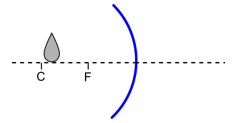
Por meio da reflexão dos raios de luz no espelho esférico apresentado, a imagem formada será
Provas
Questão presente nas seguintes provas
Leia o texto e observe a figura a seguir.
As curvas de nível (ou isoípsas) são linhas que unem os pontos do relevo que têm a mesma altitude. Traçadas num mapa, permitem a visualização tridimensional do relevo. Quanto maior a declividade (inclinação) do relevo, mais próximas as curvas de nível se apresentam no mapa; quanto menor a declividade, maior o afastamento entre elas. [...]
MOREIRA, J. C; SENE, E de. Geografia Geral e do Brasil: espaço geográfico e globalização. Ed. atualizada. São Paulo: Scipione, 2007, p. 30.
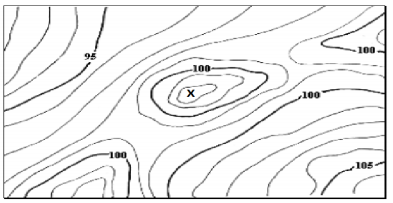 Disponível em: ww2.uefs.br/geotec/topografia/apostilas/topografia(11).html.
Acesso em: 16 nov. 2020.
Disponível em: ww2.uefs.br/geotec/topografia/apostilas/topografia(11).html.
Acesso em: 16 nov. 2020.
Considerando as informações apresentadas no texto, a leitura da figura e o fato de que os números presentes na representação topográfica são indicativos de altitude, nota-se que a área delimitada na figura com a letra X representa
As curvas de nível (ou isoípsas) são linhas que unem os pontos do relevo que têm a mesma altitude. Traçadas num mapa, permitem a visualização tridimensional do relevo. Quanto maior a declividade (inclinação) do relevo, mais próximas as curvas de nível se apresentam no mapa; quanto menor a declividade, maior o afastamento entre elas. [...]
MOREIRA, J. C; SENE, E de. Geografia Geral e do Brasil: espaço geográfico e globalização. Ed. atualizada. São Paulo: Scipione, 2007, p. 30.
Disponível em: ww2.uefs.br/geotec/topografia/apostilas/topografia(11).html.
Acesso em: 16 nov. 2020. Considerando as informações apresentadas no texto, a leitura da figura e o fato de que os números presentes na representação topográfica são indicativos de altitude, nota-se que a área delimitada na figura com a letra X representa
Provas
Questão presente nas seguintes provas
Observe a figura a seguir.
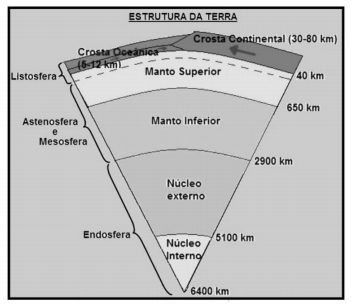
Disponível em: https://brainly.com.br/tarefa/30019680. Acesso em: 12 nov. 2020.
A Terra não é um todo homogêneo, pois é composta por camadas que se diferenciam pela espessura, temperatura, densidade e materiais que as compõem, o que constitui a estrutura geológica do planeta. Sobre essa estrutura do planeta Terra, verifica-se que
Provas
Questão presente nas seguintes provas
Cadernos
Caderno Container