Foram encontradas 60 questões.
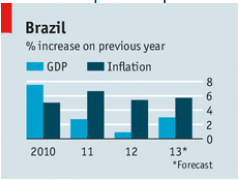
ALMOST exactly 20 years ago, in May 1993, Fernando Henrique Cardoso was named as Brazil’s 13th finance minister in as many years, a seemingly hopeless job in a country trapped in hyperinflation, debt and an anachronistic economic statism. Mr Cardoso’s Real Plan swiftly tamed inflation and took him to the presidency. There he laid the foundations for a new Brazil, of stability and liberal economic reform. This success was reinforced by his successor, Luiz Inácio Lula da Silva, a left-wing former union leader, whose government saw 30m Brazilians get out of poverty.
The trouble is that in Lula’s second term (2007-10) and especially under his chosen successor, Dilma Rousseff, the formula behind Brazil’s success has been slowly abandoned. The policy secret was simple: inflation targeting by a Central Bank operating with de facto independence; transparent public accounts; a rigorous fiscal target, which brought down the public debt; and a much more open attitude to foreign trade and private investment.
But the global recession of 2008-09 prompted Lula and Ms Rousseff to shrug at decadent liberal economics and ape Chinese state capitalism. The finance ministry wrote vast cheques to boost lending by state banks. The government gave up on market reform, and spent remorselessly. When overheating turned to stagnation (the economy grew by a paltry 0.9% last year), Ms Rousseff publicly chivvied the Central Bank to slash interest rates. When inflation neared the top of its target range (6.5%), she said she cared more about growth. She unleashed a bewildering and ever-shifting barrage of tax breaks (and tariff rises) for favoured industries but failed to balance these with spending cuts. And instead of a clear fiscal target, there are some worryingly Argentine accounting fudges (see article).
The upshot is that investors have become confused about Brazil’s economic policies. This uncertainty has contributed to a mediocre performance: since 2011 growth has been lower and inflation higher than in most Latin American countries.
Fortunately, Brazil still has some big strengths, including its farming and energy industries, more science and innovation than you might think and a huge, albeit less fizzy, domestic market. And whatever Ms Rousseff’s mistakes, they are small compared with those of, say, Argentina’s Cristina Fernández. But in any event, the going for Brazil is getting harder. A consumption and credit boom has run out of steam, the trade account has moved into deficit as Chinese demand for Brazilian iron ore slows and the imminent end of cheap money in the rich world is prompting a slide in the real. Though that will help Brazilian manufacturers, it will push up inflation.
Disponível em: <http://www.economist.com/news/leaders/21579007-
how-squander-inheritanceand-how-easily-it-could-be-restored-fall-grace?> Acesso em: 11 jun. 2013
Twenty years ago, Fernando Henrique Cardoso had a job which:
Provas

ALMOST exactly 20 years ago, in May 1993, Fernando Henrique Cardoso was named as Brazil’s 13th finance minister in as many years, a seemingly hopeless job in a country trapped in hyperinflation, debt and an anachronistic economic statism. Mr Cardoso’s Real Plan swiftly tamed inflation and took him to the presidency. There he laid the foundations for a new Brazil, of stability and liberal economic reform. This success was reinforced by his successor, Luiz Inácio Lula da Silva, a left-wing former union leader, whose government saw 30m Brazilians get out of poverty.
The trouble is that in Lula’s second term (2007-10) and especially under his chosen successor, Dilma Rousseff, the formula behind Brazil’s success has been slowly abandoned. The policy secret was simple: inflation targeting by a Central Bank operating with de facto independence; transparent public accounts; a rigorous fiscal target, which brought down the public debt; and a much more open attitude to foreign trade and private investment.
But the global recession of 2008-09 prompted Lula and Ms Rousseff to shrug at decadent liberal economics and ape Chinese state capitalism. The finance ministry wrote vast cheques to boost lending by state banks. The government gave up on market reform, and spent remorselessly. When overheating turned to stagnation (the economy grew by a paltry 0.9% last year), Ms Rousseff publicly chivvied the Central Bank to slash interest rates. When inflation neared the top of its target range (6.5%), she said she cared more about growth. She unleashed a bewildering and ever-shifting barrage of tax breaks (and tariff rises) for favoured industries but failed to balance these with spending cuts. And instead of a clear fiscal target, there are some worryingly Argentine accounting fudges (see article).
The upshot is that investors have become confused about Brazil’s economic policies. This uncertainty has contributed to a mediocre performance: since 2011 growth has been lower and inflation higher than in most Latin American countries.
Fortunately, Brazil still has some big strengths, including its farming and energy industries, more science and innovation than you might think and a huge, albeit less fizzy, domestic market. And whatever Ms Rousseff’s mistakes, they are small compared with those of, say, Argentina’s Cristina Fernández. But in any event, the going for Brazil is getting harder. A consumption and credit boom has run out of steam, the trade account has moved into deficit as Chinese demand for Brazilian iron ore slows and the imminent end of cheap money in the rich world is prompting a slide in the real. Though that will help Brazilian manufacturers, it will push up inflation.
Disponível em: <http://www.economist.com/news/leaders/21579007-
how-squander-inheritanceand-how-easily-it-could-be-restored-fall-grace?> Acesso em: 11 jun. 2013
According to the title and the figure at the beginning of the text, one can say that:
Provas
Abstract
Neuroanatomically precise, genome-wide maps of transcript distributions are critical resources to complement genomic sequence data and to correlate functional and genetic brain architecture. Here we describe the generation and analysis of a transcriptional atlas of the adult human brain, comprising extensive histological analysis and comprehensive microarray profiling of ~900 neuroanatomically precise subdivisions in two individuals. […] relationships between fine anatomical subdivisions are associated with discrete neuronal subtypes and genes involved with synaptic transmission. The neocortex displays a relatively homogeneous transcriptional pattern, but with distinct features associated selectively with primary sensorimotor cortices and with enriched frontal lobe expression. Notably, the spatial topography of the neocortex is strongly reflected in its molecular topography—the closer two cortical regions, the more similar their transcriptomes. This freely accessible online data resource forms a high-resolution transcriptional baseline for neurogenetic studies of normal and abnormal human brain function.
(Fonte:Nature 489,391–399 (20 September 2012 Disponível em http://www.nature.com/nature/journal/v489/n7416/abs/nature11405.html
As informações apresentadas pelo texto acima têm como base:
Provas
Abstract
Neuroanatomically precise, genome-wide maps of transcript distributions are critical resources to complement genomic sequence data and to correlate functional and genetic brain architecture. Here we describe the generation and analysis of a transcriptional atlas of the adult human brain, comprising extensive histological analysis and comprehensive microarray profiling of ~900 neuroanatomically precise subdivisions in two individuals. […] relationships between fine anatomical subdivisions are associated with discrete neuronal subtypes and genes involved with synaptic transmission. The neocortex displays a relatively homogeneous transcriptional pattern, but with distinct features associated selectively with primary sensorimotor cortices and with enriched frontal lobe expression. Notably, the spatial topography of the neocortex is strongly reflected in its molecular topography—the closer two cortical regions, the more similar their transcriptomes. This freely accessible online data resource forms a high-resolution transcriptional baseline for neurogenetic studies of normal and abnormal human brain function.
(Fonte:Nature 489,391–399 (20 September 2012 Disponível em http://www.nature.com/nature/journal/v489/n7416/abs/nature11405.html
Assinale a alternativa que melhor descreve o texto acima:
Provas
Homeless’ s Tour
Quem melhor para conhecer os cantinhos mais secretos de uma cidade e as histórias por trás de vários lugares, senão quem vive nas ruas? Em Londres, um grupo de voluntários treina os sem-teto a trabalharem como guias turísticos, e assim os Unseen Tours já viraram um verdadeiro sucesso. Ótimo para conhecer um lado da cidade diferente dos cartões postais e também para ajudar os menos afortunados. by Linda Ligios
THE STREETS OF LONDON
If you want to discover London there’s a whole range of walking tours on offer. But surely few can be more original than ‘Unseen Tours’, which use homeless people as guides. The tours were set up in August 2010 by an organisation called Sock Mob Events, whose Lidija Mavra (below left) explains how they work: Lidija
Unseen Tours are different because they show you off-the-beaten-track parts of the city, but also through the eyes of someone that you might not expect. That’s the main difference, really. So you get the history and the culture, like you would on any tour, but the twist is that you’re seeing all these things through the eyes of a person who maybe has a very different reality to a lot of us. So it’s not a case of pointing out where homeless people live, but it’s seeing the city as it is, but through someone else’s eyes. And the guides, they have some very interesting stories about street life and also wider social issues . They’re very good at debating and challenging people’s thinking about wider social issues that affect all of us, not just homelessness. So it’s a really interesting mix on the tour: you get the history, culture, social issues, but also a lot of fun and entertainment ‘cause the guides are very good at making people laugh and building up rapport, so it’s a very personal tour as well. We then asked her about the individual "Unseen Tours":
They’re all very different: some of them are in more maybe tourist central areas, like Covent Garden or London Bridge. So, if you want to see like some of the famous landmarks of London, but also combine that with a bit of unusual history, then I would recommend Covent Garden or London Bridge. If you want something more Bohemian, a bit more on the edge, a bit more trendy, then I would recommend horeditch and Brick Lane. And those tours also have a deep history of multiculturalism, immigration, and really show you how the city has changed over the years. And then, if you want a tour that shows you some deep contrasts between rich and poor, and how hidden poverty can be in London, then (the) Mayfair tour.
I think a lot of people are quite surprised, initially, because I think a lot of people come wanting to help the homeless, but then they don’t understand they’re going to get a very good professional tour as well. I remember one lady said to me, when we first started, “Very honestly,” she said, “I came along to sympathise and to tolerate, but actually I was blown away by how good the tour is!" And that seems to characterise a lot of people’s reactions, so, yes, very positive
Fonte: http://www.speakup.com.br/index.
php/materias/251-308-homeless-tours.html Acesso em 12 de junho de 2013.
O projeto ‘Unseen Tour’ evidencia que:
Provas
Homeless’ s Tour
Quem melhor para conhecer os cantinhos mais secretos de uma cidade e as histórias por trás de vários lugares, senão quem vive nas ruas? Em Londres, um grupo de voluntários treina os sem-teto a trabalharem como guias turísticos, e assim os Unseen Tours já viraram um verdadeiro sucesso. Ótimo para conhecer um lado da cidade diferente dos cartões postais e também para ajudar os menos afortunados. by Linda Ligios
THE STREETS OF LONDON
If you want to discover London there’s a whole range of walking tours on offer. But surely few can be more original than ‘Unseen Tours’, which use homeless people as guides. The tours were set up in August 2010 by an organisation called Sock Mob Events, whose Lidija Mavra (below left) explains how they work: Lidija
Unseen Tours are different because they show you off-the-beaten-track parts of the city, but also through the eyes of someone that you might not expect. That’s the main difference, really. So you get the history and the culture, like you would on any tour, but the twist is that you’re seeing all these things through the eyes of a person who maybe has a very different reality to a lot of us. So it’s not a case of pointing out where homeless people live, but it’s seeing the city as it is, but through someone else’s eyes. And the guides, they have some very interesting stories about street life and also wider social issues . They’re very good at debating and challenging people’s thinking about wider social issues that affect all of us, not just homelessness. So it’s a really interesting mix on the tour: you get the history, culture, social issues, but also a lot of fun and entertainment ‘cause the guides are very good at making people laugh and building up rapport, so it’s a very personal tour as well. We then asked her about the individual "Unseen Tours":
They’re all very different: some of them are in more maybe tourist central areas, like Covent Garden or London Bridge. So, if you want to see like some of the famous landmarks of London, but also combine that with a bit of unusual history, then I would recommend Covent Garden or London Bridge. If you want something more Bohemian, a bit more on the edge, a bit more trendy, then I would recommend horeditch and Brick Lane. And those tours also have a deep history of multiculturalism, immigration, and really show you how the city has changed over the years. And then, if you want a tour that shows you some deep contrasts between rich and poor, and how hidden poverty can be in London, then (the) Mayfair tour.
I think a lot of people are quite surprised, initially, because I think a lot of people come wanting to help the homeless, but then they don’t understand they’re going to get a very good professional tour as well. I remember one lady said to me, when we first started, “Very honestly,” she said, “I came along to sympathise and to tolerate, but actually I was blown away by how good the tour is!" And that seems to characterise a lot of people’s reactions, so, yes, very positive
Fonte: http://www.speakup.com.br/index.
php/materias/251-308-homeless-tours.html Acesso em 12 de junho de 2013.
As palavras ‘homelessness’, ‘poverty’, ‘deep’, e ‘initially’, incluídas no texto, são respectivamente:
Provas
Homeless’ s Tour
Quem melhor para conhecer os cantinhos mais secretos de uma cidade e as histórias por trás de vários lugares, senão quem vive nas ruas? Em Londres, um grupo de voluntários treina os sem-teto a trabalharem como guias turísticos, e assim os Unseen Tours já viraram um verdadeiro sucesso. Ótimo para conhecer um lado da cidade diferente dos cartões postais e também para ajudar os menos afortunados. by Linda Ligios
THE STREETS OF LONDON
If you want to discover London there’s a whole range of walking tours on offer. But surely few can be more original than ‘Unseen Tours’, which use homeless people as guides. The tours were set up in August 2010 by an organisation called Sock Mob Events, whose Lidija Mavra (below left) explains how they work: Lidija
Unseen Tours are different because they show you off-the-beaten-track parts of the city, but also through the eyes of someone that you might not expect. That’s the main difference, really. So you get the history and the culture, like you would on any tour, but the twist is that you’re seeing all these things through the eyes of a person who maybe has a very different reality to a lot of us. So it’s not a case of pointing out where homeless people live, but it’s seeing the city as it is, but through someone else’s eyes. And the guides, they have some very interesting stories about street life and also wider social issues . They’re very good at debating and challenging people’s thinking about wider social issues that affect all of us, not just homelessness. So it’s a really interesting mix on the tour: you get the history, culture, social issues, but also a lot of fun and entertainment ‘cause the guides are very good at making people laugh and building up rapport, so it’s a very personal tour as well. We then asked her about the individual "Unseen Tours":
They’re all very different: some of them are in more maybe tourist central areas, like Covent Garden or London Bridge. So, if you want to see like some of the famous landmarks of London, but also combine that with a bit of unusual history, then I would recommend Covent Garden or London Bridge. If you want something more Bohemian, a bit more on the edge, a bit more trendy, then I would recommend horeditch and Brick Lane. And those tours also have a deep history of multiculturalism, immigration, and really show you how the city has changed over the years. And then, if you want a tour that shows you some deep contrasts between rich and poor, and how hidden poverty can be in London, then (the) Mayfair tour.
I think a lot of people are quite surprised, initially, because I think a lot of people come wanting to help the homeless, but then they don’t understand they’re going to get a very good professional tour as well. I remember one lady said to me, when we first started, “Very honestly,” she said, “I came along to sympathise and to tolerate, but actually I was blown away by how good the tour is!" And that seems to characterise a lot of people’s reactions, so, yes, very positive
Fonte: http://www.speakup.com.br/index.
php/materias/251-308-homeless-tours.html Acesso em 12 de junho de 2013.
The verb ‘tolerate’ is similar to:
Provas
Homeless’ s Tour
Quem melhor para conhecer os cantinhos mais secretos de uma cidade e as histórias por trás de vários lugares, senão quem vive nas ruas? Em Londres, um grupo de voluntários treina os sem-teto a trabalharem como guias turísticos, e assim os Unseen Tours já viraram um verdadeiro sucesso. Ótimo para conhecer um lado da cidade diferente dos cartões postais e também para ajudar os menos afortunados. by Linda Ligios
THE STREETS OF LONDON
If you want to discover London there’s a whole range of walking tours on offer. But surely few can be more original than ‘Unseen Tours’, which use homeless people as guides. The tours were set up in August 2010 by an organisation called Sock Mob Events, whose Lidija Mavra (below left) explains how they work: Lidija
Unseen Tours are different because they show you off-the-beaten-track parts of the city, but also through the eyes of someone that you might not expect. That’s the main difference, really. So you get the history and the culture, like you would on any tour, but the twist is that you’re seeing all these things through the eyes of a person who maybe has a very different reality to a lot of us. So it’s not a case of pointing out where homeless people live, but it’s seeing the city as it is, but through someone else’s eyes. And the guides, they have some very interesting stories about street life and also wider social issues . They’re very good at debating and challenging people’s thinking about wider social issues that affect all of us, not just homelessness. So it’s a really interesting mix on the tour: you get the history, culture, social issues, but also a lot of fun and entertainment ‘cause the guides are very good at making people laugh and building up rapport, so it’s a very personal tour as well. We then asked her about the individual "Unseen Tours":
They’re all very different: some of them are in more maybe tourist central areas, like Covent Garden or London Bridge. So, if you want to see like some of the famous landmarks of London, but also combine that with a bit of unusual history, then I would recommend Covent Garden or London Bridge. If you want something more Bohemian, a bit more on the edge, a bit more trendy, then I would recommend horeditch and Brick Lane. And those tours also have a deep history of multiculturalism, immigration, and really show you how the city has changed over the years. And then, if you want a tour that shows you some deep contrasts between rich and poor, and how hidden poverty can be in London, then (the) Mayfair tour.
I think a lot of people are quite surprised, initially, because I think a lot of people come wanting to help the homeless, but then they don’t understand they’re going to get a very good professional tour as well. I remember one lady said to me, when we first started, “Very honestly,” she said, “I came along to sympathise and to tolerate, but actually I was blown away by how good the tour is!" And that seems to characterise a lot of people’s reactions, so, yes, very positive
Fonte: http://www.speakup.com.br/index.
php/materias/251-308-homeless-tours.html Acesso em 12 de junho de 2013.
The visitors consider the tours very ‘positive’ because....
Provas
Homeless’ s Tour
Quem melhor para conhecer os cantinhos mais secretos de uma cidade e as histórias por trás de vários lugares, senão quem vive nas ruas? Em Londres, um grupo de voluntários treina os sem-teto a trabalharem como guias turísticos, e assim os Unseen Tours já viraram um verdadeiro sucesso. Ótimo para conhecer um lado da cidade diferente dos cartões postais e também para ajudar os menos afortunados. by Linda Ligios
THE STREETS OF LONDON
If you want to discover London there’s a whole range of walking tours on offer. But surely few can be more original than ‘Unseen Tours’, which use homeless people as guides. The tours were set up in August 2010 by an organisation called Sock Mob Events, whose Lidija Mavra (below left) explains how they work: Lidija
Unseen Tours are different because they show you off-the-beaten-track parts of the city, but also through the eyes of someone that you might not expect. That’s the main difference, really. So you get the history and the culture, like you would on any tour, but the twist is that you’re seeing all these things through the eyes of a person who maybe has a very different reality to a lot of us. So it’s not a case of pointing out where homeless people live, but it’s seeing the city as it is, but through someone else’s eyes. And the guides, they have some very interesting stories about street life and also wider social issues . They’re very good at debating and challenging people’s thinking about wider social issues that affect all of us, not just homelessness. So it’s a really interesting mix on the tour: you get the history, culture, social issues, but also a lot of fun and entertainment ‘cause the guides are very good at making people laugh and building up rapport, so it’s a very personal tour as well. We then asked her about the individual "Unseen Tours":
They’re all very different: some of them are in more maybe tourist central areas, like Covent Garden or London Bridge. So, if you want to see like some of the famous landmarks of London, but also combine that with a bit of unusual history, then I would recommend Covent Garden or London Bridge. If you want something more Bohemian, a bit more on the edge, a bit more trendy, then I would recommend horeditch and Brick Lane. And those tours also have a deep history of multiculturalism, immigration, and really show you how the city has changed over the years. And then, if you want a tour that shows you some deep contrasts between rich and poor, and how hidden poverty can be in London, then (the) Mayfair tour.
I think a lot of people are quite surprised, initially, because I think a lot of people come wanting to help the homeless, but then they don’t understand they’re going to get a very good professional tour as well. I remember one lady said to me, when we first started, “Very honestly,” she said, “I came along to sympathise and to tolerate, but actually I was blown away by how good the tour is!" And that seems to characterise a lot of people’s reactions, so, yes, very positive
Fonte: http://www.speakup.com.br/index.
php/materias/251-308-homeless-tours.html Acesso em 12 de junho de 2013.
Qual é a grande diferença do projeto ‘The Unseen Tour’?
Provas
Homeless’ s Tour
Quem melhor para conhecer os cantinhos mais secretos de uma cidade e as histórias por trás de vários lugares, senão quem vive nas ruas? Em Londres, um grupo de voluntários treina os sem-teto a trabalharem como guias turísticos, e assim os Unseen Tours já viraram um verdadeiro sucesso. Ótimo para conhecer um lado da cidade diferente dos cartões postais e também para ajudar os menos afortunados. by Linda Ligios
THE STREETS OF LONDON
If you want to discover London there’s a whole range of walking tours on offer. But surely few can be more original than ‘Unseen Tours’, which use homeless people as guides. The tours were set up in August 2010 by an organisation called Sock Mob Events, whose Lidija Mavra (below left) explains how they work: Lidija
Unseen Tours are different because they show you off-the-beaten-track parts of the city, but also through the eyes of someone that you might not expect. That’s the main difference, really. So you get the history and the culture, like you would on any tour, but the twist is that you’re seeing all these things through the eyes of a person who maybe has a very different reality to a lot of us. So it’s not a case of pointing out where homeless people live, but it’s seeing the city as it is, but through someone else’s eyes. And the guides, they have some very interesting stories about street life and also wider social issues . They’re very good at debating and challenging people’s thinking about wider social issues that affect all of us, not just homelessness. So it’s a really interesting mix on the tour: you get the history, culture, social issues, but also a lot of fun and entertainment ‘cause the guides are very good at making people laugh and building up rapport, so it’s a very personal tour as well. We then asked her about the individual "Unseen Tours":
They’re all very different: some of them are in more maybe tourist central areas, like Covent Garden or London Bridge. So, if you want to see like some of the famous landmarks of London, but also combine that with a bit of unusual history, then I would recommend Covent Garden or London Bridge. If you want something more Bohemian, a bit more on the edge, a bit more trendy, then I would recommend horeditch and Brick Lane. And those tours also have a deep history of multiculturalism, immigration, and really show you how the city has changed over the years. And then, if you want a tour that shows you some deep contrasts between rich and poor, and how hidden poverty can be in London, then (the) Mayfair tour.
I think a lot of people are quite surprised, initially, because I think a lot of people come wanting to help the homeless, but then they don’t understand they’re going to get a very good professional tour as well. I remember one lady said to me, when we first started, “Very honestly,” she said, “I came along to sympathise and to tolerate, but actually I was blown away by how good the tour is!" And that seems to characterise a lot of people’s reactions, so, yes, very positive
Fonte: http://www.speakup.com.br/index.
php/materias/251-308-homeless-tours.html Acesso em 12 de junho de 2013.
Which is the ‘Unseen Tour’ in London?
Provas
Caderno Container