Foram encontradas 60 questões.
“[…] Translation never communicates in an untroubled fashion because the translator negociates the linguistic and cultural differences of the foreign text by reducing them and supplying another set of differences, basically domestic, drawn from the receiving language and culture to enable the foreign to be received there. The foreign text, then, is not so much communicated as inscribed with domestic intelligibilities and interests. The inscription begins at the very choice of a text for translation, always a very selective, densely motivates choice, and continues in the development of discoursive strategies to translate it, always a choice of certain domestic discourses over others. Hence, the domesticating process is totalizing, even if never total, never seamless or final. It can be said to operate in any word of the text.[…]
( VENUTTI,2000, p.468)
According to the text, the “domestication” of the foreign text is:
Provas

“[…] Translation never communicates in an untroubled fashion because the translator negociates the linguistic and cultural differences of the foreign text by reducing them and supplying another set of differences, basically domestic, drawn from the receiving language and culture to enable the foreign to be received there. The foreign text, then, is not so much communicated as inscribed with domestic intelligibilities and interests. The inscription begins at the very choice of a text for translation, always a very selective, densely motivates choice, and continues in the development of discoursive strategies to translate it, always a choice of certain domestic discourses over others. Hence, the domesticating process is totalizing, even if never total, never seamless or final. It can be said to operate in any word of the text.[…]
( VENUTTI,2000, p.468)
Provas
Leia o texto a seguir.
“Ms. Feinstein said on ABC News’s “This Week” program on Sunday that a secret court order on the phone-data program (leaked by Mr. Snowden) didn’t tell the full story. Another court document explained the strictures on the program, but that wasn’t leaked, she said,
sounding almost regretful that it remains under seal. Ms. Feinstein doesn’t have the authority to release it herself, but she could at least demand that the administration make it public.”
“ Why is data from every phone call collected, and not just those made by people whom the government suspects of terrorist activity?” According to the sentence, one can say that : the suspects of terrorist activities:
Provas
Leia o texto a seguir.
“Ms. Feinstein said on ABC News’s “This Week” program on Sunday that a secret court order on the phone-data program (leaked by Mr. Snowden) didn’t tell the full story. Another court document explained the strictures on the program, but that wasn’t leaked, she said,
sounding almost regretful that it remains under seal. Ms. Feinstein doesn’t have the authority to release it herself, but she could at least demand that the administration make it public.”
his newfound interest in openness is a little hard to take seriously, not only because of the hypocrisy involved but because neither official seems to want to do more than talk about being open. According to this passage, the lack of credibility this kind of interest is due to
Provas
TEXT 3: A Real Debate on Surveillance - NYTimes.com A Real Debate on Surveillance
By THE EDITORIAL BOARD
For years, as the federal surveillance state grew into every corner of American society, the highest officials worked to pretend that it didn’t exist. Now that Americans are learning what really takes place behind locked doors, many officials claim they are eager to talk about it.
“That’s a conversation that I welcome having,” President Obama said on Saturday. Senator Dianne Feinstein, chairwoman of the Intelligence Committee, said on Sunday that she was open to holding a public hearing on the subject now, a hearing next month, a hearing every month.
This newfound interest in openness is a little hard to take seriously, not only because of the hypocrisy involved but because neither official seems to want to do more than talk about being open. If the president wants to have a meaningful discussion, he can order his intelligence directors to explain to the public precisely how the National Security Agency’s widespread collection of domestic telephone data works. Since there’s not much point in camouflaging the program anymore, it’s time for the public to get answers to some basic questions.
Are the calls and texts of ordinary Americans mined for patterns that might put innocent people under suspicion? Why is data from every phone call collected, and not just those made by people whom the government suspects of terrorist activity? How long is the data kept, and can it be used for routine police investigations? Why was a private contractor like
Edward Snowden allowed to have access to it? So far, no one at the White House seems interested in a substantive public debate.
Ms. Feinstein said on ABC News’s “This Week” program on Sunday that a secret court order on the phone-data program (leaked by Mr. Snowden) didn’t tell the full story. Another court document explained the strictures on the program, but that wasn’t leaked, she said, sounding almost regretful that it remains under seal. Ms. Feinstein doesn’t have the authority to release it herself, but she could at least demand that the administration make it public.
While they’re at it, some of the opinions of the Foreign Intelligence Surveillance Court that made these data-collection programs possible could be released. Ms. Feinstein was rebuffed when she asked the court for redacted summaries of its opinions; as chairwoman, she should use her power to demand that the administration find ways to make the court even slightly more transparent.”
Disponível em: <www.nytimes.com/2013/06/11/opinion/a-real-debate-on surveillance.html> Acesso em: 10 jun. 2013
The word “hypocrisy” ( second paragraph) refers to:
Provas
TEXT 3: A Real Debate on Surveillance - NYTimes.com A Real Debate on Surveillance
By THE EDITORIAL BOARD
For years, as the federal surveillance state grew into every corner of American society, the highest officials worked to pretend that it didn’t exist. Now that Americans are learning what really takes place behind locked doors, many officials claim they are eager to talk about it.
“That’s a conversation that I welcome having,” President Obama said on Saturday. Senator Dianne Feinstein, chairwoman of the Intelligence Committee, said on Sunday that she was open to holding a public hearing on the subject now, a hearing next month, a hearing every month.
This newfound interest in openness is a little hard to take seriously, not only because of the hypocrisy involved but because neither official seems to want to do more than talk about being open. If the president wants to have a meaningful discussion, he can order his intelligence directors to explain to the public precisely how the National Security Agency’s widespread collection of domestic telephone data works. Since there’s not much point in camouflaging the program anymore, it’s time for the public to get answers to some basic questions.
Are the calls and texts of ordinary Americans mined for patterns that might put innocent people under suspicion? Why is data from every phone call collected, and not just those made by people whom the government suspects of terrorist activity? How long is the data kept, and can it be used for routine police investigations? Why was a private contractor like
Edward Snowden allowed to have access to it? So far, no one at the White House seems interested in a substantive public debate.
Ms. Feinstein said on ABC News’s “This Week” program on Sunday that a secret court order on the phone-data program (leaked by Mr. Snowden) didn’t tell the full story. Another court document explained the strictures on the program, but that wasn’t leaked, she said, sounding almost regretful that it remains under seal. Ms. Feinstein doesn’t have the authority to release it herself, but she could at least demand that the administration make it public.
While they’re at it, some of the opinions of the Foreign Intelligence Surveillance Court that made these data-collection programs possible could be released. Ms. Feinstein was rebuffed when she asked the court for redacted summaries of its opinions; as chairwoman, she should use her power to demand that the administration find ways to make the court even slightly more transparent.”
Disponível em: <www.nytimes.com/2013/06/11/opinion/a-real-debate-on surveillance.html> Acesso em: 10 jun. 2013
According to the text one can say that Americans are becoming aware of:
Provas
ALMOST exactly 20 years ago, in May 1993, Fernando Henrique Cardoso was named as Brazil’s 13th finance minister in as many years, a seemingly hopeless job in a country trapped in hyperinflation, debt and an anachronistic economic statism. Mr Cardoso’s Real Plan swiftly tamed inflation and took him to the presidency. There he laid the foundations for a new Brazil, of stability and liberal economic reform. This success was reinforced by his successor, Luiz Inácio Lula da Silva, a left-wing former union leader, whose government saw 30m Brazilians get out of poverty.
The trouble is that in Lula’s second term (2007-10) and especially under his chosen successor, Dilma Rousseff, the formula behind Brazil’s success has been slowly abandoned. The policy secret was simple: inflation targeting by a Central Bank operating with de facto independence; transparent public accounts; a rigorous fiscal target, which brought down the public debt; and a much more open attitude to foreign trade and private investment.
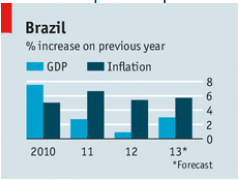
But the global recession of 2008-09 prompted Lula and Ms Rousseff to shrug at decadent liberal economics and ape Chinese state capitalism. The finance ministry wrote vast cheques to boost lending by state banks. The government gave up on market reform, and spent remorselessly. When overheating turned to stagnation (the economy grew by a paltry 0.9% last year), Ms Rousseff publicly chivvied the Central Bank to slash interest rates. When inflation neared the top of its target range (6.5%), she said she cared more about growth. She unleashed a bewildering and ever-shifting barrage of tax breaks (and tariff rises) for favoured industries but failed to balance these with spending cuts. And instead of a clear fiscal target, there are some worryingly Argentine accounting fudges (see article).
The upshot is that investors have become confused about Brazil’s economic policies. This uncertainty has contributed to a mediocre performance: since 2011 growth has been lower and inflation higher than in most Latin American countries.
Fortunately, Brazil still has some big strengths, including its farming and energy industries, more science and innovation than you might think and a huge, albeit less fizzy, domestic market. And whatever Ms Rousseff’s mistakes, they are small compared with those of, say, Argentina’s Cristina Fernández. But in any event, the going for Brazil is getting harder. A consumption and credit boom has run out of steam, the trade account has moved into deficit as Chinese demand for Brazilian iron ore slows and the imminent end of cheap money in the rich world is prompting a slide in the real. Though that will help Brazilian manufacturers, it will push up inflation.
Disponível em: <http://www.economist.com/news/leaders/21579007-
how-squander-inheritanceand-how-easily-it-could-be-restored-fall-grace?> Acesso em: 11 jun. 2013
Some of the qualities that can help Brazilian economy to get better are:
Provas
ALMOST exactly 20 years ago, in May 1993, Fernando Henrique Cardoso was named as Brazil’s 13th finance minister in as many years, a seemingly hopeless job in a country trapped in hyperinflation, debt and an anachronistic economic statism. Mr Cardoso’s Real Plan swiftly tamed inflation and took him to the presidency. There he laid the foundations for a new Brazil, of stability and liberal economic reform. This success was reinforced by his successor, Luiz Inácio Lula da Silva, a left-wing former union leader, whose government saw 30m Brazilians get out of poverty.
The trouble is that in Lula’s second term (2007-10) and especially under his chosen successor, Dilma Rousseff, the formula behind Brazil’s success has been slowly abandoned. The policy secret was simple: inflation targeting by a Central Bank operating with de facto independence; transparent public accounts; a rigorous fiscal target, which brought down the public debt; and a much more open attitude to foreign trade and private investment.
But the global recession of 2008-09 prompted Lula and Ms Rousseff to shrug at decadent liberal economics and ape Chinese state capitalism. The finance ministry wrote vast cheques to boost lending by state banks. The government gave up on market reform, and spent remorselessly. When overheating turned to stagnation (the economy grew by a paltry 0.9% last year), Ms Rousseff publicly chivvied the Central Bank to slash interest rates. When inflation neared the top of its target range (6.5%), she said she cared more about growth. She unleashed a bewildering and ever-shifting barrage of tax breaks (and tariff rises) for favoured industries but failed to balance these with spending cuts. And instead of a clear fiscal target, there are some worryingly Argentine accounting fudges (see article).
The upshot is that investors have become confused about Brazil’s economic policies. This uncertainty has contributed to a mediocre performance: since 2011 growth has been lower and inflation higher than in most Latin American countries.
Fortunately, Brazil still has some big strengths, including its farming and energy industries, more science and innovation than you might think and a huge, albeit less fizzy, domestic market. And whatever Ms Rousseff’s mistakes, they are small compared with those of, say, Argentina’s Cristina Fernández. But in any event, the going for Brazil is getting harder. A consumption and credit boom has run out of steam, the trade account has moved into deficit as Chinese demand for Brazilian iron ore slows and the imminent end of cheap money in the rich world is prompting a slide in the real. Though that will help Brazilian manufacturers, it will push up inflation.
Disponível em: <http://www.economist.com/news/leaders/21579007-
how-squander-inheritanceand-how-easily-it-could-be-restored-fall-grace?> Acesso em: 11 jun. 2013
Mark the option that correctly substitutes the underlined words in the sentence: “But the global recession of 2008-09 prompted Lula and Ms Rousseff to shrug at decadent liberal economics and ape Chinese state capitalism.”
Provas
ALMOST exactly 20 years ago, in May 1993, Fernando Henrique Cardoso was named as Brazil’s 13th finance minister in as many years, a seemingly hopeless job in a country trapped in hyperinflation, debt and an anachronistic economic statism. Mr Cardoso’s Real Plan swiftly tamed inflation and took him to the presidency. There he laid the foundations for a new Brazil, of stability and liberal economic reform. This success was reinforced by his successor, Luiz Inácio Lula da Silva, a left-wing former union leader, whose government saw 30m Brazilians get out of poverty.
The trouble is that in Lula’s second term (2007-10) and especially under his chosen successor, Dilma Rousseff, the formula behind Brazil’s success has been slowly abandoned. The policy secret was simple: inflation targeting by a Central Bank operating with de facto independence; transparent public accounts; a rigorous fiscal target, which brought down the public debt; and a much more open attitude to foreign trade and private investment.
But the global recession of 2008-09 prompted Lula and Ms Rousseff to shrug at decadent liberal economics and ape Chinese state capitalism. The finance ministry wrote vast cheques to boost lending by state banks. The government gave up on market reform, and spent remorselessly. When overheating turned to stagnation (the economy grew by a paltry 0.9% last year), Ms Rousseff publicly chivvied the Central Bank to slash interest rates. When inflation neared the top of its target range (6.5%), she said she cared more about growth. She unleashed a bewildering and ever-shifting barrage of tax breaks (and tariff rises) for favoured industries but failed to balance these with spending cuts. And instead of a clear fiscal target, there are some worryingly Argentine accounting fudges (see article).
The upshot is that investors have become confused about Brazil’s economic policies. This uncertainty has contributed to a mediocre performance: since 2011 growth has been lower and inflation higher than in most Latin American countries.
Fortunately, Brazil still has some big strengths, including its farming and energy industries, more science and innovation than you might think and a huge, albeit less fizzy, domestic market. And whatever Ms Rousseff’s mistakes, they are small compared with those of, say, Argentina’s Cristina Fernández. But in any event, the going for Brazil is getting harder. A consumption and credit boom has run out of steam, the trade account has moved into deficit as Chinese demand for Brazilian iron ore slows and the imminent end of cheap money in the rich world is prompting a slide in the real. Though that will help Brazilian manufacturers, it will push up inflation.
Disponível em: <http://www.economist.com/news/leaders/21579007-
how-squander-inheritanceand-how-easily-it-could-be-restored-fall-grace?> Acesso em: 11 jun. 2013
Mark the option that correctly substitutes the underlined words “ Mr Cardoso’s Real Plan swiftly tamed inflation and took him to the presidency.”
Provas
ALMOST exactly 20 years ago, in May 1993, Fernando Henrique Cardoso was named as Brazil’s 13th finance minister in as many years, a seemingly hopeless job in a country trapped in hyperinflation, debt and an anachronistic economic statism. Mr Cardoso’s Real Plan swiftly tamed inflation and took him to the presidency. There he laid the foundations for a new Brazil, of stability and liberal economic reform. This success was reinforced by his successor, Luiz Inácio Lula da Silva, a left-wing former union leader, whose government saw 30m Brazilians get out of poverty.
The trouble is that in Lula’s second term (2007-10) and especially under his chosen successor, Dilma Rousseff, the formula behind Brazil’s success has been slowly abandoned. The policy secret was simple: inflation targeting by a Central Bank operating with de facto independence; transparent public accounts; a rigorous fiscal target, which brought down the public debt; and a much more open attitude to foreign trade and private investment.
But the global recession of 2008-09 prompted Lula and Ms Rousseff to shrug at decadent liberal economics and ape Chinese state capitalism. The finance ministry wrote vast cheques to boost lending by state banks. The government gave up on market reform, and spent remorselessly. When overheating turned to stagnation (the economy grew by a paltry 0.9% last year), Ms Rousseff publicly chivvied the Central Bank to slash interest rates. When inflation neared the top of its target range (6.5%), she said she cared more about growth. She unleashed a bewildering and ever-shifting barrage of tax breaks (and tariff rises) for favoured industries but failed to balance these with spending cuts. And instead of a clear fiscal target, there are some worryingly Argentine accounting fudges (see article).
The upshot is that investors have become confused about Brazil’s economic policies. This uncertainty has contributed to a mediocre performance: since 2011 growth has been lower and inflation higher than in most Latin American countries.
Fortunately, Brazil still has some big strengths, including its farming and energy industries, more science and innovation than you might think and a huge, albeit less fizzy, domestic market. And whatever Ms Rousseff’s mistakes, they are small compared with those of, say, Argentina’s Cristina Fernández. But in any event, the going for Brazil is getting harder. A consumption and credit boom has run out of steam, the trade account has moved into deficit as Chinese demand for Brazilian iron ore slows and the imminent end of cheap money in the rich world is prompting a slide in the real. Though that will help Brazilian manufacturers, it will push up inflation.
Disponível em: <http://www.economist.com/news/leaders/21579007-
how-squander-inheritanceand-how-easily-it-could-be-restored-fall-grace?> Acesso em: 11 jun. 2013
The hyperinflation and, debt and anachronistic economic statism refer to:
Provas
Caderno Container