Foram encontradas 40 questões.
For question below, listen to the radio interview “60-Second Ideas to Improve the World” and answer accordingly.
What is the main point in Ms Beard’s remark, “We’re not stupid; we’re smart.”?
Provas
Questão presente nas seguintes provas

Read the text and answer the question.
Who is a native speaker of English?
Jack Scholes
In 2006 the British Council published English Next – Why global English may mean the end of ‘English’ as a Foreign Language’ by David Graddol. This booklet is free of charge from the British Council and can also be read and downloaded for free from the British Council website – www.britishcouncil.org.br/elt.
Graddol’s research shows that “Global English has led to a crisis of terminology. The distinctions betwee ‘native speaker’, ‘second-language speaker’, and ‘foreign-language user’ have become blurred. One of the most familiar ways of representing the global community of English speakers is in terms of three circles. (figure 1)
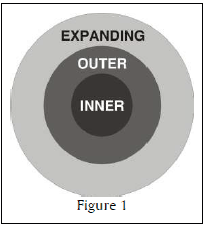
The ‘inner’ circle represents the native speakers; the ‘outer circle’ consists of second-language speakers in countries like India. The ‘expanding circle’ was the ever-increasing number of people learning English as a foreign language. The three circles were first described in this way by the sociolinguist Braj Kachru in 1985. By 1997, such a model was already failing to capture the increasing importance of the outer circle, and the degree to which ‘foreign language’ learners in some countries – especially Europe – were becoming more like second language users.
In a globalized world, the traditional definition of ‘second-language user’ (as one who uses the language for communication within his own country) no longer makes sense. Also, there is an increasing need to distinguish between proficiencies in English, rather than a speaker’s bilingual status. Kachru himself has recently proposed (figure 2) that the ‘inner circle’ is now better conceived of as the group of highly proficient 0speakers of English – those who have ‘functional nativenesss’ regardless of how they learned or use the language.
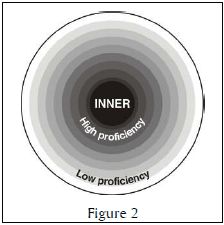
I particularly like the term ‘functional nativenesss’, and this is how I would like to describe my level of proficiency in Portuguese. I also believe that this should be the realistic aim of anyone learning any foreign language.
But why is it so difficult to achieve this ‘functional nativeness’? There are, of course, many reasons but undoubtedly, one of the biggest challenges of becoming a fluent, native-like speaker of another language is having an in-depth knowledge of common, everyday words and phrases and an ability to understand them and use them correctly and appropriately, especially the ones that reflect deeply rooted socio-cultural aspects of the language and which are often difficult or impossible to translate.
So, when we are asked, “What’s the English word for rodízio”, or “How do you say quebrar o galho in English, the simple answer is, “There is no word in English for rodízio and there is no direct translation for quebrar o galho. Our aim as English teachers should be to enable learners to communicate effectively, achieve native-like fluency more quickly and also learn to appreciate the fascinating richness of another language and culture.
(Adapted from New Routes, Sept. 2008)
The text you have read can be described as
Provas
Questão presente nas seguintes provas
The text below belongs to one of UFPel’s international partner universities. For question, choose the alternative that best corresponds to a possible Portuguese version of the underlined passage, respecting textual elements such as tone and register.
Vision and Mission Statements
The vision of Mississippi State University is to be the most respected land-grant institution in the region.
The mission of Mississippi State University is to educate the workforce and leaders of the future, produce robust research for our state and nation, and provide expert services to our citizens, communities and businesses.
Enhancing its historic strengths in agriculture, natural resources, science, and engineering, Mississippi State entered the twenty-first century with additional strengths in a comprehensive range of graduate and undergraduate programs. These include architecture, the arts, business, education, the humanities, the social and behavioral sciences, and veterinary medicine. The Meridian Campus focuses on meeting the needs of place-bound students and working adults through upper division and graduate programs in education, business, liberal arts, and social work.
The university's educational programs emphasize the exploration of ideas and the discovery, application, and dissemination of knowledge. The university embraces its role as a major contributor to the economic development of the state through targeted research and the transfer of ideas to the marketplace, aided by faculty-industry relationships and by interdisciplinary initiatives. Building on its land-grant tradition, MSU extends its resources and expertise throughout the entire state for the benefit of Mississippi's citizens. Through integration of its programs in learning, research, and service, through traditional scholarship, through statewide extension and outreach, and through engagement with business, industry, government, communities and organizations, the university is committed to maintaining its tradition as the People's University.
Access and Excellence
Mississippi State University will provide access and opportunity to students from all sectors of the state's diverse population. The university promotes citizenship and leadership in its students and fosters in them an understanding of their history and culture, an appreciation of the arts, a tolerance for opposing points of view, a facility with written and spoken language, an understanding of scientific principles and methods, a command of modern technologies, a competence in critical thinking and problem solving, a commitment to life-long learning, and a spirit of inquiry. MSU will provide mentoring and support to the students admitted to maximize their chances of success and to help Mississippi reach and surpass the national average in the percentage of our population that holds a college degree, and will provide access for working and place-bound adult learners, particularly through its Meridian Campus and distance learning programs. The university will develop competent and informed citizens and professionals who are equipped to lead in the world of work and in their communities through traditional academic programs, experiential learning, and opportunities for leadership development and community service.
Statewide Mission
Mississippi State University will serve the State of Mississippi and beyond through its broad range of instruction, research, and outreach functions. The university maintains four strategically located research and extension centers around the state and has staff in every county of Mississippi. The institution regularly enrolls students from each of the state's eighty-two counties and is actively engaged with business and industry, agriculture and natural resources, schools, communities and organizations in every part of the state.
(Adapted from http://www.msstate.edu/web/mission.html)
“The institution regularly enrolls students from each of the state's eighty-two counties and is actively engaged with business and industry, agriculture and natural resources, schools, communities and organizations in every part of the state.”
Provas
Questão presente nas seguintes provas
The following text is found at the UFPel website and will serve as basis the question. Choose the alternative that best corresponds to a possible English version of the underlined passage, respecting textual elements such as tone and register.
Perfil do Corpo Docente
Embora não devendo constituir-se no componente mais importante do processo, o professor acaba indiretamente por sê-lo, tendo em vista as condições de poder com que se reveste em sala de aula, em relação com os alunos. Desta forma, não se concebe como factível a mudança do paradigma educacional, se não acompanhada previamente da predisposição do docente neste sentido. Para que o professor efetivamente seja incorporado a essa nova concepção e possa trabalhar dentro de uma nova realidade educacional, mormente de acordo com uma pedagogia interativa e moderna, entendem-se como necessários os seguintes pressupostos principais, desde os mais gerais aos mais particularizados.
(Adapted from http://www.ufpel.edu.br)
“...entendem-se como necessários os seguintes pressupostos principais, desde os mais gerais aos mais particularizados:”
Provas
Questão presente nas seguintes provas
The following text is found at the UFPel website and will serve as basis the question. Choose the alternative that best corresponds to a possible English version of the underlined passage, respecting textual elements such as tone and register.
Perfil do Corpo Docente
Embora não devendo constituir-se no componente mais importante do processo, o professor acaba indiretamente por sê-lo, tendo em vista as condições de poder com que se reveste em sala de aula, em relação com os alunos. Desta forma, não se concebe como factível a mudança do paradigma educacional, se não acompanhada previamente da predisposição do docente neste sentido. Para que o professor efetivamente seja incorporado a essa nova concepção e possa trabalhar dentro de uma nova realidade educacional, mormente de acordo com uma pedagogia interativa e moderna, entendem-se como necessários os seguintes pressupostos principais, desde os mais gerais aos mais particularizados.
(Adapted from http://www.ufpel.edu.br)
“Embora não devendo constituir-se no componente mais importante do processo,...”
Provas
Questão presente nas seguintes provas
Read the text and answer the question.
Who is a native speaker of English?
Jack Scholes
In 2006 the British Council published English Next – Why global English may mean the end of ‘English’ as a Foreign Language’ by David Graddol. This booklet is free of charge from the British Council and can also be read and downloaded for free from the British Council website – www.britishcouncil.org.br/elt.
Graddol’s research shows that “Global English has led to a crisis of terminology. The distinctions betwee ‘native speaker’, ‘second-language speaker’, and ‘foreign-language user’ have become blurred. One of the most familiar ways of representing the global community of English speakers is in terms of three circles. (figure 1)
The ‘inner’ circle represents the native speakers; the ‘outer circle’ consists of second-language speakers in countries like India. The ‘expanding circle’ was the ever-increasing number of people learning English as a foreign language. The three circles were first described in this way by the sociolinguist Braj Kachru in 1985. By 1997, such a model was already failing to capture the increasing importance of the outer circle, and the degree to which ‘foreign language’ learners in some countries – especially Europe – were becoming more like second language users.
In a globalized world, the traditional definition of ‘second-language user’ (as one who uses the language for communication within his own country) no longer makes sense. Also, there is an increasing need to distinguish between proficiencies in English, rather than a speaker’s bilingual status. Kachru himself has recently proposed (figure 2) that the ‘inner circle’ is now better conceived of as the group of highly proficient 0speakers of English – those who have ‘functional nativenesss’ regardless of how they learned or use the language.
I particularly like the term ‘functional nativenesss’, and this is how I would like to describe my level of proficiency in Portuguese. I also believe that this should be the realistic aim of anyone learning any foreign language.
But why is it so difficult to achieve this ‘functional nativeness’? There are, of course, many reasons but undoubtedly, one of the biggest challenges of becoming a fluent, native-like speaker of another language is having an in-depth knowledge of common, everyday words and phrases and an ability to understand them and use them correctly and appropriately, especially the ones that reflect deeply rooted socio-cultural aspects of the language and which are often difficult or impossible to translate.
So, when we are asked, “What’s the English word for rodízio”, or “How do you say quebrar o galho in English, the simple answer is, “There is no word in English for rodízio and there is no direct translation for quebrar o galho. Our aim as English teachers should be to enable learners to communicate effectively, achieve native-like fluency more quickly and also learn to appreciate the fascinating richness of another language and culture.
(Adapted from New Routes, Sept. 2008)
Looking at the two circles, it is correct to say that
Provas
Questão presente nas seguintes provas
The text below belongs to one of UFPel’s international partner universities. For question, choose the alternative that best corresponds to a possible Portuguese version of the underlined passage, respecting textual elements such as tone and register.
Vision and Mission Statements
The vision of Mississippi State University is to be the most respected land-grant institution in the region.
The mission of Mississippi State University is to educate the workforce and leaders of the future, produce robust research for our state and nation, and provide expert services to our citizens, communities and businesses.
Enhancing its historic strengths in agriculture, natural resources, science, and engineering, Mississippi State entered the twenty-first century with additional strengths in a comprehensive range of graduate and undergraduate programs. These include architecture, the arts, business, education, the humanities, the social and behavioral sciences, and veterinary medicine. The Meridian Campus focuses on meeting the needs of place-bound students and working adults through upper division and graduate programs in education, business, liberal arts, and social work.
The university's educational programs emphasize the exploration of ideas and the discovery, application, and dissemination of knowledge. The university embraces its role as a major contributor to the economic development of the state through targeted research and the transfer of ideas to the marketplace, aided by faculty-industry relationships and by interdisciplinary initiatives. Building on its land-grant tradition, MSU extends its resources and expertise throughout the entire state for the benefit of Mississippi's citizens. Through integration of its programs in learning, research, and service, through traditional scholarship, through statewide extension and outreach, and through engagement with business, industry, government, communities and organizations, the university is committed to maintaining its tradition as the People's University.
Access and Excellence
Mississippi State University will provide access and opportunity to students from all sectors of the state's diverse population. The university promotes citizenship and leadership in its students and fosters in them an understanding of their history and culture, an appreciation of the arts, a tolerance for opposing points of view, a facility with written and spoken language, an understanding of scientific principles and methods, a command of modern technologies, a competence in critical thinking and problem solving, a commitment to life-long learning, and a spirit of inquiry. MSU will provide mentoring and support to the students admitted to maximize their chances of success and to help Mississippi reach and surpass the national average in the percentage of our population that holds a college degree, and will provide access for working and place-bound adult learners, particularly through its Meridian Campus and distance learning programs. The university will develop competent and informed citizens and professionals who are equipped to lead in the world of work and in their communities through traditional academic programs, experiential learning, and opportunities for leadership development and community service.
Statewide Mission
Mississippi State University will serve the State of Mississippi and beyond through its broad range of instruction, research, and outreach functions. The university maintains four strategically located research and extension centers around the state and has staff in every county of Mississippi. The institution regularly enrolls students from each of the state's eighty-two counties and is actively engaged with business and industry, agriculture and natural resources, schools, communities and organizations in every part of the state.
(Adapted from http://www.msstate.edu/web/mission.html)
“… Mississippi State entered the twentyfirst century with additional strengths in a comprehensive range of graduate and undergraduate programs.”
Provas
Questão presente nas seguintes provas
Read the text and answer the question.
Who is a native speaker of English?
Jack Scholes
In 2006 the British Council published English Next – Why global English may mean the end of ‘English’ as a Foreign Language’ by David Graddol. This booklet is free of charge from the British Council and can also be read and downloaded for free from the British Council website – www.britishcouncil.org.br/elt.
Graddol’s research shows that “Global English has led to a crisis of terminology. The distinctions betwee ‘native speaker’, ‘second-language speaker’, and ‘foreign-language user’ have become blurred. One of the most familiar ways of representing the global community of English speakers is in terms of three circles. (figure 1)
The ‘inner’ circle represents the native speakers; the ‘outer circle’ consists of second-language speakers in countries like India. The ‘expanding circle’ was the ever-increasing number of people learning English as a foreign language. The three circles were first described in this way by the sociolinguist Braj Kachru in 1985. By 1997, such a model was already failing to capture the increasing importance of the outer circle, and the degree to which ‘foreign language’ learners in some countries – especially Europe – were becoming more like second language users.
In a globalized world, the traditional definition of ‘second-language user’ (as one who uses the language for communication within his own country) no longer makes sense. Also, there is an increasing need to distinguish between proficiencies in English, rather than a speaker’s bilingual status. Kachru himself has recently proposed (figure 2) that the ‘inner circle’ is now better conceived of as the group of highly proficient 0speakers of English – those who have ‘functional nativenesss’ regardless of how they learned or use the language.
I particularly like the term ‘functional nativenesss’, and this is how I would like to describe my level of proficiency in Portuguese. I also believe that this should be the realistic aim of anyone learning any foreign language.
But why is it so difficult to achieve this ‘functional nativeness’? There are, of course, many reasons but undoubtedly, one of the biggest challenges of becoming a fluent, native-like speaker of another language is having an in-depth knowledge of common, everyday words and phrases and an ability to understand them and use them correctly and appropriately, especially the ones that reflect deeply rooted socio-cultural aspects of the language and which are often difficult or impossible to translate.
So, when we are asked, “What’s the English word for rodízio”, or “How do you say quebrar o galho in English, the simple answer is, “There is no word in English for rodízio and there is no direct translation for quebrar o galho. Our aim as English teachers should be to enable learners to communicate effectively, achieve native-like fluency more quickly and also learn to appreciate the fascinating richness of another language and culture.
(Adapted from New Routes, Sept. 2008)
“Our aim as English teachers should be to enable learners to communicate effectively, achieve native-like fluency more quickly and also learn to appreciate the fascinating richness of another language and culture.” The meaning of this paragraph would not change if it the author had written it differently. Which of the alternative below best maintain the original meaning of the passage above?
Provas
Questão presente nas seguintes provas
The following text is found at the UFPel website and will serve as basis the question. Choose the alternative that best corresponds to a possible English version of the underlined passage, respecting textual elements such as tone and register.
Perfil do Corpo Docente
Embora não devendo constituir-se no componente mais importante do processo, o professor acaba indiretamente por sê-lo, tendo em vista as condições de poder com que se reveste em sala de aula, em relação com os alunos. Desta forma, não se concebe como factível a mudança do paradigma educacional, se não acompanhada previamente da predisposição do docente neste sentido. Para que o professor efetivamente seja incorporado a essa nova concepção e possa trabalhar dentro de uma nova realidade educacional, mormente de acordo com uma pedagogia interativa e moderna, entendem-se como necessários os seguintes pressupostos principais, desde os mais gerais aos mais particularizados.
(Adapted from http://www.ufpel.edu.br)
“Desta forma, não se concebe como factível a mudança do paradigma educacional, se não acompanhada previamente da predisposição do docente neste sentido.”
Provas
Questão presente nas seguintes provas
For question below, listen to the radio interview “60-Second Ideas to Improve the World” and answer accordingly.
According to Ms Beard, what is one good reason why prisons should be shut down?
Provas
Questão presente nas seguintes provas
Cadernos
Caderno Container