Foram encontradas 40 questões.
Para responder a questão, leia o texto a seguir.
Body acoustics can turn your arm into a touchscreen
By Paul Marks | March, 2010
Finding the keypad on your cellphone or music player a bit cramped? Maybe your forearm could be more accommodating. It could become part of a skin-based interface that effectively turns your body into a touchscreen.
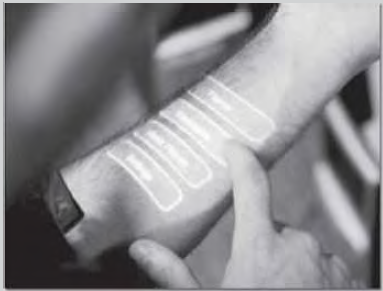
Bodily interface (Image: ACM)
Called Skinput, the system is a marriage of two technologies: the ability to detect the ultralow-frequency sound produced by tapping the skin with a finger, and the microchip-sized "pico" projectors now found in some cellphones.
The system beams a keyboard or menu onto the user's forearm and hand from a projector housed in an armband. An acoustic detector, also in the armband, then calculates which part of the display you want to activate.
But how does the system know which icon, button or finger you tapped? Chris Harrison at Carnegie Mellon University in Pittsburgh, Pennsylvania, working with Dan Morris and Desney Tan at Microsoft's research lab in Redmond, Washington, exploit the way our skin, musculature and skeleton combine to make distinctive sounds when we tap on different parts of the arm, palm, fingers and thumb.
Bone machine
They have identified various locations on the forearm and hand that produce characteristic acoustic patterns when tapped. The acoustic detector in the armband contains five piezoelectric cantilevers, each weighted to respond to certain bands of sound frequencies. Different combinations of the sensors are activated to differing degrees depending on where the arm is tapped.
Twenty volunteers tested the system and most found it easy to navigate through icons on the forearm and tap fingers to actuate commands.
“Skinput works very well for a series of gestures, even when the body is in motion, “the researchers say, with subjects able to deftly scroll through menus whether they moved up and down or flicked across their arm.
The system could use wireless technology like Bluetooth to transmit commands to many types of device – including phones, iPods and even PCs. The researchers will present their work in April at the ACM Computer- Human Interaction meeting in Atlanta, Georgia.
Body control
Pranav Mistry of the Media Lab at the Massachusetts Institute of Technology warns that users will have to position the armband very precisely so the projection always appears in the right place.
Nevertheless, Skinput looks a promising idea, says Michael Liebschner, director of the Bio-Innovations Lab at Baylor College of Medicine in Houston, Texas, who has worked on bone acoustic conduction technology for gadget-to-gadget transmission.
“This sounds a very feasible approach to using the body itself as an input device," he says. "When you are immersed in a virtual game using a head-mounted 3D display, you cannot just take it off to fiddle around with control buttons. This will make things much easier.”
Fonte: http://www newscientist.com
No segmento “This sounds a very feasible approach to using the body itself as an input device”, o termo “sounds” funciona como verbo e significa “parecer, aparentar”, assim comoem
Provas

É comum encontrar equipamentos de áudio que têm saídas e entradas ora projetadas com valor nominal de +4[dBu] (Equipamento A), ora projetadas com valor nominal de -10[dBV] (Equipamento B). A tensão nominal de saída para o equipamento A é de 1,23 [V]. A tensão nominal de saída para o equipamento B é de 0,316 [V]. Se um operador conecta a saída do Equipamento A na entrada do Equipamento B, qual das alternativas a seguir corresponde ao que acontecerá à entrada do equipamento B.
Provas
Em um painel de conectores(patchbay), há uma regra geral para entradas(in) e saídas(out). Baseando-se nessa afirmação, assinale a alternativa correta.
Provas
Para responder a questão, leia o texto a seguir.
Body acoustics can turn your arm into a touchscreen
By Paul Marks | March, 2010
Finding the keypad on your cellphone or music player a bit cramped? Maybe your forearm could be more accommodating. It could become part of a skin-based interface that effectively turns your body into a touchscreen.
Bodily interface (Image: ACM)
Called Skinput, the system is a marriage of two technologies: the ability to detect the ultralow-frequency sound produced by tapping the skin with a finger, and the microchip-sized "pico" projectors now found in some cellphones.
The system beams a keyboard or menu onto the user's forearm and hand from a projector housed in an armband. An acoustic detector, also in the armband, then calculates which part of the display you want to activate.
But how does the system know which icon, button or finger you tapped? Chris Harrison at Carnegie Mellon University in Pittsburgh, Pennsylvania, working with Dan Morris and Desney Tan at Microsoft's research lab in Redmond, Washington, exploit the way our skin, musculature and skeleton combine to make distinctive sounds when we tap on different parts of the arm, palm, fingers and thumb.
Bone machine
They have identified various locations on the forearm and hand that produce characteristic acoustic patterns when tapped. The acoustic detector in the armband contains five piezoelectric cantilevers, each weighted to respond to certain bands of sound frequencies. Different combinations of the sensors are activated to differing degrees depending on where the arm is tapped.
Twenty volunteers tested the system and most found it easy to navigate through icons on the forearm and tap fingers to actuate commands.
“Skinput works very well for a series of gestures, even when the body is in motion, “the researchers say, with subjects able to deftly scroll through menus whether they moved up and down or flicked across their arm.
The system could use wireless technology like Bluetooth to transmit commands to many types of device – including phones, iPods and even PCs. The researchers will present their work in April at the ACM Computer- Human Interaction meeting in Atlanta, Georgia.
Body control
Pranav Mistry of the Media Lab at the Massachusetts Institute of Technology warns that users will have to position the armband very precisely so the projection always appears in the right place.
Nevertheless, Skinput looks a promising idea, says Michael Liebschner, director of the Bio-Innovations Lab at Baylor College of Medicine in Houston, Texas, who has worked on bone acoustic conduction technology for gadget-to-gadget transmission.
“This sounds a very feasible approach to using the body itself as an input device," he says. "When you are immersed in a virtual game using a head-mounted 3D display, you cannot just take it off to fiddle around with control buttons. This will make things much easier.”
Fonte: http://www newscientist.com
Assinale a alternativa que expressa o objetivo principal do texto.
Provas
Para responder a questão, leia o texto a seguir.
Body acoustics can turn your arm into a touchscreen
By Paul Marks | March, 2010
Finding the keypad on your cellphone or music player a bit cramped? Maybe your forearm could be more accommodating. It could become part of a skin-based interface that effectively turns your body into a touchscreen.
Bodily interface (Image: ACM)
Called Skinput, the system is a marriage of two technologies: the ability to detect the ultralow-frequency sound produced by tapping the skin with a finger, and the microchip-sized "pico" projectors now found in some cellphones.
The system beams a keyboard or menu onto the user's forearm and hand from a projector housed in an armband. An acoustic detector, also in the armband, then calculates which part of the display you want to activate.
But how does the system know which icon, button or finger you tapped? Chris Harrison at Carnegie Mellon University in Pittsburgh, Pennsylvania, working with Dan Morris and Desney Tan at Microsoft's research lab in Redmond, Washington, exploit the way our skin, musculature and skeleton combine to make distinctive sounds when we tap on different parts of the arm, palm, fingers and thumb.
Bone machine
They have identified various locations on the forearm and hand that produce characteristic acoustic patterns when tapped. The acoustic detector in the armband contains five piezoelectric cantilevers, each weighted to respond to certain bands of sound frequencies. Different combinations of the sensors are activated to differing degrees depending on where the arm is tapped.
Twenty volunteers tested the system and most found it easy to navigate through icons on the forearm and tap fingers to actuate commands.
“Skinput works very well for a series of gestures, even when the body is in motion, “the researchers say, with subjects able to deftly scroll through menus whether they moved up and down or flicked across their arm.
The system could use wireless technology like Bluetooth to transmit commands to many types of device – including phones, iPods and even PCs. The researchers will present their work in April at the ACM Computer- Human Interaction meeting in Atlanta, Georgia.
Body control
Pranav Mistry of the Media Lab at the Massachusetts Institute of Technology warns that users will have to position the armband very precisely so the projection always appears in the right place.
Nevertheless, Skinput looks a promising idea, says Michael Liebschner, director of the Bio-Innovations Lab at Baylor College of Medicine in Houston, Texas, who has worked on bone acoustic conduction technology for gadget-to-gadget transmission.
“This sounds a very feasible approach to using the body itself as an input device," he says. "When you are immersed in a virtual game using a head-mounted 3D display, you cannot just take it off to fiddle around with control buttons. This will make things much easier.”
Fonte: http://www newscientist.com
Considere os seguintes segmentos:
I - “Twenty volunteers tested the system…”
II - “Skinput works very well for a series of gestures…”
III - “The researchers will present their work inApril…”
IV. “‘This sounds a very feasible approach…”
Os tempos verbais usados em cada segmento citado são, respectivamente,
Provas
Considerando a conversão de áudio de analógico para digital (e vice-versa), assinale a alternativa correta.
Provas
Analisando as opções a seguir, pode-se afirmar que crossfade é
Provas
Os microfones omnidirecionais são os únicos que não sofrem o efeito de proximidade. Considerando um microfone com outro padrão polar, esse efeito determina que
Provas
Sobre o sistema auditivo humano e a capacidade de perceber sons, assinale verdadeira (V) ou falsa (F) em cada afirmativa a seguir.
( ) Em média, um ser humano com boa saúde auditiva consegue ouvir frequências na faixa dos 20 Hz a 20.000 [Hz].
( ) O limiar inferior da audição (menor nível que um ser humano médio consegue escutar) corresponde a um Nível de Pressão Sonora (NPS) de 0 dB para uma ponderação linear.
( ) A exposição a altos níveis de pressão sonora podem levar a diversos problemas de saúde, que, necessariamente, não estão diretamente ligados à audição.
A sequência correta é
Provas
Sabe-se que o Nível de Pressão Sonora (em [dB]) é definido por !$ LP=20 \log (\large{P \over P_{ref}}) !$, onde P é a pressão sonora em [Pa] e Pref é o limiar de pressão sonora dado por Pref = 20.10-6 [Pa]. Considere que log(2) = 0,3 e que log(3) = 0,45. A seguir, assinale verdadeira (V) ou falsa (F)emcada afirmativa.
( ) Quando P= 2[Pa], o LP= 100 [dB].
( ) Se forem combinadas duas fontes sonoras (não correlacionadas) com LP = 100 [dB] cada uma, o nível de pressão sonora resultante será L= 200 [dB].
( ) Se forem combinadas três fontes sonoras (não correlacionadas) com LP = 100 [dB] cada uma, o nível de pressão sonora resultante será L= 109 [dB].
A sequência correta é
Provas
Caderno Container