Foram encontradas 355 questões.
Disciplina: Literatura Brasileira e Estrangeira
Banca: CESPE / CEBRASPE
Orgão: UnB

Candido Portinari. Meninos brincando. Rio de Janeiro, 1955. Internet:<www.portinari.org.br>.

Roger Mayne. Handstand. London, 1956. Internet: <viewingroom.huxleyparlour.com>.
O pátio, que se desdobrava diante do copiar, era imenso, julgo que não me atreveria a percorrê-lo. O fim dele tocava o céu. Um dia, entretanto, achei-me além do pátio, além do céu. Como cheguei ali não sei. Homens cavavam o chão, um buraco se abria, medonho, precipício que me encolhia apavorado entre montanhas erguidas nas bordas. Para que estariam fazendo aquela toca profunda? Para que estariam construindo aqueles montes que um pó envolvia como fumaça? Retraí-me na admiração que me causava o extraordinário formigueiro. As formigas suavam, as camisas brancas tingiam-se, enegreciam, ferramentas cravavam-se na terra, outras jogavam para cima o nevoeiro que formava os morros. (...) O que então me pasmou foi o açude, maravilha, água infinita onde patos e marrecos nadavam. Surpreenderam-me essas criaturas capazes de viver no líquido. O mundo era complicado. O maior volume de água conhecido antes continha-se no bojo de um pote e aquele enorme vaso metido no chão, coberto de folhas verdes, flores, aves que mergulhavam de cabeça para baixo, desarranjava-me a ciência. Com dificuldade, estabeleci relação entre o fenômeno singular e a cova fumacenta. Esta, porém, fora aberta numa região distante, e o açude se estirava defronte da casa. Estava ali, mas tinha caprichos, mudava de lugar, não se aquietava, era uma coisa vagabunda.
Graciliano Ramos. Infância. Rio de Janeiro: Record, 2003, pp. 14 e 15.
Considerando as imagens apresentadas e o texto precedente, extraído de Infância, obra em que o escritor Graciliano Ramos narra suas memórias infantis, julgue o item seguinte.
Do trecho “Estava ali, mas tinha caprichos, mudava de lugar, não se aquietava” infere-se que a percepção do açude pela perspectiva infantil, aberta ao contato mais dinâmico com os objetos, vistos ao revés como nas imagens apresentadas, mostra-se mais criativa, móvel e realista que a experimentada pelos adultos já integrados a uma visão estanque da realidade.
Provas

Disciplina: Literatura Brasileira e Estrangeira
Banca: CESPE / CEBRASPE
Orgão: UnB
Candido Portinari. Meninos brincando. Rio de Janeiro, 1955. Internet:<www.portinari.org.br>.
Roger Mayne. Handstand. London, 1956. Internet: <viewingroom.huxleyparlour.com>.
O pátio, que se desdobrava diante do copiar, era imenso, julgo que não me atreveria a percorrê-lo. O fim dele tocava o céu. Um dia, entretanto, achei-me além do pátio, além do céu. Como cheguei ali não sei. Homens cavavam o chão, um buraco se abria, medonho, precipício que me encolhia apavorado entre montanhas erguidas nas bordas. Para que estariam fazendo aquela toca profunda? Para que estariam construindo aqueles montes que um pó envolvia como fumaça? Retraí-me na admiração que me causava o extraordinário formigueiro. As formigas suavam, as camisas brancas tingiam-se, enegreciam, ferramentas cravavam-se na terra, outras jogavam para cima o nevoeiro que formava os morros. (...) O que então me pasmou foi o açude, maravilha, água infinita onde patos e marrecos nadavam. Surpreenderam-me essas criaturas capazes de viver no líquido. O mundo era complicado. O maior volume de água conhecido antes continha-se no bojo de um pote e aquele enorme vaso metido no chão, coberto de folhas verdes, flores, aves que mergulhavam de cabeça para baixo, desarranjava-me a ciência. Com dificuldade, estabeleci relação entre o fenômeno singular e a cova fumacenta. Esta, porém, fora aberta numa região distante, e o açude se estirava defronte da casa. Estava ali, mas tinha caprichos, mudava de lugar, não se aquietava, era uma coisa vagabunda.
Graciliano Ramos. Infância. Rio de Janeiro: Record, 2003, pp. 14 e 15.
Considerando as imagens apresentadas e o texto precedente, extraído de Infância, obra em que o escritor Graciliano Ramos narra suas memórias infantis, julgue o item seguinte.
No trecho “As formigas suavam, as camisas brancas tingiam-se, enegreciam”, o emprego da metáfora para representar os trabalhadores é um recurso estético que distancia a narrativa da imaginação infantil.
Provas
Disciplina: Literatura Brasileira e Estrangeira
Banca: CESPE / CEBRASPE
Orgão: UnB
Candido Portinari. Meninos brincando. Rio de Janeiro, 1955. Internet:<www.portinari.org.br>.
Roger Mayne. Handstand. London, 1956. Internet: <viewingroom.huxleyparlour.com>.
O pátio, que se desdobrava diante do copiar, era imenso, julgo que não me atreveria a percorrê-lo. O fim dele tocava o céu. Um dia, entretanto, achei-me além do pátio, além do céu. Como cheguei ali não sei. Homens cavavam o chão, um buraco se abria, medonho, precipício que me encolhia apavorado entre montanhas erguidas nas bordas. Para que estariam fazendo aquela toca profunda? Para que estariam construindo aqueles montes que um pó envolvia como fumaça? Retraí-me na admiração que me causava o extraordinário formigueiro. As formigas suavam, as camisas brancas tingiam-se, enegreciam, ferramentas cravavam-se na terra, outras jogavam para cima o nevoeiro que formava os morros. (...) O que então me pasmou foi o açude, maravilha, água infinita onde patos e marrecos nadavam. Surpreenderam-me essas criaturas capazes de viver no líquido. O mundo era complicado. O maior volume de água conhecido antes continha-se no bojo de um pote e aquele enorme vaso metido no chão, coberto de folhas verdes, flores, aves que mergulhavam de cabeça para baixo, desarranjava-me a ciência. Com dificuldade, estabeleci relação entre o fenômeno singular e a cova fumacenta. Esta, porém, fora aberta numa região distante, e o açude se estirava defronte da casa. Estava ali, mas tinha caprichos, mudava de lugar, não se aquietava, era uma coisa vagabunda.
Graciliano Ramos. Infância. Rio de Janeiro: Record, 2003, pp. 14 e 15.
Considerando as imagens apresentadas e o texto precedente, extraído de Infância, obra em que o escritor Graciliano Ramos narra suas memórias infantis, julgue o item seguinte.
A forma narrativa em primeira pessoa impede o narrador — um escritor experiente — de se aproximar da perspectiva infantil do personagem, uma vez que é impossível, mesmo para um artista, representar esteticamente o seu outro de classe, gênero ou etnia.
Provas
Literature, Environment, Activism – Module description
The Literature, Environment, Activism module explores the creative and quietly subversive political performances of environmental writing-as-advocacy, within a predominantly North American context. This module explores how nature and environmental writing can be politicised in defence of local, state, and federal land protections — whether by writers themselves, or by conservationists, activists, policymakers, and others. We will study the intersections of page and place through a selection of nonfiction environmental texts from the mid-nineteenth century onwards that have informed and moulded on-the-ground land conservation practices, or contributed to environmental regulation and legislation. We will also look at how fiction — such as climate fiction, speculative fiction, and graphic novels — has emerged as another platform for commentary on the environmental condition. This module offers geographical approaches and tools to help students explore the contributions of environmental writing to conservation campaigns, and its place in wider environmental activism and protest narratives. We will ask questions of ‘literature,’ ‘environment,’ and ‘activism,’ and the intersections between them.
Internet: <geography.exeter.ac.uk> (adapted).
According to the previous text, choose the correct option.
The passage “We will ask questions of ‘literature,’ ‘environment,’ and ‘activism,’ and the intersections between them”, at the end of the text, means that students will
Provas
Literature, Environment, Activism – Module description
The Literature, Environment, Activism module explores the creative and quietly subversive political performances of environmental writing-as-advocacy, within a predominantly North American context. This module explores how nature and environmental writing can be politicised in defence of local, state, and federal land protections — whether by writers themselves, or by conservationists, activists, policymakers, and others. We will study the intersections of page and place through a selection of nonfiction environmental texts from the mid-nineteenth century onwards that have informed and moulded on-the-ground land conservation practices, or contributed to environmental regulation and legislation. We will also look at how fiction — such as climate fiction, speculative fiction, and graphic novels — has emerged as another platform for commentary on the environmental condition. This module offers geographical approaches and tools to help students explore the contributions of environmental writing to conservation campaigns, and its place in wider environmental activism and protest narratives. We will ask questions of ‘literature,’ ‘environment,’ and ‘activism,’ and the intersections between them.
Internet: <geography.exeter.ac.uk> (adapted).
According to the previous text, judge the item below.
The module focuses on American authors who wrote fiction during the 19th century.
Provas
Literature, Environment, Activism – Module description
The Literature, Environment, Activism module explores the creative and quietly subversive political performances of environmental writing-as-advocacy, within a predominantly North American context. This module explores how nature and environmental writing can be politicised in defence of local, state, and federal land protections — whether by writers themselves, or by conservationists, activists, policymakers, and others. We will study the intersections of page and place through a selection of nonfiction environmental texts from the mid-nineteenth century onwards that have informed and moulded on-the-ground land conservation practices, or contributed to environmental regulation and legislation. We will also look at how fiction — such as climate fiction, speculative fiction, and graphic novels — has emerged as another platform for commentary on the environmental condition. This module offers geographical approaches and tools to help students explore the contributions of environmental writing to conservation campaigns, and its place in wider environmental activism and protest narratives. We will ask questions of ‘literature,’ ‘environment,’ and ‘activism,’ and the intersections between them.
Internet: <geography.exeter.ac.uk> (adapted).
According to the previous text, judge the item below.
The text informs the reader about a course offered to students interested in writing their own literary works on nature.
Provas
Literature, Environment, Activism – Module description
The Literature, Environment, Activism module explores the creative and quietly subversive political performances of environmental writing-as-advocacy, within a predominantly North American context. This module explores how nature and environmental writing can be politicised in defence of local, state, and federal land protections — whether by writers themselves, or by conservationists, activists, policymakers, and others. We will study the intersections of page and place through a selection of nonfiction environmental texts from the mid-nineteenth century onwards that have informed and moulded on-the-ground land conservation practices, or contributed to environmental regulation and legislation. We will also look at how fiction — such as climate fiction, speculative fiction, and graphic novels — has emerged as another platform for commentary on the environmental condition. This module offers geographical approaches and tools to help students explore the contributions of environmental writing to conservation campaigns, and its place in wider environmental activism and protest narratives. We will ask questions of ‘literature,’ ‘environment,’ and ‘activism,’ and the intersections between them.
Internet: <geography.exeter.ac.uk> (adapted).
According to the previous text, judge the item below.
At the beginning of the text, the expression “quietly subversive” means that the authors associated to environmental writing establish their point of view on environmental topics in a discreet and subtle way.
Provas
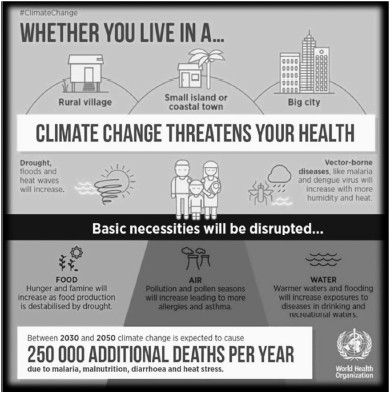
World Health Organization. Basic Necessities Disrupted. Internet: <www.who.in>.
Judge the item below based on the preceding infographic.
With the infographic, the World Health Organization wants to inform that two hundred and fifty thousand people will die by 2050.
Provas
World Health Organization. Basic Necessities Disrupted. Internet: <www.who.in>.
Judge the item below based on the preceding infographic.
The modal verb “will” is used in most sentences of the infographic because the World Health Organization is showing the reader some projections about the future of the world regarding climate change.
Provas
World Health Organization. Basic Necessities Disrupted. Internet: <www.who.in>.
Judge the item below based on the preceding infographic.
One of the main goals of the text is to draw attention to the relationship between vector-borne diseases and the lack of clean water.
Provas
Caderno Container