Foram encontradas 96 questões.
Em uma bancada de laboratório encontram-se três tubos de ensaios numerados de I a III, contendo volumes iguais de água. Alguns cristais de acetato de sódio (A), cloreto de sódio (B) e cloreto de amônio (C) são adicionados nos tubos I, II e III, respectivamente.
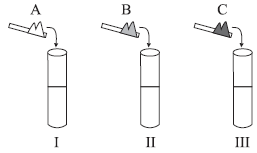
Ao medir o pH das soluções aquosas resultantes nos tubos de ensaio I, II e III, deve-se verificar que:
Provas
Questão presente nas seguintes provas

Desde 1960, o Sistema Internacional de Unidades (SI) adota uma única unidade para quantidade de calor, trabalho e energia, e recomenda o abandono da antiga unidade ainda em uso. Assinale a alternativa que indica na coluna I a unidade adotada pelo SI e na coluna II a unidade a ser abandonada.
| I | II |
Provas
Questão presente nas seguintes provas
Os hidrocarbonetos aromáticos simples são provenientes de duas fontes principais: carvão e petróleo. A decomposição do carvão por aquecimento na ausência de ar conduz à formação de compostos voláteis (gases), um líquido viscoso (alcatrão da hulha) e um resíduo sólido (coque). A partir da destilação fracionada do alcatrão da hulha obtêm-se diversas substâncias aromáticas, dentre essas, benzeno, tolueno, p-xileno e o bifenilo.
| Substância | Temperatura de fusão (ºC) | Temperatura de ebulição (ºC) |
|
benzeno
tolueno
p-xileno
bifenilo
|
5,5
-95
13
70
|
80
111
138
255
|
Baseando-se nas propriedades físicas apresentadas na tabela à pressão de 1 atm, assinale a alternativa correta, considerando que todos os processos citados ocorram nesta pressão.
Provas
Questão presente nas seguintes provas
- Estatística DescritivaMedidas de Tendência CentralMédiasMédia AritméticaMédia Ponderada (Agrupados por Valor)
Durante o ano letivo, um professor de matemática aplicou cinco provas para seus alunos. A tabela apresenta as notas obtidas por um determinado aluno em quatro das cinco provas realizadas e os pesos estabelecidos pelo professor para cada prova.
| PROVA | I | II | III | IV | V |
| NOTA | 6,5 | 7,3 | 7,5 | ? | 6,2 |
| PESO | 1 | 2 | 3 | 2 | 2 |
Se o aluno foi aprovado com média final ponderada igual a 7,3, calculada entre as cinco provas, a nota obtida por esse aluno na prova IV foi:
Provas
Questão presente nas seguintes provas
Na evolução dos modelos atômicos, a principal contribuição introduzida pelo modelo de Bohr foi:
Provas
Questão presente nas seguintes provas
TEXTO 1
Brazilian ethanol is not causing deforestation
Ethanol production in Brazil is not causing deforestation in the Amazon region, says Peter Zuurbier, Associate Professor and Director of the Latin America Office of Wageningen University, the world’s leading center of expertise on tropical agriculture.
According to him, the notion often held by NGO’s that sugarcane is displacing cattle and soybean production into the Amazon is inaccurate. “The real problem lies in illegal deforestation and lack of property rights, as around 50 percent of the Amazon region has disputed titles and this is an invitation for timber companies,” he says.
Prof. Zuurbier tries to explain a dynamic process between illegal activities in the Amazon rainforest and the expansion of agricultural lands towards that region. NGO’s often state that sugarcane production is displacing cattle and soybean production towards and into the Amazon, burning down the area to make it suitable for agriculture and pastures.
According to Zuurbier, however, the process is slightly different. “Well organized groups and corporations with questionable land titles, but also official land owners began to chop down large acreages of forest to trade timber, both legally and illegally,” he says. “Usually, after the empty strips of land were abandoned, cattle owners would move into these cheap lands. However, after 3 to 4 years of cattle breeding, the thin soil of the Amazon is completely useless without any form of fertilization and livestock owners usually move into the next abandoned area. Soybean farmers meanwhile replace the livestock in these areas, recognizing the opportunity to fertilize the area for soybean production.”
Prof. Zuurbier says the cause of deforestation and agricultural production in or near the Amazon, is simply illegal deforestation itself. According to him, the fact that Brazil still has questionable land titles, no set-aside policy and great difficulty to enforce existing laws to counter illegal timber trade, are the real reasons why the Amazon rainforest is in danger.
(Ethanol Statistics - January 21st 2008, http://www.sucre-ethique.org/ Wageningen-expert-Brazilian)
TEXTO 2
Coasting on Past Glory
The Amazon is still largely intact, but the future hinges on decisions being made now.
From the window of a Boeing, few countries are greener than Brazil. Since much of this vast territory in the heart of South America is still unpeopled and unblemished, it’s not surprising that Brazil looks good against the backdrop of a mistreated planet. It ranks 34th of 149 nations in Yale and Columbia’s Environmental Performance Index – greener than Ireland (35th) and the United States (39th). But how long will the country be able to hold on to this favorable score?
To get a better look, you have to go to 9,000 meters, the altitude from which the NASA remote-sensing satellites sweep the earth. Every year, scientists at Brazil’s National Institute for Space Research (INPE) pore over satellite images to produce the most detailed survey of deforestation of any nation in the world. Such candor has won Brazil kudos, but also criticism. Brazil is the fourth biggest contributor of greenhouse gases globally, of which 75 percent comes from the felling and burning of forests.
So when data released by INPE in late May showed that 5,850 square kilometers of forest (an area larger than Brunei) had disappeared from August 2007 to April 2008 – a 17 percent spike from the year before – the planet took notice. “Brazil has a fantastic endowment from nature but is failing when it comes to managing it,” says Judicael Clevelario Junior, head of environmental studies at the Brazilian Institute of Geography and Statistics (IBGE), the census bureau.
Brazil’s green laurels are not an illusion. Four fifths of its electric power comes from hydroelectric plants. It is the world leader in biofuels – nearly 30 percent of its cars run on ethanol. The trouble is that these virtues reflect sound decisions made in the 1970s, during the ambitious military government of Gen. Ernesto Geisel. Brazil has not always followed them up.
(…) Fortunately, Brazil has options. Its booming economy is not beholden to coal-fired power plants, and the rain forest is still largely intact. “Brazil has a rare opportunity to transform itself into a rich country and still maintain its natural capital,” says Clevelario Jr. If it can go back to its old habit of making the right environmental moves.
(Newsweek, July 14th 2008, http://www.newsweek.com/id/143696)
INSTRUÇÃO: A questão refere-se aos textos 1 e 2.
De acordo com os dois textos, é possível afirmar que:
Provas
Questão presente nas seguintes provas
Uma rede de supermercados fornece a seus clientes um cartão de crédito cuja identificação é formada por 3 letras distintas (dentre 26), seguidas de 4 algarismos distintos. Uma determinada cidade receberá os cartões que têm L como terceira letra, o último algarismo é zero e o penúltimo é 1. A quantidade total de cartões distintos oferecidos por tal rede de supermercados para essa cidade é
Provas
Questão presente nas seguintes provas
TEXTO 2
Wangari Maathaï: “Je rêve qu’en replantant des millions
d’arbres, on oriente l’Afrique vers la paix.”
d’arbres, on oriente l’Afrique vers la paix.”
J’ai longtemps cru que le monde était une vallée de terre riche, dominée para les contreforts des monts Aberdore et au nord par le mont Kenya. Je pensais que les acacias au feuillage mince et dur, les torrents vivaces et purs où nous allions chercher l’eau étaient éternels. (...) À mes yeux, cette vallée du Rift où mon père travaillait dans la ferme d’un colon britannique était l’univers tout entier. Et cet univers avait la couleur des forêts. (...)
De chez moi, on pouvait apercevoir les neiges du mont Kenya, à 5000 mètres d’altitude. Il y en avait encore beaucoup à cette époque. Et mon peuple, les Kikuyu, respectueux de cette majesté qui émergeait parfois des nuages, considérait la montagne comme sacrée. (...)
Si je vous décris ces paysages, c’est parce qu’ils ont aujourd’hui disparu et que cette perte est une menace mortelle pour le Kenya, l’Afrique et peut-être le monde. (...)
Notez pourtant ce chiffre stupéfiant: à l’époque de la colonisation britannique, 30% du territoire étaient couverts par la forêt. Aujourd’hui, la forêt représente à peine 2% des terres. Mon rêve s’est donc dessiné peu à peu avec la disparition des arbres et la fonte des neiges du mont Kenya. Oh, il a commencé modestement, et sur une idée toute simple: à ces femmes qui décrivaient leurs champs devenus infertiles, j’ai proposé de replanter des arbres. C’était en 1974, et je n’avais alors pas de stratégie très elaborée. Mais je suis allée voir un forestier et j’ai réclamé des plantes. Quinze millions. Il a ri. « Quinze millions ? » « Nous sommes 15 millions de Kenyans. Un Kenyan, un arbre. » (...)
Quand on m’appela, un matin d’octobre 2004, pour m’annoncer qu’on m’attribuait le prix Nobel de la paix, je suis tombée des nues ! La paix ? ... Oui, la paix. Et c’est bien de cela, au fond, qu’il s’agit. Détruire l’environnement affecte les conditions de survie des hommes et fournit le cadre de conflits potentiels. Paix, gestion durable des ressources et bonne gouvernance sont indissociablement liées. Y a-t-il meilleur symbole de paix et d’espoir qu’un arbre vivant ? (...)
(Le Monde, 22.07.2008.)
Assinale a alternativa que completa corretamente as lacunas.
......... paysannes, qui venaient parfois des régions mêmes de ......... enfance, se plaignaient ......... de la pauvreté.
Provas
Questão presente nas seguintes provas
Um rapaz apaixonado desenhou no tronco de um abacateiro, a 1,5 metros do chão, um coração com o nome de sua amada. Muitos anos depois, voltou ao local e encontrou o mesmo abacateiro, agora com o dobro de altura. Procurou pelo desenho que havia feito e verificou que ele se encontrava
Provas
Questão presente nas seguintes provas
Um pesquisador analisou células em divisão das gônadas e do trato digestório de um macho de uma nova espécie de mosca. A partir de suas observações, fez as seguintes anotações:
Nas células do tecido I, em uma das fases da divisão celular, vêem-se 8 cromossomos, cada um deles com uma única cromátide, 4 deles migrando para um dos pólos da célula e os outros 4 migrando para o pólo oposto.
Nas células do tecido II, em uma das fases da divisão celular, vêem-se 4 cromossomos, cada um deles com duas cromátides, 2 deles migrando para um dos pólos da célula e os outros 2 migrando para o pólo oposto.
Pode-se afirmar que as células do tecido I e as células do tecido II são, respectivamente,
Provas
Questão presente nas seguintes provas
Cadernos
Caderno Container