Foram encontradas 60 questões.
1. What is an analog-digital converter?
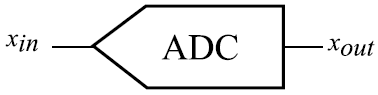
An Analog-Digital Converter (ADC) is a widely used electronic component that converts an analog electric signal (usually a voltage) into a digital representation. The ADCs are at the front-end of any digital circuit that needs to process signals coming from the exterior world. Its schematic symbol is:
The output of a microphone, the voltage at a photodiode or the signal of an accelerometer are examples of analog values that need to be converted so that a microprocessor can work with them.
2. How does the ADC convert a signal?
Many ways have been developed to convert an analog signal, each with its strengths and weaknesses. The choice of the ADC for a given application is usually defined by the requirements you have: if you need speed, use a fast ADC; if you need precision, use an accurate ADC; if you are constrained in space, use a compact ADC.
All ADCs work under the same principle: they need to convert a signal to a certain number of bits N. The sequence of bits represents the number and each bit has the double of the weight of the next, starting from the Most Significant Bit (MSB) up to the Least Significant Bit (LSB). In a nutshell, we want to find the sequence of bits bN−1, bN−2, ..., b0 that represents the analog value Vin as Vin=Σn=0N−1bn2nVref2N.
(www.onmyphd.com/?p=analog.digital.converter. Adaptado)
No trecho da resposta à segunda pergunta – In a nutshell, we want to find the sequence of bits…–, a expressão destacada equivale, em português, a
Provas
Questão presente nas seguintes provas

1. What is an analog-digital converter?
An Analog-Digital Converter (ADC) is a widely used electronic component that converts an analog electric signal (usually a voltage) into a digital representation. The ADCs are at the front-end of any digital circuit that needs to process signals coming from the exterior world. Its schematic symbol is:
The output of a microphone, the voltage at a photodiode or the signal of an accelerometer are examples of analog values that need to be converted so that a microprocessor can work with them.
2. How does the ADC convert a signal?
Many ways have been developed to convert an analog signal, each with its strengths and weaknesses. The choice of the ADC for a given application is usually defined by the requirements you have: if you need speed, use a fast ADC; if you need precision, use an accurate ADC; if you are constrained in space, use a compact ADC.
All ADCs work under the same principle: they need to convert a signal to a certain number of bits N. The sequence of bits represents the number and each bit has the double of the weight of the next, starting from the Most Significant Bit (MSB) up to the Least Significant Bit (LSB). In a nutshell, we want to find the sequence of bits bN−1, bN−2, ..., b0 that represents the analog value Vin as Vin=Σn=0N−1bn2nVref2N.
(www.onmyphd.com/?p=analog.digital.converter. Adaptado)
No trecho da resposta à segunda pergunta – Many wayshave been developed to convert an analog signal, each with its strengths and weaknesses. –, a expressão destacada pode ser substituída, sem alteração de sentido, por:
Provas
Questão presente nas seguintes provas
1. What is an analog-digital converter?
An Analog-Digital Converter (ADC) is a widely used electronic component that converts an analog electric signal (usually a voltage) into a digital representation. The ADCs are at the front-end of any digital circuit that needs to process signals coming from the exterior world. Its schematic symbol is:
The output of a microphone, the voltage at a photodiode or the signal of an accelerometer are examples of analog values that need to be converted so that a microprocessor can work with them.
2. How does the ADC convert a signal?
Many ways have been developed to convert an analog signal, each with its strengths and weaknesses. The choice of the ADC for a given application is usually defined by the requirements you have: if you need speed, use a fast ADC; if you need precision, use an accurate ADC; if you are constrained in space, use a compact ADC.
All ADCs work under the same principle: they need to convert a signal to a certain number of bits N. The sequence of bits represents the number and each bit has the double of the weight of the next, starting from the Most Significant Bit (MSB) up to the Least Significant Bit (LSB). In a nutshell, we want to find the sequence of bits bN−1, bN−2, ..., b0 that represents the analog value Vin as Vin=Σn=0N−1bn2nVref2N.
(www.onmyphd.com/?p=analog.digital.converter. Adaptado)
No trecho da resposta à primeira pergunta – ... that need to be converted so that a microprocessor can work with them. –, a expressão destacada indica
Provas
Questão presente nas seguintes provas
1. What is an analog-digital converter?
An Analog-Digital Converter (ADC) is a widely used electronic component that converts an analog electric signal (usually a voltage) into a digital representation. The ADCs are at the front-end of any digital circuit that needs to process signals coming from the exterior world. Its schematic symbol is:
The output of a microphone, the voltage at a photodiode or the signal of an accelerometer are examples of analog values that need to be converted so that a microprocessor can work with them.
2. How does the ADC convert a signal?
Many ways have been developed to convert an analog signal, each with its strengths and weaknesses. The choice of the ADC for a given application is usually defined by the requirements you have: if you need speed, use a fast ADC; if you need precision, use an accurate ADC; if you are constrained in space, use a compact ADC.
All ADCs work under the same principle: they need to convert a signal to a certain number of bits N. The sequence of bits represents the number and each bit has the double of the weight of the next, starting from the Most Significant Bit (MSB) up to the Least Significant Bit (LSB). In a nutshell, we want to find the sequence of bits bN−1, bN−2, ..., b0 that represents the analog value Vin as Vin=Σn=0N−1bn2nVref2N.
(www.onmyphd.com/?p=analog.digital.converter. Adaptado)
Na primeira resposta, um exemplo de valor analógico a ser convertido em valor digital é
Provas
Questão presente nas seguintes provas
1. What is an analog-digital converter?
An Analog-Digital Converter (ADC) is a widely used electronic component that converts an analog electric signal (usually a voltage) into a digital representation. The ADCs are at the front-end of any digital circuit that needs to process signals coming from the exterior world. Its schematic symbol is:
The output of a microphone, the voltage at a photodiode or the signal of an accelerometer are examples of analog values that need to be converted so that a microprocessor can work with them.
2. How does the ADC convert a signal?
Many ways have been developed to convert an analog signal, each with its strengths and weaknesses. The choice of the ADC for a given application is usually defined by the requirements you have: if you need speed, use a fast ADC; if you need precision, use an accurate ADC; if you are constrained in space, use a compact ADC.
All ADCs work under the same principle: they need to convert a signal to a certain number of bits N. The sequence of bits represents the number and each bit has the double of the weight of the next, starting from the Most Significant Bit (MSB) up to the Least Significant Bit (LSB). In a nutshell, we want to find the sequence of bits bN−1, bN−2, ..., b0 that represents the analog value Vin as Vin=Σn=0N−1bn2nVref2N.
(www.onmyphd.com/?p=analog.digital.converter. Adaptado)
According to the first answer, the Analog-Digital Converter
Provas
Questão presente nas seguintes provas
Com os dígitos 1, 2, 3, 4, 5 e 6 escreveram-se números inteiros com três algarismos, que foram, todos, distribuídos a pessoas que participariam do sorteio de dois desses números. Sabendo-se que cada pessoa recebeu apenas um desses números, a probabilidade de serem sorteadas a pessoa com o número par e iniciado por 5 e a pessoa com o número par e com o elemento da dezena igual a 5 é:
Provas
Questão presente nas seguintes provas
No ano de 2017, uma pesquisa do Ministério da Saúde revelou que, no Brasil, para cada pessoa obesa, há quatro pessoas não obesas. Isso nos leva corretamente a afirmar que, na época da pesquisa realizada pelo Ministério da Saúde, a razão entre o número de brasileiros obesos e o número total de brasileiros era igual a
Provas
Questão presente nas seguintes provas
A Free Press Needs You
By The Editorial Board
August 15, 2018
In 1787, the year the Constitution was adopted in the USA, Thomas Jefferson famously wrote to a friend, “Were it left to me to decide whether we should have a government without newspapers, or newspapers without a government, I should not hesitate a moment to prefer the latter.”
That’s how he felt before he became president, anyway. Twenty years later, after enduring the oversight of the press from inside the White House, he was less sure of its value. “Nothing can now be believed which is seen in a newspaper,” he wrote. “Truth itself becomes suspicious by being put into that polluted vehicle.”
Jefferson’s discomfort was, and remains, understandable. Reporting the news in an open society is an enterprise laced with conflict. His discomfort also illustrates the need for the right of free press he helped to preserve. As the founders believed from their own experience, a well-informed public is best equipped to root out corruption and, over the long haul, promotes liberty and justice. “Public discussion is a political duty,” the Supreme Court said in 1964. That discussion must be “uninhibited, robust, and wide-open” and “may well include vehement, caustic and sometimes unpleasantly sharp attacks on government and public officials.”
(www.nytimes.com/interactive/2018/08/15/opinion/editorials/free-press-local
-journalism-news-donald-trump.html?action=click&module=Trending&
pgtype=Article®ion=Footer&contentCollection=Trending. Adaptado.)
No trecho do terceiro parágrafo – That discussion must be “uninhibited, robust, and wide-open” –, o termo em destaque pode ser substituído, sem alteração de sentido, por
Provas
Questão presente nas seguintes provas
A Free Press Needs You
By The Editorial Board
August 15, 2018
In 1787, the year the Constitution was adopted in the USA, Thomas Jefferson famously wrote to a friend, “Were it left to me to decide whether we should have a government without newspapers, or newspapers without a government, I should not hesitate a moment to prefer the latter.”
That’s how he felt before he became president, anyway. Twenty years later, after enduring the oversight of the press from inside the White House, he was less sure of its value. “Nothing can now be believed which is seen in a newspaper,” he wrote. “Truth itself becomes suspicious by being put into that polluted vehicle.”
Jefferson’s discomfort was, and remains, understandable. Reporting the news in an open society is an enterprise laced with conflict. His discomfort also illustrates the need for the right of free press he helped to preserve. As the founders believed from their own experience, a well-informed public is best equipped to root out corruption and, over the long haul, promotes liberty and justice. “Public discussion is a political duty,” the Supreme Court said in 1964. That discussion must be “uninhibited, robust, and wide-open” and “may well include vehement, caustic and sometimes unpleasantly sharp attacks on government and public officials.”
(www.nytimes.com/interactive/2018/08/15/opinion/editorials/free-press-local
-journalism-news-donald-trump.html?action=click&module=Trending&
pgtype=Article®ion=Footer&contentCollection=Trending. Adaptado.)
According to the third paragraph, a well-informed public
Provas
Questão presente nas seguintes provas
A Free Press Needs You
By The Editorial Board
August 15, 2018
In 1787, the year the Constitution was adopted in the USA, Thomas Jefferson famously wrote to a friend, “Were it left to me to decide whether we should have a government without newspapers, or newspapers without a government, I should not hesitate a moment to prefer the latter.”
That’s how he felt before he became president, anyway. Twenty years later, after enduring the oversight of the press from inside the White House, he was less sure of its value. “Nothing can now be believed which is seen in a newspaper,” he wrote. “Truth itself becomes suspicious by being put into that polluted vehicle.”
Jefferson’s discomfort was, and remains, understandable. Reporting the news in an open society is an enterprise laced with conflict. His discomfort also illustrates the need for the right of free press he helped to preserve. As the founders believed from their own experience, a well-informed public is best equipped to root out corruption and, over the long haul, promotes liberty and justice. “Public discussion is a political duty,” the Supreme Court said in 1964. That discussion must be “uninhibited, robust, and wide-open” and “may well include vehement, caustic and sometimes unpleasantly sharp attacks on government and public officials.”
(www.nytimes.com/interactive/2018/08/15/opinion/editorials/free-press-local
-journalism-news-donald-trump.html?action=click&module=Trending&
pgtype=Article®ion=Footer&contentCollection=Trending. Adaptado.)
De acordo com as informações apresentadas no segundo parágrafo, Thomas Jefferson
Provas
Questão presente nas seguintes provas
Cadernos
Caderno Container