Foram encontradas 45.435 questões.
Instruction: answer question based on the following text.
Jean-Michel Basquiat
Lisa S. Wainwright
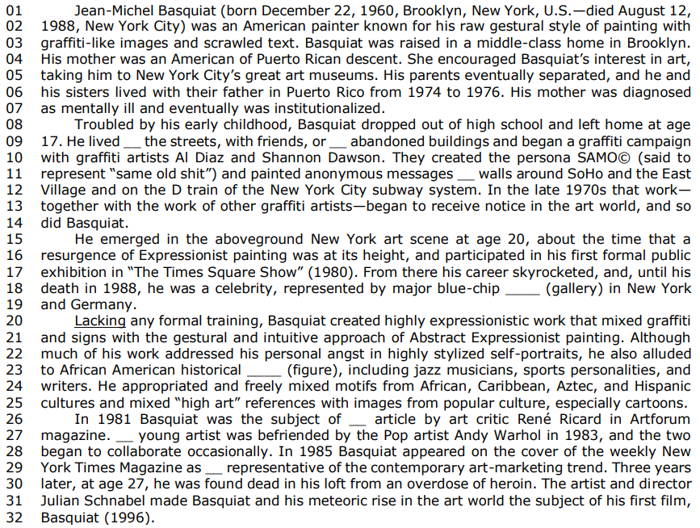
(Available in: https://www.britannica.com/biography/Jean-Michel-Basquiat – text especially adapted for this
test).
Provas
Questão presente nas seguintes provas

Instruction: answer question based on the following text.
Jean-Michel Basquiat
Lisa S. Wainwright
(Available in: https://www.britannica.com/biography/Jean-Michel-Basquiat – text especially adapted for this
test).
Provas
Questão presente nas seguintes provas
3603831
Ano: 2025
Disciplina: Inglês (Língua Inglesa)
Banca: OBJETIVA
Orgão: Pref. Nonoai-RS
Disciplina: Inglês (Língua Inglesa)
Banca: OBJETIVA
Orgão: Pref. Nonoai-RS
Provas:
Mark the CORRECT item to fill in the blank.
If I had studied harder in school, I_________a better job now.
If I had studied harder in school, I_________a better job now.
Provas
Questão presente nas seguintes provas
3603830
Ano: 2025
Disciplina: Inglês (Língua Inglesa)
Banca: OBJETIVA
Orgão: Pref. Nonoai-RS
Disciplina: Inglês (Língua Inglesa)
Banca: OBJETIVA
Orgão: Pref. Nonoai-RS
Provas:
Regarding prepositions, number the second column
according to the first one so as to fill in the blanks, and then
choose the item that correspondsto the CORRECT sequence.
(1) on (2) at (3) in
( ) Wait for me ____ the bus stop!
( ) My grandmother passed away ____ 2014.
( ) Come and see us ____ Christmas Day
(1) on (2) at (3) in
( ) Wait for me ____ the bus stop!
( ) My grandmother passed away ____ 2014.
( ) Come and see us ____ Christmas Day
Provas
Questão presente nas seguintes provas
3603829
Ano: 2025
Disciplina: Inglês (Língua Inglesa)
Banca: OBJETIVA
Orgão: Pref. Nonoai-RS
Disciplina: Inglês (Língua Inglesa)
Banca: OBJETIVA
Orgão: Pref. Nonoai-RS
Provas:
The size and age of the Cosmos are beyond ordinary human understanding. Lost somewhere between immensity and eternity is our tiny planetary home. In a cosmic perspective, most human concerns seem insignificant, even petty. And yet our species is young and curious and brave and shows much promise. In the last few millennia we have made the most astonishing and unexpected discoveries about the Cosmos and our place within it, explorations that are exhilarating to consider. They remind us that humans have evolved to wonder, that understanding is a joy, that knowledge is prerequisite to survival. I believe our future depends on how well we know this Cosmos in which we float like a mote of dust in the morning sky.
Those explorations required skepticism and imagination both. Imagination will often carry us to worlds that never were. But without it, we go nowhere. Skepticism enables us to distinguish fancy from fact, to test our speculations. The Cosmos is rich beyond measure — in elegant facts, in exquisite interrelationships, in the subtle machinery of awe. The surface of the Earth is the shore of the cosmic ocean. From it we have learned most of what we know. Recently, we have waded a little out to sea, enough to dampen our toes or, at most, wet our ankles. The water seems inviting. The ocean calls. Some part of our being knows this is from where we came. We long to return. These aspirations are not, I think, irreverent, although they may trouble whatever gods may be.
Cosmos. Carl Sagan.
Provas
Questão presente nas seguintes provas
3603828
Ano: 2025
Disciplina: Inglês (Língua Inglesa)
Banca: OBJETIVA
Orgão: Pref. Nonoai-RS
Disciplina: Inglês (Língua Inglesa)
Banca: OBJETIVA
Orgão: Pref. Nonoai-RS
Provas:
The size and age of the Cosmos are beyond ordinary human understanding. Lost somewhere between immensity and eternity is our tiny planetary home. In a cosmic perspective, most human concerns seem insignificant, even petty. And yet our species is young and curious and brave and shows much promise. In the last few millennia we have made the most astonishing and unexpected discoveries about the Cosmos and our place within it, explorations that are exhilarating to consider. They remind us that humans have evolved to wonder, that understanding is a joy, that knowledge is prerequisite to survival. I believe our future depends on how well we know this Cosmos in which we float like a mote of dust in the morning sky.
Those explorations required skepticism and imagination both. Imagination will often carry us to worlds that never were. But without it, we go nowhere. Skepticism enables us to distinguish fancy from fact, to test our speculations. The Cosmos is rich beyond measure — in elegant facts, in exquisite interrelationships, in the subtle machinery of awe. The surface of the Earth is the shore of the cosmic ocean. From it we have learned most of what we know. Recently, we have waded a little out to sea, enough to dampen our toes or, at most, wet our ankles. The water seems inviting. The ocean calls. Some part of our being knows this is from where we came. We long to return. These aspirations are not, I think, irreverent, although they may trouble whatever gods may be.
Cosmos. Carl Sagan.
Provas
Questão presente nas seguintes provas
3603827
Ano: 2025
Disciplina: Inglês (Língua Inglesa)
Banca: OBJETIVA
Orgão: Pref. Nonoai-RS
Disciplina: Inglês (Língua Inglesa)
Banca: OBJETIVA
Orgão: Pref. Nonoai-RS
Provas:
The size and age of the Cosmos are beyond ordinary human understanding. Lost somewhere between immensity and eternity is our tiny planetary home. In a cosmic perspective, most human concerns seem insignificant, even petty. And yet our species is young and curious and brave and shows much promise. In the last few millennia we have made the most astonishing and unexpected discoveries about the Cosmos and our place within it, explorations that are exhilarating to consider. They remind us that humans have evolved to wonder, that understanding is a joy, that knowledge is prerequisite to survival. I believe our future depends on how well we know this Cosmos in which we float like a mote of dust in the morning sky.
Those explorations required skepticism and imagination both. Imagination will often carry us to worlds that never were. But without it, we go nowhere. Skepticism enables us to distinguish fancy from fact, to test our speculations. The Cosmos is rich beyond measure — in elegant facts, in exquisite interrelationships, in the subtle machinery of awe. The surface of the Earth is the shore of the cosmic ocean. From it we have learned most of what we know. Recently, we have waded a little out to sea, enough to dampen our toes or, at most, wet our ankles. The water seems inviting. The ocean calls. Some part of our being knows this is from where we came. We long to return. These aspirations are not, I think, irreverent, although they may trouble whatever gods may be.
Cosmos. Carl Sagan.
Provas
Questão presente nas seguintes provas
3603826
Ano: 2025
Disciplina: Inglês (Língua Inglesa)
Banca: OBJETIVA
Orgão: Pref. Nonoai-RS
Disciplina: Inglês (Língua Inglesa)
Banca: OBJETIVA
Orgão: Pref. Nonoai-RS
Provas:
The size and age of the Cosmos are beyond ordinary human understanding. Lost somewhere between immensity and eternity is our tiny planetary home. In a cosmic perspective, most human concerns seem insignificant, even petty. And yet our species is young and curious and brave and shows much promise. In the last few millennia we have made the most astonishing and unexpected discoveries about the Cosmos and our place within it, explorations that are exhilarating to consider. They remind us that humans have evolved to wonder, that understanding is a joy, that knowledge is prerequisite to survival. I believe our future depends on how well we know this Cosmos in which we float like a mote of dust in the morning sky.
Those explorations required skepticism and imagination both. Imagination will often carry us to worlds that never were. But without it, we go nowhere. Skepticism enables us to distinguish fancy from fact, to test our speculations. The Cosmos is rich beyond measure — in elegant facts, in exquisite interrelationships, in the subtle machinery of awe. The surface of the Earth is the shore of the cosmic ocean. From it we have learned most of what we know. Recently, we have waded a little out to sea, enough to dampen our toes or, at most, wet our ankles. The water seems inviting. The ocean calls. Some part of our being knows this is from where we came. We long to return. These aspirations are not, I think, irreverent, although they may trouble whatever gods may be.
Cosmos. Carl Sagan.
Provas
Questão presente nas seguintes provas
3603825
Ano: 2025
Disciplina: Inglês (Língua Inglesa)
Banca: OBJETIVA
Orgão: Pref. Nonoai-RS
Disciplina: Inglês (Língua Inglesa)
Banca: OBJETIVA
Orgão: Pref. Nonoai-RS
Provas:
The size and age of the Cosmos are beyond ordinary human understanding. Lost somewhere between immensity and eternity is our tiny planetary home. In a cosmic perspective, most human concerns seem insignificant, even petty. And yet our species is young and curious and brave and shows much promise. In the last few millennia we have made the most astonishing and unexpected discoveries about the Cosmos and our place within it, explorations that are exhilarating to consider. They remind us that humans have evolved to wonder, that understanding is a joy, that knowledge is prerequisite to survival. I believe our future depends on how well we know this Cosmos in which we float like a mote of dust in the morning sky.
Those explorations required skepticism and imagination both. Imagination will often carry us to worlds that never were. But without it, we go nowhere. Skepticism enables us to distinguish fancy from fact, to test our speculations. The Cosmos is rich beyond measure — in elegant facts, in exquisite interrelationships, in the subtle machinery of awe. The surface of the Earth is the shore of the cosmic ocean. From it we have learned most of what we know. Recently, we have waded a little out to sea, enough to dampen our toes or, at most, wet our ankles. The water seems inviting. The ocean calls. Some part of our being knows this is from where we came. We long to return. These aspirations are not, I think, irreverent, although they may trouble whatever gods may be.
Cosmos. Carl Sagan.
From it we have learned most of what we know. Recently, we have waded a little out to sea, enough to dampen our toes or, at most, wet our ankles.
Provas
Questão presente nas seguintes provas
Read Text II and answer question
TEXT II
Uses of AI in Education
In May 2023, the U.S. Department of Education released a
report titled Artificial Intelligence and the Future of Teaching and
Learning: Insights and Recommendations. The department had
conducted listening sessions in 2022 with more than 700 people,
including educators and parents, to gauge their views on AI. The
report noted that “constituents believe that action is required now
in order to get ahead of the expected increase of AI in education
technology – and they want to roll up their sleeves and start
working together.” People expressed anxiety about “future
potential risks” with AI but also felt that “AI may enable achieving
educational priorities in better ways, at scale, and with lower
costs.
AI could serve – or is already serving – in several teachingand-learning roles, for instance:
instructional assistants: AI’s ability to conduct human-like
conversations opens up possibilities for adaptive tutoring or
instructional assistants that can help explain difficult concepts to
students. AI-based feedback systems can offer constructive
critiques on student writing, which can help students fine-tune
their writing skills. Some research also suggests certain kinds of
prompts can help children generate more fruitful questions about
learning. AI models might also support customized learning for
students with disabilities and provide translation for English
language learners; and teaching assistants: AI might tackle some
of the administrative tasks that keep teachers from investing more
time with their peers or students. Early uses include automated
routine tasks such as drafting lesson plans, creating differentiated
materials, designing worksheets, developing quizzes, and
exploring ways of explaining complicated academic materials. AI
can also provide educators with recommendations to meet
student needs and help teachers reflect, plan, and improve their
practice.
Along with these potential benefits come some difficult
challenges and risks the education community must navigate. For
example, both teachers and students face the risk of becoming
overly reliant on AI-driven technology. For students, this could
stifle learning, especially the development of critical thinking. This
challenge extends to educators as well. While AI can expedite
lesson-plan generation, speed does not equate to quality.
Teachers may be tempted to accept the initial AI-generated
content rather than devote time to reviewing and refining it for
optimal educational value.
In light of these challenges, the Department of Education has
stressed the importance of keeping “humans in the loop” when
using AI, particularly when the output might be used to inform a
decision. As the department encouraged in its 2023 report,
teachers, learners, and others need to retain their agency. AI
cannot “replace a teacher, a guardian, or an education leader as
the custodian of their students’ learning,” the report stressed.
Adapted from: https://www.educationnext.org/a-i-in-education-leap-into-new-eramachine-intelligence-carries-risks-challenges-promises/
Provas
Questão presente nas seguintes provas
Cadernos
Caderno Container