Foram encontradas 45.388 questões.
Disciplina: Inglês (Língua Inglesa)
Banca: SELECON
Orgão: Pref. Nova Mutum-MT
TEXT:
Flipped learning – could it work for you?
Exploring the benefits, challenges and tips for success
By Stephanie Hirschman
October 2, 2023
Flipped learning is very much a buzz word these days, and it’s worth thinking about whether this approach is suitable for your lessons. It’s quite easy to define: whereas a more traditional model of teaching involves some sort of initial input (for example a lecture or demonstration) followed by some sort of related output (for example a discussion or experiment) with some homework to follow, in flipped learning, this order is disrupted. Students do their homework before the class meets by watching a recorded lecture or video or reading an article. This enables them to spend the lesson time on activities which make a more significant contribution to their deep understanding and mastery of important ideas, for example, discussion, roleplay or presentations. It sits well within blended learning as the pre-lesson homework is likely to be accessed online, while the class activities are conducted face-to-face.
Why is it important?
Flipped learning makes good use of technology, allowing students to approach the input at their own level. Some may need to view a video several times more than would be possible in a group classroom setting, with frequent pauses and rewinding to ensure that they have recognized the main points. It’s also possible for students to explore other aspects of a topic, either using further links that the teacher provides, or finding other relevant resources to explore on their own. Finally, they can do the work when and where they wish, and even make use of otherwise “dead” time, like waiting for a bus.
How relevant is it for English language teaching (ELT)?
It’s important to recognize that flipped learning was not developed with ELT contexts in mind. In a language lesson, we may find students reading a text about, say, major infrastructure projects, but this content is merely a vehicle for some other language point like expressing high numbers or making comparisons. During a conventional English lesson, the teacher would be guiding students through the text, encouraging prediction and other strategies and setting achievable reading or listening tasks to check basic understanding, before introducing key language points in a staged presentation. This would be followed by controlled practice and freer production. It’s not easy to see how this pattern of brief but meaningful interactive activities maps onto flipped learning. ELT texts, even at advanced levels, tend to be too short to be worth exploring in depth, unlike a 30-minute lecture or video that students of other subjects may be watching. Of course, it could be argued that the true content of the lesson, ie the language point, could be the subject of flipped learning, with students watching a presentation on this subject before the class meets. However, this removes the language point from an engaging and meaningful context and furthermore, working alone robs students of the opportunity to ask questions and discuss emergent ideas about meaning, which are key elements of communicative learning.
Tips for success
Nonetheless, it is possible to flip an ELT classroom, with some adjustments:
1. Flipped learning would suit certain types of ELT which are heavily content based, like CLIL or Business. Mature students are more likely to have the motivation required to implement this approach sensibly.
2. It makes sense to devote the final stages of a lesson to introducing the content that students will explore independently before the next class meeting. This should include a justification of why the content was chosen, how students should approach it and how they can check their understanding. Providing some comprehension questions is a minimum. If answers aren’t furnished, the next class meeting could open with an activity to discuss and check these.
3. The teacher must provide an easy and reliable way for students to access the content, for example via an online learning system.
4. It’s reasonable to expect that students will require training and a settling-in period, as they come to terms with the demands of the new system. It could even be worth trialing the routine during a face-to-face lesson, with students accessing content on their phones or laptops, and with some reminders about how to approach a reading text (for example skimming and scanning) or how to make good use of technology to ensure effective listening (for example, rewinding, user slower speed settings or making use of a tape script).
5. Because of the investment required in learner training, flipped learning will be tricky to implement in programs with continuous enrolment. It’s far more suitable for a setting with a termly or yearly intake date.
6. Even when the system is up and running, there will probably always be a number of students who have not prepared adequately for the lesson. This will affect how successful follow-up activities are and the teacher needs some strategies in place to address this.
Available in: https://linguahouse.com/blog/post/flipped-learning-could-it-work-for-you Acesso: 17/10/2024
No primeiro parágrafo do texto, a expressão “buzz word” é definida como:
Provas

Disciplina: Inglês (Língua Inglesa)
Banca: SELECON
Orgão: Pref. Nova Mutum-MT
TEXT:
Flipped learning – could it work for you?
Exploring the benefits, challenges and tips for success
By Stephanie Hirschman
October 2, 2023
Flipped learning is very much a buzz word these days, and it’s worth thinking about whether this approach is suitable for your lessons. It’s quite easy to define: whereas a more traditional model of teaching involves some sort of initial input (for example a lecture or demonstration) followed by some sort of related output (for example a discussion or experiment) with some homework to follow, in flipped learning, this order is disrupted. Students do their homework before the class meets by watching a recorded lecture or video or reading an article. This enables them to spend the lesson time on activities which make a more significant contribution to their deep understanding and mastery of important ideas, for example, discussion, roleplay or presentations. It sits well within blended learning as the pre-lesson homework is likely to be accessed online, while the class activities are conducted face-to-face.
Why is it important?
Flipped learning makes good use of technology, allowing students to approach the input at their own level. Some may need to view a video several times more than would be possible in a group classroom setting, with frequent pauses and rewinding to ensure that they have recognized the main points. It’s also possible for students to explore other aspects of a topic, either using further links that the teacher provides, or finding other relevant resources to explore on their own. Finally, they can do the work when and where they wish, and even make use of otherwise “dead” time, like waiting for a bus.
How relevant is it for English language teaching (ELT)?
It’s important to recognize that flipped learning was not developed with ELT contexts in mind. In a language lesson, we may find students reading a text about, say, major infrastructure projects, but this content is merely a vehicle for some other language point like expressing high numbers or making comparisons. During a conventional English lesson, the teacher would be guiding students through the text, encouraging prediction and other strategies and setting achievable reading or listening tasks to check basic understanding, before introducing key language points in a staged presentation. This would be followed by controlled practice and freer production. It’s not easy to see how this pattern of brief but meaningful interactive activities maps onto flipped learning. ELT texts, even at advanced levels, tend to be too short to be worth exploring in depth, unlike a 30-minute lecture or video that students of other subjects may be watching. Of course, it could be argued that the true content of the lesson, ie the language point, could be the subject of flipped learning, with students watching a presentation on this subject before the class meets. However, this removes the language point from an engaging and meaningful context and furthermore, working alone robs students of the opportunity to ask questions and discuss emergent ideas about meaning, which are key elements of communicative learning.
Tips for success
Nonetheless, it is possible to flip an ELT classroom, with some adjustments:
1. Flipped learning would suit certain types of ELT which are heavily content based, like CLIL or Business. Mature students are more likely to have the motivation required to implement this approach sensibly.
2. It makes sense to devote the final stages of a lesson to introducing the content that students will explore independently before the next class meeting. This should include a justification of why the content was chosen, how students should approach it and how they can check their understanding. Providing some comprehension questions is a minimum. If answers aren’t furnished, the next class meeting could open with an activity to discuss and check these.
3. The teacher must provide an easy and reliable way for students to access the content, for example via an online learning system.
4. It’s reasonable to expect that students will require training and a settling-in period, as they come to terms with the demands of the new system. It could even be worth trialing the routine during a face-to-face lesson, with students accessing content on their phones or laptops, and with some reminders about how to approach a reading text (for example skimming and scanning) or how to make good use of technology to ensure effective listening (for example, rewinding, user slower speed settings or making use of a tape script).
5. Because of the investment required in learner training, flipped learning will be tricky to implement in programs with continuous enrolment. It’s far more suitable for a setting with a termly or yearly intake date.
6. Even when the system is up and running, there will probably always be a number of students who have not prepared adequately for the lesson. This will affect how successful follow-up activities are and the teacher needs some strategies in place to address this.
Available in: https://linguahouse.com/blog/post/flipped-learning-could-it-work-for-you Acesso: 17/10/2024
Analisando o trecho do texto: “Some may need to view a video several times more than would be possible in a group classroom setting, with frequent pauses and rewinding to ensure that they have recognized the main points”, pode-se concluir que ao realizar tal tarefa, o aluno estará exercitando a habilidade comunicativa que envolve:
Provas
Disciplina: Inglês (Língua Inglesa)
Banca: SELECON
Orgão: Pref. Nova Mutum-MT
TEXT:
Flipped learning – could it work for you?
Exploring the benefits, challenges and tips for success
By Stephanie Hirschman
October 2, 2023
Flipped learning is very much a buzz word these days, and it’s worth thinking about whether this approach is suitable for your lessons. It’s quite easy to define: whereas a more traditional model of teaching involves some sort of initial input (for example a lecture or demonstration) followed by some sort of related output (for example a discussion or experiment) with some homework to follow, in flipped learning, this order is disrupted. Students do their homework before the class meets by watching a recorded lecture or video or reading an article. This enables them to spend the lesson time on activities which make a more significant contribution to their deep understanding and mastery of important ideas, for example, discussion, roleplay or presentations. It sits well within blended learning as the pre-lesson homework is likely to be accessed online, while the class activities are conducted face-to-face.
Why is it important?
Flipped learning makes good use of technology, allowing students to approach the input at their own level. Some may need to view a video several times more than would be possible in a group classroom setting, with frequent pauses and rewinding to ensure that they have recognized the main points. It’s also possible for students to explore other aspects of a topic, either using further links that the teacher provides, or finding other relevant resources to explore on their own. Finally, they can do the work when and where they wish, and even make use of otherwise “dead” time, like waiting for a bus.
How relevant is it for English language teaching (ELT)?
It’s important to recognize that flipped learning was not developed with ELT contexts in mind. In a language lesson, we may find students reading a text about, say, major infrastructure projects, but this content is merely a vehicle for some other language point like expressing high numbers or making comparisons. During a conventional English lesson, the teacher would be guiding students through the text, encouraging prediction and other strategies and setting achievable reading or listening tasks to check basic understanding, before introducing key language points in a staged presentation. This would be followed by controlled practice and freer production. It’s not easy to see how this pattern of brief but meaningful interactive activities maps onto flipped learning. ELT texts, even at advanced levels, tend to be too short to be worth exploring in depth, unlike a 30-minute lecture or video that students of other subjects may be watching. Of course, it could be argued that the true content of the lesson, ie the language point, could be the subject of flipped learning, with students watching a presentation on this subject before the class meets. However, this removes the language point from an engaging and meaningful context and furthermore, working alone robs students of the opportunity to ask questions and discuss emergent ideas about meaning, which are key elements of communicative learning.
Tips for success
Nonetheless, it is possible to flip an ELT classroom, with some adjustments:
1. Flipped learning would suit certain types of ELT which are heavily content based, like CLIL or Business. Mature students are more likely to have the motivation required to implement this approach sensibly.
2. It makes sense to devote the final stages of a lesson to introducing the content that students will explore independently before the next class meeting. This should include a justification of why the content was chosen, how students should approach it and how they can check their understanding. Providing some comprehension questions is a minimum. If answers aren’t furnished, the next class meeting could open with an activity to discuss and check these.
3. The teacher must provide an easy and reliable way for students to access the content, for example via an online learning system.
4. It’s reasonable to expect that students will require training and a settling-in period, as they come to terms with the demands of the new system. It could even be worth trialing the routine during a face-to-face lesson, with students accessing content on their phones or laptops, and with some reminders about how to approach a reading text (for example skimming and scanning) or how to make good use of technology to ensure effective listening (for example, rewinding, user slower speed settings or making use of a tape script).
5. Because of the investment required in learner training, flipped learning will be tricky to implement in programs with continuous enrolment. It’s far more suitable for a setting with a termly or yearly intake date.
6. Even when the system is up and running, there will probably always be a number of students who have not prepared adequately for the lesson. This will affect how successful follow-up activities are and the teacher needs some strategies in place to address this.
Available in: https://linguahouse.com/blog/post/flipped-learning-could-it-work-for-you Acesso: 17/10/2024
Após a leitura do texto, é possível definir “flipped learning” como:
Provas
Disciplina: Inglês (Língua Inglesa)
Banca: FEPESE
Orgão: Pref. Concórdia-SC
A prática pedagógica é um elemento-chave no processo de ensino e aprendizagem de uma língua estrangeira, pois ela define a ................................. como o conteúdo é apresentado aos alunos.
Neste contexto, é necessário que a prática pedagógica seja estruturada, organizada e .............................., a fim de estabelecer .............................. para o conhecimento adquirido.
Assinale a alternativa que completa corretamente as lacunas do texto.
Provas
Disciplina: Inglês (Língua Inglesa)
Banca: FEPESE
Orgão: Pref. Concórdia-SC
Column 1 Activities
1. Reading
2. Writing
3. Listening
4. Speaking
Column 2 Exemples
( ) dialogues, conversations, messages.
( ) everyday communication: meeting new people.
( ) fill in a form, express yourself through the written word.
( ) timetables, signs, adverts.
Select the option that presents the correct sequence from top to bottom.
Provas
Disciplina: Inglês (Língua Inglesa)
Banca: FEPESE
Orgão: Pref. Concórdia-SC
( ) The plan has been carefully looked at. (The sentence is in the Passive Voice)
( ) After the performance, the actor took a bow. (The underlined word means a fancy knot).
( ) I’m not liking her hairstyle.(The sentence is in the Present Progressive Tense)
( ) Staying at home in such bad weather was a sensible thing to do. (The underlined word is a false cognate that means easily affected by).
( ) She got ill because she hadn’t been sleeping enough. (The sentence is in the Past Perfect Tense)
Select the option that presents the correct sequence from top to bottom.
Provas
Disciplina: Inglês (Língua Inglesa)
Banca: FEPESE
Orgão: Pref. Concórdia-SC
Choose the alternative that presents these kind of words.
Provas
Disciplina: Inglês (Língua Inglesa)
Banca: FEPESE
Orgão: Pref. Concórdia-SC
Assinale a alternativa que apresenta exemplos de palavras do inglês que se tornaram comuns na língua portuguesa.
Provas
Disciplina: Inglês (Língua Inglesa)
Banca: FEPESE
Orgão: Pref. Concórdia-SC
( ) Os estrangeirismos são privilégio da língua portuguesa.
( ) O estrangeirismo se refere ao uso de palavras ou expressões estrangeiras na comunicação quando não há uma palavra equivalente na língua do enunciador.
( ) Estrangeirismo é um fenômeno linguístico caraterizado pela apropriação de uma palavra ou expressão estrangeira.
( ) No português brasileiro, são bastante comuns os anglicismos, como e-mail, feedback, internet, por exemplo.
Assinale a alternativa que indica a sequência correta, de cima para baixo.
Provas
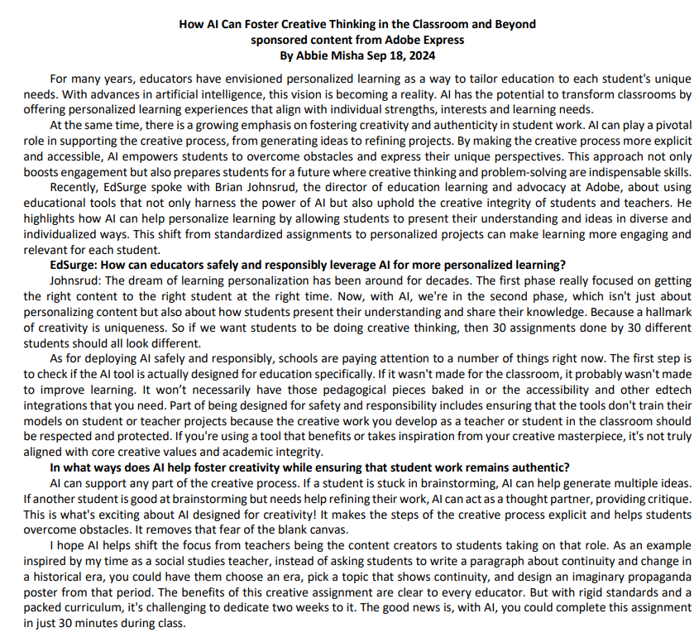
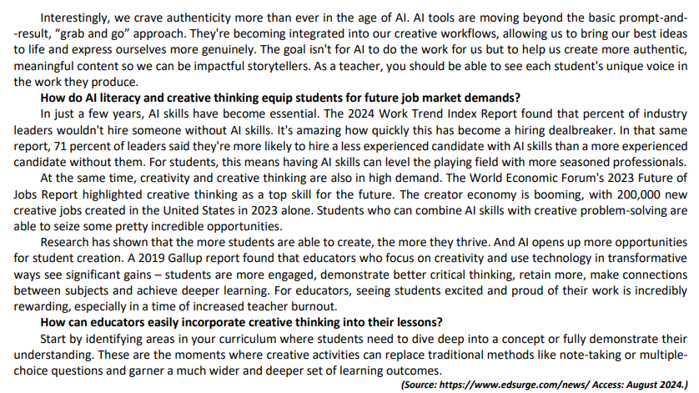
Read the statements about the text and choose the option that shows correctly which are true and which are false respectively.
( ) AI tools which are especially tailored for pedagogical purposes should be used by teachers if they want to enhance student’s creativity and authenticity.
( ) The standardization of tasks is one the goals of using AI in the classroom.
( ) Providing students with opportunities to develop their authenticity and creativity through the use of AI is useless considering future job market demands.
( ) Individualized learning experience is considered to be one the goals of using AI in the classroom.
Provas
Caderno Container