Foram encontradas 45.388 questões.
Read text I and then answer the questions.
TEXT I
“All crimes are not created equal in the harm they cause: homicide is many times more harmful than shoplifting but in crime statistics where offences are counted by number, they appear equivalent. For example, in the UK for the year ending September 2019, there were 3,578,000 incidents of theft and 729 homicides (Office for National Statistics, 2019). An increase of 500 thefts would be a small change in the overall number of thefts and have little impact on police resources. 500 extra homicides would have large consequences both for the harm caused and the impact on police resources. In a number-only count, the additional 500 thefts or homicides would result in the same overall number of crimes, yet clearly the impacts are disparate.
This reality has led to the proposition of a “Harm Index” to measure how harmful different crimes are in proportion to the others. This approach adds a larger weight to more harmful crimes (e.g. homicide, rape and grievous bodily harm with intent), distinguishing them from less harmful types of crime (e.g. minor thefts, criminal damage and common assault). Practically, adoption of a harm index can allow targeting of the highest-harm places, the most harmful offenders, the most harmed victims, and can assist in identifying victim-offenders. Experimentally, use of a harm index can add an additional dimension to the usual measures of success or failure, by considering harm prevented as well as reductions in prevalence or frequency. For the police, creation of harm index could allow them to invest scarce resources in proportion to the harm of each offence type.
Sherman, Neyroud and Neyroud (2016) propose that any index needs to meet three requirements in order to be considered a legitimate measure of harm: An index must meet a democratic standard, be reliable and also be adopted at minimal cost to the end user. To meet these requirements, Sherman, Neyroud and Neyroud (2016) opted for using sentence starting points rather than maximum or average actual sentences. The sentencing starting point is used to calculate crime harm as it provides a baseline penalty relative to the crime. We propose that it is a better measure of harm caused by the crime than average actual sentences, which are offender-focused and thus substantially affected by previous offending history.
The Cambridge Crime Harm Consensus proposes creation of seven statistics for counting crime, usefully including separation of historic crime reports, creation of a harm detection fraction and separation of public reported crime and those detected by proactive police activity, with the aim of providing the public with a more reliable and realistic assessment of trends, patterns and differences in public safety.
Counting crime by harm is an idea that has spread beyond the United Kingdom with indices published for Denmark (Andersen and Mueller-Johnson, 2018), Sweden (Karrholm et al. 2020), Western Australia (House and Neyroud, 2018), California (Mitchell, 2017), New Zealand and other countries.”
Cambridge Centre for Evidence-Based Policing. Available at: https://www.cambridge-ebp.co.uk/the-chi Accessed on: June 30, 2024.
What does the text I suggest as a better measure to calculate the crime harm?
Provas

Read text I and then answer the questions.
TEXT I
“All crimes are not created equal in the harm they cause: homicide is many times more harmful than shoplifting but in crime statistics where offences are counted by number, they appear equivalent. For example, in the UK for the year ending September 2019, there were 3,578,000 incidents of theft and 729 homicides (Office for National Statistics, 2019). An increase of 500 thefts would be a small change in the overall number of thefts and have little impact on police resources. 500 extra homicides would have large consequences both for the harm caused and the impact on police resources. In a number-only count, the additional 500 thefts or homicides would result in the same overall number of crimes, yet clearly the impacts are disparate.
This reality has led to the proposition of a “Harm Index” to measure how harmful different crimes are in proportion to the others. This approach adds a larger weight to more harmful crimes (e.g. homicide, rape and grievous bodily harm with intent), distinguishing them from less harmful types of crime (e.g. minor thefts, criminal damage and common assault). Practically, adoption of a harm index can allow targeting of the highest-harm places, the most harmful offenders, the most harmed victims, and can assist in identifying victim-offenders. Experimentally, use of a harm index can add an additional dimension to the usual measures of success or failure, by considering harm prevented as well as reductions in prevalence or frequency. For the police, creation of harm index could allow them to invest scarce resources in proportion to the harm of each offence type.
Sherman, Neyroud and Neyroud (2016) propose that any index needs to meet three requirements in order to be considered a legitimate measure of harm: An index must meet a democratic standard, be reliable and also be adopted at minimal cost to the end user. To meet these requirements, Sherman, Neyroud and Neyroud (2016) opted for using sentence starting points rather than maximum or average actual sentences. The sentencing starting point is used to calculate crime harm as it provides a baseline penalty relative to the crime. We propose that it is a better measure of harm caused by the crime than average actual sentences, which are offender-focused and thus substantially affected by previous offending history.
The Cambridge Crime Harm Consensus proposes creation of seven statistics for counting crime, usefully including separation of historic crime reports, creation of a harm detection fraction and separation of public reported crime and those detected by proactive police activity, with the aim of providing the public with a more reliable and realistic assessment of trends, patterns and differences in public safety.
Counting crime by harm is an idea that has spread beyond the United Kingdom with indices published for Denmark (Andersen and Mueller-Johnson, 2018), Sweden (Karrholm et al. 2020), Western Australia (House and Neyroud, 2018), California (Mitchell, 2017), New Zealand and other countries.”
Cambridge Centre for Evidence-Based Policing. Available at: https://www.cambridge-ebp.co.uk/the-chi Accessed on: June 30, 2024.
According to the text I, why is a "Harm Index" proposed for measuring crimes?
Provas
Disciplina: Inglês (Língua Inglesa)
Banca: DIRENS Aeronáutica
Orgão: EPCAR
Read text IV to answer question.
TEXT IV
I Was Here – Daine Warren
I wanna leave my footprints on the sands of time
Know there was something that meant something that I left
behind
When I leave this world, I'll leave no regrets
Leave something to remember, so they won't forget
I was here
I lived, I loved
I was here
I did, I've done everything that I wanted
And it was more than I thought it would be
I will leave my mark so everyone will know lt
I was here
I wanna say I lived each day until I die
And know that I meant something in somebody's life
The hearts that I have touched will be the proof that I leave
That I made a difference, and this world will see
Adapted from: (https://www.letrasdemusicas.
fm/beyonce/i-was-here.) Accessed on March 06th, 2024
Concerning the underlined pronouns,
Provas
Disciplina: Inglês (Língua Inglesa)
Banca: DIRENS Aeronáutica
Orgão: EPCAR
Read text IV to answer question.
TEXT IV
I Was Here – Daine Warren
I wanna leave my footprints on the sands of time
Know there was something that meant something that I left
behind
When I leave this world, I'll leave no regrets
Leave something to remember, so they won't forget
I was here
I lived, I loved
I was here
I did, I've done everything that I wanted
And it was more than I thought it would be
I will leave my mark so everyone will know lt
I was here
I wanna say I lived each day until I die
And know that I meant something in somebody's life
The hearts that I have touched will be the proof that I leave
That I made a difference, and this world will see
Adapted from: (https://www.letrasdemusicas.
fm/beyonce/i-was-here.) Accessed on March 06th, 2024
Choose the sentence that best relates to the text:
Provas
Disciplina: Inglês (Língua Inglesa)
Banca: DIRENS Aeronáutica
Orgão: EPCAR
Read text IV to answer question.
TEXT IV
I Was Here – Daine Warren
I wanna leave my footprints on the sands of time
Know there was something that meant something that I left
behind
When I leave this world, I'll leave no regrets
Leave something to remember, so they won't forget
I was here
I lived, I loved
I was here
I did, I've done everything that I wanted
And it was more than I thought it would be
I will leave my mark so everyone will know lt
I was here
I wanna say I lived each day until I die
And know that I meant something in somebody's life
The hearts that I have touched will be the proof that I leave
That I made a difference, and this world will see
Adapted from: (https://www.letrasdemusicas.
fm/beyonce/i-was-here.) Accessed on March 06th, 2024
Consider the passages below:
“I wanna leave my footprints on the sands of time”
“Leave something to remember, so they won’t forget”
It’s possible to understand that
Provas
Disciplina: Inglês (Língua Inglesa)
Banca: DIRENS Aeronáutica
Orgão: EPCAR
Consider texts I and III to answer question.
TEXT I
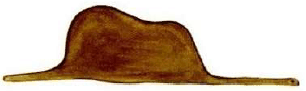
Drawing Number One
“I showed the grown-ups my masterpiece, and I asked them if my drawing scared them. They answered, ‘Why be scared of a hat?’ My drawing was not a picture of a hat. It was a picture of a boa constrictor digesting an elephant. Then I drew the inside of the boa constrictor, so the grownups could understand. They always need explanations. My Drawing Number Two looked like this:
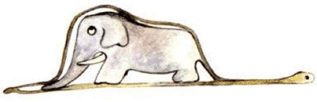
Drawing Number Two
The grown-ups' advised me to put away my drawings of boa constrictors, outside or inside, and apply myself instead to geography, history, arithmetic, and grammar. That is why, I abandoned, at the age of six, a magnificent career as an artist. I had been discouraged by the failure of my Drawing Number One and of my Drawing Number Two. Grown-ups never understand anything by themselves, and it is exhausting for children to have to provide explanations over and over again. So then I had to choose another career, and I learned to pilot airplanes. I have flown almost everywhere in the world. And, as a matter of fact, geography has been a big help to me. I could tell China from Arizona at first glance, which is very useful if you get lost during the night. So I have had in the course of my life, lots of encounters with lots of serious people. I have spent lots of time with grown-ups. I have seen them at close range... which hasn’t much improved my opinion of them.”
Source: SAINT-EXUPÉRY, Antoine. The little Prince. New York:
Mariner Books, 1943. Translated from French by Richard Howard.
TEXT III
The world is changing
Posted on April 4, 2020 by Sandy Millin
The title of this week’s post is inspired by this cartoon from Michael Leunig which appeared on my Facebook stream this week:
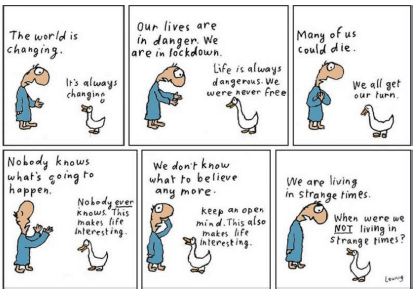
Adapted from: https://sandymillin.wordpress.com/2020/04/04 /the-world-is-changing/ Accessed on March 06th, 2024
According to both texts we CANNOT state that
Provas
Disciplina: Inglês (Língua Inglesa)
Banca: DIRENS Aeronáutica
Orgão: EPCAR
Read text III to answer question.
TEXT III
The world is changing
Posted on April 4, 2020 by Sandy Millin
The title of this week’s post is inspired by this cartoon from Michael Leunig which appeared on my Facebook stream this week:
Adapted from: https://sandymillin.wordpress.com/2020/04/04 /the-world-is-changing/ Accessed on March 06th, 2024
The underlined word “ever”
Provas
Disciplina: Inglês (Língua Inglesa)
Banca: DIRENS Aeronáutica
Orgão: EPCAR
Read text III to answer question.
TEXT III
The world is changing
Posted on April 4, 2020 by Sandy Millin
The title of this week’s post is inspired by this cartoon from Michael Leunig which appeared on my Facebook stream this week:
Adapted from: https://sandymillin.wordpress.com/2020/04/04 /the-world-is-changing/ Accessed on March 06th, 2024
The duck from the comic strip thinks life is
Provas
Disciplina: Inglês (Língua Inglesa)
Banca: DIRENS Aeronáutica
Orgão: EPCAR
Read text III to answer question.
TEXT III
The world is changing
Posted on April 4, 2020 by Sandy Millin
The title of this week’s post is inspired by this cartoon from Michael Leunig which appeared on my Facebook stream this week:
Adapted from: https://sandymillin.wordpress.com/2020/04/04 /the-world-is-changing/ Accessed on March 06th, 2024
Read the sentences and choose TRUE or FALSE:
( ) one of them is afraid of death, the other treats the topic as ordinary.
( ) life’s unpredictability is seen as positive by one of the characters.
( ) according to the characters, life is more dangerous now than in the past.
( ) the man is skeptical whereas the duck is realistic.
( ) both characters are trying to cheer each other up.
Mark the correct option:
Provas
Disciplina: Inglês (Língua Inglesa)
Banca: DIRENS Aeronáutica
Orgão: EPCAR
Read texts I and II to answer question.
TEXT I
Drawing Number One
“I showed the grown-ups my masterpiece, and I asked them if my drawing scared them. They answered, ‘Why be scared of a hat?’ My drawing was not a picture of a hat. It was a picture of a boa constrictor digesting an elephant. Then I drew the inside of the boa constrictor, so the grownups could understand. They always need explanations. My Drawing Number Two looked like this:
Drawing Number Two
The grown-ups' advised me to put away my drawings of boa constrictors, outside or inside, and apply myself instead to geography, history, arithmetic, and grammar. That is why, I abandoned, at the age of six, a magnificent career as an artist. I had been discouraged by the failure of my Drawing Number One and of my Drawing Number Two. Grown-ups never understand anything by themselves, and it is exhausting for children to have to provide explanations over and over again. So then I had to choose another career, and I learned to pilot airplanes. I have flown almost everywhere in the world. And, as a matter of fact, geography has been a big help to me. I could tell China from Arizona at first glance, which is very useful if you get lost during the night. So I have had in the course of my life, lots of encounters with lots of serious people. I have spent lots of time with grown-ups. I have seen them at close range... which hasn’t much improved my opinion of them.”
Source: SAINT-EXUPÉRY, Antoine. The little Prince. New York:
Mariner Books, 1943. Translated from French by Richard Howard.
TEXT II
Around the World with Barrier Breaking Women Pilots
Oct 31, 2021
By Dorothy Cochrane and P. Ramirez
We know the names of early American women pilots like Bessie Coleman and Amelia Earhart. However, across the globe, women pilots were also taking to the skies and setting records. Travel across with these stories of two such pilots.
Part I
Hélène Dutrieu, Belgium
Hélène Dutrieu of Belgium was known as the "girl hawk" of aviation because she was the most daring and accomplished woman pilot of her time. She first soloed in France in 1909 and within a year was setting altitude and distance records. She thrilled the world in September of 1910 by flying non-stop from Ostend to Bruges, Belgium, and she became the first Belgian woman to receive a pilot license on November 25, 1910. During her second year as an aviator she narrowly escaped death twice. She visited the United States in 1911, making her American debut at the Nassau Boulevard Aviation meeting. Back in Europe, Dutrieu won France's Coupe Femina for the women's world nonstop light record on December 31, 1911, flying 158 miles (254 kilometers) in 178 minutes. In Florence, Italy, she was the only woman in a field of 15 and outflew all of her male competitors to win the King's Cup. In 1913 the French government awarded Dutrieu the Legion of Honor for her achievements. She also became an ambulance driver and later a director of a military hospital.
Part II
Jean Batten, New Zealand
Jean Batten grew up in New Zealand and developed a love for aviation that overcame her desire to be a concert pianist. Her interest in flying stemmed from the 1919 England to Australia flight by Ross and Keith Smith, and later solo flights. Batten's father did not approve of her aviation enthusiasm but she convinced her mother to move to England with her and help her become a pilot. She received her license and her commercial rating at the London Aeroplane Club at Stag Lane and then began planning for a flight from England to Australia. Her first two attempts failed, but she succeeded in 1934, flying a Gipsy Moth. Batten became an instant sensation in Australia, New Zealand, and in England upon her return flight the next year (it was the first roundtrip by a woman). In 1935, she broke James Mollison's records for England to Brazil and Dakar to Natal while becoming the first woman to solo across the South Atlantic. Then, in 1936, she realized her dream of flying solo from England to New Zealand in a Percival Gull in 11 days and earned her second consecutive Harmon Trophy, having shared the first one in 1935 with Amelia Earhart. In 1937, she set another record for an Australia to England flight. Unable to obtain a flying job during World War II, Batten gave up flying and eventually became a recluse, living with her mother in Majorca, Spain, and appearing in public only for a few anniversary events. In 1937, she published her autobiography, My Life.
Adapted from: RAMIREZ. Around the World with Barrier
Breaking Women Pilots:https://airandspace.si.edu
/stories/editorial/around-world-barrier-breaking-women-
pilotshttps:// airandspace.si.edu/stories/editorial/around-world-barrier-
breaking- women-pilots. Accessed on February 20th 2024
Check an event that is common for both texts:
Provas
Caderno Container