Foram encontradas 45.244 questões.
Disciplina: Inglês (Língua Inglesa)
Banca: UEPB
Orgão: Pref. Alagoa Nova-PB
Provas

Literature, Environment, Activism – Module description
The Literature, Environment, Activism module explores the creative and quietly subversive political performances of environmental writing-as-advocacy, within a predominantly North American context. This module explores how nature and environmental writing can be politicised in defence of local, state, and federal land protections — whether by writers themselves, or by conservationists, activists, policymakers, and others. We will study the intersections of page and place through a selection of nonfiction environmental texts from the mid-nineteenth century onwards that have informed and moulded on-the-ground land conservation practices, or contributed to environmental regulation and legislation. We will also look at how fiction — such as climate fiction, speculative fiction, and graphic novels — has emerged as another platform for commentary on the environmental condition. This module offers geographical approaches and tools to help students explore the contributions of environmental writing to conservation campaigns, and its place in wider environmental activism and protest narratives. We will ask questions of ‘literature,’ ‘environment,’ and ‘activism,’ and the intersections between them.
Internet: <geography.exeter.ac.uk> (adapted).
According to the previous text, choose the correct option.
The passage “We will ask questions of ‘literature,’ ‘environment,’ and ‘activism,’ and the intersections between them”, at the end of the text, means that students will
Provas
Literature, Environment, Activism – Module description
The Literature, Environment, Activism module explores the creative and quietly subversive political performances of environmental writing-as-advocacy, within a predominantly North American context. This module explores how nature and environmental writing can be politicised in defence of local, state, and federal land protections — whether by writers themselves, or by conservationists, activists, policymakers, and others. We will study the intersections of page and place through a selection of nonfiction environmental texts from the mid-nineteenth century onwards that have informed and moulded on-the-ground land conservation practices, or contributed to environmental regulation and legislation. We will also look at how fiction — such as climate fiction, speculative fiction, and graphic novels — has emerged as another platform for commentary on the environmental condition. This module offers geographical approaches and tools to help students explore the contributions of environmental writing to conservation campaigns, and its place in wider environmental activism and protest narratives. We will ask questions of ‘literature,’ ‘environment,’ and ‘activism,’ and the intersections between them.
Internet: <geography.exeter.ac.uk> (adapted).
According to the previous text, judge the item below.
The module focuses on American authors who wrote fiction during the 19th century.
Provas
Literature, Environment, Activism – Module description
The Literature, Environment, Activism module explores the creative and quietly subversive political performances of environmental writing-as-advocacy, within a predominantly North American context. This module explores how nature and environmental writing can be politicised in defence of local, state, and federal land protections — whether by writers themselves, or by conservationists, activists, policymakers, and others. We will study the intersections of page and place through a selection of nonfiction environmental texts from the mid-nineteenth century onwards that have informed and moulded on-the-ground land conservation practices, or contributed to environmental regulation and legislation. We will also look at how fiction — such as climate fiction, speculative fiction, and graphic novels — has emerged as another platform for commentary on the environmental condition. This module offers geographical approaches and tools to help students explore the contributions of environmental writing to conservation campaigns, and its place in wider environmental activism and protest narratives. We will ask questions of ‘literature,’ ‘environment,’ and ‘activism,’ and the intersections between them.
Internet: <geography.exeter.ac.uk> (adapted).
According to the previous text, judge the item below.
The text informs the reader about a course offered to students interested in writing their own literary works on nature.
Provas
Literature, Environment, Activism – Module description
The Literature, Environment, Activism module explores the creative and quietly subversive political performances of environmental writing-as-advocacy, within a predominantly North American context. This module explores how nature and environmental writing can be politicised in defence of local, state, and federal land protections — whether by writers themselves, or by conservationists, activists, policymakers, and others. We will study the intersections of page and place through a selection of nonfiction environmental texts from the mid-nineteenth century onwards that have informed and moulded on-the-ground land conservation practices, or contributed to environmental regulation and legislation. We will also look at how fiction — such as climate fiction, speculative fiction, and graphic novels — has emerged as another platform for commentary on the environmental condition. This module offers geographical approaches and tools to help students explore the contributions of environmental writing to conservation campaigns, and its place in wider environmental activism and protest narratives. We will ask questions of ‘literature,’ ‘environment,’ and ‘activism,’ and the intersections between them.
Internet: <geography.exeter.ac.uk> (adapted).
According to the previous text, judge the item below.
At the beginning of the text, the expression “quietly subversive” means that the authors associated to environmental writing establish their point of view on environmental topics in a discreet and subtle way.
Provas
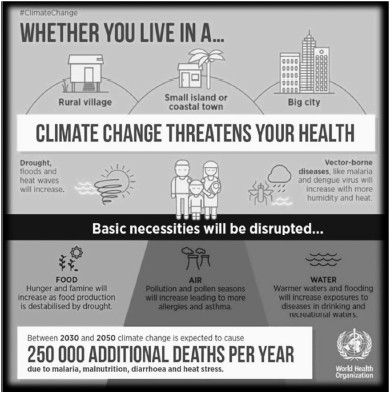
World Health Organization. Basic Necessities Disrupted. Internet: <www.who.in>.
Judge the item below based on the preceding infographic.
With the infographic, the World Health Organization wants to inform that two hundred and fifty thousand people will die by 2050.
Provas
World Health Organization. Basic Necessities Disrupted. Internet: <www.who.in>.
Judge the item below based on the preceding infographic.
The modal verb “will” is used in most sentences of the infographic because the World Health Organization is showing the reader some projections about the future of the world regarding climate change.
Provas
World Health Organization. Basic Necessities Disrupted. Internet: <www.who.in>.
Judge the item below based on the preceding infographic.
One of the main goals of the text is to draw attention to the relationship between vector-borne diseases and the lack of clean water.
Provas
World Health Organization. Basic Necessities Disrupted. Internet: <www.who.in>.
Judge the item below based on the preceding infographic.
According to the infographic, the entire population will suffer the effects of the climate change irrespective of where people live.
Provas
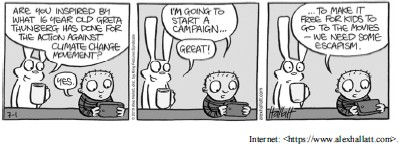
Regarding the preceding comic strip and the conversation between the rabbit and the kid, judge the following item.
The passage “to make it free for kids to go to the movies” (third box) can be correctly rewritten as to make kids free to go to the cinema.
Provas
Caderno Container