Foram encontradas 45.123 questões.
Generic catastrophic poverty when selfish investors exploit a degradable common resource
Game theory deals with situations in which a number of agents compete with each other, with each participant trying to maximize his or her own profit individually. One speaks of a "Nash equilibrium" if players cannot increase their returns further. The "Tragedy of the Commons" is a game theoretical scenario in which the actors do not compete directly, but indirectly: If someone takes a piece of a common pie, there will be less for everybody else.
Instead of investigating how to avoid the "Tragedy of the Commons," Claudius Gros from Goethe University's Institute for Theoretical Physics examined the resulting Nash equilibrium, with unexpected results: If a common good is divided more or less equally among N interested parties, then each receives a share of the order 1/N. However, the respective investment costs still need to be deducted.
Gros' calculations show that, in equilibrium, the actors increase their engagement until the resulting investment costs almost reach the value of the resources the individual investor can secure for her- or himself. Mathematically, the theoretical physicist was able to show that the final profit of the individual investor scales as 1/N2.
The original expectation, that investors each receive a proportional share from the resource, remains correct, as Gros' research shows. However, this does not translate into an overall return of the same proportion, which is smaller by a power in the number of investors. Gros denotes the dramatic deterioration of the net profit as "catastrophic poverty," as it implies that unregulated competition drives the individual actor close to the profitability limit, viz to the subsistence level.
Similarly, Gros was able to show that catastrophic poverty can be avoided when the actors cooperate with each other.
Cooperation leads to a net profit corresponding to the number of investors in simple power, the classical result.
The result of the investigations is therefore that the "Tragedy of the Commons" can cause substantially more damage than previously assumed. Uncontrolled access not only leads to a potentially excessive exploitation of the resource, a topic that has been the focus of many previous studies. In addition, investors suffer themselves when only maximizing their own profits.
GROS, Claudius. Generic catastrophic poverty when selfish investors exploit a degradable
common resource. Royal Society Open Science (online), 08 Fev. 2023 (adaptado)
Segundo o estudo, a "Tragédia dos Comuns" pode trazer mais prejuízos do que aqueles considerados inicialmente e pode levar aos seguintes efeitos:
Provas

Generic catastrophic poverty when selfish investors exploit a degradable common resource
Game theory deals with situations in which a number of agents compete with each other, with each participant trying to maximize his or her own profit individually. One speaks of a "Nash equilibrium" if players cannot increase their returns further. The "Tragedy of the Commons" is a game theoretical scenario in which the actors do not compete directly, but indirectly: If someone takes a piece of a common pie, there will be less for everybody else.
Instead of investigating how to avoid the "Tragedy of the Commons," Claudius Gros from Goethe University's Institute for Theoretical Physics examined the resulting Nash equilibrium, with unexpected results: If a common good is divided more or less equally among N interested parties, then each receives a share of the order 1/N. However, the respective investment costs still need to be deducted.
Gros' calculations show that, in equilibrium, the actors increase their engagement until the resulting investment costs almost reach the value of the resources the individual investor can secure for her- or himself. Mathematically, the theoretical physicist was able to show that the final profit of the individual investor scales as 1/N2.
The original expectation, that investors each receive a proportional share from the resource, remains correct, as Gros' research shows. However, this does not translate into an overall return of the same proportion, which is smaller by a power in the number of investors. Gros denotes the dramatic deterioration of the net profit as "catastrophic poverty," as it implies that unregulated competition drives the individual actor close to the profitability limit, viz to the subsistence level.
Similarly, Gros was able to show that catastrophic poverty can be avoided when the actors cooperate with each other.
Cooperation leads to a net profit corresponding to the number of investors in simple power, the classical result.
The result of the investigations is therefore that the "Tragedy of the Commons" can cause substantially more damage than previously assumed. Uncontrolled access not only leads to a potentially excessive exploitation of the resource, a topic that has been the focus of many previous studies. In addition, investors suffer themselves when only maximizing their own profits.
GROS, Claudius. Generic catastrophic poverty when selfish investors exploit a degradable
common resource. Royal Society Open Science (online), 08 Fev. 2023 (adaptado)
O termo "each" refere-se a
Provas
Generic catastrophic poverty when selfish investors exploit a degradable common resource
Game theory deals with situations in which a number of agents compete with each other, with each participant trying to maximize his or her own profit individually. One speaks of a "Nash equilibrium" if players cannot increase their returns further. The "Tragedy of the Commons" is a game theoretical scenario in which the actors do not compete directly, but indirectly: If someone takes a piece of a common pie, there will be less for everybody else.
Instead of investigating how to avoid the "Tragedy of the Commons," Claudius Gros from Goethe University's Institute for Theoretical Physics examined the resulting Nash equilibrium, with unexpected results: If a common good is divided more or less equally among N interested parties, then each receives a share of the order 1/N. However, the respective investment costs still need to be deducted.
Gros' calculations show that, in equilibrium, the actors increase their engagement until the resulting investment costs almost reach the value of the resources the individual investor can secure for her- or himself. Mathematically, the theoretical physicist was able to show that the final profit of the individual investor scales as 1/N2.
The original expectation, that investors each receive a proportional share from the resource, remains correct, as Gros' research shows. However, this does not translate into an overall return of the same proportion, which is smaller by a power in the number of investors. Gros denotes the dramatic deterioration of the net profit as "catastrophic poverty," as it implies that unregulated competition drives the individual actor close to the profitability limit, viz to the subsistence level.
Similarly, Gros was able to show that catastrophic poverty can be avoided when the actors cooperate with each other.
Cooperation leads to a net profit corresponding to the number of investors in simple power, the classical result.
The result of the investigations is therefore that the "Tragedy of the Commons" can cause substantially more damage than previously assumed. Uncontrolled access not only leads to a potentially excessive exploitation of the resource, a topic that has been the focus of many previous studies. In addition, investors suffer themselves when only maximizing their own profits.
GROS, Claudius. Generic catastrophic poverty when selfish investors exploit a degradable
common resource. Royal Society Open Science (online), 08 Fev. 2023 (adaptado)
De acordo com o texto, a "Tragédia dos Comuns" pode ser definida como
Provas
'A Spiraling Loop of Feedbacks':
Worst-Case Scenario for Amazon Rainforest
A paper to be published in the Journal Science on January 27 has found that humans have degraded more than one-third of the remaining trees in the Amazon rainforest. This degradation could eventually lead to "a spiraling loop of feedbacks," Jos Barlow, a professor of conservation science at Lancaster University in the U.K. and co-author of the paper, told Newsweek.
Up to 38 percent of the remaining Amazon has been affected by human actions, researchers from Brazil's University of Campinas (Unicamp), the Amazon Environmental Research Institute (IPAM), National Institute for Space Research (INPE), and Lancaster University found.
The degradation of this area - equivalent to 5.5 times the size of the state of California - releases carbon emissions equivalent to or greater than those from deforestation.
The Amazon contributes 16 percent of all the land-based photosynthesis in the world, and strongly regulates global carbon and water cycles, sucking in carbon dioxide and producing oxygen. Additionally, despite only covering around 0.5 percent of the Earth's surface, the Amazon is home to over 10 percent of all named plant and vertebrate species on Earth.
"Healthy rainforests provide amazing habitat for biodiversity - this is what the Amazon is most famous for," Sally Thompson, an ecohydrologist at The University of Western Australia, told Newsweek. "They usually support clean water in rivers, make it rain, and cool the surrounding area. You can hunt, harvest timber or foods sustainably from healthy and wellmanaged forests. And a healthy forest can often recover from disturbance. Degraded forests aren't as good at doing any of those things, and often they struggle to recover from disturbance."
Deforestation involves a loss of the forest canopy and a change in land use (e.g., from forest to agriculture or urban land use), while degradation is a process affecting the remaining forests. Degradation essentially means that there is still forest in place but it is not as healthy or as good at providing benefits for the environment or for people.
THOMSON, Jess. 'A Spiraling Loop of Feedbacks': Worst-Case Scenario
for Amazon Rainforest. Newsweek (online), 26 jan. 2023 (adaptado).
Leia a sentença a seguir:
"Up to 38 percent of the remaining Amazon has been affected by human actions, researchers from Brazil's University of Campinas (Unicamp), the Amazon Environmental Research Institute (IPAM), National Institute for Space Research (INPE), and Lancaster University found."
Assinale a alternativa que apresenta sentença cujo uso da expressão "up to" é semelhante ao empregado no trecho apresentado.
Provas
'A Spiraling Loop of Feedbacks':
Worst-Case Scenario for Amazon Rainforest
A paper to be published in the Journal Science on January 27 has found that humans have degraded more than one-third of the remaining trees in the Amazon rainforest. This degradation could eventually lead to "a spiraling loop of feedbacks," Jos Barlow, a professor of conservation science at Lancaster University in the U.K. and co-author of the paper, told Newsweek.
Up to 38 percent of the remaining Amazon has been affected by human actions, researchers from Brazil's University of Campinas (Unicamp), the Amazon Environmental Research Institute (IPAM), National Institute for Space Research (INPE), and Lancaster University found.
The degradation of this area - equivalent to 5.5 times the size of the state of California - releases carbon emissions equivalent to or greater than those from deforestation.
The Amazon contributes 16 percent of all the land-based photosynthesis in the world, and strongly regulates global carbon and water cycles, sucking in carbon dioxide and producing oxygen. Additionally, despite only covering around 0.5 percent of the Earth's surface, the Amazon is home to over 10 percent of all named plant and vertebrate species on Earth.
"Healthy rainforests provide amazing habitat for biodiversity - this is what the Amazon is most famous for," Sally Thompson, an ecohydrologist at The University of Western Australia, told Newsweek. "They usually support clean water in rivers, make it rain, and cool the surrounding area. You can hunt, harvest timber or foods sustainably from healthy and wellmanaged forests. And a healthy forest can often recover from disturbance. Degraded forests aren't as good at doing any of those things, and often they struggle to recover from disturbance."
Deforestation involves a loss of the forest canopy and a change in land use (e.g., from forest to agriculture or urban land use), while degradation is a process affecting the remaining forests. Degradation essentially means that there is still forest in place but it is not as healthy or as good at providing benefits for the environment or for people.
THOMSON, Jess. 'A Spiraling Loop of Feedbacks': Worst-Case Scenario
for Amazon Rainforest. Newsweek (online), 26 jan. 2023 (adaptado).
De acordo com o texto, a degradação e o desmatamento são processos diferentes, pois
Provas
'A Spiraling Loop of Feedbacks':
Worst-Case Scenario for Amazon Rainforest
A paper to be published in the Journal Science on January 27 has found that humans have degraded more than one-third of the remaining trees in the Amazon rainforest. This degradation could eventually lead to "a spiraling loop of feedbacks," Jos Barlow, a professor of conservation science at Lancaster University in the U.K. and co-author of the paper, told Newsweek.
Up to 38 percent of the remaining Amazon has been affected by human actions, researchers from Brazil's University of Campinas (Unicamp), the Amazon Environmental Research Institute (IPAM), National Institute for Space Research (INPE), and Lancaster University found.
The degradation of this area - equivalent to 5.5 times the size of the state of California - releases carbon emissions equivalent to or greater than those from deforestation.
The Amazon contributes 16 percent of all the land-based photosynthesis in the world, and strongly regulates global carbon and water cycles, sucking in carbon dioxide and producing oxygen. Additionally, despite only covering around 0.5 percent of the Earth's surface, the Amazon is home to over 10 percent of all named plant and vertebrate species on Earth.
"Healthy rainforests provide amazing habitat for biodiversity - this is what the Amazon is most famous for," Sally Thompson, an ecohydrologist at The University of Western Australia, told Newsweek. "They usually support clean water in rivers, make it rain, and cool the surrounding area. You can hunt, harvest timber or foods sustainably from healthy and wellmanaged forests. And a healthy forest can often recover from disturbance. Degraded forests aren't as good at doing any of those things, and often they struggle to recover from disturbance."
Deforestation involves a loss of the forest canopy and a change in land use (e.g., from forest to agriculture or urban land use), while degradation is a process affecting the remaining forests. Degradation essentially means that there is still forest in place but it is not as healthy or as good at providing benefits for the environment or for people.
THOMSON, Jess. 'A Spiraling Loop of Feedbacks': Worst-Case Scenario
for Amazon Rainforest. Newsweek (online), 26 jan. 2023 (adaptado).
De acordo com o texto, a degradação da Floresta Amazônica tem como decorrência
Provas
TEXTO PARA A QUESTÃO.
We've been given no shortage of digital tools that should, in theory, help us work better, with more focus and efficiency, and connect us more easily with our colleagues. Instead, email, instant messaging, remote-meeting apps, work-flow and project-management software can feel like buckets with holes in the bottom, maddeningly inadequate to the task of keeping us from drowning in work It's clear that something in the great digital-workplace experiment has gone wrong. Or maybe it's more accurate to say that it's still too early to expect that we would have figured out how to make things go right. "We're working now with new technologies that only emerged in the late '90s," says Cal Newport, a Georgetown computer-science professor. "The idea that we immediately figured out the best way to use them is ahistorical. Of course we haven't gotten it right yet."
Disponível em http://www.nytimes.com (adaptado).
A expressão sublinhada no trecho "The idea that we immediately figured out the best way to use them is ahistorical" pode ser substiuída, sem prejuízo do sentido, por
Provas
TEXTO PARA A QUESTÃO.
We've been given no shortage of digital tools that should, in theory, help us work better, with more focus and efficiency, and connect us more easily with our colleagues. Instead, email, instant messaging, remote-meeting apps, work-flow and project-management software can feel like buckets with holes in the bottom, maddeningly inadequate to the task of keeping us from drowning in work It's clear that something in the great digital-workplace experiment has gone wrong. Or maybe it's more accurate to say that it's still too early to expect that we would have figured out how to make things go right. "We're working now with new technologies that only emerged in the late '90s," says Cal Newport, a Georgetown computer-science professor. "The idea that we immediately figured out the best way to use them is ahistorical. Of course we haven't gotten it right yet."
Disponível em http://www.nytimes.com (adaptado).
No trecho "Or maybe it's more accurate to say that it's still too early to expect that we would have figured out how to make things go right", o termo sublinhado equivale, em português, a
Provas
TEXTO PARA A QUESTÃO.
We've been given no shortage of digital tools that should, in theory, help us work better, with more focus and efficiency, and connect us more easily with our colleagues. Instead, email, instant messaging, remote-meeting apps, work-flow and project-management software can feel like buckets with holes in the bottom, maddeningly inadequate to the task of keeping us from drowning in work It's clear that something in the great digital-workplace experiment has gone wrong. Or maybe it's more accurate to say that it's still too early to expect that we would have figured out how to make things go right. "We're working now with new technologies that only emerged in the late '90s," says Cal Newport, a Georgetown computer-science professor. "The idea that we immediately figured out the best way to use them is ahistorical. Of course we haven't gotten it right yet."
Disponível em http://www.nytimes.com (adaptado).
Observe o seguinte trecho do texto:
"Instead, email, instant messaging, remote-meeting apps, work-flow and project-management software can feel like buckets with holes in the bottom [...]".
O emprego do termo "instead", no contexto em que se encontra, indica que, no ambiente de trabalho, as ferramentas digitais
Provas
TEXTO PARA A QUESTÃO.
Considere a charge de Sarah Kempa:
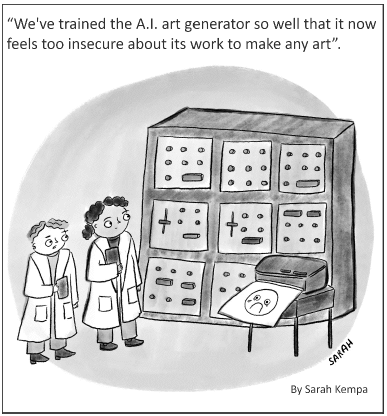
Revista New Yorker. 11/01/ 2023
Considerando o segmento "so well that", depreende-se que o termo "that" introduz ideia de
Provas
Caderno Container