Foram encontradas 64 questões.
Uma onda estacionária é estabelecida em uma corda homogênea de comprimento !$ 2\pi \,m !$ , presa pelas extremidades, A e B, conforme figura abaixo.
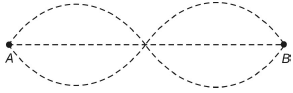
Considere que a corda esteja submetida a uma tensão de 10 N e que sua densidade linear de massa seja igual a 0,1 kg/m .
Nessas condições, a opção que apresenta um sistema massa-mola ideal, de constante elástica k, em N/m e massa m , em kg , que oscila em movimento harmônico simples na vertical com a mesma frequência da onda estacionária considerada é
Provas
Questão presente nas seguintes provas

Em um recipiente termicamente isolado de capacidade térmica 40,0 cal / °C e na temperatura de 25 °C são colocados 600 g de gelo a −10 °C e uma garrafa parcialmente cheia, contendo 2,0 L de refrigerante também a 25 °C , sob pressão normal.
Considerando a garrafa com capacidade térmica desprezível e o refrigerante com características semelhantes às da água, isto é, calor específico na fase líquida 1,0 cal / g °C e na fase sólida 0,5 cal / g °C , calor latente de fusão de 80,0 cal / g °C bem como densidade absoluta na fase líquida igual a 1,0 !$ g/ cm^3 !$ , a temperatura final de equilíbrio térmico do sistema, em °C, é
Provas
Questão presente nas seguintes provas
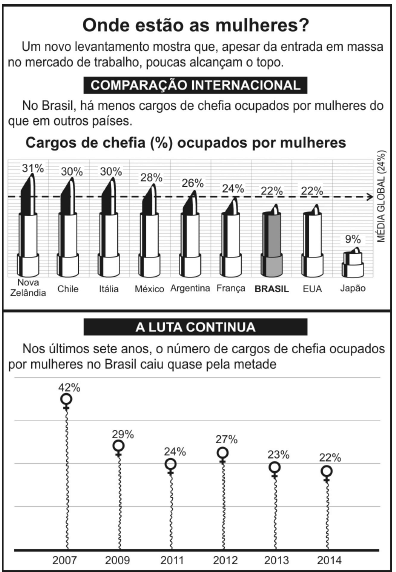
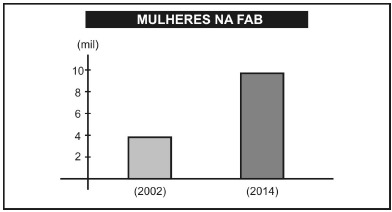
Para a responder a questão, leia o texto e analise os gráficos abaixo.
TEXTO III
PALAVRAS DO COMANDANTE
“As mulheres estão conquistando cada vez mais espaço na Força Aérea Brasileira. Só em pensar que, em 2002, o efetivo da FAB era composto por, apenas, 3.249 mulheres e que hoje em dia, já somam 9.250, isso mostra o quanto elas têm se esforçado para ajudar na defesa do país. (P) E, aos poucos, elas alcançam patentes cada vez mais altas. Já existem, inclusive, mulheres Tenente-Coronel e, este ano, as primeiras aviadoras chegam ao posto de Capitão. É bem possível que, no futuro, tenhamos mulheres Coronel e, quem sabe, possam chegar ao posto de Oficial-General.”
(NOTAER, ano XXXVII/nº3, março de 2014, p.3)
(Época, número 823, 10 de março de 2014. Editora Globo; p.64 -adaptado)
(NOTAER, ano XXXVII/nº3, março de 2014, p.7)
Marque a opção em que a reescrita de trechos retirados dos textos indicados ao lado de cada alternativa permanece de acordo com a norma padrão da língua portuguesa.
Provas
Questão presente nas seguintes provas
Directions: Answer question according to TEXT II.
TEXT II
JOBS OF THE FUTURE

“There is no future in any job. The future lies in the person
who holds the job.” – George W. Crane
One of my primary complaints with higher education is that they tend to prepare students for jobs of the past. Similarly, the best paying jobs of the future are all jobs that currently exist today. Many of them will still exist in the future, but with some changes as technology and communication systems make their impact.
As a rule of thumb, 60% of the jobs 10 years from now haven’t been invented yet. With that in mind, I’ve decided to put together a list of some jobs that will be in high demand in the future.
Jobs before 2020
Many of the changes we see today will cause new jobs to materialize quickly. This first section deals with new positions that will likely be developed within the next 10 years.
3D printing engineers – Classes in 3D printing are already being introduced into high schools and the demand for printer-produced products will rise quickly. The trend will be for these worker-less workshops to enter virtually different fields, at the same time, driving the need for competent technicians and engineers to design and maintain the next wave of this technology.
Nano-medics – Health professionals capable of working on the nano-level, both in designing diagnostics systems, remedies, and monitoring solutions will be in high demand.
Organ agents – The demand for transplantable organs is exploding and people who can track down and deliver healthy organs will be in hot demand.
Octogenarian service providers – As the population continues to age we will have record numbers of people living into their 80s, 90s, and 100s. This growing group of active oldsters will provide a demand for goods and services currently not being addressed in today’s marketplace.
Jobs in 2030 and beyond
A number of technologies currently on the drawing board will require a bit longer lead time before the industry comes into its own. Here are a few examples of these kinds of jobs:
Body part & limb makers – The organ agents listed before will quickly find themselves out of work as soon as we figure out how to efficiently grow and mass produce our own organs from scratch.
Earthquake forecasters – While scientists are developing skills to work with nanoscale precision on the earth’s surface, the best we can know about below the surface is blindfolded guesswork done with 100-mile precision. What we don’t know is literally killing us – over 226,000 killed in 2010 alone. But that will change over time as we begin to understand the inner working of the earth and accurately forecast when the next big quakes are about to hit.
“Heavy air” engineers – Compressed air is useful in a wide variety of ways. However, we have yet to figure out how to compress streams of air as they pass through our existing atmosphere. Once we do, it will create untold opportunity for non-surface based housing and transportation system, weather control, and other kinds of experimentation.
Final thoughts
The jobs and occupations listed above are just scratching the surface. This list is intended to help stretch your imagination and start you down a path of imagining your own future.
(Adapted from http://www.futuristspeaker.com/2011/11/55-jobs-of-the-future)
The text's main goal is to
Provas
Questão presente nas seguintes provas
Directions: Answer question according to TEXT I.
TEXT I
JOBS AT HIGH RISK
It is an invisible force that goes by many names. Computerization. Automation. Artificial intelligence. Technology. Innovation. And, everyone's favorite, ROBOTS.
Whatever name you prefer, some form of it has been stimulating progress and killing jobs — from tailors to paralegals — for centuries. But this time is different: nearly half of American jobs today could be automated in "a decade or two". The question is: which half?
Another way of posing the same question is: Where do machines work better than people? Tractors are more powerful than farmers. Robotic arms are stronger and more tireless than assembly-line workers. But in the past 30 years, software and robots have succeeded replacing a particular kind of occupation: the average-wage, middle-skill, routine-heavy worker, especially in manufacturing and office administration.
Indeed, it's projected that the next wave of computer progress will continue to endanger human work where it already has: manufacturing, administrative support, retail, and transportation. Most remaining factory jobs are "likely to diminish over the next decades". Cashiers, counter clerks, and telemarketers are similarly endangered. On the other hand, health care workers, people responsible for our safety, and
management positions are the least likely to be automated.
The next big thing
We might be on the edge of an innovating moment in robotics and artificial intelligence. Although the past 30 years have reduced the middle, high- and low-skill jobs have actually increased, as if protected from the invading armies of robots by their own moats. Higher-skill workers have been protected by a kind of social-intelligence moat. Computers are historically good at executing routines, but they're bad at finding patterns, communicating with people, and making decisions, which is what managers are paid to do. This is why some people think managers are, for the moment, one of the largest categories immune to the fast wave of AI.
Meanwhile, lower-skill workers have been protected by the Moravec moat. Hans Moravec was a futurist who pointed out that machine technology copied a savant infant: Machines could do long math equations instantly and beat anybody in chess, but they can't answer a simple question or walk up a flight of stairs. As a result, not skilled work done by people without much education (like home health care workers, or fast-food attendants) have been saved, too.
The human half
In the 19th century, new manufacturing technology replaced what was then skilled labor. In the second half of the 20th century, however, software technology took the place of median-salaried office work. The first wave showed that machines are better at assembling things. The second showed that machines are better at organizing things. Now data analytics and self-driving cars suggest they might be better at patternrecognition and driving. So what are we better at?
The safest industries and jobs are dominated by managers, health-care workers, and a super-category that includes education, media, and community service. One conclusion to draw from this is that humans are, and will always be, superior at working with, and caring for other humans. In this light, automation doesn't make the world worse. Far from it: it creates new opportunities for human creativity.
But robots are already creeping into diagnostics and surgeries. Schools are already experimenting with software that replaces teaching hours. The fact that some industries have been safe from automation for the last three decades doesn't guarantee that they'll be safe for the next one.
It would be anxious enough if we knew exactly which jobs are next in line for automation. The truth is scarier. We don't really have a clue.
(Adapted from http://www.businessinsider.com/robots-overtakingamerican-jobs-2014-1)
Glossary:
savant infant – a child with great knowledge and ability
to assemble – to make something by joining separate parts
to creep – to move slowly, quietly and carefully
One of the purposes of the text is to show that
Provas
Questão presente nas seguintes provas
Directions: Answer question according to TEXT II.
TEXT II
JOBS OF THE FUTURE
“There is no future in any job. The future lies in the person
who holds the job.” – George W. Crane
One of my primary complaints with higher education is that they tend to prepare students for jobs of the past. Similarly, the best paying jobs of the future are all jobs that currently exist today. Many of them will still exist in the future, but with some changes as technology and communication systems make their impact.
As a rule of thumb, 60% of the jobs 10 years from now haven’t been invented yet. With that in mind, I’ve decided to put together a list of some jobs that will be in high demand in the future.
Jobs before 2020
Many of the changes we see today will cause new jobs to materialize quickly. This first section deals with new positions that will likely be developed within the next 10 years.
3D printing engineers – Classes in 3D printing are already being introduced into high schools and the demand for printer-produced products will rise quickly. The trend will be for these worker-less workshops to enter virtually different fields, at the same time, driving the need for competent technicians and engineers to design and maintain the next wave of this technology.
Nano-medics – Health professionals capable of working on the nano-level, both in designing diagnostics systems, remedies, and monitoring solutions will be in high demand.
Organ agents – The demand for transplantable organs is exploding and people who can track down and deliver healthy organs will be in hot demand.
Octogenarian service providers – As the population continues to age we will have record numbers of people living into their 80s, 90s, and 100s. This growing group of active oldsters will provide a demand for goods and services currently not being addressed in today’s marketplace.
Jobs in 2030 and beyond
A number of technologies currently on the drawing board will require a bit longer lead time before the industry comes into its own. Here are a few examples of these kinds of jobs:
Body part & limb makers – The organ agents listed before will quickly find themselves out of work as soon as we figure out how to efficiently grow and mass produce our own organs from scratch.
Earthquake forecasters – While scientists are developing skills to work with nanoscale precision on the earth’s surface, the best we can know about below the surface is blindfolded guesswork done with 100-mile precision. What we don’t know is literally killing us – over 226,000 killed in 2010 alone. But that will change over time as we begin to understand the inner working of the earth and accurately forecast when the next big quakes are about to hit.
“Heavy air” engineers – Compressed air is useful in a wide variety of ways. However, we have yet to figure out how to compress streams of air as they pass through our existing atmosphere. Once we do, it will create untold opportunity for non-surface based housing and transportation system, weather control, and other kinds of experimentation.
Final thoughts
The jobs and occupations listed above are just scratching the surface. This list is intended to help stretch your imagination and start you down a path of imagining your own future.
(Adapted from http://www.futuristspeaker.com/2011/11/55-jobs-of-the-future)
“Many of them will still exist in the future, but with some changes as technology and communication systems make their impact.” The underlined word refers to
Provas
Questão presente nas seguintes provas
Considere o gráfico da função real !$ g:A \rightarrow A !$ e marque (V) verdadeiro ou (F) falso.
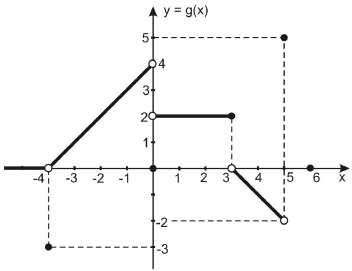
( ) A função g possui exatamente duas raízes.
( ) !$ g(4)=-g(-3) !$
( ) !$ Im(g)=\{-3\} \cup ]-2,4[ !$
( ) A função definida por !$ h(x)=g(x)+3 !$ NÃO possui raiz.
( ) !$ (g \circ g \circ g \circ g)(-2)=2 !$
A sequência correta é
Provas
Questão presente nas seguintes provas
Considerando a circunferência de equação !$ \lambda:x^2+y^2+2x-4y-4=0 !$, é correto afirmar que
Provas
Questão presente nas seguintes provas
Directions: Answer question according to TEXT II.
TEXT II
JOBS OF THE FUTURE
“There is no future in any job. The future lies in the person
who holds the job.” – George W. Crane
One of my primary complaints with higher education is that they tend to prepare students for jobs of the past. Similarly, the best paying jobs of the future are all jobs that currently exist today. Many of them will still exist in the future, but with some changes as technology and communication systems make their impact.
As a rule of thumb, 60% of the jobs 10 years from now haven’t been invented yet. With that in mind, I’ve decided to put together a list of some jobs that will be in high demand in the future.
Jobs before 2020
Many of the changes we see today will cause new jobs to materialize quickly. This first section deals with new positions that will likely be developed within the next 10 years.
3D printing engineers – Classes in 3D printing are already being introduced into high schools and the demand for printer-produced products will rise quickly. The trend will be for these worker-less workshops to enter virtually different fields, at the same time, driving the need for competent technicians and engineers to design and maintain the next wave of this technology.
Nano-medics – Health professionals capable of working on the nano-level, both in designing diagnostics systems, remedies, and monitoring solutions will be in high demand.
Organ agents – The demand for transplantable organs is exploding and people who can track down and deliver healthy organs will be in hot demand.
Octogenarian service providers – As the population continues to age we will have record numbers of people living into their 80s, 90s, and 100s. This growing group of active oldsters will provide a demand for goods and services currently not being addressed in today’s marketplace.
Jobs in 2030 and beyond
A number of technologies currently on the drawing board will require a bit longer lead time before the industry comes into its own. Here are a few examples of these kinds of jobs:
Body part & limb makers – The organ agents listed before will quickly find themselves out of work as soon as we figure out how to efficiently grow and mass produce our own organs from scratch.
Earthquake forecasters – While scientists are developing skills to work with nanoscale precision on the earth’s surface, the best we can know about below the surface is blindfolded guesswork done with 100-mile precision. What we don’t know is literally killing us – over 226,000 killed in 2010 alone. But that will change over time as we begin to understand the inner working of the earth and accurately forecast when the next big quakes are about to hit.
“Heavy air” engineers – Compressed air is useful in a wide variety of ways. However, we have yet to figure out how to compress streams of air as they pass through our existing atmosphere. Once we do, it will create untold opportunity for non-surface based housing and transportation system, weather control, and other kinds of experimentation.
Final thoughts
The jobs and occupations listed above are just scratching the surface. This list is intended to help stretch your imagination and start you down a path of imagining your own future.
(Adapted from http://www.futuristspeaker.com/2011/11/55-jobs-of-the-future)
“This first section deals with new positions that will likely be developed within the next 10 years.” The underlined word is closest in meaning to
Provas
Questão presente nas seguintes provas
Uma determinada caixa é transportada em um caminhão que percorre, com velocidade escalar constante, uma estrada plana e horizontal. Em um determinado instante, o caminhão entra em uma curva circular de raio igual a 51,2 m, mantendo a mesma velocidade escalar. Sabendo-se que os coeficientes de atrito cinético e estático entre a caixa e o assoalho horizontal são, respectivamente, 0,4 e 0,5 e considerando que as dimensões do caminhão, em relação ao raio da curva, são desprezíveis e que a caixa esteja apoiada apenas no assoalho da carroceria, pode-se afirmar que a máxima velocidade, em m/s, que o caminhão poderá desenvolver, sem que a caixa escorregue é
Provas
Questão presente nas seguintes provas
Cadernos
Caderno Container