Foram encontradas 64 questões.
Seja a matriz !$ \begin{pmatrix} 1 & \cos x & \sin x \\ \cos x & 1 & 0 \\ \sin x & 2 & 1 \end{pmatrix} !$
Considere a função !$ f:IR \rightarrow IR !$ definida por !$ f(x)= \det A !$
Sobre a função !$ g:IR \rightarrow IR !$ definida por !$ g(x)=1-{\large{1 \over 2}}.\left\vert f(x) \right\vert !$, em que !$ \left\vert f(x) \right\vert !$ é o módulo de !$ f(x) !$, é correto afirmar que
Provas
Questão presente nas seguintes provas

Directions: Read the text below and answer question according to it.
TEXT
Howard Gardner: ‘Multiple intelligences’ are not ‘learning styles’ by Valerie Strauss
The fields of psychology and education were revolutionized 30 years ago when we now worldrenowned psychologist Howard Gardner published his 1983 book Frames of Mind: The Theory of Multiple Intelligences, which detailed a new model of human intelligence that went beyond the traditional view that there was a single kind that could be measured by standardized tests.
Gardner’s theory initially listed seven intelligences which work together: linguistic, logical-mathematical, musical, bodily-kinesthetic, interpersonal and intrapersonal; he later added an eighth, naturalist intelligence and says there may be a few more. The theory became highly popular with K-12 educators1 around the world seeking ways to reach students who did not respond to traditional approaches, but over time, ‘multiple intelligences’ somehow became synonymous with the concept of ‘learning styles’. In this important post, Gardner explains why the former is not the latter.
It’s been 30 years since I developed the notion of ‘multiple intelligences’. I have been gratified by the interest shown in this idea and the ways it’s been used in schools, museums, and business around the world. But one unanticipated consequence has driven me to distraction and that’s the tendency of many people, including persons whom I cherish, to credit me with the notion of ‘learning styles’ or to collapse ‘multiple intelligences’ with ‘learning styles’. It’s high time to relieve my pain and to set the record straight.
First a word about ‘MI theory’. On the basis of research in several disciplines, including the study of how human capacities are represented in the brain, I developed the idea that each of us has a number of relatively independent mental faculties, which can be termed our ‘multiple intelligences’. The basic idea is simplicity itself. A belief in a single intelligence assumes that we have one central, all-purpose computer, and it determines how well we perform in every sector of life. In contrast, a belief in multiple intelligences assumes that human beings have 7 to 10 distinct intelligences.
Even before I spoke and wrote about ‘MI’, the term ‘learning styles’ was being bandied about in educational circles. The idea, reasonable enough on the surface, is that all children (indeed all of us) have distinctive minds and personalities. Accordingly, it makes sense to find out about learners and to teach and nurture them in ways that are appropriate, that they value, and above all, are effective.
Two problems: first, the notion of ‘learning styles’ is itself not coherent. Those who use this term do not define the criteria for a style, nor where styles come from, how they are recognized/ assessed/ exploited. Say that Johnny is said to have a learning style that is ‘impulsive’. Does that mean that Johnny is ‘impulsive’ about everything? How do we know this? What does this imply about teaching? Should we teach ‘impulsively’, or should we compensate by ‘teaching reflectively’? What of learning style is ‘right-brained’ or visual or tactile? Same issues apply.
Problem #2: when researchers have tried to identify learning styles, teach consistently with those styles, and examine outcomes, there is not persuasive evidence that the learning style analysis produces more effective outcomes than a ‘one size fits all approach’. Of course, the learning style analysis might have been inadequate. Or even if it is on the mark, the fact that one intervention did not work does not mean that the concept of learning styles is fatally imperfect; another intervention might have proved effective. Absence of evidence does not prove non-existence of a phenomenon; it signals to educational researchers: ‘back to the drawing boards’.
Here’s my considered judgment about the best way to analyze this lexical terrain:
Intelligence: We all have the multiple intelligences. But we signed out, as a strong intelligence, an area where the person has considerable computational power.
Style or learning style: A hypothesis of how an individual approaches the range of materials. If an individual has a ‘reflective style’, he/she is hypothesized to be reflective about the full range of materials. We cannot assume that reflectiveness in writing necessarily signals reflectiveness in one’s interaction with the others.
Senses: Sometimes people speak about a ‘visual’ learner or an ‘auditory’ learner. The implication is that some people learn through their eyes, others through their ears. This notion is incoherent. Both spatial information and reading occur with the eyes, but they make use of entirely different cognitive faculties. What matters is the power of the mental computer, the intelligence that acts upon that sensory information once picked up.
These distinctions are consequential. If people want to talk about ‘an impulsive style’ or a ‘visual learner’, that’s their prerogative. But they should recognize that these labels may be unhelpful, at best, and ill-conceived at worst.
In contrast, there is strong evidence that human beings have a range of intelligences and that strength (or weakness) in one intelligence does not predict strength (or weakness) in any other intelligences. All of us exhibit jagged profiles of intelligences. There are common sense ways of assessing our own intelligences, and even if it seems appropriate, we can take a more formal test battery. And then, as teachers, parents, or selfassessors, we can decide how best to make use of this information.
(Adapted from https://www.washingtonpost.com/news/answer-sheet)
Glossary:
1. K-12 educators defend the adoption of an interdisciplinary curriculum and methods for teaching with objects.
In the fragment “why the former is not the latter”, the highlighted words refer to
Provas
Questão presente nas seguintes provas
TEXTO VI
LEITE DERRAMADO
“Um homem muito velho está num leito de hospital. E desfia a quem quiser ouvir suas memórias. Uma saga familiar caracterizada pela decadência social e econômica, tendo como pano de fundo a história do Brasil dos últimos dois séculos.”
Não sei por que você não me alivia a dor. Todo dia a senhora levanta a persiana com bruteza e joga sol no meu rosto. Não sei que graça pode achar dos meus esgares, é uma pontada cada vez que respiro. Às vezes aspiro fundo e encho os pulmões de um ar insuportável, para ter alguns segundos de conforto, expelindo a dor. Mas bem antes da doença e da velhice, talvez minha vida já fosse um pouco assim, uma dorzinha chata a me espetar o tempo todo, e de repente uma lambada atroz. Quando perdi minha mulher, foi atroz. E qualquer coisa que eu recorde agora, vai doer, a memória é uma vasta ferida. Mas nem assim você me dá os remédios, você é meio desumana. Acho que nem é da enfermagem, nunca vi essa cara sua por aqui. Claro, você é a minha filha que estava na contraluz, me dê um beijo. Eu ia mesmo lhe telefonar para me fazer companhia, me ler jornais, romances russos. Fica essa televisão ligada o dia inteiro, as pessoas aqui não são sociáveis. Não estou me queixando de nada, seria uma ingratidão com você e com o seu filho. Mas se o garotão está tão rico, não sei por que diabos não me interna em uma casa de saúde tradicional, de religiosas. Eu próprio poderia arcar com viagem e tratamento no estrangeiro, se o seu marido não me tivesse arruinado.
(BUARQUE, Chico. Leite derramado. São Paulo: Companhia das Letras, 2009, p. 10 – 11.)
O discurso do personagem só NÃO nos permite afirmar que ele:
Provas
Questão presente nas seguintes provas
A Figura 1 abaixo representa um arranjo experimental para a obtenção do espectro de emissão da luz emitida por uma lâmpada de gás de hidrogênio.
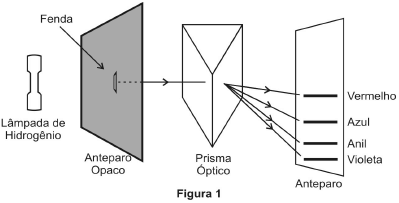
Ao passar pelo prisma, a luz divide-se em quatro feixes de cores distintas: violeta, anil, azul e vermelho. Projetando-se esses feixes em um anteparo, eles ficam espalhados, como ilustrado na Figura 1.
Considere, agora, a Figura 2, que ilustra esquematicamente alguns níveis de energia do átomo de hidrogênio, onde as setas I, II, III e IV mostram transições possíveis para esse átomo.
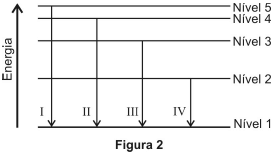
Relacionando as informações contidas na Figura 2 com as cores da luz emitida pela lâmpada de gás de hidrogênio mostrada na Figura 1, é correto afirmar que a cor anil corresponde à transição
Provas
Questão presente nas seguintes provas
Num auditório da Academia da Força Aérea estão presentes 20 alunos do Curso de Formação de Oficiais Aviadores dos quais apenas 10 usam agasalho. Estão presentes, também, 25 alunos do Curso de Formação de Oficiais Intendentes dos quais apenas 15 usam agasalho. Um dos alunos presentes é escolhido ao acaso.
É correto afirmar que é igual a !$ \large{2 \over 9} !$ a probabilidade de que o aluno escolhido
Provas
Questão presente nas seguintes provas
Directions: Read the text below and answer question according to it.
TEXT
Howard Gardner: ‘Multiple intelligences’ are not ‘learning styles’ by Valerie Strauss
The fields of psychology and education were revolutionized 30 years ago when we now worldrenowned psychologist Howard Gardner published his 1983 book Frames of Mind: The Theory of Multiple Intelligences, which detailed a new model of human intelligence that went beyond the traditional view that there was a single kind that could be measured by standardized tests.
Gardner’s theory initially listed seven intelligences which work together: linguistic, logical-mathematical, musical, bodily-kinesthetic, interpersonal and intrapersonal; he later added an eighth, naturalist intelligence and says there may be a few more. The theory became highly popular with K-12 educators1 around the world seeking ways to reach students who did not respond to traditional approaches, but over time, ‘multiple intelligences’ somehow became synonymous with the concept of ‘learning styles’. In this important post, Gardner explains why the former is not the latter.
It’s been 30 years since I developed the notion of ‘multiple intelligences’. I have been gratified by the interest shown in this idea and the ways it’s been used in schools, museums, and business around the world. But one unanticipated consequence has driven me to distraction and that’s the tendency of many people, including persons whom I cherish, to credit me with the notion of ‘learning styles’ or to collapse ‘multiple intelligences’ with ‘learning styles’. It’s high time to relieve my pain and to set the record straight.
First a word about ‘MI theory’. On the basis of research in several disciplines, including the study of how human capacities are represented in the brain, I developed the idea that each of us has a number of relatively independent mental faculties, which can be termed our ‘multiple intelligences’. The basic idea is simplicity itself. A belief in a single intelligence assumes that we have one central, all-purpose computer, and it determines how well we perform in every sector of life. In contrast, a belief in multiple intelligences assumes that human beings have 7 to 10 distinct intelligences.
Even before I spoke and wrote about ‘MI’, the term ‘learning styles’ was being bandied about in educational circles. The idea, reasonable enough on the surface, is that all children (indeed all of us) have distinctive minds and personalities. Accordingly, it makes sense to find out about learners and to teach and nurture them in ways that are appropriate, that they value, and above all, are effective.
Two problems: first, the notion of ‘learning styles’ is itself not coherent. Those who use this term do not define the criteria for a style, nor where styles come from, how they are recognized/ assessed/ exploited. Say that Johnny is said to have a learning style that is ‘impulsive’. Does that mean that Johnny is ‘impulsive’ about everything? How do we know this? What does this imply about teaching? Should we teach ‘impulsively’, or should we compensate by ‘teaching reflectively’? What of learning style is ‘right-brained’ or visual or tactile? Same issues apply.
Problem #2: when researchers have tried to identify learning styles, teach consistently with those styles, and examine outcomes, there is not persuasive evidence that the learning style analysis produces more effective outcomes than a ‘one size fits all approach’. Of course, the learning style analysis might have been inadequate. Or even if it is on the mark, the fact that one intervention did not work does not mean that the concept of learning styles is fatally imperfect; another intervention might have proved effective. Absence of evidence does not prove non-existence of a phenomenon; it signals to educational researchers: ‘back to the drawing boards’.
Here’s my considered judgment about the best way to analyze this lexical terrain:
Intelligence: We all have the multiple intelligences. But we signed out, as a strong intelligence, an area where the person has considerable computational power.
Style or learning style: A hypothesis of how an individual approaches the range of materials. If an individual has a ‘reflective style’, he/she is hypothesized to be reflective about the full range of materials. We cannot assume that reflectiveness in writing necessarily signals reflectiveness in one’s interaction with the others.
Senses: Sometimes people speak about a ‘visual’ learner or an ‘auditory’ learner. The implication is that some people learn through their eyes, others through their ears. This notion is incoherent. Both spatial information and reading occur with the eyes, but they make use of entirely different cognitive faculties. What matters is the power of the mental computer, the intelligence that acts upon that sensory information once picked up.
These distinctions are consequential. If people want to talk about ‘an impulsive style’ or a ‘visual learner’, that’s their prerogative. But they should recognize that these labels may be unhelpful, at best, and ill-conceived at worst.
In contrast, there is strong evidence that human beings have a range of intelligences and that strength (or weakness) in one intelligence does not predict strength (or weakness) in any other intelligences. All of us exhibit jagged profiles of intelligences. There are common sense ways of assessing our own intelligences, and even if it seems appropriate, we can take a more formal test battery. And then, as teachers, parents, or selfassessors, we can decide how best to make use of this information.
(Adapted from https://www.washingtonpost.com/news/answer-sheet)
Glossary:
1. K-12 educators defend the adoption of an interdisciplinary curriculum and methods for teaching with objects.
In the sentence “it’s been 30 years since I developed the notion of ‘multiple intelligences’” , the contraction refers to
Provas
Questão presente nas seguintes provas
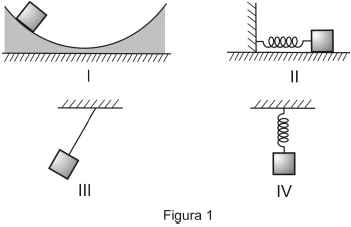
Uma partícula de massa m pode ser colocada a oscilar em quatro experimentos diferentes, como mostra a Figura 1 abaixo.
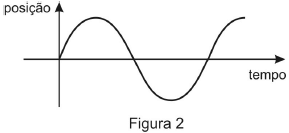
Para apenas duas dessas situações, tem-se o registro do gráfico senoidal da posição da partícula em função do tempo, apresentado na Figura 2.
Considere que não existam forças dissipativas nos quatro experimentos; que, nos experimentos II e IV , as molas sejam ideais e que as massas oscilem em trajetórias perfeitamente retilíneas; que no experimento III o fio conectado à massa seja ideal e inextensível; e que nos experimentos I e III a massa descreva uma trajetória que é um arco de circunferência.
Nessas condições, os experimentos em que a partícula oscila certamente em movimento harmônico simples são, apenas
Provas
Questão presente nas seguintes provas
Directions: Read the text below and answer question according to it.
TEXT
Howard Gardner: ‘Multiple intelligences’ are not ‘learning styles’ by Valerie Strauss
The fields of psychology and education were revolutionized 30 years ago when we now worldrenowned psychologist Howard Gardner published his 1983 book Frames of Mind: The Theory of Multiple Intelligences, which detailed a new model of human intelligence that went beyond the traditional view that there was a single kind that could be measured by standardized tests.
Gardner’s theory initially listed seven intelligences which work together: linguistic, logical-mathematical, musical, bodily-kinesthetic, interpersonal and intrapersonal; he later added an eighth, naturalist intelligence and says there may be a few more. The theory became highly popular with K-12 educators1 around the world seeking ways to reach students who did not respond to traditional approaches, but over time, ‘multiple intelligences’ somehow became synonymous with the concept of ‘learning styles’. In this important post, Gardner explains why the former is not the latter.
It’s been 30 years since I developed the notion of ‘multiple intelligences’. I have been gratified by the interest shown in this idea and the ways it’s been used in schools, museums, and business around the world. But one unanticipated consequence has driven me to distraction and that’s the tendency of many people, including persons whom I cherish, to credit me with the notion of ‘learning styles’ or to collapse ‘multiple intelligences’ with ‘learning styles’. It’s high time to relieve my pain and to set the record straight.
First a word about ‘MI theory’. On the basis of research in several disciplines, including the study of how human capacities are represented in the brain, I developed the idea that each of us has a number of relatively independent mental faculties, which can be termed our ‘multiple intelligences’. The basic idea is simplicity itself. A belief in a single intelligence assumes that we have one central, all-purpose computer, and it determines how well we perform in every sector of life. In contrast, a belief in multiple intelligences assumes that human beings have 7 to 10 distinct intelligences.
Even before I spoke and wrote about ‘MI’, the term ‘learning styles’ was being bandied about in educational circles. The idea, reasonable enough on the surface, is that all children (indeed all of us) have distinctive minds and personalities. Accordingly, it makes sense to find out about learners and to teach and nurture them in ways that are appropriate, that they value, and above all, are effective.
Two problems: first, the notion of ‘learning styles’ is itself not coherent. Those who use this term do not define the criteria for a style, nor where styles come from, how they are recognized/ assessed/ exploited. Say that Johnny is said to have a learning style that is ‘impulsive’. Does that mean that Johnny is ‘impulsive’ about everything? How do we know this? What does this imply about teaching? Should we teach ‘impulsively’, or should we compensate by ‘teaching reflectively’? What of learning style is ‘right-brained’ or visual or tactile? Same issues apply.
Problem #2: when researchers have tried to identify learning styles, teach consistently with those styles, and examine outcomes, there is not persuasive evidence that the learning style analysis produces more effective outcomes than a ‘one size fits all approach’. Of course, the learning style analysis might have been inadequate. Or even if it is on the mark, the fact that one intervention did not work does not mean that the concept of learning styles is fatally imperfect; another intervention might have proved effective. Absence of evidence does not prove non-existence of a phenomenon; it signals to educational researchers: ‘back to the drawing boards’.
Here’s my considered judgment about the best way to analyze this lexical terrain:
Intelligence: We all have the multiple intelligences. But we signed out, as a strong intelligence, an area where the person has considerable computational power.
Style or learning style: A hypothesis of how an individual approaches the range of materials. If an individual has a ‘reflective style’, he/she is hypothesized to be reflective about the full range of materials. We cannot assume that reflectiveness in writing necessarily signals reflectiveness in one’s interaction with the others.
Senses: Sometimes people speak about a ‘visual’ learner or an ‘auditory’ learner. The implication is that some people learn through their eyes, others through their ears. This notion is incoherent. Both spatial information and reading occur with the eyes, but they make use of entirely different cognitive faculties. What matters is the power of the mental computer, the intelligence that acts upon that sensory information once picked up.
These distinctions are consequential. If people want to talk about ‘an impulsive style’ or a ‘visual learner’, that’s their prerogative. But they should recognize that these labels may be unhelpful, at best, and ill-conceived at worst.
In contrast, there is strong evidence that human beings have a range of intelligences and that strength (or weakness) in one intelligence does not predict strength (or weakness) in any other intelligences. All of us exhibit jagged profiles of intelligences. There are common sense ways of assessing our own intelligences, and even if it seems appropriate, we can take a more formal test battery. And then, as teachers, parents, or selfassessors, we can decide how best to make use of this information.
(Adapted from https://www.washingtonpost.com/news/answer-sheet)
Glossary:
1. K-12 educators defend the adoption of an interdisciplinary curriculum and methods for teaching with objects.
Mark the alternative in which the problems described in paragraphs 6 and 7 are correctly summarized.
Provas
Questão presente nas seguintes provas
Directions: Read the text below and answer question according to it.
TEXT
Howard Gardner: ‘Multiple intelligences’ are not ‘learning styles’ by Valerie Strauss
The fields of psychology and education were revolutionized 30 years ago when we now worldrenowned psychologist Howard Gardner published his 1983 book Frames of Mind: The Theory of Multiple Intelligences, which detailed a new model of human intelligence that went beyond the traditional view that there was a single kind that could be measured by standardized tests.
Gardner’s theory initially listed seven intelligences which work together: linguistic, logical-mathematical, musical, bodily-kinesthetic, interpersonal and intrapersonal; he later added an eighth, naturalist intelligence and says there may be a few more. The theory became highly popular with K-12 educators1 around the world seeking ways to reach students who did not respond to traditional approaches, but over time, ‘multiple intelligences’ somehow became synonymous with the concept of ‘learning styles’. In this important post, Gardner explains why the former is not the latter.
It’s been 30 years since I developed the notion of ‘multiple intelligences’. I have been gratified by the interest shown in this idea and the ways it’s been used in schools, museums, and business around the world. But one unanticipated consequence has driven me to distraction and that’s the tendency of many people, including persons whom I cherish, to credit me with the notion of ‘learning styles’ or to collapse ‘multiple intelligences’ with ‘learning styles’. It’s high time to relieve my pain and to set the record straight.
First a word about ‘MI theory’. On the basis of research in several disciplines, including the study of how human capacities are represented in the brain, I developed the idea that each of us has a number of relatively independent mental faculties, which can be termed our ‘multiple intelligences’. The basic idea is simplicity itself. A belief in a single intelligence assumes that we have one central, all-purpose computer, and it determines how well we perform in every sector of life. In contrast, a belief in multiple intelligences assumes that human beings have 7 to 10 distinct intelligences.
Even before I spoke and wrote about ‘MI’, the term ‘learning styles’ was being bandied about in educational circles. The idea, reasonable enough on the surface, is that all children (indeed all of us) have distinctive minds and personalities. Accordingly, it makes sense to find out about learners and to teach and nurture them in ways that are appropriate, that they value, and above all, are effective.
Two problems: first, the notion of ‘learning styles’ is itself not coherent. Those who use this term do not define the criteria for a style, nor where styles come from, how they are recognized/ assessed/ exploited. Say that Johnny is said to have a learning style that is ‘impulsive’. Does that mean that Johnny is ‘impulsive’ about everything? How do we know this? What does this imply about teaching? Should we teach ‘impulsively’, or should we compensate by ‘teaching reflectively’? What of learning style is ‘right-brained’ or visual or tactile? Same issues apply.
Problem #2: when researchers have tried to identify learning styles, teach consistently with those styles, and examine outcomes, there is not persuasive evidence that the learning style analysis produces more effective outcomes than a ‘one size fits all approach’. Of course, the learning style analysis might have been inadequate. Or even if it is on the mark, the fact that one intervention did not work does not mean that the concept of learning styles is fatally imperfect; another intervention might have proved effective. Absence of evidence does not prove non-existence of a phenomenon; it signals to educational researchers: ‘back to the drawing boards’.
Here’s my considered judgment about the best way to analyze this lexical terrain:
Intelligence: We all have the multiple intelligences. But we signed out, as a strong intelligence, an area where the person has considerable computational power.
Style or learning style: A hypothesis of how an individual approaches the range of materials. If an individual has a ‘reflective style’, he/she is hypothesized to be reflective about the full range of materials. We cannot assume that reflectiveness in writing necessarily signals reflectiveness in one’s interaction with the others.
Senses: Sometimes people speak about a ‘visual’ learner or an ‘auditory’ learner. The implication is that some people learn through their eyes, others through their ears. This notion is incoherent. Both spatial information and reading occur with the eyes, but they make use of entirely different cognitive faculties. What matters is the power of the mental computer, the intelligence that acts upon that sensory information once picked up.
These distinctions are consequential. If people want to talk about ‘an impulsive style’ or a ‘visual learner’, that’s their prerogative. But they should recognize that these labels may be unhelpful, at best, and ill-conceived at worst.
In contrast, there is strong evidence that human beings have a range of intelligences and that strength (or weakness) in one intelligence does not predict strength (or weakness) in any other intelligences. All of us exhibit jagged profiles of intelligences. There are common sense ways of assessing our own intelligences, and even if it seems appropriate, we can take a more formal test battery. And then, as teachers, parents, or selfassessors, we can decide how best to make use of this information.
(Adapted from https://www.washingtonpost.com/news/answer-sheet)
Glossary:
1. K-12 educators defend the adoption of an interdisciplinary curriculum and methods for teaching with objects.
Mark the option that contains the correct negative form for the sentence “researchers have tried to identify learning styles”.
Provas
Questão presente nas seguintes provas
Sejam os números reais
!$ a=\large{ \sqrt{(-1)^2}.0,1222 \, \cdots \over (1,2)^{-1}} !$
b = comprimento de uma circunferência de raio 1
!$ c=\sqrt{12}. \sqrt {90}. \sqrt {160}. \sqrt {147} !$
Sendo !$ IN !$, !$ \mathbb{Z} !$, !$ \mathbb{Q} !$ e !$ IR !$ os conjuntos numéricos, assinale a alternativa FALSA.
Provas
Questão presente nas seguintes provas
Cadernos
Caderno Container