Foram encontradas 64 questões.
Provas

RAIOS CAUSAM 130 MORTES POR ANO NO BRASIL; SAIBA COMO PREVENIR
Começou a temporada de raios e o Brasil é o lugar onde eles mais caem no mundo.
Os raios são fenômenos da natureza impressionantes, mas causam mortes e prejuízos. Todos os anos morrem em média 130 pessoas no país atingidas por essas descargas elétricas. (...)
(...) Segundo as pesquisas feitas pelo grupo de eletricidade atmosférica do INPE, o número de mortes por raios é maior do que por deslizamentos e enchentes. E é na primavera e no verão, época com mais tempestades, que a preocupação aumenta (...)
(Disponível em: ww1.g1.globo.com/bom-dia-brasil. Acesso em:16 fev.2017)
Como se pode verificar na notícia acima, os raios causam mortes e, além disso, constantemente há outros prejuízos ligados a eles: destruição de linhas de transmissão de energia e telefonia, incêndios florestais, dentre outros.
As nuvens se eletrizam devido às partículas de gelo que começam a descer muito rapidamente, criando correntes de ar bastante bruscas, o que provoca fricção entre gotas de água e de gelo, responsável pela formação e, consequentemente, a acumulação de eletricidade estática.
Quando se acumula carga elétrica negativa demasiadamente na zona inferior da nuvem (este é o caso mais comum) ocorre uma descarga elétrica em direção ao solo (que por indução eletrostática adquiriu cargas positivas).
Considere que a base de uma nuvem de tempestade, eletricamente carregada com carga de módulo igual a !$ 2,0 ⋅10^2 C !$ , situa-se a 500 m acima do solo. O ar mantém-se isolante até que o campo elétrico entre a base da nuvem e o solo atinja o valor de !$ 5,00⋅10^6 \,V/m !$.
Nesse instante a nuvem se descarrega por meio de um raio que dura 0,10 s. Considerando que o campo elétrico na região onde ocorreu o raio seja uniforme, a energia liberada neste raio é, em joules, igual a
Provas
Provas
Directions: Read the text below and answer question according to it.
TEXT
FOOD SHORTAGE CAUSES, EFFECTS AND SOLUTIONS
Food shortage is a serious problem facing the world and is prevalent in sub-Saharan Africa. The scarcity of food is caused by economic, environmental and social factors such as crop failure, overpopulation and poor government policies are the main cause of food scarcity in most countries. Environmental factors determine the kind of crops to be produced in a given place, economic factors determine the buying and production capacity and socio-political factors determine distribution of food to the masses. Food shortage has far reaching long and short term negative impacts which include starvation, malnutrition, increased mortality and political unrest1. There is need to collectively address the issue of food insecurity using both emergency and long term measures.
Causes of food shortages
There are a number of social factors causing food shortages. The rate of population increase is higher than increase in food production. The world is consuming more than it is producing, leading to decline in food stock and storage level and increased food prices due to soaring2 demand. Increased population has led to clearing of agricultural land for human settlement reducing agricultural production (Kamdor, 2007). Overcrowding of population in a given place results in urbanization of previously rich agricultural fields. Destruction of forests for human settlement, particularly tropical rain forest has led to climatic changes, such as prolonged droughts and desertification. Population increase means more pollution as people use more fuel in cars, industry, domestic cooking. The resultant effect is increased air and water pollution which affect the climate and food production.
Environmental factors have greatly contributed to food shortage. Climatic change has reduced agricultural production. The change in climate is majorly caused by human activities and to some small extent natural activities. Increased combustion of fossil fuels due to increasing population through power plant, motor transport and mining of coal and oil emits green house gases which have continued to affect world climate. Deforestation of tropical forest due to human pressure has changed climatic patterns and rainfall seasons, and led to desertification which cannot support a crop production. Land degradation due to increased human activities has impacted negatively on agricultural production (Kamdor, 2007). Natural disasters such as floods, tropical storms and prolonged droughts are on the increase and have devastating impacts on food security particularly in developing countries. There are several economic factors that contribute to food shortage. Economic factors affect the ability of farmers to engage in agricultural production. Poverty situation in developing nations have reduced their capacity to produce food, as most farmers cannot afford seed and fertilizers. They use poor farming methods that cannot yield3 enough, even substantial use. Investments in agricultural research and developing are very low in developing nations. Recent global financial crisis have led to increase in food prices and reduced investments in agriculture by individuals and governments in developed nations resulting in reduced food production.
Effects of food shortage
There are a number of short term effects of food shortage. The impact on children, mothers and elderly are very evident as seen in malnutrition and hunger related deaths. Children succumb to hunger within short period as they cannot stand long period of starvation and they die even before the arrival of emergency assistance.
There are also long term effects of food shortage. These include increase in the price of food as a result demand and supply forces. Increasing cost of food production due to the increase in fuel prices coupled with persistent drought in grain producing regions has contributed to the increase in the price of food in the world. Increase in oil price led to increase in the price of fertilizers, transportation of food and also industrial agriculture. Increasing food prices culminated in political instability and social unrest in several nations across the globe in 2007, in countries of Mexico, Cameroon, Brazil, Burkina Faso, Pakistan, Egypt and Bangladesh among other nations (Kamdor, 2007).
Solution to problem of food shortage
There are some solutions to the problem of food shortage. There is need to reduce production of carbon emissions and pollution to reduce the resultant climatic change through concerted and individual efforts. There is need to invest in clean energy such as solar, nuclear, and geothermal power in homes and industries, because they don’t have adverse effects on the environment (Kamdor, 2007). Rich nations should help poor nations to develop and use clean and renewable energy in order to stabilize green house emissions into the atmosphere (Watson, nd). Government need to work in consultation with climatic bodies, World Bank and the UN to engage in projects aimed at promoting green environment.
Conclusion
Causes of food shortage are well known and can be solved if appropriate measures to solve the problem are taken and effectively implemented. Environmental causes of food shortages are changes in climatic and pollution due to human activities such overgrazing!$ ^4 !$ and deforestation which can be controlled through legislation.
(Adapted from http://www.paypervids.com/food-shortage-causeseffects-solutions/Acesso em:14 fev 2017)
Glossary:
1. unrest – disagreement or fighting between different
groups of people
2. soaring – something that increases rapidly above the
usual level
3. yield – to supply or produce something such as profit or
an amount or food
4. overgrazing – excessive use of land where animals feed
on grass
Mark the INCORRECT option according to the text.
Provas
Provas
Dois recipientes A e B, contendo o mesmo volume de água, são colocados separadamente sobre duas balanças I e II, respectivamente, conforme indicado na figura a seguir.
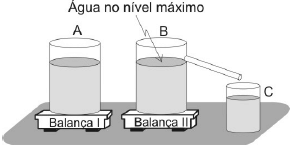
A única diferença entre os recipientes A e B está no fato de que B possui um “ladrão” que permite que a água escoe para um outro recipiente C, localizado fora das balanças.
Em seguida, mergulha-se, lentamente, sem girar e com velocidade constante, por meio de um fio ideal, em cada recipiente, um cilindro metálico, maciço, de material não homogêneo, de tal forma que o seu eixo sempre se mantém na vertical. Os cilindros vão imergindo na água, sem provocar variação de temperatura e sem encostar nas paredes e nos fundos dos recipientes, de tal forma que os líquidos, nos recipientes A e B, sempre estarão em equilíbrio hidrostático no momento da leitura nas balanças. O gráfico que melhor representa a leitura L das balanças I e II, respectivamente, !$ L_I !$ e !$ L_{II} !$ , em função da altura h submersa de cada cilindro é
Provas
Provas

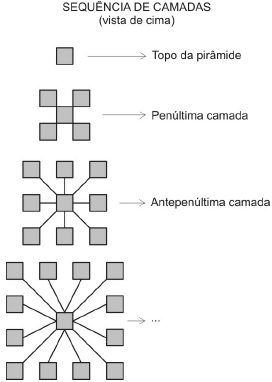
Provas
Um corpo M de dimensões desprezíveis e massa 10 kg movimentando-se em uma dimensão, inicialmente com velocidade !$ \vec{V} !$, vai sucessivamente colidindo inelasticamente com N partículas m, todas de mesma massa 1 kg, e com velocidades de módulo v = 20 m/s, que também se movimentam em uma dimensão de acordo com a Figura 1, a seguir.
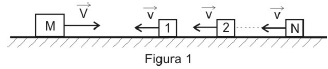
O gráfico que representa a velocidade final do conjunto !$ v_f !$ após cada colisão em função do número de partículas N é apresentado na Figura 2, a seguir.
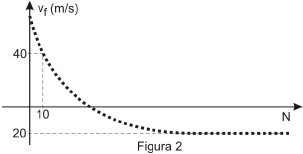
Desconsiderando as forças de atrito e a resistência do ar sobre o corpo e as partículas, a colisão de ordem No na qual a velocidade do corpo resultante (corpo !$ M + N_o !$ partículas m) se anula, é,
Provas
Provas
Caderno Container