Foram encontradas 64 questões.
Seja D o conjunto domínio mais amplo da função real !$ \sqrt{ { \large (x - 4)(x^2 - 25) \over - x^2 + 5x -4}} !$ e !$ S ⊂ \mathbb R\ !$ o conjunto solução da inequação !$ x + 6 ≤ x (x + 6) !$.
O conjunto !$ D ∩ S !$ é
Provas

Numa partida de vôlei, certo atleta dá um mergulho na quadra, a uma distância x = 2,5 m da rede, defendendo um ataque adversário, conforme figura a seguir.
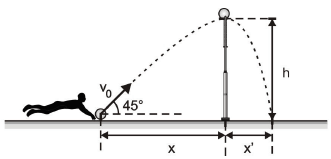
Após essa defesa, considere que a bola é lançada de uma altura desprezível em relação ao chão, de forma que sua velocidade faz um ângulo de 45º com a direção horizontal. Ao longo de sua trajetória, essa bola toca a fita da rede caindo, posteriormente, do outro lado da quadra. Imediatamente antes e imediatamente após tocar a fita, a velocidade da bola tem direção horizontal. A distância x' , onde a bola cai na quadra, é igual à metade da altura h da fita.
Despreze a resistência do ar e considere a bola uma partícula de massa 200 g, cujo movimento se dá no plano da figura. O módulo do impulso, aplicado pela fita sobre a bola, em !$ N ⋅ s !$, vale
Provas
TEXT
The end of life on Earth?
It weighted about 10,000 tons, entered the atmosphere at a speed of 64,000 km/h and exploded over a city with a blast of 500 kilotons. But on 15 February 2013, we were lucky. The metereorite that showered pieces of rock over Chelyabinsk, Russia, was relatively small, at only about 17 metres wide. Although many people were injured by falling glass, the damage was nothing compared to what had happened in Siberia nearly one hundred years ago, when a relatively small object (approximately 50 metres in diameter) exploded in mid-air over a forest region, flattening about 80 million trees. If it had exploded over a city such as Moscow or London, millions of people would have been killed.
By a strange coincidence, the same day that the meteorite terrified the people of Chelyabinsk, another 50m-wide asteroid passed relatively close to Earth. Scientists were expecting that visit and know that the asteroid will return to fly close by us in 2046, but the Russian meteorite earlier in the day had been too small for anyone to spot.
Most scientists agree that comets and asteroids pose the biggest natural threat to human existence. It was probably a large asteroid or comet colliding with Earth which wiped out the dinosaurs about 65 million years ago. An enormous object, 10 to 16 km in diameter, struck the Yucatan region in Mexico with the force of 100 megatons. That is the equivalent of one Hiroshima bomb for every person alive on Earth today.
Many scientists, including the late Stephen Hawking, say that any comet or asteroid greater than 20km in diameter that hits Earth will result in the complete destruction of complex life, including all animals and most plants. As we have seen even a much smaller asteroid can cause great damage.
The Earth has been kept fairly safe for the last 65 million years by good fortune and the massive gravitational field of the planet Jupiter. Our cosmic guardian, with its stable circular orbit far from the sun, sweeps up and scatters away most of the dangerous comets and asteroids which might cross Earth’s orbit.
After the Chelyabinsk meteorite, scientists are now monitoring potential hazards even more carefully but, as far as they know, there is no danger in the foreseeable future.
Types of space rocks
• Comet – a ball of rock and ice that sends out a tail of gas and dust behind it. Bright comets only appear in our visible night sky about once every ten years.
• Asteroid – a rock a few feet to several kms in diameter. Unlike comets, asteroids have no tail. Most are to small to cause any damage and burn up in the atmosphere.
• Meteoroid – part of an asteroid or comet.
• Meteorite – what a meteoroid is called when it hits Earth.
Taken from: http://learningenglishteens.britishcouncil.org
- Access on 29/06/2020
“If it had exploded over a city such as Moscow or London, millions of people would have been killed”. We can conclude from the information in this passage that
Provas
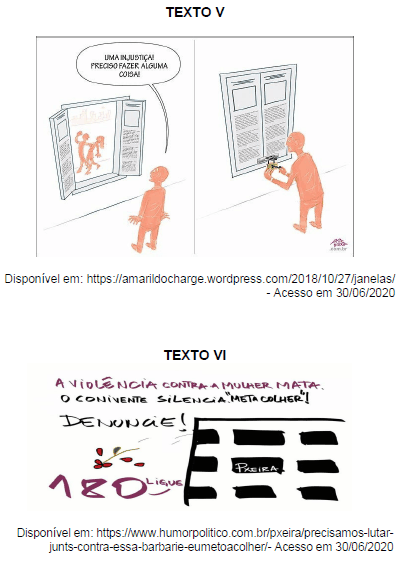
Considerando os elementos visuais e verbais do texto V e VI, é correto afirmar que
Provas
TEXT
The end of life on Earth?
It weighted about 10,000 tons, entered the atmosphere at a speed of 64,000 km/h and exploded over a city with a blast of 500 kilotons. But on 15 February 2013, we were lucky. The metereorite that showered pieces of rock over Chelyabinsk, Russia, was relatively small, at only about 17 metres wide. Although many people were injured by falling glass, the damage was nothing compared to what had happened in Siberia nearly one hundred years ago, when a relatively small object (approximately 50 metres in diameter) exploded in mid-air over a forest region, flattening about 80 million trees. If it had exploded over a city such as Moscow or London, millions of people would have been killed.
By a strange coincidence, the same day that the meteorite terrified the people of Chelyabinsk, another 50m-wide asteroid passed relatively close to Earth. Scientists were expecting that visit and know that the asteroid will return to fly close by us in 2046, but the Russian meteorite earlier in the day had been too small for anyone to spot.
Most scientists agree that comets and asteroids pose the biggest natural threat to human existence. It was probably a large asteroid or comet colliding with Earth which wiped out the dinosaurs about 65 million years ago. An enormous object, 10 to 16 km in diameter, struck the Yucatan region in Mexico with the force of 100 megatons. That is the equivalent of one Hiroshima bomb for every person alive on Earth today.
Many scientists, including the late Stephen Hawking, say that any comet or asteroid greater than 20km in diameter that hits Earth will result in the complete destruction of complex life, including all animals and most plants. As we have seen even a much smaller asteroid can cause great damage.
The Earth has been kept fairly safe for the last 65 million years by good fortune and the massive gravitational field of the planet Jupiter. Our cosmic guardian, with its stable circular orbit far from the sun, sweeps up and scatters away most of the dangerous comets and asteroids which might cross Earth’s orbit.
After the Chelyabinsk meteorite, scientists are now monitoring potential hazards even more carefully but, as far as they know, there is no danger in the foreseeable future.
Types of space rocks
• Comet – a ball of rock and ice that sends out a tail of gas and dust behind it. Bright comets only appear in our visible night sky about once every ten years.
• Asteroid – a rock a few feet to several kms in diameter. Unlike comets, asteroids have no tail. Most are to small to cause any damage and burn up in the atmosphere.
• Meteoroid – part of an asteroid or comet.
• Meteorite – what a meteoroid is called when it hits Earth.
Taken from: http://learningenglishteens.britishcouncil.org
- Access on 29/06/2020
The Russian meteorite
Provas
Em uma aula de topografia, o professor queria medir a largura de um rio.
Para tal, ele tomou dois pontos A e B em uma margem do rio e outro ponto C na margem oposta, de modo que o segmento !$ \overline {CA} !$ ficasse perpendicular ao segmento !$ \overline {AB} !$ , como indicado na figura a seguir.
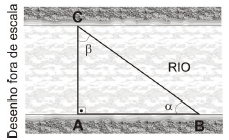
Considere que:
• a distância entre os pontos A e B é de 30 m;
• os ângulos agudos !$ \alpha !$ e !$ \beta !$ podem ser obtidos através da equação !$ \left (sen^2\alpha\right)x^2 - 9(sen\alpha)(cos \beta) + { \large 5 \over 2} cos\beta = 0 !$, na qual !$ x = 2 !$ é uma de suas raízes;
• !$ \sqrt 2 = 1,4 \ e \ \sqrt 3 = 1,7 !$.
A largura aproximada do rio, em m, é igual a
Provas
A figura abaixo ilustra dois resistores de imersão dentro de recipientes termicamente isolados e com capacidades térmicas desprezíveis, contendo as mesmas quantidades de água. Os resistores R1 e R2 estão ligados, respectivamente, a uma associação de geradores em série e em paralelo.
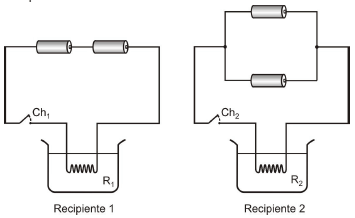
Os valores das resistências elétricas de R1 e R2 foram ajustados adequadamente de tal forma que cada associação de geradores transfere a máxima potência a cada um dos resistores.
Despreze a influência da temperatura na resistência elétrica e no calor específico da água e considere que todos os geradores apresentem a mesma fem e a mesma resistência interna.
Fecha-se simultaneamente as chaves Ch1 e Ch2 e, após 5 min, verifica-se que a variação de temperatura da água no recipiente 1 foi de 20 ºC. Nesse mesmo intervalo, a água no recipiente 2 apresenta uma variação de temperatura, em ºC, igual a
Provas
TEXT
The end of life on Earth?
It weighted about 10,000 tons, entered the atmosphere at a speed of 64,000 km/h and exploded over a city with a blast of 500 kilotons. But on 15 February 2013, we were lucky. The metereorite that showered pieces of rock over Chelyabinsk, Russia, was relatively small, at only about 17 metres wide. Although many people were injured by falling glass, the damage was nothing compared to what had happened in Siberia nearly one hundred years ago, when a relatively small object (approximately 50 metres in diameter) exploded in mid-air over a forest region, flattening about 80 million trees. If it had exploded over a city such as Moscow or London, millions of people would have been killed.
By a strange coincidence, the same day that the meteorite terrified the people of Chelyabinsk, another 50m-wide asteroid passed relatively close to Earth. Scientists were expecting that visit and know that the asteroid will return to fly close by us in 2046, but the Russian meteorite earlier in the day had been too small for anyone to spot.
Most scientists agree that comets and asteroids pose the biggest natural threat to human existence. It was probably a large asteroid or comet colliding with Earth which wiped out the dinosaurs about 65 million years ago. An enormous object, 10 to 16 km in diameter, struck the Yucatan region in Mexico with the force of 100 megatons. That is the equivalent of one Hiroshima bomb for every person alive on Earth today.
Many scientists, including the late Stephen Hawking, say that any comet or asteroid greater than 20km in diameter that hits Earth will result in the complete destruction of complex life, including all animals and most plants. As we have seen even a much smaller asteroid can cause great damage.
The Earth has been kept fairly safe for the last 65 million years by good fortune and the massive gravitational field of the planet Jupiter. Our cosmic guardian, with its stable circular orbit far from the sun, sweeps up and scatters away most of the dangerous comets and asteroids which might cross Earth’s orbit.
After the Chelyabinsk meteorite, scientists are now monitoring potential hazards even more carefully but, as far as they know, there is no danger in the foreseeable future.
Types of space rocks
• Comet – a ball of rock and ice that sends out a tail of gas and dust behind it. Bright comets only appear in our visible night sky about once every ten years.
• Asteroid – a rock a few feet to several kms in diameter. Unlike comets, asteroids have no tail. Most are to small to cause any damage and burn up in the atmosphere.
• Meteoroid – part of an asteroid or comet.
• Meteorite – what a meteoroid is called when it hits Earth.
Taken from: http://learningenglishteens.britishcouncil.org
- Access on 29/06/2020
Experts maintain that comets and asteroids could
Provas
TEXTO III
Mulheres de Atenas
Mirem-se no exemplo
Daquelas mulheres de Atenas
Vivem pros seus maridos
Orgulho e raça de Atenas
Quando amadas, se perfumam
Se banham com leite, se
Arrumam
Suas melenas
Quando fustigadas não choram
Se ajoelham, pedem, imploram
Mais duras penas; cadenas
Mirem-se no exemplo
Daquelas mulheres de Atenas
Sofrem pros seus maridos
Poder e Força de Atenas
(...)
Elas não têm gosto ou vontade
Nem defeito, nem qualidade
Têm medo apenas
Não têm sonhos, só têm
Presságios
O seu homem, mares,
Naufrágios
Lindas sirenas, morenas
Mirem-se no exemplo
Daquelas mulheres de Atenas
Temem por seus maridos
Heróis e amantes de Atenas
As jovens viúvas marcadas
E as gestantes abandonadas
Não fazem cenas
Vestem-se de negro, se
Encolhem
Se conformam e se recolhem
Às suas novenas, serenas
(HOLANDA, Chico Buarque de. Meus caros amigos. LP, 1976.
Phonogram/Philips)
Em relação à composição linguística do texto III, é INCORRETO afirmar que
Provas
Considere as funções !$ f: \mathbb R^* \rightarrow \mathbb R - \{2\} !$ e !$ g: \mathbb R^* \rightarrow \mathbb R - \{2\} !$ definidas por !$ f(x) = 2 + { \large 1 \over 2x} !$ e !$ g(x) = x + 2 !$ e, também, a função real h definida por !$ h(x) = f^{-1} (g(x)) !$.
É correto afirmar que
Provas
Caderno Container