Foram encontradas 64 questões.
TEXT
The end of life on Earth?
It weighted about 10,000 tons, entered the atmosphere at a speed of 64,000 km/h and exploded over a city with a blast of 500 kilotons. But on 15 February 2013, we were lucky. The metereorite that showered pieces of rock over Chelyabinsk, Russia, was relatively small, at only about 17 metres wide. Although many people were injured by falling glass, the damage was nothing compared to what had happened in Siberia nearly one hundred years ago, when a relatively small object (approximately 50 metres in diameter) exploded in mid-air over a forest region, flattening about 80 million trees. If it had exploded over a city such as Moscow or London, millions of people would have been killed.
By a strange coincidence, the same day that the meteorite terrified the people of Chelyabinsk, another 50m-wide asteroid passed relatively close to Earth. Scientists were expecting that visit and know that the asteroid will return to fly close by us in 2046, but the Russian meteorite earlier in the day had been too small for anyone to spot.
Most scientists agree that comets and asteroids pose the biggest natural threat to human existence. It was probably a large asteroid or comet colliding with Earth which wiped out the dinosaurs about 65 million years ago. An enormous object, 10 to 16 km in diameter, struck the Yucatan region in Mexico with the force of 100 megatons. That is the equivalent of one Hiroshima bomb for every person alive on Earth today.
Many scientists, including the late Stephen Hawking, say that any comet or asteroid greater than 20km in diameter that hits Earth will result in the complete destruction of complex life, including all animals and most plants. As we have seen even a much smaller asteroid can cause great damage.
The Earth has been kept fairly safe for the last 65 million years by good fortune and the massive gravitational field of the planet Jupiter. Our cosmic guardian, with its stable circular orbit far from the sun, sweeps up and scatters away most of the dangerous comets and asteroids which might cross Earth’s orbit.
After the Chelyabinsk meteorite, scientists are now monitoring potential hazards even more carefully but, as far as they know, there is no danger in the foreseeable future.
Types of space rocks
• Comet – a ball of rock and ice that sends out a tail of gas and dust behind it. Bright comets only appear in our visible night sky about once every ten years.
• Asteroid – a rock a few feet to several kms in diameter. Unlike comets, asteroids have no tail. Most are to small to cause any damage and burn up in the atmosphere.
• Meteoroid – part of an asteroid or comet.
• Meteorite – what a meteoroid is called when it hits Earth.
Taken from: http://learningenglishteens.britishcouncil.org
- Access on 29/06/2020
The statement “many people were injured by falling glass” stands for
Falling glass many people.
Provas

Um sistema massa-mola é composto de uma mola ideal de constante elástica k e de um recipiente, de volume interno V e massa desprezível, que é totalmente preenchido com um líquido homogêneo X de densidade constante e desconhecida.
Verifica-se que, ao se colocar esse primeiro sistema para oscilar, seu período de oscilação se iguala ao período de oscilação de um segundo sistema, formado de um pêndulo simples de comprimento L e massa m.
Considere que os dois sistemas oscilam em movimento harmônico simples em um local em que a aceleração gravitacional vale g; e que o recipiente preenchido pelo líquido comporte-se como uma massa pontual.
Nessas condições, a densidade do líquido X pode ser expressa por
Provas
Um observador O visualiza uma placa com a inscrição AFA através de um periscópio rudimentar construído com dois espelhos planos E1 e E2 paralelos e inclinados de 45º em relação ao eixo de um tubo opaco, conforme figura abaixo.
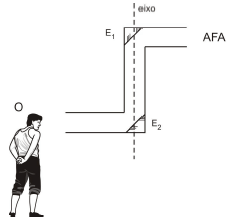
Nessas condições, a opção que melhor representa, respectivamente, a imagem da palavra AFA conjugada pelo espelho E1 e a imagem final que o observador O visualiza através do espelho E2 é
Provas
TEXT
The end of life on Earth?
It weighted about 10,000 tons, entered the atmosphere at a speed of 64,000 km/h and exploded over a city with a blast of 500 kilotons. But on 15 February 2013, we were lucky. The metereorite that showered pieces of rock over Chelyabinsk, Russia, was relatively small, at only about 17 metres wide. Although many people were injured by falling glass, the damage was nothing compared to what had happened in Siberia nearly one hundred years ago, when a relatively small object (approximately 50 metres in diameter) exploded in mid-air over a forest region, flattening about 80 million trees. If it had exploded over a city such as Moscow or London, millions of people would have been killed.
By a strange coincidence, the same day that the meteorite terrified the people of Chelyabinsk, another 50m-wide asteroid passed relatively close to Earth. Scientists were expecting that visit and know that the asteroid will return to fly close by us in 2046, but the Russian meteorite earlier in the day had been too small for anyone to spot.
Most scientists agree that comets and asteroids pose the biggest natural threat to human existence. It was probably a large asteroid or comet colliding with Earth which wiped out the dinosaurs about 65 million years ago. An enormous object, 10 to 16 km in diameter, struck the Yucatan region in Mexico with the force of 100 megatons. That is the equivalent of one Hiroshima bomb for every person alive on Earth today.
Many scientists, including the late Stephen Hawking, say that any comet or asteroid greater than 20km in diameter that hits Earth will result in the complete destruction of complex life, including all animals and most plants. As we have seen even a much smaller asteroid can cause great damage.
The Earth has been kept fairly safe for the last 65 million years by good fortune and the massive gravitational field of the planet Jupiter. Our cosmic guardian, with its stable circular orbit far from the sun, sweeps up and scatters away most of the dangerous comets and asteroids which might cross Earth’s orbit.
After the Chelyabinsk meteorite, scientists are now monitoring potential hazards even more carefully but, as far as they know, there is no danger in the foreseeable future.
Types of space rocks
• Comet – a ball of rock and ice that sends out a tail of gas and dust behind it. Bright comets only appear in our visible night sky about once every ten years.
• Asteroid – a rock a few feet to several kms in diameter. Unlike comets, asteroids have no tail. Most are to small to cause any damage and burn up in the atmosphere.
• Meteoroid – part of an asteroid or comet.
• Meteorite – what a meteoroid is called when it hits Earth.
Taken from: http://learningenglishteens.britishcouncil.org
- Access on 29/06/2020
On the same day as the meteorite exploded over Chelyabinsk,
Provas
TEXTO I
As mulheres são vítimas de violência porque são mulheres
Wânia Pasinato
Nos últimos anos, a violência contra as mulheres no Brasil vem se tornando assunto público e reconhecido como problema ao qual qualquer mulher, independentemente de raça, cor, etnia, idade ou classe social pode estar sujeita. Trata-se de reconhecer que a violência não é um infortúnio pessoal, mas tem origem na constituição desigual dos lugares de homens e mulheres nas sociedades – a desigualdade de gênero -, que tem implicações não apenas nos papéis sociais do masculino e feminino e nos comportamentos sexuais, mas também em uma relação de poder. Em outras palavras, significa dizer que a desigualdade é estrutural. Ou seja, social, histórica e culturalmente a sociedade designa às mulheres um lugar de submissão e menor poder em relação aos homens. Qualquer outro fator – o desemprego, o alcoolismo, o ciúme, o comportamento da mulher, seu jeito de vestir ou exercer sua sexualidade – não são causas, mas justificativas socialmente aceitas para que as mulheres continuem a sofrer violência.
(...) Em anos recentes, esse reconhecimento foi acompanhado por mudanças na forma como devemos responder a essa violência, atacando não as justificativas, mas as causas. O país tornou-se referência internacional com a Lei 11.340/2006 – a Lei Maria da Penha, cujo diferencial é a forma de abordar o problema, propondo a criminalização e a aplicação de penas para os agressores, mas também medidas que são dirigidas às mulheres para a proteção de sua integridade física e de seus direitos, além de medidas de prevenção destinadas a modificar as relações entre homens e mulheres na sociedade, campo no qual a educação desempenha papel estratégico. Apesar de tudo, o Brasil segue sendo um país violento para as mulheres. Anualmente são registradas centenas de ocorrências de violência doméstica, de violência sexual, além das elevadas taxas de homicídios de mulheres que, quando motivadas pelas razões de gênero, são tipificadas como feminicídios. Esses números expressam uma parte do problema e comumente dizemos que a subnotificação é uma característica dessas situações!$ ^{D)} !$.
O medo, a dúvida, a vergonha são algumas explicações para esse silêncio, mas novamente nos contentamos em olhar para as justificativas e não para as causas. (...)
De modo geral, mudamos as leis, mas não a forma como as instituições funcionam. O Sistema de Justiça segue atuando de forma seletiva e distribuindo de forma desigual o acesso à Justiça!$ ^{B)} !$. Existem poucos serviços especializados para atender as mulheres em
situação de violência. Faltam protocolos que orientem o atendimento. Falta capacitação para os profissionais cuja atuação é muitas vezes balizada por convicções pessoais e julgamentos de valor que nada têm a ver com os direitos humanos. (...)
Disponível em: https://revistagalileu.globo.com/Sociedade/notícia/2018/02/
violencia-contra-mulher-wania-pasinato.html - Acesso em 30/06/2020
TEXTO II
Porém igualmente
É uma santa. Diziam os vizinhos. E D. Eulália
apanhando. É um anjo. Diziam os parentes. E D. Eulália
sangrando. Porém igualmente se surpreenderam na
noite em que, mais bêbado que de costume, o marido,
depois de surrá-la, jogou-a pela janela, e D. Eulália
rompeu em asas o voo de sua trajetória.
(COLASANTI, Marina. Um espinho de marfim e outras histórias.
Porto Alegre: L & PM, 1999.)
TEXTO III
Mulheres de Atenas
Mirem-se no exemplo
Daquelas mulheres de Atenas
Vivem pros seus maridos
Orgulho e raça de Atenas
Quando amadas, se perfumam
Se banham com leite, se
Arrumam
Suas melenas
Quando fustigadas não choram
Se ajoelham, pedem, imploram
Mais duras penas; cadenas
Mirem-se no exemplo
Daquelas mulheres de Atenas
Sofrem pros seus maridos
Poder e Força de Atenas
(...)
Elas não têm gosto ou vontade
Nem defeito, nem qualidade
Têm medo apenas
Não têm sonhos, só têm
Presságios
O seu homem, mares,
Naufrágios
Lindas sirenas, morenas
Mirem-se no exemplo
Daquelas mulheres de Atenas
Temem por seus maridos
Heróis e amantes de Atenas
As jovens viúvas marcadas
E as gestantes abandonadas
Não fazem cenas
Vestem-se de negro, se
Encolhem
Se conformam e se recolhem
Às suas novenas, serenas!$ ^{C)} !$
(HOLANDA, Chico Buarque de. Meus caros amigos. LP, 1976.
Phonogram/Philips)
TEXTO IV
Apelo
Amanhã faz um mês que a Senhora está longe de casa. Primeiros dias, para dizer a verdade, não senti falta, bom chegar tarde, esquecido na conversa de esquina. Não foi ausência por uma semana: o batom ainda no lenço, o prato na mesa por engano, a imagem de relance no espelho.
Com os dias, Senhora, o leite primeira vez coalhou. A notícia de sua perda veio aos poucos: a pilha de jornais ali no chão, ninguém os guardou debaixo da escada. Toda a casa era um corredor deserto, até o canário ficou mudo. Não dar parte de fraco, ah, Senhora, fui beber com os amigos. Uma hora da noite eles se iam. Ficava só, sem o perdão de sua presença, última luz na varanda, a todas as aflições do dia.
Sentia falta da pequena briga pelo sal no tomate – meu jeito de querer bem. Acaso é saudade, Senhora? Às suas violetas, na janela, não lhes poupei água e elas murcham!$ ^{A)} !$. Não tenho botão na camisa. Calço a meia furada. Que fim levou o saca-rolha? Nenhum de nós sabe, sem a Senhora, conversar com os outros: bocas raivosas mastigando. Venha para casa, Senhora, por favor.
(TREVISAN, Dalton. Mistérios de Curitiba. 5ª ed. Record.
Rio de Janeiro, 1996.)
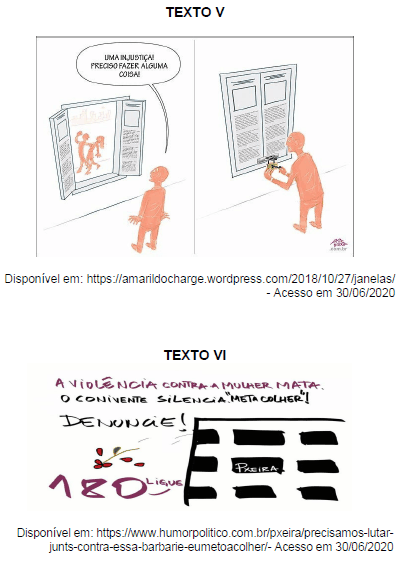
Observe o emprego do conectivo “E” no seguinte enunciado e assinale a alternativa em que ele foi empregado no mesmo sentido.
“É uma santa. Diziam os vizinhos. E D. Eulália apanhando.”
Provas
TEXT
The end of life on Earth?
It weighted about 10,000 tons, entered the atmosphere at a speed of 64,000 km/h and exploded over a city with a blast of 500 kilotons. But on 15 February 2013, we were lucky. The metereorite that showered pieces of rock over Chelyabinsk, Russia, was relatively small, at only about 17 metres wide. Although many people were injured by falling glass, the damage was nothing compared to what had happened in Siberia nearly one hundred years ago, when a relatively small object (approximately 50 metres in diameter) exploded in mid-air over a forest region, flattening about 80 million trees. If it had exploded over a city such as Moscow or London, millions of people would have been killed.
By a strange coincidence, the same day that the meteorite terrified the people of Chelyabinsk, another 50m-wide asteroid passed relatively close to Earth. Scientists were expecting that visit and know that the asteroid will return to fly close by us in 2046, but the Russian meteorite earlier in the day had been too small for anyone to spot.
Most scientists agree that comets and asteroids pose the biggest natural threat to human existence. It was probably a large asteroid or comet colliding with Earth which wiped out the dinosaurs about 65 million years ago. An enormous object, 10 to 16 km in diameter, struck the Yucatan region in Mexico with the force of 100 megatons. That is the equivalent of one Hiroshima bomb for every person alive on Earth today.
Many scientists, including the late Stephen Hawking, say that any comet or asteroid greater than 20km in diameter that hits Earth will result in the complete destruction of complex life, including all animals and most plants. As we have seen even a much smaller asteroid can cause great damage.
The Earth has been kept fairly safe for the last 65 million years by good fortune and the massive gravitational field of the planet Jupiter. Our cosmic guardian, with its stable circular orbit far from the sun, sweeps up and scatters away most of the dangerous comets and asteroids which might cross Earth’s orbit.
After the Chelyabinsk meteorite, scientists are now monitoring potential hazards even more carefully but, as far as they know, there is no danger in the foreseeable future.
Types of space rocks
• Comet – a ball of rock and ice that sends out a tail of gas and dust behind it. Bright comets only appear in our visible night sky about once every ten years.
• Asteroid – a rock a few feet to several kms in diameter. Unlike comets, asteroids have no tail. Most are to small to cause any damage and burn up in the atmosphere.
• Meteoroid – part of an asteroid or comet.
• Meteorite – what a meteoroid is called when it hits Earth.
Taken from: http://learningenglishteens.britishcouncil.org
- Access on 29/06/2020
The Siberian meteorite
Provas
Considere no plano de Argand Gauss os números complexos !$ z = A (cos \ \alpha + i sen \ \alpha) !$ e !$ w = B(cos \beta + i \ sen\beta) !$ conforme gráfico abaixo.
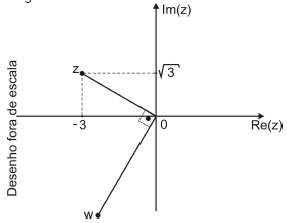
Se !$ w = z^4 !$, então B é igual a
Provas
TEXT
The end of life on Earth?
It weighted about 10,000 tons, entered the atmosphere at a speed of 64,000 km/h and exploded over a city with a blast of 500 kilotons. But on 15 February 2013, we were lucky. The metereorite that showered pieces of rock over Chelyabinsk, Russia, was relatively small, at only about 17 metres wide. Although many people were injured by falling glass, the damage was nothing compared to what had happened in Siberia nearly one hundred years ago, when a relatively small object (approximately 50 metres in diameter) exploded in mid-air over a forest region, flattening about 80 million trees. If it had exploded over a city such as Moscow or London, millions of people would have been killed.
By a strange coincidence, the same day that the meteorite terrified the people of Chelyabinsk, another 50m-wide asteroid passed relatively close to Earth. Scientists were expecting that visit and know that the asteroid will return to fly close by us in 2046, but the Russian meteorite earlier in the day had been too small for anyone to spot.
Most scientists agree that comets and asteroids pose the biggest natural threat to human existence. It was probably a large asteroid or comet colliding with Earth which wiped out the dinosaurs about 65 million years ago. An enormous object, 10 to 16 km in diameter, struck the Yucatan region in Mexico with the force of 100 megatons. That is the equivalent of one Hiroshima bomb for every person alive on Earth today.
Many scientists, including the late Stephen Hawking, say that any comet or asteroid greater than 20km in diameter that hits Earth will result in the complete destruction of complex life, including all animals and most plants. As we have seen even a much smaller asteroid can cause great damage.
The Earth has been kept fairly safe for the last 65 million years by good fortune and the massive gravitational field of the planet Jupiter. Our cosmic guardian, with its stable circular orbit far from the sun, sweeps up and scatters away most of the dangerous comets and asteroids which might cross Earth’s orbit.
After the Chelyabinsk meteorite, scientists are now monitoring potential hazards even more carefully but, as far as they know, there is no danger in the foreseeable future.
Types of space rocks
• Comet – a ball of rock and ice that sends out a tail of gas and dust behind it. Bright comets only appear in our visible night sky about once every ten years.
• Asteroid – a rock a few feet to several kms in diameter. Unlike comets, asteroids have no tail. Most are to small to cause any damage and burn up in the atmosphere.
• Meteoroid – part of an asteroid or comet.
• Meteorite – what a meteoroid is called when it hits Earth.
Taken from: http://learningenglishteens.britishcouncil.org
- Access on 29/06/2020
Scientists support the idea that
Provas
Sequências têm relevância para estudos em matemática, mas também habitam o imaginário das pessoas na observação de possíveis coincidências.
Um exemplo foi a data de 02 de fevereiro deste ano de 2020. Esse foi o 33o dia do ano e estava a 333 dias do fim de 2020.
Além disso, 02/02/2020 é uma capicua, ou seja, uma sequência de números que tanto pode ser lida da direita para a esquerda como da esquerda para direita sem alteração de significado.
Considere todas as combinações numéricas capicuas no formato DD/MM/AAAA, em que DD é dia com dois algarismos, MM é mês com dois algarismos e AAAA é ano com quatro algarismos.
A diferença entre o número de capicuas possíveis de 01 de janeiro de 2 000 a 31 de dezembro de 2 999 e de 01 de janeiro de 3 000 a 31 de dezembro de 3 999, nessa ordem, é um número do intervalo
Provas
TEXT
The end of life on Earth?
It weighted about 10,000 tons, entered the atmosphere at a speed of 64,000 km/h and exploded over a city with a blast of 500 kilotons. But on 15 February 2013, we were lucky. The metereorite that showered pieces of rock over Chelyabinsk, Russia, was relatively small, at only about 17 metres wide. Although many people were injured by falling glass, the damage was nothing compared to what had happened in Siberia nearly one hundred years ago, when a relatively small object (approximately 50 metres in diameter) exploded in mid-air over a forest region, flattening about 80 million trees. If it had exploded over a city such as Moscow or London, millions of people would have been killed.
By a strange coincidence, the same day that the meteorite terrified the people of Chelyabinsk, another 50m-wide asteroid passed relatively close to Earth. Scientists were expecting that visit and know that the asteroid will return to fly close by us in 2046, but the Russian meteorite earlier in the day had been too small for anyone to spot.
Most scientists agree that comets and asteroids pose the biggest natural threat to human existence. It was probably a large asteroid or comet colliding with Earth which wiped out the dinosaurs about 65 million years ago. An enormous object, 10 to 16 km in diameter, struck the Yucatan region in Mexico with the force of 100 megatons. That is the equivalent of one Hiroshima bomb for every person alive on Earth today.
Many scientists, including the late Stephen Hawking, say that any comet or asteroid greater than 20km in diameter that hits Earth will result in the complete destruction of complex life, including all animals and most plants. As we have seen even a much smaller asteroid can cause great damage.
The Earth has been kept fairly safe for the last 65 million years by good fortune and the massive gravitational field of the planet Jupiter. Our cosmic guardian, with its stable circular orbit far from the sun, sweeps up and scatters away most of the dangerous comets and asteroids which might cross Earth’s orbit.
After the Chelyabinsk meteorite, scientists are now monitoring potential hazards even more carefully but, as far as they know, there is no danger in the foreseeable future.
Types of space rocks
• Comet – a ball of rock and ice that sends out a tail of gas and dust behind it. Bright comets only appear in our visible night sky about once every ten years.
• Asteroid – a rock a few feet to several kms in diameter. Unlike comets, asteroids have no tail. Most are to small to cause any damage and burn up in the atmosphere.
• Meteoroid – part of an asteroid or comet.
• Meteorite – what a meteoroid is called when it hits Earth.
Taken from: http://learningenglishteens.britishcouncil.org
- Access on 29/06/2020
According to the text
Provas
Caderno Container