Foram encontradas 64 questões.
Considere o gráfico da função real \( f: \mathbb{R} \rightarrow B \) definida por \( f(x)=1-x^2- \left\vert x^2-1 \right\vert \)
Sobre a função f, marque a alternativa correta.
Provas

No universo dos complexos, sobre a equação \( 2x^6-4x^5-64x+128=0 \), marque a alternativa correta.
Provas
A equação de uma onda periódica harmônica se propagando em um meio unidimensional é dada, em unidades do SI, por \( y(x,t)=\pi^2 \cos(80 \pi t-2 \pi x) \).
Nessas condições, são feitas as seguintes afirmativas sobre essa onda:
I) O comprimento de onda é 2 m.
II) A velocidade de propagação é 40 m/s.
III) A frequência é 50 Hz.
IV) O período de oscilação é 2,5∙10-2 s.
V) A amplitude de onda é de \( \pi \) m e a onda se propaga para a direita.
São corretas apenas as afirmativas
Provas
Considere o polinômio \( P(x)=5x^{2n}-4x^{2n+1}-2 \), em que n é um número natural.
Dividindo \( P(x) \) por \( (x+1) \), o resto r encontrado é tal que
Provas
Answer question according to the text.
TEXT
When making a decision, it is a common impulse to look and see what others are doing. Nevertheless, it is often unclear whether the path that everyone else may be following is good for us as well. After all, sometimes following the crowd has merit - at other times, it is simply peer pressure blinding us.
The phenomenon of looking to others and following the crowd has been studied by social science for a long time. Nevertheless, those findings do not always make their way to individual decision-makers. Therefore, let’s review why people conform to the crowd – and under what conditions it is a god idea to go your own way instead.
To start, individuals tend to look to the opinions of others, especially when they are unsure and lack information from other sources. This dynamic was supported by classic research from Sherif (1937), who explored how a person’s perception of a very ambiguous stimuli can be influenced by the opinion of others. Sherif (1937) asked participants to watch a small light in a dark and featureless room and evaluate how much that light moved around. In actuality, however, the light never moved at all – but the way our perception works in that situation gives the possible illusion of movement (called the Autokinetic Effect). In this uncertain and ambiguous perceptual situation, Sherif (1937) found that individuals were quite susceptible to the influence of the opinions of others when trying to decide how much light was “moving”.
Unfortunately, this phenomenon also extends to individuals following the crowd, even when they can clearly see that others are wrong. This was first evaluated by Asch (1955), who asked participants to pick a line from a few choices of varying lengths that matched up with another example line given to them. From a perceptual standpoint, the task was easy – as the correct choice of which lines were actually similar to one another was clear. Nevertheless, when participants were surrounded by other individuals giving the wrong answer, they often conformed and made the wrong choice as well. Thus, even when the correct choice is clear, and what others are doing is wrong, that peer pressure can still cause us to doubt ourselves and follow the crowd.
Why is it that we are so compelled to follow the crowd, even when it is objectively clear that they are wrong? According to more recent research, we may simply be wired that way. Specifically, these social influences can actually change our perceptions and memories (Edelson, Sharot, Dolan, & Dudai, 2011). Therefore, rather than knowingly making the wrong choice just to conform to peer pressure, the influence of others may actually change what we see as the correct choice in the moment and remember as the right thing after the fact. Beyond that, we might just have “herding brains” with built-in components that monitor our social alignments and make us feel good when we follow the crowd too (Shamay-Tsoory, Saporta, Marton-Alper, & Gvirts, 2019).
Fortunately, this effect has good points as well. In many cases, group decision-making can help individuals look beyond their own private perspectives and make more rational decisions (Fahr & Irlenbusch, 2011). Furthermore, pro-social and altruistic behaviors can be influenced and shared through such conformity as well (Nook, Ong, Morelli, Mitchell, & Zaki, 2016). Therefore, sometimes following the crowd helps people get along and make better decisions too.
Given the above, when making a decision, it is important to consider whether following others is a good idea – or is leading you astray instead. Some simple steps can help you figure it out.
Getting swept away by what everyone else is doing is often an emotional and thoughtless process. We are conforming simply because we have not given sufficient attention and effort toward considering any other options. Therefore, unless you are in an emergency situation and need to immediately follow everyone else toward the nearest exit, it might be a good idea to switch to more deliberate thinking processes, rather than just going with your initial reaction.
Some choices and decision-making situations are more individual, while others are more social. Therefore, it is important to consider the specific situation. Is this an individual choice, or does it involve others? If you have sufficient information to make a clear choice on your own, and you do not need group approval, then you might want to make up your own mind. If you are personally unsure, or you need the support of others to make something happen, then taking the opinion of others into consideration might be a good idea instead.
It is generally a good idea to evaluate your choices and decisions from multiple perspectives. The same is true for following the opinion of others too. Although it might not feel that way at times, especially in the modern day of media coverage and social networking, everyone is not doing it – whatever “it” is that you are considering. Given that, before you follow the advice or choices of any particular group of people, it might be a good idea to look at what other groups of people are doing or choosing too. In addition, we can learn a lot from people making choices contrary to ourselves or our preferred group, particularly about potential down-sides to choices we might not be seeing. Therefore, if you do need to look to others to help provide information regarding a particular choice or decision, then it might help to seek out people with a few different opinions, weigh your options among them, and figure out what will work best for you.
(Adapted from https://www.psychologytoday.com. Access on March 25th, 2021)
Mark the option in which the passage expresses a condition.
Provas
Considere, no plano cartesiano, a circunferência \( λ:mx^2+4y^2+nxy-16x+3k-1=0 \), em que m, n e k são números reais.
Sabe-se que a circunferência \( λ \) tangencia a reta de equação \( 3x-4y-16=0 \)
Analise cada proposição abaixo quanto a ser (V) VERDADEIRA ou (F) FALSA.
( ) O ponto P(3k , n) é interior a \( λ \)
( ) \( λ \) tangencia o eixo das ordenadas.
( ) \( λ \) tem abscissa máxima igual à ordenada máxima.
Tem-se a sequência correta em
Provas
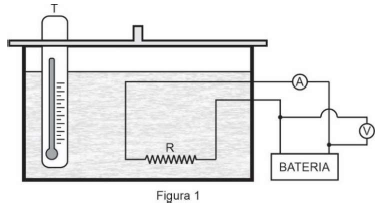
Para determinar o calor específico de um objeto de material desconhecido, de massa igual a 600 g, um professor sugeriu aos seus alunos um experimento que foi realizado em duas etapas.
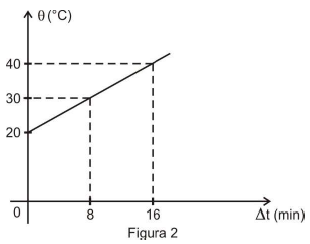
1ª etapa: no interior de um recipiente adiabático, de capacidade térmica desprezível, colocou-se certa quantidade de água que foi aquecida por uma resistência elétrica R. Utilizando-se de um amperímetro A e de um voltímetro V, ambos ideais, manteve-se a corrente e a voltagem fornecidas por uma bateria em 2 A e 20 V, conforme ilustrado na Figura 1.
Com a temperatura θ lida no termômetro T, obteve-se, em função do tempo de aquecimento \( Δ t \), o gráfico representado na Figura 2.
2ª etapa: repete-se a experiência, desde o início, desta vez, colocando o objeto de material desconhecido imerso na água. Sem alterar a quantidade de água, a corrente e a tensão no circuito elétrico, obteve-se o gráfico representado na Figura 3.
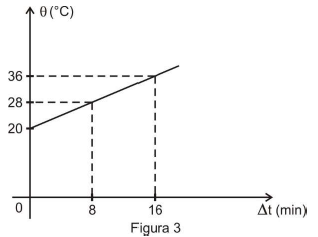
Considerando que, em ambas as etapas, toda energia elétrica foi dissipada por efeito Joule no resistor R, pode-se concluir que o calor específico do material de que é feito o objeto é, em cal/(g∙°C) igual a
Provas
Seja e o número de Euler.
O domínio mais amplo da função real f definida por \( f(x)=\sqrt{\left({\large{1 \over e}} \right)^x -1} + \log (-x^2+x+6) \) é
Provas
Um projétil de massa 2m é disparado horizontalmente com velocidade de módulo v, conforme indica a Figura 1, e se movimenta com essa velocidade até que colide com um pêndulo simples, de comprimento L e massa m, inicialmente em repouso, em uma colisão perfeitamente elástica.
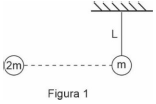
Considere que o projétil tenha sido lançado de uma distância muito próxima do pêndulo e que, após a colisão, esse pêndulo passe a oscilar em movimento harmônico simples, como indica a Figura 2, com amplitude A.
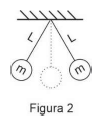
Desprezando a ação de forças dissipativas, o período de oscilação desse pêndulo, logo após a colisão, é dado por
Provas
Uma barra homogênea e impermeável de massa específica \( ρ \) é mantida presa, por um fio ideal, ao fundo de um tanque que contém dois líquidos não miscíveis, de densidades \( ρ_A \) e \( ρ_B \), conforme a figura abaixo:
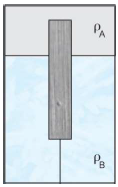
Para que seja nula a tração no fio, a razão entre o volume da barra que fica submersa apenas no líquido de densidades \( ρ_A \) e o seu volume total, pode ser expressa por:
Provas
Caderno Container