Foram encontradas 223 questões.
Ache os valores de !$ x_1 !$ e !$ x_2 !$ correspondentes ao máximo da função !$ y = ( - x^2_1 - x^2_2 + 10x_1 + 10x_2 + 31)^{^1_2} !$ e satisfazem a equação !$ x_1 + 2x_2 = 5 !$. Em cada opção assinale se falsa ou verdadeira:
Item 0: 0 e 4.
Provas

Classifique, como V ou F, a afirmativa abaixo:
Item 4: Uma inovação financeira que reduzisse a demanda por base monetária também reduzirá, tudo o mais constante, o imposto inflacionário recolhido pelo governo.
Provas
Se !$ f(x) = x^a !$, !$ x \ge 0 !$ e !$ 0 < a < 1 !$, examine as seguintes afirmações:
Item 2: !$ lim_{x \rightarrow 0} f (x) = - \infty !$
Provas
Numa economia os balanços consolidados dos bancos comerciais e do Banco Central são:
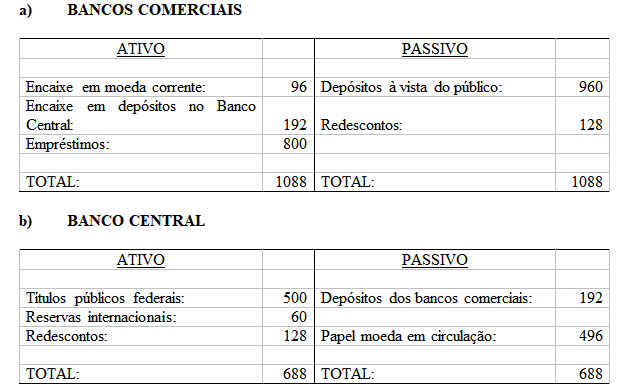
Através dessas informações, classifique, com V ou F a afirmativa abaixo:
Item 2: o crédito interno líquido é igual a 1.428.
Provas
Supondo uma empresa monopolista, seja por concessão do governo ou naturalmente originado por economias de escala na produção, é possível afirmar que:
Item 2: Ao praticar uma discriminação de preços do 3º grau, seja por um questão de sobrevivência ou não, é absolutamente necessário que as elasticidades de demanda sejam diferentes nos mercados discriminados.
Provas
ECONOMIC GROWTH
As long as the fruits of economic growth are taken in the form of higher income, economic growth will be accompanied by increases in the mean of the income distribution. However, poverty will not necessarily decrease if growth is accompanied by a sufficiently large, offsetting increase in inequality. Unfortunately the impact of growth on inequality is not nearly as clear, either theoretically or empirically, as its impact on the mean of the distribution.
Growth and the distribution of income are the joint results of a complicated set of underlying economic processes, reflected in changes in supplies of and demands for factors of production. Arguments that inequality is necessary for growth or that growth necessarily reduces inequality ignore the process generating growth and inequality simultaneously. Any correlation between these two variables is likely to be spurious - it is not growth per se, but how that growth is achieved, which determines inequality.
Technological change and increases in the supply of labor or capital offer two routes to economic growth. They are, however, not on equal footing. Since the amount of labor or capital cannot be increased indefinitely, only technological change can offer a permanent increase in the rate of growth of output. The two also differ in the ways in which they affect the distribution of income.
Technological change may increase or decrease inequality. The initial impact of technological change is to alter the demands for labor and capital. This in turn changes prices, which may call forth a supply response as workers flow to those jobs for which demand and, hence, wages are greater.
While technological change may increase the demand for all skill classes, this is by no means necessary. The result may be an increase in both economic growth and poverty. For example, a labor-saving technological change may lower the demand for low-skilled workers. The resulting decrease in wages of those at the bottom of the distribution will have two effects - some workers will drop out of the labor force, while others will be induced to gain skills in response to the drop in the relative wages of unskilled workers. Whether or not poverty increases depends on the relative magnitude of these two changes.
DANZIGER, Sheldon, GOTTSCHALK, Peter. Increasing inequality in the United States: what we know and what we don’t. Journal of Post Keynesian Economics,New York, 11(2): 181-182, 1988-89.
Still in the fifth paragraph, the authors indicate that:
Item 3: all unskilled workers necessarily look for better skill when their relative wages drop.
Provas
ECONOMIC GROWTH
As long as the fruits of economic growth are taken in the form of higher income, economic growth will be accompanied by increases in the mean of the income distribution. However, poverty will not necessarily decrease if growth is accompanied by a sufficiently large, offsetting increase in inequality. Unfortunately the impact of growth on inequality is not nearly as clear, either theoretically or empirically, as its impact on the mean of the distribution.
Growth and the distribution of income are the joint results of a complicated set of underlying economic processes, reflected in changes in supplies of and demands for factors of production. Arguments that inequality is necessary for growth or that growth necessarily reduces inequality ignore the process generating growth and inequality simultaneously. Any correlation between these two variables is likely to be spurious - it is not growth per se, but how that growth is achieved, which determines inequality.
Technological change and increases in the supply of labor or capital offer two routes to economic growth. They are, however, not on equal footing. Since the amount of labor or capital cannot be increased indefinitely, only technological change can offer a permanent increase in the rate of growth of output. The two also differ in the ways in which they affect the distribution of income.
Technological change may increase or decrease inequality. The initial impact of technological change is to alter the demands for labor and capital. This in turn changes prices, which may call forth a supply response as workers flow to those jobs for which demand and, hence, wages are greater.
While technological change may increase the demand for all skill classes, this is by no means necessary. The result may be an increase in both economic growth and poverty. For example, a labor-saving technological change may lower the demand for low-skilled workers. The resulting decrease in wages of those at the bottom of the distribution will have two effects - some workers will drop out of the labor force, while others will be induced to gain skills in response to the drop in the relative wages of unskilled workers. Whether or not poverty increases depends on the relative magnitude of these two changes.
DANZIGER, Sheldon, GOTTSCHALK, Peter. Increasing inequality in the United States: what we know and what we don’t. Journal of Post Keynesian Economics, New York, 11(2): 181-182, 1988-89.
As found in the first paragraph, the phrase “as long as” can be translated as:
Item 3: No período que.
Provas
Dada a equação em diferenças finitas
!$ y_{t+2} - 5y_{t+1} + 6y_t = 2 !$
diga se a afirmação seria verdadeira ou falsa:
Item 2: Toda solução é combinação linear de funções trigonométricas.
Provas
Numa economia tem-se, em percentagens do produto interno líquido:
- Poupança do setor privado: 18%
- Carga tributária bruta: 25%
- Outras receitas correntes do Governo: 1%
- Consumo do Governo: 10%
- Transferências: 10%
- Subsídios: 4%
- Superávit do balanço de pagamentos em transações correntes: 1%
- Depreciação do capital fixo: 6%
- Relação incremental capital/produto (líquida): 3
Isto posto:
Item 2: A Poupança Interna Líquida é 14% do Produto Interno Líquido.
Provas
Com relação à demanda de um insumo variável de produção, pode-se afirmar que:
Item 2: No caso de mercados competitivos, variações da demanda de mercado de produto não afetam a curva de valor do produto marginal das firmas individuais.
Provas
Caderno Container