Foram encontradas 312 questões.
Tight Money
By
Robert Heilbroner and Lester Thurow. Economics Explained. Chapter 12, pp. 158-159. Touchstone Book. Simon and Schuster, 1994.
That bring us, of course, back to square one. If we cannot easily introduce deep institutional changes and if the use of controls promises quick relief but no permanent cure, how do we cope with the inflationary propensities that continue to lurk within modern capitalism?
The answer is very likely to be continued reliance on the one medicine that has brought inflationary fever down: tight money. As we have seen, if we are willing to tighten money ruthlessly, and to keep it tight until unions quit asking for higher wages and corporations are forced into price wars to win markets, then inflation will come to an end.
The problem with tight money is twofold. The first, obvious, problem is that the cure is so severe it threatens the health of the patient, even though it rids him of his immediate ailment. The recession that stopped inflation in the early 1980s was the worst economic catastrophe that afflicted the capitalist world since the Great Depression itself. No one wants to go through that experience again.
The second problem with tight money is certainly not an equitable, and likely not an effective anti-inflationary policy unless it is imposed with Draconian severity. Suppose a tight-money policy brings unemployment up to, say, 8 percent. That does not mean that every worker is laid off for 8 percent of the year. It means that some workers are unemployed for long periods of time. Over 50 percent of the total number of weeks of unemployment is typically borne by individuals who are unemployed for more than half of the year. Almost half of those who suffer long spells of unemployment end up not with a job, but by withdrawing from the work force.
Thus if a relatively mild recession is the way we decide to fight inflation, we should recognize that the honor of being designated as an inflation fighter is rather selectively awarded. It does not mainly go to those whose recruitment into the brigade of the unemployed would be most effective in bringing down wage rates, namely the group of prime-age white males. Rather, enlistment in the ranks of inflation fighters is predominantly that of younger workers, age 16-24, of women, of blacks and of Hispanics. These groups share two characteristics: they tend to be relatively unskilled, and they tend to lack political clout. Thus their impact on the trend of the national wage rate is small. The brigade is not only inequitably chosen, but is ineffective.
The authors argue that
Item 3: the anti-inflation policy hurts more the well paid skilled labor.
Provas

Provas
Provas
Considere cinco firmas que se encontram nas seguintes situações de curto prazo:
Firma a: P = Rm = Cm = CM
Firma b: P > Rm = Cm < CM = P
Firma c: P = Rm > Cm = CM < P
Firma d: P > Rm < Cm = CM < P
Firma e: P = Rm < Cm > CM < P
onde P = preço do bem produzido, Rm = receita marginal, Cm = custo marginal, e CM = custo médio.
Em relação a essas situações, pode-se afirmar que:
Item 0: As firmas a, c e e estão operando em um mercado competitivo.
Provas
Canadian Economic Nationalism
By
Paul Krugman. Geography and Trade. Chapter 3, pp. 90-92. Leuven University Press and The MIT Press, 1991
In 1873, when the various British colonies north of the United States were gathered under a single government, it looked likely that the whole nation would become part of the North American periphery to the already coalescing U.S. manufacturing belt. We are used to thinking of Canada, like the United States, as being a great immigrant nation. In its early years as a nation, however, Canada attracted few immigrants from abroad--and Canadians, especially from impoverished Quebec, were migrating in substantial numbers to the United States. There was little manufacturing in Canada and seemingly little prospect that any would arise. Agricultural expansion was proceeding westward into the prairies, much as it was in the United States, but as in the United States it was not pulling manufacturing and urbanization west with it.
If one had made a guess in 1870, one would probably have predicted an agricultural Canada of perhaps 5 or at most 10 million people--a sort of oversized Nebraska. Most of those people would have been fairly prosperous, much as most U.S. farmers are; but there wouldn’t have been much of a nation.
What happened instead, of course, was a deliberate policy of delinking from the U.S. economy. In 1878 Canada introduced the so-called National Policy, which had two main elements; a tariff wall that in effect forced the Canadian agricultural sector to turn to domestic producers rather than established U.S. suppliers, and a national railway that in effect subsidized East-West traffic in opposition to the natural North-South direction.
Isn’t this simply a standard kind of infant-industry, import-substitution policy, of the kind that has gotten such a bad name in the past forty years? Not quite. Until the 1920’s, Canada and the United States were in a fairly unusual situation with respect to one another: in effect labor mobility between the two was nearly perfect. The reason is that both countries were the targets of large-scale, economically motivated immigration, and so on the margin were competing for workers.
But what that means is that Canadian import substitution could do something that similar policies elsewhere cannot: by protecting the domestic market, they could also enlarge it. Because Canadian farmers were forced to buy Canadian, there were more Canadians than there would otherwise have been and hence a larger Canadian market. In principle, that market would eventually be large enough to be self-sustaining. That is, the Canadian market would eventually become large enough to make it efficient to locate manufacturing there to serve the market even without protection. At that point the economy could throw away its crutches and accept free trade without fear of becoming peripheralized. This is not so much an infant-industry as an infant-country argument for protection.
Was this policy a success? Presumably that depends on one’s objectives. What seems clear is that the policy did more than create a hothouse industrial sector that would die off as soon as it was exposed to the winds of international competition. Canada now is strong enough industrially to accept free trade with the United States without fearing that it will be peripheralized. (Well, okay, some Canadians still fear it, and they could even be right; but they are a minority and are probably wrong.) It seems reasonable to argue that Canada’s nationalistic economic policies were the key factor in creating this strength.
The author affirms that
Item 3: the Canadian national railway in effect subsidized the East-West trade.
Provas
Considere os seguintes balanços consolidados dos bancos comerciais e do Banco Central e Classifique como Verdadeira ou Falsa a seguinte afirmativa abaixo:
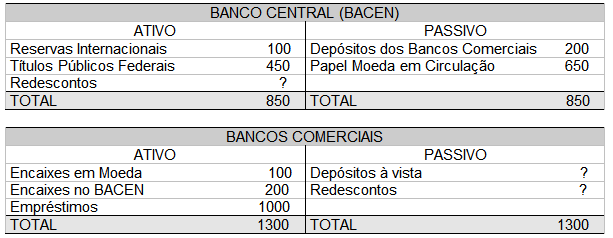
Item 1: M1 é igual a 1550.
Provas
Provas
Indique se a afirmativa é verdadeira ou falsa:
Item 0: No !$ \Re^3 !$, a distância entre os pontos (1, 2, 3) e (2, 0, 5) é 3.
Provas
Provas
Indique se cada afirmativa é verdadeira ou falsa.
Seja: !$ f: \Re \rightarrow \Re !$ dada por !$ f(x) = x^3 + 3x^2 + 2 !$.
Item 2: !$ f(x) !$ é estritamente crescente para !$ x > 1 !$.
Provas
Caderno Container