Magna Concursos

Foram encontradas 359 questões.

111478 Ano: 1996
Disciplina: Economia
Banca: ANPEC
Orgão: ANPEC
Provas:

Sobre o desempenho da economia brasileira no Governo João Goulart pode-se afirmar que:

Item 3 - o Plano Trienal de Celso Furtado, implementado a partir de 1963, foi responsável pela recuperação da economia nos primeiros anos do governo militar;


Provas

Questão presente nas seguintes provas
111477 Ano: 1996
Disciplina: Economia
Banca: ANPEC
Orgão: ANPEC
Provas:

No que se refere ao equilíbrio de trocas:

Item 1 - Somente preços relativos serão determinados em equilíbrio geral.


Provas

Questão presente nas seguintes provas
111476 Ano: 1996
Disciplina: Inglês (Língua Inglesa)
Banca: ANPEC
Orgão: ANPEC
Provas:

Part III.

Macroeconomics and Small Developing Economies: A Policy-Maker’s Perspective. (Section 5, External Debt ) PP. 111-112 By DeLisle Worrell.

In Economics in a Changing World. Edited by Edmar L. Bacha

Issues of major concern in the macroeconomic literature on external debt are the optimal level of debt and the risk of debt repudiation. The optimum rate of debt accumulation is determined by the growth rate and the real interest rate. The faster the growth rate of a competitive economy the greater is its capacity to service external debt. The more rapidly an economy grows the more external debt it may support, for any level of the interest rate.

In the open economy the real interest rate is exogenous, determined on the international capital market. The rate of debt accumulation therefore depends on the growth rate. If the growth rate is exogenous, as it is in many models of debt accumulation, there is a maximum sustainable rate of debt accumulation. Models where growth depends on savings encourage the notion of an external debt constraint on growth, because an increase in interest rates reduces the optimal rate of external debt accumulation and therefore the resources available for growth. However, this implies that the increase in domestic finance in response to the increase in real interest rates is not sufficient to compensate for the reduction in external borrowing.

In models of endogenous growth it becomes clear that external debt accumulation is not the constraint, though real interest rates may be. The rate of growth depends on investment-promoting policies such as macroeconomic stability, trade policy, tax policy and the provision of public goods. For any rate of growth the real interest rate determines the ratio of external to domestic finance. If there is an external constraint on growth it is the real interest rate, which may reduce the level of investment, ceteris paribus.

One may assess the risk of default on external debt by comparing the cost of economic adjustment to provide surpluses for debt servicing with the costs of debt repudiation (Ghatak and Levine, 1991). These models are helpful in understanding the evolution and treatment of debt in the recent past, but they are less useful in determining future strategy because the results depend critically on parameters such as the rate of time preference of borrowers and the degree of risk aversion of lenders, which can only be guessed at.

According to the author, in endogenous growth models, the rate of growth depends on appropriate investment-promoting policies such as:

Item 0 - real interest rates and trade policy.

 

Provas

Questão presente nas seguintes provas
111475 Ano: 1996
Disciplina: Inglês (Língua Inglesa)
Banca: ANPEC
Orgão: ANPEC
Provas:

Part III.

Macroeconomics and Small Developing Economies: A Policy-Maker’s Perspective. (Section 5, External Debt ) PP. 111-112 By DeLisle Worrell.

In Economics in a Changing World. Edited by Edmar L. Bacha

Issues of major concern in the macroeconomic literature on external debt are the optimal level of debt and the risk of debt repudiation. The optimum rate of debt accumulation is determined by the growth rate and the real interest rate. The faster the growth rate of a competitive economy the greater is its capacity to service external debt. The more rapidly an economy grows the more external debt it may support, for any level of the interest rate.

In the open economy the real interest rate is exogenous, determined on the international capital market. The rate of debt accumulation therefore depends on the growth rate. If the growth rate is exogenous, as it is in many models of debt accumulation, there is a maximum sustainable rate of debt accumulation. Models where growth depends on savings encourage the notion of an external debt constraint on growth, because an increase in interest rates reduces the optimal rate of external debt accumulation and therefore the resources available for growth. However, this implies that the increase in domestic finance in response to the increase in real interest rates is not sufficient to compensate for the reduction in external borrowing.

In models of endogenous growth it becomes clear that external debt accumulation is not the constraint, though real interest rates may be. The rate of growth depends on investment-promoting policies such as macroeconomic stability, trade policy, tax policy and the provision of public goods. For any rate of growth the real interest rate determines the ratio of external to domestic finance. If there is an external constraint on growth it is the real interest rate, which may reduce the level of investment, ceteris paribus.

One may assess the risk of default on external debt by comparing the cost of economic adjustment to provide surpluses for debt servicing with the costs of debt repudiation (Ghatak and Levine, 1991). These models are helpful in understanding the evolution and treatment of debt in the recent past, but they are less useful in determining future strategy because the results depend critically on parameters such as the rate of time preference of borrowers and the degree of risk aversion of lenders, which can only be guessed at.

According to the author:

Item 0 - the international capital market determines the real rate of interest.


Provas

Questão presente nas seguintes provas
111474 Ano: 1996
Disciplina: Inglês (Língua Inglesa)
Banca: ANPEC
Orgão: ANPEC
Provas:

Part III.

Macroeconomics and Small Developing Economies: A Policy-Maker’s Perspective. (Section 5, External Debt ) PP. 111-112 By DeLisle Worrell.

In Economics in a Changing World. Edited by Edmar L. Bacha

Issues of major concern in the macroeconomic literature on external debt are the optimal level of debt and the risk of debt repudiation. The optimum rate of debt accumulation is determined by the growth rate and the real interest rate. The faster the growth rate of a competitive economy the greater is its capacity to service external debt. The more rapidly an economy grows the more external debt it may support, for any level of the interest rate.

In the open economy the real interest rate is exogenous, determined on the international capital market. The rate of debt accumulation therefore depends on the growth rate. If the growth rate is exogenous, as it is in many models of debt accumulation, there is a maximum sustainable rate of debt accumulation. Models where growth depends on savings encourage the notion of an external debt constraint on growth, because an increase in interest rates reduces the optimal rate of external debt accumulation and therefore the resources available for growth. However, this implies that the increase in domestic finance in response to the increase in real interest rates is not sufficient to compensate for the reduction in external borrowing.

In models of endogenous growth it becomes clear that external debt accumulation is not the constraint, though real interest rates may be. The rate of growth depends on investment-promoting policies such as macroeconomic stability, trade policy, tax policy and the provision of public goods. For any rate of growth the real interest rate determines the ratio of external to domestic finance. If there is an external constraint on growth it is the real interest rate, which may reduce the level of investment, ceteris paribus.

One may assess the risk of default on external debt by comparing the cost of economic adjustment to provide surpluses for debt servicing with the costs of debt repudiation (Ghatak and Levine, 1991). These models are helpful in understanding the evolution and treatment of debt in the recent past, but they are less useful in determining future strategy because the results depend critically on parameters such as the rate of time preference of borrowers and the degree of risk aversion of lenders, which can only be guessed at.

The author states that:

Item 0 - in models of endogenous growth, for any rate of growth the real interest rate determines the ratio of external to domestic finance.


Provas

Questão presente nas seguintes provas
111473 Ano: 1996
Disciplina: Matemática
Banca: ANPEC
Orgão: ANPEC
Provas:

Seja !$ \mathbb{R} !$ o conjunto dos números reais. Classifique como verdadeira ou falsa a afirmação a seguir:

Item 2 - !$ f:\mathbb{R} \rightarrow \mathbb{R} !$ é uma função contínua em x=xo desde que f(xo) exista.


Provas

Questão presente nas seguintes provas
111472 Ano: 1996
Disciplina: Matemática
Banca: ANPEC
Orgão: ANPEC
Provas:

O item abaixo se refere a seqüências e séries de números reais. Julgue a afirmação:

Item 2 - !$ |\alpha| < 1,\, então\, \sum^\infty_{n=0}\alpha^n = \dfrac{1}{1-\alpha} !$.


Provas

Questão presente nas seguintes provas
111471 Ano: 1996
Disciplina: Economia
Banca: ANPEC
Orgão: ANPEC
Provas:

Indique se a proposição abaixo é falsas ou verdadeira:

Item 2 - Num regime de taxa de câmbio flexível, a taxa da câmbio se ajusta de forma a equilibrar o balanço de pagamentos.


Provas

Questão presente nas seguintes provas
111470 Ano: 1996
Disciplina: Estatística
Banca: ANPEC
Orgão: ANPEC
Provas:

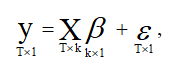
Considere o seguinte modelo de regressão, em forma matricial, com T observações amostrais e k regressores (X):

Enunciado 2629373-1

Item 1 - o estimador de máxima verossimilhança de !$ \beta !$ requer o pressuposto de média zero e de variância finita na estrutura de erros, dispensando a especificação de uma distribuição paramétrica da mesma.


Provas

Questão presente nas seguintes provas
111469 Ano: 1996
Disciplina: Economia
Banca: ANPEC
Orgão: ANPEC
Provas:

O crescimento expressivo da indústria brasileira, na segunda metade das década dos cinqüenta, deveu-se, em grande parte, à política desenvolvimentista então implementada — consubstanciada no Plano de Metas do Governo Kubitschek. Em relação a esse período, pode-se afirmar que:

Item 3 - o crescimento da indústria foi financiado exclusivamente por capital externo e por poupanças privadas domésticas;


Provas

Questão presente nas seguintes provas