Foram encontradas 347 questões.
Com relação à Teoria do Consumidor, é correto afirmar que:
Item 1 - A taxa marginal de substituição entre dois bens é igual ao valor absoluto da inclinação da curva de indiferença, em qualquer ponto.
Provas

Foram encontrados os seguintes resultados para estimar uma regressão linear com duas variáveis explicativas para uma amostra de tamanho 10.
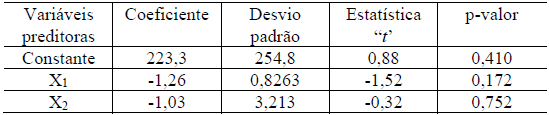
!$ R^2=81,2% !$; !$ R^2 !$ ajustado =76,1%; Valor calcuado da estatística F=15,1
Podemos afirmar que:
Item 2 - O coeficiente de determinação indica que 81,2b% da variação amostral de Y podem ser atribuídos as variações de X1 e X2.
Provas
“Reconsideration of Import Substitution”, by Henry J. Breton, Journal of Economic Literature June 1998, pp. 903-936.
The following text contains two sections of the article above by Henry J. Breton. Your job is to agree or disagree with these statements. Read the definition and mark it right or wrong.
Section 3.2. Key Role of Capital Formation
These ideas put primary emphasis on capital formation as the source of growth. The most obvious difference between firms in rich countries and those in poor ones was the extent to which physical capital was available to work with the labor. There are virtually no data on capital/labor ratios for the early 195 Q's, but there is little doubt that this ratio was vastly higher in the North than in the South in virtually all sectors, except for foreign firms engaged in mining of one kind or another. Thus another policy objective eras to accelerate the rate of investment. This view was supported by a now-famous Arthur Lewis statement: "The central problem in the theory of economic growth is to understand the process by which a community is converted from being a 5 percent saver to a 12 percent saver"(Lewis 1955, pp. 325-26). Tae nearest thing available to a formal theory of growth was that of Roy F. Harrod (1939. 1949), in which the only specified source of growth was capital formation. Harrod specified a simple relationship between increased output and increased capital--the incremental capital/output ratio (ICOR). This ratio was assumed to be constant due to technological factors. There were numerous estimates of the ICOR, and most plans made specific assumptions about its value for sectors and for the economy as a whole. Such estimates were widely used to determine the amount of new capital required to achieve a given growth target. Most observers considered domestic saving the primary constraint, and the earliest arguments for foreign aid rested on the assumption that the savings of the poor countries had to be supplemented by foreign savings if acceptable growth rates were to be achieved.
The allocation of capital within the boundaries laid down with respect to structural change was an important issue. In some instances, the ICOR estimates were used as a criterion; that is; invest where the ICORs are smallest. There were efforts to identify specific objectives to be served by the new investment: for example to raise the saving rate, increase exports, maximize na employment effect, meet certain regional objectives, etc. Evidently this way of thinking revealed further doubts about an effective market answer.
The capital goods sector :vas small or nonexistent in the newly independent countries, and most capital goods had to be imported. An obvious way to encourage investment was to maintain an exchange rate that kept capital's domestic price low. This could be most easily done by maintaining an overvalued exchange rate (or, less frequently, multiple exchange rates). Overvalued exchange rates (relative to a free trade situation) appeared as a means to encourage investment. This produced balance of payment pressures, and to counter these
varieties of tariffs. import licenses, and exchange controls were put in place. Protection in many forms was afforded currently imported consumer durables (and now and then simple capital goods) behind which domestic production took place. Consumer goods (especially durables), rather than capital goods, were protected on the grounds that their costs of production in the developing country would be relatively less than those of capital goods, because production of the latter goods was assumed to be more capital intensive and to employ more complex technology. Where Mahalanobis' view strongly prevailed--India. Brazil, and possibly other large countries--domestic production of capital goods .:as encouraged by keeping out imports and by direct subsidies. Even in such countries. however, attention was given mainly to protecting the domestic market from importation of consumer durables.
The structuralist put primary emphasis on capital formation.
Item 0 - They argued that the firms in the north worked with a higher capital,' labor ratio than the firms in the south even though there was no data available in the early 1950s to confirm this assertion.
Provas
Assinale o item se é certo ou errado:
Considere uma economia que produza somente três tipos de frutas: maçãs, laranjas e bananas. Para o ano base (alguns anos atrás), os dados de produção e de preço são os seguintes:
|
Fruta |
Quantidade |
Preço |
|
Maçãs |
3000 sacos |
R$2,00 por saco |
|
Bananas |
6000 cachos |
R$3,00 por cacho |
|
Laranja |
8000 sacos |
R$4,00 por saco |
Para o ano corrente os dados de produção e preço são os seguintes:
|
Fruta |
Quantidade |
Preço |
|
Maçãs |
4000 sacos |
R$3,00 por saco |
|
Bananas |
14000 cachos |
R$2,00 por cacho |
|
Laranja |
32000 sacos |
R$5,00 por saco |
Item 3 - A inflação medida por um índice de pesos fixos que toma a produção do ano base como referência foi superior à inflação medida pelo deflator implícito do PIB.
Provas
“Reconsideration of Import Substitution”, by Henry J. Breton, Journal of Economic Literature June 1998, pp. 903-936.
The following text contains two sections of the article above by Henry J. Breton. Your job is to agree or disagree with these statements. Read the definition and mark it right or wrong.
Section 3.2. Key Role of Capital Formation
These ideas put primary emphasis on capital formation as the source of growth. The most obvious difference between firms in rich countries and those in poor ones was the extent to which physical capital was available to work with the labor. There are virtually no data on capital/labor ratios for the early 195 Q's, but there is little doubt that this ratio was vastly higher in the North than in the South in virtually all sectors, except for foreign firms engaged in mining of one kind or another. Thus another policy objective eras to accelerate the rate of investment. This view was supported by a now-famous Arthur Lewis statement: "The central problem in the theory of economic growth is to understand the process by which a community is converted from being a 5 percent saver to a 12 percent saver"(Lewis 1955, pp. 325-26). Tae nearest thing available to a formal theory of growth was that of Roy F. Harrod (1939. 1949), in which the only specified source of growth was capital formation. Harrod specified a simple relationship between increased output and increased capital--the incremental capital/output ratio (ICOR). This ratio was assumed to be constant due to technological factors. There were numerous estimates of the ICOR, and most plans made specific assumptions about its value for sectors and for the economy as a whole. Such estimates were widely used to determine the amount of new capital required to achieve a given growth target. Most observers considered domestic saving the primary constraint, and the earliest arguments for foreign aid rested on the assumption that the savings of the poor countries had to be supplemented by foreign savings if acceptable growth rates were to be achieved.
The allocation of capital within the boundaries laid down with respect to structural change was an important issue. In some instances, the ICOR estimates were used as a criterion; that is; invest where the ICORs are smallest. There were efforts to identify specific objectives to be served by the new investment: for example to raise the saving rate, increase exports, maximize na employment effect, meet certain regional objectives, etc. Evidently this way of thinking revealed further doubts about an effective market answer.
The capital goods sector :vas small or nonexistent in the newly independent countries, and most capital goods had to be imported. An obvious way to encourage investment was to maintain an exchange rate that kept capital's domestic price low. This could be most easily done by maintaining an overvalued exchange rate (or, less frequently, multiple exchange rates). Overvalued exchange rates (relative to a free trade situation) appeared as a means to encourage investment. This produced balance of payment pressures, and to counter these
varieties of tariffs. import licenses, and exchange controls were put in place. Protection in many forms was afforded currently imported consumer durables (and now and then simple capital goods) behind which domestic production took place. Consumer goods (especially durables), rather than capital goods, were protected on the grounds that their costs of production in the developing country would be relatively less than those of capital goods, because production of the latter goods was assumed to be more capital intensive and to employ more complex technology. Where Mahalanobis' view strongly prevailed--India. Brazil, and possibly other large countries--domestic production of capital goods .:as encouraged by keeping out imports and by direct subsidies. Even in such countries. however, attention was given mainly to protecting the domestic market from importation of consumer durables.
The structuralist put primary emphasis on capital formation.
Item 3 - To capitalize the economy in the south, it was necessary to increase the saving rate.
Provas
Assinale o item abaixo se é certo ou errado:
Item 2 - No caso de uma pequena economia aberta, a política fiscal não exerce impacto sobre a renda quando as taxas de cambio são fixas.
Provas
Com relação à inequação:
!$ 2x^2-13x+13 \le(x-2)(x-3) !$
Item 2 - É satisfeita para quaisquer valores de x compreendidos entre 1 e 7
Provas
As reformas institucionais de meados dos anos sessenta, mormente dos sistemas monetário-financeiro e fiscal, foram importantes à retomada do crescimento econômico a partir de 1968. Diante desse fato pode-se afirmar que:
Item 4 - os bancos de investimento passaram a financiar o capital de giro das empresas mediante o repasse de recursos externos.
Provas
As reformas institucionais de meados dos anos sessenta, mormente dos sistemas monetário-financeiro e fiscal, foram importantes à retomada do crescimento econômico a partir de 1968. Diante desse fato pode-se afirmar que:
Item 3 - o BNDE especializou-se no financiamento da indústria doméstica de bens de capital;
Provas
Em relação as preferências dos consumidores podemos dizer que:
Item 3 - A fim de discutir convexidade das preferências é necessário admitir algum tipo de monotonicidade das preferências.
Provas
Caderno Container