Foram encontradas 347 questões.
Classifique como certo ou errado o item abaixo:
Item 1 - !$ \underset{x\rightarrow 0 }{\lim } {\large{(e^x-1) \over \sin (x)}}=0 !$
Provas

A implementação do II PND (1974/1978) provocou importantes efeitos na economia brasileira. Dentre eles destacam-se:
Item 4 - a atrofia das atividades de exportação, dada a prioridade concedida á substituição de importações.
Provas
Classifique como certo ou errado sobre a função abaixo:
!$ f(x)={\large{x^3 \over 3}}-{\large{5 \over 2}}x^2-14x+7 !$; !$ x ∈ R !$:
Item 3 - Apresenta descontinuidade em x=2,5
Provas
Podemos afirmar que:
Item 2 - A distribuição “F” é uma razão entre duas variáveis aleatórias “t” independentes, cada uma delas dividida pelo respectivo número de graus de liberdade.
Provas
Com base na teoria dos Números Índices, pode-se afirmar que:
Item 3 - Os índices de Fisher, definidos como a média geométrica dos índices de Laspeyres e de Paasche, são sempre maiores do que estes dois últimos.
Provas
Com base na teoria da estimação, pode-se fazer a seguinte afirmação :
Item 1 - Seja !$ \hat{\theta} !$ um estimador não-viciado de !$ \theta !$. Se !$ g(\hat{\theta}) !$ é uma função do parâmetro !$ \theta !$, então !$ E[g(\hat{\theta})]\ne g[E(\hat{\theta})] !$ com a igualdade ocorrendo somente quando !$ g(\theta) !$for uma função linear.
Provas
A economia brasileira apresentou taxas de crescimento relativamente baixas no período de 1962 a 1967. Contribuíram para tal performance :
Item 3 - o arrefecimento da demanda por bens duráveis de consumo, uma vez atendida a demanda reprimida preexistente;
Provas
Assinale o item abaixo se é certo ou errado:
Robinson Crusoe planta coqueiros e pesca. No ano passado ele colheu 1000 cocos e pescou 500 peixes. Para ele um peixe vale dois cocos. Robinson deu para Sexta-feira 200 cocos em troca da ajuda na colheita e 100 peixes para que ele colhesse minhocas que seriam usadas de isca na pescaria. Robinson estocou 100 dos seus cocos na sua cabana para consumo futuro. Ele também usou 100 peixes como fertilizantes para os seus coqueiros, o que é necessário fazer para que os coqueiros produzam bem. Sexta-feira consumiu todos os seus cocos e peixes.
Item 0 - O PIB desta economia em termos de peixe é 1000.
Provas
Seja a seguinte distribuição conjunta de probabilidade entre as variáveis aleatórias X e Y.
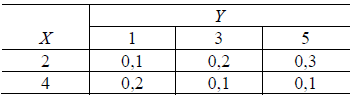
Podemos afirmar que:
Item 1 - A variância de Y é 2,76.
Provas
“Reconsideration of Import Substitution”, by Henry J. Breton, Journal of Economic Literature June 1998, pp. 903-936.
The following text contains two sections of the article above by Henry J. Breton. Your job is to agree or disagree with these statements. Read the definition and mark it right or wrong.
Section 3.2. Key Role of Capital Formation
These ideas put primary emphasis on capital formation as the source of growth. The most obvious difference between firms in rich countries and those in poor ones was the extent to which physical capital was available to work with the labor. There are virtually no data on capital/labor ratios for the early 195 Q's, but there is little doubt that this ratio was vastly higher in the North than in the South in virtually all sectors, except for foreign firms engaged in mining of one kind or another. Thus another policy objective eras to accelerate the rate of investment. This view was supported by a now-famous Arthur Lewis statement: "The central problem in the theory of economic growth is to understand the process by which a community is converted from being a 5 percent saver to a 12 percent saver"(Lewis 1955, pp. 325-26). Tae nearest thing available to a formal theory of growth was that of Roy F. Harrod (1939. 1949), in which the only specified source of growth was capital formation. Harrod specified a simple relationship between increased output and increased capital--the incremental capital/output ratio (ICOR). This ratio was assumed to be constant due to technological factors. There were numerous estimates of the ICOR, and most plans made specific assumptions about its value for sectors and for the economy as a whole. Such estimates were widely used to determine the amount of new capital required to achieve a given growth target. Most observers considered domestic saving the primary constraint, and the earliest arguments for foreign aid rested on the assumption that the savings of the poor countries had to be supplemented by foreign savings if acceptable growth rates were to be achieved.
The allocation of capital within the boundaries laid down with respect to structural change was an important issue. In some instances, the ICOR estimates were used as a criterion; that is; invest where the ICORs are smallest. There were efforts to identify specific objectives to be served by the new investment: for example to raise the saving rate, increase exports, maximize na employment effect, meet certain regional objectives, etc. Evidently this way of thinking revealed further doubts about an effective market answer.
The capital goods sector :vas small or nonexistent in the newly independent countries, and most capital goods had to be imported. An obvious way to encourage investment was to maintain an exchange rate that kept capital's domestic price low. This could be most easily done by maintaining an overvalued exchange rate (or, less frequently, multiple exchange rates). Overvalued exchange rates (relative to a free trade situation) appeared as a means to encourage investment. This produced balance of payment pressures, and to counter these
varieties of tariffs. import licenses, and exchange controls were put in place. Protection in many forms was afforded currently imported consumer durables (and now and then simple capital goods) behind which domestic production took place. Consumer goods (especially durables), rather than capital goods, were protected on the grounds that their costs of production in the developing country would be relatively less than those of capital goods, because production of the latter goods was assumed to be more capital intensive and to employ more complex technology. Where Mahalanobis' view strongly prevailed--India. Brazil, and possibly other large countries--domestic production of capital goods .:as encouraged by keeping out imports and by direct subsidies. Even in such countries. however, attention was given mainly to protecting the domestic market from importation of consumer durables.
There was a consensus among these theoreticians that the saving in the south had to be increased.
Item 2 - There was no consensus about the saving needs to stimulate growth.
Provas
Caderno Container