Foram encontradas 347 questões.
Em relação às reformas monetárias implementadas por Ouro Preto e Rui Barbosa pode-se afirmar que:
Item 4 - o sucesso da reforma monetária de Rui Barbosa e seus sucessores imediatos no Ministério da Fazenda se deveu em grande parte aos empréstimos externos obtidos.
Provas

Assinale o item abaixo se é certo ou errado:
Item 3 - Uma curva de Phillips aceleracionista com expectativas adaptativas implica na existência de um trade off permanente entre inflação e produto.
Provas
“Reconsideration of Import Substitution”, by Henry J. Breton, Journal of Economic Literature June 1998, pp. 903-936.
The following text contains two sections of the article above by Henry J. Breton. Your job is to agree or disagree with these statements. Read the definition and mark it right or wrong.
Section 3.2. Key Role of Capital Formation
These ideas put primary emphasis on capital formation as the source of growth. The most obvious difference between firms in rich countries and those in poor ones was the extent to which physical capital was available to work with the labor. There are virtually no data on capital/labor ratios for the early 195 Q's, but there is little doubt that this ratio was vastly higher in the North than in the South in virtually all sectors, except for foreign firms engaged in mining of one kind or another. Thus another policy objective eras to accelerate the rate of investment. This view was supported by a now-famous Arthur Lewis statement: "The central problem in the theory of economic growth is to understand the process by which a community is converted from being a 5 percent saver to a 12 percent saver"(Lewis 1955, pp. 325-26). Tae nearest thing available to a formal theory of growth was that of Roy F. Harrod (1939. 1949), in which the only specified source of growth was capital formation. Harrod specified a simple relationship between increased output and increased capital--the incremental capital/output ratio (ICOR). This ratio was assumed to be constant due to technological factors. There were numerous estimates of the ICOR, and most plans made specific assumptions about its value for sectors and for the economy as a whole. Such estimates were widely used to determine the amount of new capital required to achieve a given growth target. Most observers considered domestic saving the primary constraint, and the earliest arguments for foreign aid rested on the assumption that the savings of the poor countries had to be supplemented by foreign savings if acceptable growth rates were to be achieved.
The allocation of capital within the boundaries laid down with respect to structural change was an important issue. In some instances, the ICOR estimates were used as a criterion; that is; invest where the ICORs are smallest. There were efforts to identify specific objectives to be served by the new investment: for example to raise the saving rate, increase exports, maximize na employment effect, meet certain regional objectives, etc. Evidently this way of thinking revealed further doubts about an effective market answer.
The capital goods sector :vas small or nonexistent in the newly independent countries, and most capital goods had to be imported. An obvious way to encourage investment was to maintain an exchange rate that kept capital's domestic price low. This could be most easily done by maintaining an overvalued exchange rate (or, less frequently, multiple exchange rates). Overvalued exchange rates (relative to a free trade situation) appeared as a means to encourage investment. This produced balance of payment pressures, and to counter these
varieties of tariffs. import licenses, and exchange controls were put in place. Protection in many forms was afforded currently imported consumer durables (and now and then simple capital goods) behind which domestic production took place. Consumer goods (especially durables), rather than capital goods, were protected on the grounds that their costs of production in the developing country would be relatively less than those of capital goods, because production of the latter goods was assumed to be more capital intensive and to employ more complex technology. Where Mahalanobis' view strongly prevailed--India. Brazil, and possibly other large countries--domestic production of capital goods .:as encouraged by keeping out imports and by direct subsidies. Even in such countries. however, attention was given mainly to protecting the domestic market from importation of consumer durables.
There was a consensus among these theoreticians that the saving in the south had to be increased.
Item 1 - Most observers agreed that the main constraint to growth was the lower saving rate in the South.
Provas
Considere a Caixa de Edgeworth abaixo, que descreve as preferências de dois indivíduos A e B com relação a dois bens, e suas dotações iniciais caracterizadas pelo ponto E. Os níveis de utilidade obtidos com as dotações iniciais são respectivamente UA,0 e UB,0. Observe que o indivíduo A tem toda a dotação de um dos bens, e que o indivíduo B tem toda a dotação do outro bem. Nesta situação, é correto afirmar que:
Item 3 - No equilíbrio competitivo com troca, a linha de preço é tangente às curvas de indiferença dos dois indivíduos e passa pelo ponto E.
Provas
Segundo Celso Furtado, em Formação Econômica do Brasil, "...o fato de maior relevância ocorrido na economia brasileira no último quartel do século XIX, foi sem lugar à dúvida, o aumento da importância relativa do setor assalariado". Esse aumento da importância relativa do setor assalariado:
Item 4 - contribuiu favoravelmente para a evolução da indústria brasileira.
Provas
Assinale o item abaixo se é certo ou errado:
Item 1 - O financiamento do déficit público por meio da emissão de títulos do Tesouro adquiridos pelo Banco Central, que os retém em carteira, constitui fator de expansão da base.
Provas
“Reconsideration of Import Substitution”, by Henry J. Breton, Journal of Economic Literature June 1998, pp. 903-936.
The following text contains two sections of the article above by Henry J. Breton. Your job is to agree or disagree with these statements. Read the definition and mark it right or wrong.
Section 3.1. Reflection of the Market Solution
The view that a more or less free market would not solve the development problem was widely accepted. The problem was not market failure in the usual textbook sense (externalities, decreasing costs, etc.). Rather, the notion was that the division of labor between the rich countries and the poor ones seemed to doom the latter to permanent poverty. The most widely cited evidence was data purporting to show that the net barter terms of trade had turned against the developing countries over the decades prior to 1940. Raul Prebisch, Hares Singer, and others calculated many such series that seemed to show a secular deterioration in the terms of trade of the poor countries. Prebisch's explanation that the gains from productivity growth in the North resulted in rising wages, not falling prices, due to the monopoly power of both labor and firms in the North, was widely accepted. In the South, dependent mainly on agricultural and mineral exports, there was lower productivity growth, and surplus labor, weak unions, and competition among exporters held down wages. The rewards of productivity growth in manufacturing activities were thus not available to importers of such products in the South.
Also cited as a source of difficulties were Engel curve arguments that the income elasticity of demand for agricultural products and raw materials in the North declines as incomes reach higher and higher levels. If exports lagged behind the growth of income in the South for this reason, then import substitution of some kind must take place to protect the balance of payments, or growth would slow or stop. Widespread protection of agriculture in many rich countries exacerbated this effect. Added to all this was the argument that cyclical
changes in the North resulted in reduced employment and income, and hence import, rather than in falling product and factor prices. while in the South it was wages and prices that responded to downturns.
The specific arguments about the terms of trade were buttressed by more general views that the market was an instrument that kept poor countries poor and rich countries rich. There were several reasons for such views. Men who led independence movements had lived their adult lives during two world wars and a devastating worldwide depression that severely penalized the South. Predictions in mid to the late forties were generally to the effect that the post-World War II world economy would resemble that of the 1930's. Though the years 1870 to 1914 were fairly satisfactory, that period was hardly fresh in any decision maker's mind, and at that date, Europe and the United States had been growing steadily for 50 to 75 years, while most of the rest of the world's population remained mired in severe and mass poverty. In addition, the Keynesian ideas that even a perfectly functioning market may not ensure full utilization of resources were becoming widely accepted. The conclusion for many policy makers and professional economists was clear: the "structure" of the economies of the developing countries had to be changed in fundamental ways if they were to compete on equal terms in the world markets, and a market mechanism could not bring about this sort of structural change.
The Soviet Union's experience had yet to be understood very well, and many otherwise informed economists and political leaders were impressed by w-hat evidence was available. The great evils of the Stalin era were not widely known. It was known, however, that growth during the 1920's and 1930's had been quite remarkable. The USSR's commitment to central planning and to large-scale, capital intensive industrialization was especially appealing to those countries that put great weight on becoming a world economic power.
India was such a country, and the Indian effort was widely regarded as a model by other developing countries in the 1950's. The defense of the investment in heavy industry rested on strong assumptions that there were economy-wide effects on productivity growth created by a domestic capital goods sector; furthermore, economic independence required a country to have its own large-scale capital goods sector.
This view of development was most clearly articulated by P.C. Mahalanobis of the Indian Statistical Institute, who argued that the countries must not only change their structure, but must change it by creating a domestic heavy capital goods sector. The Indian Second Plan (1956-61) was greatly influenced by the Mahalanobis view. Wilfred Malenbaum (1962, p. 87) shows that the investment allocation for the second plan was virtually equivalent to that worked out by Mahalanobis in his operational research exercises (Mahalanobis 1955). In both, about one-third of total investment was allocated to "basic investment goods," about 18 percent to industrial consumer goods, and 17 percent to agriculture. Equally important, there was essentially no effort to allocate resources optimally in the usual sense. Other people showed that the objectives could have been achieved with less capital than the plan called for, and that more jobs could have been created. Such findings were not looked upon as especially relevant (or accurate), given the assumed (but not measured) externalities and the importance of the economic independence objective.
Mahalanobis' argument fit well with the structuralism of Prebisch and his Latin American colleagues. There it was widely assumed that factor prices, especially wage rates and the exchange rate, had little effect on the quantity of such factors demanded or on the choice of production techniques; output and its composition were the determining factors. In Latin America more than elsewhere, the strong structuralist view prevailed that wage rates could be high in order to attack the poverty problem with no cost in terms of employment. Similarly, the exchange rate did not matter much for exporting, so its value could be set to achieve other objectives, such as inducing capital formation or dampening inflation.
Given these arguments, many students and policy makers in much of the world believed that the appropriate strategy for development was to replace imports from the rich North with their own domestic production. Large-scale comprehensive planning, rather than the market, was assumed to be the appropriate instrument, even though the understanding of how to design and implement a plan was as primitive as was the understanding of growth.
The proponent of import substitution also argued that the division of labor between the rich and the poor countries would doom the later to permanent poverty because:
Item 0 - Monopoly power of unions in the north would protect labor against wages decline relative to productivity gains.
Provas
Foram encontrados os seguintes resultados para estimar uma regressão linear com duas variáveis explicativas para uma amostra de tamanho 10.
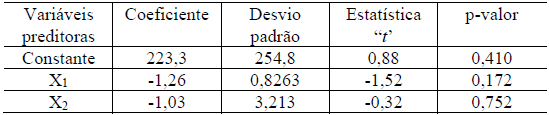
!$ R^2=81,2% !$; !$ R^2 !$ ajustado =76,1%; Valor calcuado da estatística F=15,1
Podemos afirmar que:
Item 4 - Os valores teóricos das estatísticas “t” utilizadas para testar os coeficientes das variáveis explicativas devem ser calculados para 7 graus de liberdade.
Provas
“Reconsideration of Import Substitution”, by Henry J. Breton, Journal of Economic Literature June 1998, pp. 903-936.
The following text contains two sections of the article above by Henry J. Breton. Your job is to agree or disagree with these statements. Read the definition and mark it right or wrong.
Section 3.1. Reflection of the Market Solution
The view that a more or less free market would not solve the development problem was widely accepted. The problem was not market failure in the usual textbook sense (externalities, decreasing costs, etc.). Rather, the notion was that the division of labor between the rich countries and the poor ones seemed to doom the latter to permanent poverty. The most widely cited evidence was data purporting to show that the net barter terms of trade had turned against the developing countries over the decades prior to 1940. Raul Prebisch, Hares Singer, and others calculated many such series that seemed to show a secular deterioration in the terms of trade of the poor countries. Prebisch's explanation that the gains from productivity growth in the North resulted in rising wages, not falling prices, due to the monopoly power of both labor and firms in the North, was widely accepted. In the South, dependent mainly on agricultural and mineral exports, there was lower productivity growth, and surplus labor, weak unions, and competition among exporters held down wages. The rewards of productivity growth in manufacturing activities were thus not available to importers of such products in the South.
Also cited as a source of difficulties were Engel curve arguments that the income elasticity of demand for agricultural products and raw materials in the North declines as incomes reach higher and higher levels. If exports lagged behind the growth of income in the South for this reason, then import substitution of some kind must take place to protect the balance of payments, or growth would slow or stop. Widespread protection of agriculture in many rich countries exacerbated this effect. Added to all this was the argument that cyclical
changes in the North resulted in reduced employment and income, and hence import, rather than in falling product and factor prices. while in the South it was wages and prices that responded to downturns.
The specific arguments about the terms of trade were buttressed by more general views that the market was an instrument that kept poor countries poor and rich countries rich. There were several reasons for such views. Men who led independence movements had lived their adult lives during two world wars and a devastating worldwide depression that severely penalized the South. Predictions in mid to the late forties were generally to the effect that the post-World War II world economy would resemble that of the 1930's. Though the years 1870 to 1914 were fairly satisfactory, that period was hardly fresh in any decision maker's mind, and at that date, Europe and the United States had been growing steadily for 50 to 75 years, while most of the rest of the world's population remained mired in severe and mass poverty. In addition, the Keynesian ideas that even a perfectly functioning market may not ensure full utilization of resources were becoming widely accepted. The conclusion for many policy makers and professional economists was clear: the "structure" of the economies of the developing countries had to be changed in fundamental ways if they were to compete on equal terms in the world markets, and a market mechanism could not bring about this sort of structural change.
The Soviet Union's experience had yet to be understood very well, and many otherwise informed economists and political leaders were impressed by w-hat evidence was available. The great evils of the Stalin era were not widely known. It was known, however, that growth during the 1920's and 1930's had been quite remarkable. The USSR's commitment to central planning and to large-scale, capital intensive industrialization was especially appealing to those countries that put great weight on becoming a world economic power.
India was such a country, and the Indian effort was widely regarded as a model by other developing countries in the 1950's. The defense of the investment in heavy industry rested on strong assumptions that there were economy-wide effects on productivity growth created by a domestic capital goods sector; furthermore, economic independence required a country to have its own large-scale capital goods sector.
This view of development was most clearly articulated by P.C. Mahalanobis of the Indian Statistical Institute, who argued that the countries must not only change their structure, but must change it by creating a domestic heavy capital goods sector. The Indian Second Plan (1956-61) was greatly influenced by the Mahalanobis view. Wilfred Malenbaum (1962, p. 87) shows that the investment allocation for the second plan was virtually equivalent to that worked out by Mahalanobis in his operational research exercises (Mahalanobis 1955). In both, about one-third of total investment was allocated to "basic investment goods," about 18 percent to industrial consumer goods, and 17 percent to agriculture. Equally important, there was essentially no effort to allocate resources optimally in the usual sense. Other people showed that the objectives could have been achieved with less capital than the plan called for, and that more jobs could have been created. Such findings were not looked upon as especially relevant (or accurate), given the assumed (but not measured) externalities and the importance of the economic independence objective.
Mahalanobis' argument fit well with the structuralism of Prebisch and his Latin American colleagues. There it was widely assumed that factor prices, especially wage rates and the exchange rate, had little effect on the quantity of such factors demanded or on the choice of production techniques; output and its composition were the determining factors. In Latin America more than elsewhere, the strong structuralist view prevailed that wage rates could be high in order to attack the poverty problem with no cost in terms of employment. Similarly, the exchange rate did not matter much for exporting, so its value could be set to achieve other objectives, such as inducing capital formation or dampening inflation.
Given these arguments, many students and policy makers in much of the world believed that the appropriate strategy for development was to replace imports from the rich North with their own domestic production. Large-scale comprehensive planning, rather than the market, was assumed to be the appropriate instrument, even though the understanding of how to design and implement a plan was as primitive as was the understanding of growth.
Developing countries, especially India, were impressed by the performance of the Soviet Union with its emphasis on heavy capital industries. This lead to:
Item 0 - The development of the capital goods industries believing that it would produce a spin off that would result in productivity growth in other sectors.
Provas
Em relação as preferências dos consumidores podemos dizer que:
Item 0 - As preferências por dois bens substitutos perfeitos são estritamente convexas.
Provas
Caderno Container