Foram encontradas 384 questões.
FIRST TEXT
Sympathetic writers talk of Marx’s passionate empathy toward the working class, his demands for a decent wage and improved working conditions, and his great feeling for his family’s welfare. In this respect, Marx is an enigma. In the classroom’s most popular book on the history of economics, Robert L. Heilbroner writes that, despite his reputation as a contentious and vengeful man who feuded constantly with his contemporaries, Marx was a devoted husband and father. In a sympathetic biography, Saul K. Padover notes, “Marx, the harsh critic and angry radical in his public life and writings, was a different man in private. In his personal life, he was extraordinarily kind and generous and, when not tormented by illnesses, gay. . . . [As a] self-assured male, Marx has a genuine affection and esteem for women. . . . [And] Jenny was the only woman in his life.”
Apologists for Marx are almost always blind to the darker side of the creator of communism. They write of his devotion to his family and his love letters to his wife but ignore or condone his illicit affair with the family’s household servant, Lenchen, which produced an illegitimate son whom Marx would have nothing to do with. Interestingly, Marx also never paid this servant a penny for her housework.
Karl and Jenny Marx were poverty-stricken but not for want of money. They received large sums over the years from Engels, other supporters, and from Marx’s writings. One estimate is that Marx was poor only 15 years of his 65-year career, and that his income placed him in the top 5 percent of London residents in the 1860s. But the Marxes were financially incompetent and could not control their spending habits. Marx entertained lavishly, speculated on the stock market, and spent large sums on liquor, books, travel, and other consumer goods until he had to beg for more or borrow from pawnshops at usury rates. Such irresponsible spending habits often left his family starving, destitute, and in ill health. Marx’s family life was often a nightmare, resulting in the early death or eventual suicide of most of his children. Historian Robert Payne, in his biography of Marx, concludes, “He exploited everyone around him – his wife, his children, his mistress and his friends – with a ruthlessness which was all the more terrible because it was deliberate and calculating.” (“Was Marx a Good Family Man?” Skousen, Marx, Economics on Trial: Lies, Myths, and Realities. Business One Irwin, Homewood, Ill, 1991: 212-213).
According to the text:
Item 4: As a great economist, Marx was a shrewd budget manager.
Provas
Questão presente nas seguintes provas

Na economia, há dois tipos de agentes: 50% são do tipo 1, otimista e despreocupado, e 50% são do tipo 2, pessimista e estressado. Os dois possuem um carro avaliado em R$ 20.000 e poderiam adquirir um dispositivo anti-furto por R$ 1.000, o que reduziria a probabilidade de furto de 30% para 15%. Porém, somente os agentes do tipo 2 adquirem este dispositivo. Supondo que a seguradora não tenha como distinguir entre os dois tipos de agentes, utilize o índice de utilidade de von Neumann-Morgenstern para avaliar a seguinte assertiva
Item 1: de R$ 4.000 para o agente do tipo 2.
Provas
Questão presente nas seguintes provas
Sobre a comparação entre a teoria monetária Keynesiana e a teoria quantitativa da moeda, indique se a afirmação é falsa ou verdadeira:
Item 2: Dentro da tradição Keynesiana, a demanda de moeda para transações será tanto maior quanto menor for o número de retiradas de contas remuneradas por unidade de tempo.
Provas
Questão presente nas seguintes provas
FOURTH TEXT
Most of the business of the government Tsar Peter the Great in those years concerned the war and taxes. Peter’s decrees, like his constant traveling through the country, almost invariably dealt with the enrollment of recruits or the collection of revenues. The Tsar’s demands for money were insatiable. In one attempt to uncover new sources of income, Peter in 1708 created a service of revenue officers, men whose duty it was to devise new ways of taxing the people. Called by the foreign name “fiscals,” they were commanded to “sit and make income for the Sovereign Lord.” The leader and most successful was Alexis Kurbatov, the former serf of Boris Sheremetev who had already attracted Peter’s attention with his proposal for requiring that government-stamped paper be used for all legal documents. Under Kurbatov and his ingenious, fervently hated colleagues, new taxes were levied on a wide range of human activities. There was a tax on births, on marriages, on funerals and on the registration of wills. There was a tax on wheat and tallow. Horses were taxed, and horse hides and horse collars. There was a hat tax and a strove all the time to uncover new sources of revenuetax on the wearing of leather boots. The beard tax was systematized and enforced, and a tax on mustaches was added. Ten percent was collected from all cab fares. Houses in Moscow were taxed, and beehives throughout Russia. There was a bed tax, a bath tax, an inn tax, had an insatiable thirst for revenue.a tax on kitchen chimneys and on the firewood that burned in them. Nuts, melons, cucumbers were taxed. There was even a tax on drinking water.
Money also came form an increasing number of state monopolies. This arrangement, whereby the state took control of the production and sale of a commodity, setting any price it wished, was applied to alcohol, resin, tar, fish, oil, chalk, potash, rhubarb, dice, chessmen, playing cards, and the skins of Siberian foxes, ermines and sables. The flax monopoly granted to English merchants was taken back by the Russian government. The tobacco monopoly given by Peter to Lord Carmathen in England in 1698 was abolished. The solid-oak coffins in which wealthy Muscovites elegantly spent eternity were taken over by the state and then sold at four times the original price. Of all the monopolies, however, the one most profitable to the government and most oppressive to the people was the monopoly on salt. Established by decree in 1705, it fixed the price at twice the cost to the government. Peasants who could not afford the higher price often sickened and died. (Massie, Robert. K. Peter the Great – His Life and World. Ballantine Books. New York, 1980: 401).
According to the text, in Peter’s time:
Item 1: State monopolies were the utmost important source of government revenue
Provas
Questão presente nas seguintes provas
Assinale se a proposição abaixo são falsa ou verdadeira:
Item 3: Se a curva de oferta agregada é positivamente inclinada, o efeito sobre a renda de um aumento do gasto governamental equivale àquele previsto pelo multiplicador fiscal.
Provas
Questão presente nas seguintes provas
Sobre a comparação entre a teoria monetária Keynesiana e a teoria quantitativa da moeda, indique se a afirmação é falsa ou verdadeira:
Item 0: Para Keynes, a um determinado nível de taxa de juros suficientemente baixo, a procura especulativa de moeda torna-se infinitamente elástica
Provas
Questão presente nas seguintes provas
Assinale V (verdadeiro) ou F (falso):
Item 2: A interseção dos três planos !$ \{ (x,y,z) ∈ R^3 : x + 2y + 3z = 4 \} !$, !$ \{ (x, y, z) ∈ R^3 : x + y + z = 6 \} !$ e !$ \{ (x,y,z) ∈ R^3 : 2x + 3y + 4z = 10 \} !$ é o conjunto vazio;
Provas
Questão presente nas seguintes provas
Seja T o operador linear cuja matriz na base natural {(1,0), (0,1)} é dada por !$ M = \begin{pmatrix} 3 & 1 \\ 2 & 2 \end{pmatrix} !$.
Assinale V (verdadeiro) ou F (falso):
Item 0: A imagem de T é o R2 ;
Provas
Questão presente nas seguintes provas
Dada a equação de diferenças finitas do segundo grau !$ 2y_{t+2} + 2y_{t+1} + y_t = 10 !$ com valores !$ y_0 = 3 !$ e !$ y_1 = 4 !$, assinale V (verdadeiro) ou F (falso):
Item 4: O valor da solução geral no infinito independe de !$ y_0 !$ e !$ y_1 !$.
Provas
Questão presente nas seguintes provas
Considere o jogo na forma extensiva apresentada a seguir.
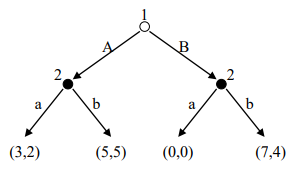
Item 3: Todo equilíbrio de Nash do jogo é perfeito em subjogos.
Provas
Questão presente nas seguintes provas
Cadernos
Caderno Container