Foram encontradas 400 questões.
É correto afirmar a respeito do modelo de regressão linear clássico multivariado: !$ Y = Xγ + ε !$, com n observações e k > 2 variáveis explicativas, incluindo-se o intercepto.
Item 4 - Sempre que o modelo tiver pelo menos duas variáveis explicativas além do intercepto, o R2 será maior ou igual ao R2 ajustado.
Provas

Considere os planos !$ \pi_1 !$ e !$ \pi_2 !$ definidos pelas seguintes equações:
!$ \pi_1: x - y + 2z = 3 !$ e !$ \pi_2 : 2x + 3y - z = 6 !$
Responda C (certo) ou E (errado):
Item 2 - A equação do plano contendo a reta interseção de !$ \pi_1 !$ com !$ \pi_2 !$ e o ponto !$ Q(1, -2,1) !$ é: !$ 3x - y + 4z = 9 !$.
Provas
No começo da década de 1980, estava claro que o Brasil enfrentava a fase aguda de uma crise de dívida externa, acompanhada de forte aceleração da inflação. Acabou, assim, sendo inevitável a implementação de políticas recessivas. É correto dizer que:
Item 0 - Esse estado de coisas resultou da política de ajuste do II PND. Este fez com que o País acumulasse uma grande dívida externa, sem nenhum resultado em termos de reajuste produtivo.
Provas
No começo da década de 1980, estava claro que o Brasil enfrentava a fase aguda de uma crise de dívida externa, acompanhada de forte aceleração da inflação. Acabou, assim, sendo inevitável a implementação de políticas recessivas. É correto dizer que:
Item 3 - Entre 1981 e 1983 foram adotadas medidas severas de contração econômica, visando conter a demanda interna para reduzir as importações e tornar mais atraentes as atividades exportadoras; visavam, também, conter a inflação. Essas políticas tiveram os efeitos desejados sobre a crise do setor externo, mas não conseguiram controlar a inflação.
Provas
Considere os jogos na forma extensiva apresentados a seguir.
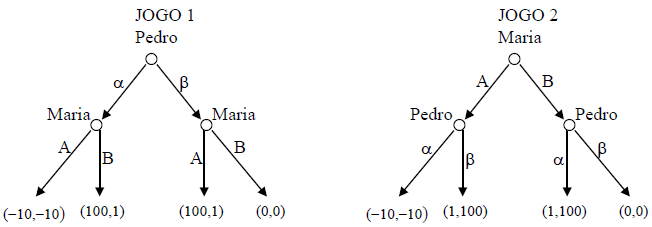
Item 3 - Em cada um destes jogos só existe 1 equilíbrio perfeito em subjogos.
Provas
BASED ON YOUR INTERPRETATION OF THE TEXT THAT FOLLOWS, DETERMINE IF EVERY STATEMENT IS RIGHT OR WRONG.
THIRD TEXT
As dramatic as it was, the global financial crises of 1997-99 was only the most recent of a rash of crises that have devastated market economies over the last 25 years. By one calculation almost 100 countries experienced a severe currency or financial crisis during that period, with adverse consequences for their national budgets and economic growth. Such patterns clearly call for an explanation: although there has been no dearth of suggestions, a consensus is growing that at least part of the explanation lies in weak financial institutions, which result in part from inadequate government regulation. The pendulum has come full circle: from the burst of enthusiasm over deregulation, policymakers now appreciate why it is that the most successful economies have long had a strong tradition of financial regulation. In the Unites States financial regulation dates back to 1863, in the middle of the American Civil War, when it became apparent that a strong banking system was essential to create a new national economy and that such a system required a strong national regulatory structure. The most recent major lapse in regulation, the deregulation effort that began in 1981, led to the savings and loan debacle. The consequences of that crisis were so severe that the U.S. economy did not recover for close to a decade.
But many developing countries are struggling with precisely the opposite problem – an overregulated financial system that stifles innovation and the flow of credit to new entrepreneurs, stunting the growth of even well-established firms. One of the many adverse effects of the East Asian financial crisis is that countries have become wary of reforms that affect the financial sector, aware that they may leave the country worse off. This article argues that reforms are possible – and indeed needed – and can be undertaken without undue fear, but success requires understanding the basic principles of financial sector regulation. The article sets forth those principles.
Even before the crisis, a theoretical literature argued that the nature of financial market failures necessitated a strong role for government. Failures in the banking system have strong spillovers, or externalities, that reach well beyond the individuals and firms directly involved. To avoid a financial collapse, governments typically bail out the affected entity, whether or not formal deposit insurance is in place; this intervention itself gives rise to problems of moral hazard. Although the absence of formal deposit insurance might give depositors a slightly increased incentive to monitor financial institutions (because there is some uncertainty about whether they will actually be bailed out), individual monitoring is actually inefficient. Monitoring is a public good, and it needs to be publicly provided. Of course, at a more practical level, a small depositor cannot be expected to examine the books of a bank on a weekly basis; there is strong evidence that regulators and rating agencies have difficulties doing so. Indeed, the widespread misconceptions about the appropriate strategy for regulating the financial sector suggests that even so-called experts are not fully aware of some of the key issues. Why, then, should one expect more from an individual depositor with little training, interest, or capacity in the arcane details of financial accounting?
Despite its long history, financial market regulation is poorly understood, as evidenced by the disasters associate with deregulation in industrial and developing countries. Often such measures were pushed through a burst of enthusiasm for free markets without recognizing the inherent market failures associate with such markets. Today few economists advocate unregulated banking, but a similar ideological agenda has pushed excessive reliance on a single regulatory instrument – capital adequacy standards. The belief is that this measure entails the minimal interference with the workings of the market and avoids the well-recognized problems of unregulated banks. A deeper analysis of the financial sector, however, shows that such reliance is not only inefficient but may even be counterproductive under some circumstances.
Principles of Financial Regulation: A Dynamic Portfolio Approach. Joseph E. Stiglitz. The World Bank
Research Observer, vol. 16, nº 1, Spring 2001.
According to the text:
Item 0 - Overregulation of financial systems chokes the flow of credit and checks the growth of firms in many developing countries.
Provas
Em 1973, os preços do petróleo quadruplicaram, dando início a uma desaceleração do crescimento mundial, acentuado por políticas de ajuste de cunho recessivo em vários países. Em virtude da forte dependência brasileira do petróleo importado, o choque do petróleo provocou forte desequilíbrio nas contas externas do Brasil e inviabilizou a expansão econômica nos moldes da observada no período do 'milagre'. A resposta do País a esse estado de coisas foi:
Item 0 - Insistir na estratégia de crescimento do 'milagre', apesar da elevada dívida externa associada a tal surto expansivo.
Provas
Em relação a índices e deflacionamento de preços é correto afirmar:
Item 1 - Se um determinado índice de preços com ano base em 1992 assume os valores I95 = 300 e I96 = 400 em 1995 e 1996, respectivamente, então um produto com preço corrente de R$ 10,00 em 1996, tem preço de R$ 7,50, em moeda de 1995.
Provas
BASED ON YOUR INTERPRETATION OF THE TEXT THAT FOLLOWS, DETERMINE IF EVERY STATEMENT IS RIGHT OR WRONG.
FIRST TEXT
At length, in 1776, our illustrious countryman, Adam Smith, published the “Wealth of Nations” – a work which has done for Political Economy what the Essay of Locke did for the philosophy of mind. In this work, the science was, for the first time, treated in its fullest extent; and the fundamental principles on which the production of wealth depends, established beyond the reach of cavil and dispute. In opposition to the Economists, Dr. Smith has shown that labor is the only source of wealth, and that the wish to augment our fortunes and to rise in the world – a wish that comes with us from the womb, and never leaves us till we go into the grave – is the cause of wealth being saved and accumulated: he has shown that labor is productive of wealth when employed in manufactures and commerce, as well as when it is employed in the cultivation of the land; he has traced the various means by which labor may be rendered most effective; and has given a most admirable analysis and exposition of the prodigious addition made to its powers by its division among different individuals and countries, and by the employment of accumulated wealth, or capital, in industrious undertakings. He has also shown, in opposition to the commonly received opinions of the merchants, politicians, and statesmen of his time, that wealth does not consist in the abundance of gold and silver, but enjoyments of human life; that it is in every case sound policy to leave individuals to pursue their own interest in their own way; that in prosecuting branches of industry advantageous to themselves, they necessarily prosecute such as are, at the same time, advantageous to the public; and that every regulation intended to force industry into particular channels, or to determine the species of commercial intercourse to be carried on between countries, is impolitic and pernicious – injurious to the rights of individuals – and adverse to the progress of real opulence and lasting prosperity.
J. R. McCulloch, on Adam Smith and Laissez-Faire from The Principles of Political Economy, 1830. Reprinted
in: Charles Dickens, Hard Times. W.W. Norton & Co, 1990: 318-319.
According to the text:
Item 2 - Smith explains how the increase in labor productivity is augmented by the division of labor and the accumulation of capital.
Provas
Assinale C (certo) ou E (errado):
Item 3 - !$ \lim_{x \rightarrow \infty}{ \large ln \ x \over \sqrt x} = 0 !$.
Provas
Caderno Container