Foram encontradas 400 questões.
A ruptura institucional de 1964 continuou a explorar um padrão de desenvolvimento semelhante ao dos anos 50: associação com empresas estrangeiras, padrões de consumo do Primeiro Mundo e adoção de tecnologias características destes padrões. Identifique abaixo quais foram as reformas institucionais implementadas pelo governo militar naquele ano e nos anos seguintes que lograram reduzir a taxa de inflação de cerca de 100% para algo em torno de 20%, em 1969.
Item 4 - Política de realismo tarifário em relação aos serviços públicos.
Provas

Considere a função !$ F : \Re^3 \rightarrow \Re !$ diferenciável !$ \nabla F(x) !$ denotando o gradiente de !$ F !$ no ponto !$ x ∈ \Re^3 !$. Assinale C (certo) ou E (errado):
Item 4 - Sabendo-se que !$ F !$ é ao mesmo tempo côncava e convexa, e que no (1,3,7) tem-se !$ \nabla F(1,3,7) = (1,2,4) !$, !$ F(1,3,7) = 36 !$, pode-se afirmar que a forma funcional de !$ F !$ é necessariamente !$ F(x_1,x_2,x_3) = x_1 + 2x_2 + 4x_3 + 1 !$.
Provas
Julgue a afirmativa abaixo.
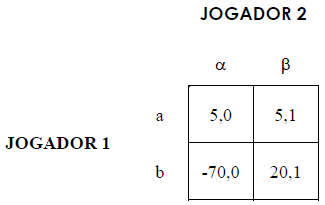
Item 0 - Com relação ao jogo descrito pela matriz de possibilidades acima representada pode-se afirmar que as estratégias a e !$ \beta !$ são dominantes.
Provas
Considere os planos !$ \pi_1 !$ e !$ \pi_2 !$ definidos pelas seguintes equações:
!$ \pi_1: x - y + 2z = 3 !$ e !$ \pi_2 : 2x + 3y - z = 6 !$
Responda C (certo) ou E (errado):
Item 3 - O ponto sobre o plano !$ \pi_1 !$ que está à menor distância de !$ Q(1,-2,1) !$ tem coordenadas: (2/3, 5/3, 1/3).
Provas
Há mais de uma década a economia brasileira vem se abrindo ao exterior. A abertura iniciou-se timidamente no final da década de 1980, transformou-se em estratégia oficial no início da década de 1990 e continua a ocorrer, com adaptações, até o presente. A natureza e os impactos da abertura nos permitem afirmar que:
Item 2 - Ao longo da década de 1990, a abertura teve impactos em termos de ganhos de eficiência técnica e alocativa na indústria nacional. Na verdade, hoje, a indústria brasileira já se encontra na fronteira de eficiência produtiva internacional.
Provas
Assinale C (certo) ou E (errado):
Item 4 - !$ \lim_{x \rightarrow -3} \sqrt{ { \large x^2 - 10x - 39 \over x^2 + 2x - 3}} = 4 !$.
Provas
Considere uma economia com dois períodos na qual existem dois tipos de empresas de tecnologia: 50% são empresas do tipo A e 50% do tipo B, ambas necessitando de financiamento de $50. Empresas que não obtêm financiamento encerram suas atividades tendo valor zero. As empresas do tipo A no segundo período poderão valer $50 ou $80 (ambos com a mesma probabilidade), enquanto as empresas do tipo B poderão valer zero ou $120 (ambos com a mesma probabilidade). Nesta economia existe apenas um banco que capta recursos a uma taxa de 10%. O banco pode emprestar recursos às empresas, cobrando juros que serão pagos apenas no segundo período, caso o valor realizado da empresa seja suficientemente elevado. No caso de uma empresa do tipo A, por exemplo, ela somente pagará $50 se esse for seu valor realizado, independentemente da taxa de juros acordada. Já no caso de uma empresa do tipo B, não haverá pagamento algum se o valor realizado for zero. Finalmente, assuma que uma empresa não tomará um empréstimo que não possa pagar nem mesmo quando seu valor realizado for elevado.
Item 4 - Em equilíbrio, firmas de ambos os tipos A e B tomam empréstimos do banco.
Provas
Examinando o desempenho da economia brasileira na década de 1930 verifica-se que, no começo da década, a crise internacional e uma sucessão de enormes safras de café provocaram quedas de PIB real. Entretanto, depois de 1932 a economia brasileira passou a registrar um acentuado crescimento. Sobre esses eventos, pode-se afirmar que:
Item 0 - A perda de dinamismo inicial deveu-se à política liberal de comércio externo, irresponsavelmente adotada pelo 'governo provisório' de Getúlio Vargas.
Provas
Considere o espaço amostral S, os eventos A e B referentes a S e a medida de probabilidade P.
Item 2 - Se !$ P(A) = 1/2, P(B) = 1/3 \ e \ P(A ∩ B) = 1/4 !$, então !$ P(A^C ∩ B^C) = 5/12 !$, em que !$ A^C \ e \ B^C !$ indicam os eventos complementares.
Provas
BASED ON YOUR INTERPRETATION OF THE TEXT THAT FOLLOWS, DETERMINE IF EVERY STATEMENT IS RIGHT OR WRONG.
SECOND TEXT
Sir, - Allow a working man to thank you for your able article on “strikes” in The Times of yesterday, and to avoid waste of your valuable space, I will proceed at once to give you a case in point.
I was three months ago at work for a good master in a good shop, one among 200, and quite content, as was the majority, with the remuneration received – viz., 5s per day. About this time trade meetings were convened to discuss the propriety of demanding an advance of 10 per cent, or 5s. 6d. per day, and a few of our men attended. A deputation was appointed and awaited on our employer, with an intimation that, unless their demand was complied with, a “strike” would be the result. The master plainly stated that, having contracts on hand to a very great amount, the completion of which in a few months was insured by heavy penalties, he could not, without great pecuniary loss, - indeed, not without risk of failure, - at once grant their request, but that, if his men would remain at their work on the then terms, he would endeavor to make such arrangements as would enable him to meet their demand when a portion of his present contracts were worked out, - say, in five or six month; but, no; the deputation were not inclined to entertain anything so reasonable as this. Other meetings were called, at which some half-dozen “speakers” and “grand movers” used all their eloquence to prove employers tyrants and workmen slaves. The result was a “turn-out”; the great majority going out because they were afraid to be marked men, and because they had no confidence in each other, although they were convinced they were thereby doing their employer an injustice and running a risk of gaining a questionable advantage for themselves. After remaining idle some time the contracts pressed so much that our employer was compelled to succumb, and we all returned with the advance demanded. But mark the sequel. I and a great many others were in a short time discharged, and arrangements were made to extend the time for several large contracts, thereby dispensing with our services. Another result is, that the high rate of wages in town has drawn so many hands from the country, although there was no lack of workmen before the advance, that I have not been able since to procure a job at the new rate of wages; and, Sir, my case is the case of hundreds besides. To keep myself from starving, I offered to work in a large shop at the old rate of 5s., but as soon as this became known I was literally hunted out of the shop, and I am now, no doubt, what is so much dreaded by all my class – a marked man.
I am not allowed to work for what my own conviction tells me is a fair remuneration, and cannot procure employment at the advanced rate, as no master is inclined to set on more workmen, under present circumstances, than will just complete what he is compelled by heavy penalties to finish in a given time. Thus, Sir, you see that numbers may remain out of employment- a burden to themselves and to society – that those who are so lucky as to be retained may exult in having obtained a trifling advantage, which they are all along afraid (and nor without reason) of losing every day. At the same time it is certain that had the “supply and demand” been duly considered, a strike or a rise would not have taken place, to throw us into this uncomfortable and ruinous state of affairs.
Your willingness to give ear to a poor man’s grievances, and my cause to complain, must be my apology for troubling you with so long a letter.
I am, Sir, your obedient servant,
A Sufferer.
An Ostracized Workman to the Editor of the Times (Letter to The Times, October 10, 1853). Published in:
Charles Dickens, Hard Times. W.W. Norton & Co, 1990: 281-282.
According to the text, the author of the letter
Item 1 - makes it clear that the benefits were not worth the costs.
Provas
Caderno Container