Foram encontradas 371 questões.
Credit for the first formal statement of the structuralist theory of inflation is due to a Mexican economist, Juan Noyola Vazquez, who in an article published in a Mexican journal in 1956 argued that, especially in underdeveloped countries, inflation is not a monetary phenomenon but the result of interaction between two factors, 'basic inflationary pressures' due to structural rigidities and the 'propagating mechanism’ of competing income claims accommodated by monetary expansion.
After this initial Mexican contribution, the structuralist theory of inflation was developed in Santiago, at ECLA (the UN Economic Commission of Latin America of which Prebisch was Executive Secretary) and at the Institute of Economics of the University of Chile. The chapter on Chile in the ECLA Economic Survey of Latin America for 1957 contained a brief statement of the view that Chile’s inflation was a structural phenomenon, but what has been called the locus classicus of the structuralist theory of inflation is an article, first published in Spanish in December 1958 by Osvaldo Sunkel. He stated the central position of structuralism concisely:
“Basic Inflationary Pressures. These are fundamentally governed by the structural limitations, rigidity or inflexibility of the economic system. In fact, the inelasticity of some productive sectors to adjust to changes in demand – or, in short, the lack of mobility of productive resources and the defective functioning of the price system – are chiefly responsible for structural inflationary disequilibria.”
The intriguing fact is that both Sunkel and Noyola (to whom Sunkel expressed his indebteness) cited, as the authority for their statements about structural factors, an article by Kalecki published in Mexico in 1955. Noyola referred to ‘the analysis by Kalecki which stresses the importance of the rigidity of supply and the degree of monopoly in the economic system’. Sunkel cited both Kalecki’s article and the UN World Economic Survey 1956 written after Kalecki had ceased to be in charge of the Survey but no doubt still under his influence.
The chief point of Kalecki’s article, based on lectures he gave in Mexico in 1953, was to stress that in LDC’s ‘the supply of food may be fairly rigid’, and that the inelastic supply of food will, if aggregate demand increases and raises food prices, ‘cause a fall in real wages and will generate an inflationary price-wage spiral’. The UN World Economic Survey spelled out the structuralist doctrine more fully:
“An additional key element in inflationary pressure in underdeveloped countries is the high degree of immobility of resources..., which prevents the structure of production from adapting itself sufficiently to the pattern of demand.... Thus, in underdeveloped countries with limited supplies of food and other essential consumer goods, severe inflationary pressures may be generated even in the absence of budget deficits and with relatively low rates of investment.”
In its analysis of Kalecki’s contributions, the text makes it plain that:
Item 2 - Inflation can occur even in the absence of a “demand pull”.
Provas

Provas
Provas
A figura abaixo mostra as curvas de indiferença de um consumidor e a direção na qual a utilidade deste consumidor aumenta.
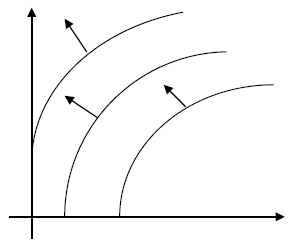
É correto afirmar:
Item 0 - Existe saciedade.
Provas
Responda V (verdadeiro) ou F (falso):
Item 2 - Seja !$ f:\mathbb{R} \rightarrow \mathbb{R} !$ uma função estritamente convexa tal que !$ f(0)=0 !$. Então .!$ 2f(\dfrac{1}{2}) < f(1) !$.
Provas
Provas
Uma variável aleatória continua x tem a sua função densidade de probabilidade dada pelo gráfico:
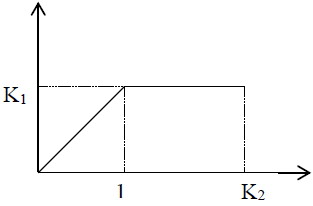
É correto afirmar:
Item 0 - O valor da constante K1 não poderá ser maior do que 1.
Provas
Em relação à teoria da produção, analise a seguinte questão:
Item 3 - A função de custo de curto prazo de uma firma é c(y) = 3y+10 para y>0 e c(0) = 6, em que y é a quantidade produzida. O custo quase-fixo da firma é igual a 10.
Provas
Provas
A year later, the American economist, Hollis Chenery, was invited to Santiago to give the ECLA Lectures. His main concern was to stimulate interest in input-output analysis and linear programming for investment planning in developing countries. But he also made a spirited plea for structuralism:
“A central problem of development policy is the adequacy of free market forces in allocating investment resources.... The traditional view of economic policy in Western countries is derived from the classical theory of competitive equilibrium.... The main policy implication of this model is that, under static conditions of perfect competition, market forces will tend to bring about the best of a country’s resources.”
He pointed out that the Keynesian revolution, while successfully challenging classical theory in relation to short-term fluctuations in income and employment, had left its conclusions on longer-term resource allocation virtually unaffected. He identified departures from competition, dynamic causes and equity considerations as the ‘three kinds of defect in the free price-mechanism as an instrument for achieving the maximum social welfare and listed, under the first heading, such obstacles as inadequate information, restrictions on entry into occupations and limited access to capital.
“Theses factors combine to produce a rigid market structure, prevalent monopoly positions, immobile labor and capital, and consequently great inequalities in the returns to labor and capital in different uses... Serious structural disequilibrium in the use of labor, natural resources or foreign exchange represents one of the situations justifying state intervention in investment decisions.”
According to Chenery:
Item 0 - The Keynesian revolution succeeded in calling the classical resource allocation theory to task.
Provas
Caderno Container