Foram encontradas 371 questões.
Credit for the first formal statement of the structuralist theory of inflation is due to a Mexican economist, Juan Noyola Vazquez, who in an article published in a Mexican journal in 1956 argued that, especially in underdeveloped countries, inflation is not a monetary phenomenon but the result of interaction between two factors, 'basic inflationary pressures' due to structural rigidities and the 'propagating mechanism’ of competing income claims accommodated by monetary expansion.
After this initial Mexican contribution, the structuralist theory of inflation was developed in Santiago, at ECLA (the UN Economic Commission of Latin America of which Prebisch was Executive Secretary) and at the Institute of Economics of the University of Chile. The chapter on Chile in the ECLA Economic Survey of Latin America for 1957 contained a brief statement of the view that Chile’s inflation was a structural phenomenon, but what has been called the locus classicus of the structuralist theory of inflation is an article, first published in Spanish in December 1958 by Osvaldo Sunkel. He stated the central position of structuralism concisely:
“Basic Inflationary Pressures. These are fundamentally governed by the structural limitations, rigidity or inflexibility of the economic system. In fact, the inelasticity of some productive sectors to adjust to changes in demand – or, in short, the lack of mobility of productive resources and the defective functioning of the price system – are chiefly responsible for structural inflationary disequilibria.”
The intriguing fact is that both Sunkel and Noyola (to whom Sunkel expressed his indebteness) cited, as the authority for their statements about structural factors, an article by Kalecki published in Mexico in 1955. Noyola referred to ‘the analysis by Kalecki which stresses the importance of the rigidity of supply and the degree of monopoly in the economic system’. Sunkel cited both Kalecki’s article and the UN World Economic Survey 1956 written after Kalecki had ceased to be in charge of the Survey but no doubt still under his influence.
The chief point of Kalecki’s article, based on lectures he gave in Mexico in 1953, was to stress that in LDC’s ‘the supply of food may be fairly rigid’, and that the inelastic supply of food will, if aggregate demand increases and raises food prices, ‘cause a fall in real wages and will generate an inflationary price-wage spiral’. The UN World Economic Survey spelled out the structuralist doctrine more fully:
“An additional key element in inflationary pressure in underdeveloped countries is the high degree of immobility of resources..., which prevents the structure of production from adapting itself sufficiently to the pattern of demand.... Thus, in underdeveloped countries with limited supplies of food and other essential consumer goods, severe inflationary pressures may be generated even in the absence of budget deficits and with relatively low rates of investment.”
In its survey of “who is who” in the development of the structuralist theory of inflation, the text leads us to the following conclusions:
Item 3 - Kalecki wrote the UN World Economic Survey 1956.
Provas

Provas
Provas
O gráfico abaixo mostra a curva de renda-consumo (ou caminho de expansão da renda) de um consumidor. A respeito do bem x1, é correto afirmar:
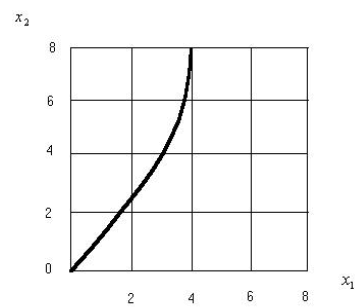
Item 2 - x1 é um bem normal.
Provas
A figura abaixo mostra as curvas de indiferença de um consumidor e a direção na qual a utilidade deste consumidor aumenta.
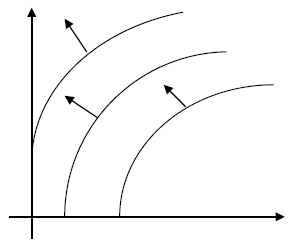
É correto afirmar:
Item 2 - O bem 1 é indesejável.
Provas
The Doctrine of Market Failure
In the nineteenth century and well into the twentieth, socialist and other critics of capitalism condemned it chiefly on two grounds. First, that it was unjust and exploitative. Secondly, that it was unstable, prone to crises and doomed to collapse. Rarely if ever, was capitalism criticized on the ground that its quintessential mechanism of market forces operating through the price system fails to work. This third line of criticism, which may be called the doctrine of market failure, was developed, chiefly in Britain, in the 1930s and 1940s, though traces of it can of course be found earlier in many places.
Socialist critics of capitalism condemn it on the grounds that it
Item 3 - is destined to a tragic fate,
Provas
Em relação à teoria da produção, analise a seguinte questão:
Item 1 - Considere uma função de produção com apenas dois insumos e que esses insumos sejam substitutos perfeitos. Esta função de produção é compatível tanto com retornos constantes, quanto com retornos crescentes ou com retornos decrescentes de escala.
Provas
Assinale V (verdadeiro) ou F (falso):
Item 2 - !$ \{x \in \mathbb{R}||x+2|+|x-4| < 6\}=(-2,4) !$
Provas
A year after the publication of Kalecki’s article, in 1956, Kaldor visited Santiago as a consultant to ECLA, commissioned to undertake a study of Chile’s economic problems. In his 1959 paper, which was also initially published in Mexico, Kaldor attributed many of Chile’s problems to over-regulation of the economy, but also restated Kalecki’s argument more formally: if productivity rises in nonagricultural sectors, but not in agriculture, then assuming that demand for food depends purely on the level of real wages and is inelastic with respect to the relative prices of food and non-food items, an expansion of money supply in step with rising GDP would raise money wages and ‘the rise in money wages would cause, by a series of steps, a sufficient rise in food prices (relative to both wages and non-food prices) to offset entirely the increase in real earnings in terms of non-food items’.
According to the text, Kaldor:
Item 3 - indicates that money supply should rise in step with GDP.
Provas
Provas
Caderno Container