Foram encontradas 200 questões.
Text I – questions 1 through 5
1 The range of uses for the laser is striking, going far
beyond the original ideas of the scientists who developed the
first models.
4 The wide variety of lasers is also striking. At one end of
the scale there are lasers made from tiny semiconductor chips
similar to those used in electronic circuits, no larger than grains
7 of salt. At the other end, building-size laser weapons are being
tested by the military.
The tasks that lasers perform are usually difficult or
10 impossible with any other tool. Lasers are relatively expensive
tools and are often brought in to do a job only because they can
deliver the required type and amount of energy to the desired
13 spot. Charles H. Townes, one of the inventors of the laser and
a Nobel Prize winner, said recently that he believes the laser “is
going to touch on a very great number of areas. The laser will
16 do almost anything. But it costs. That is the only limitation.”
A typical surgical laser, for example, costs from $ 30,000
to $ 50,000 and up, or about a thousand times more than a good
19 conventional scalpel. And to be honest, for many operations a
scalpel may be better than a laser. But if you have a detached
retina, a condition that could lead to blindness, you may be
22 happy that these expensive scalpels exist.
A laser can do what a knife can’t: weld the retina back to
the eyeball. No incision is required for this delicate surgery,
25 which can be performed right in the doctor’s office. The laser
beam shines through the lens of the patient’s eye and is focused
on the retina, producing a small lesion that helps hold it to the
28 eyeball. Exotic as this sounds, a similar laser treatment has
become a standard way of curing blindness caused by diabetes.
Brenda Wegman and Miki P. Knezevicp. A reading skills book.
Third Edition. The Mcgraw-Hill Companies, Inc. (with adaptations).
It can be deduced from text I that the laser
weapons tested by the military can be as huge as buildings.
Provas

Text I – questions 1 through 5
1 The range of uses for the laser is striking, going far
beyond the original ideas of the scientists who developed the
first models.
4 The wide variety of lasers is also striking. At one end of
the scale there are lasers made from tiny semiconductor chips
similar to those used in electronic circuits, no larger than grains
7 of salt. At the other end, building-size laser weapons are being
tested by the military.
The tasks that lasers perform are usually difficult or
10 impossible with any other tool. Lasers are relatively expensive
tools and are often brought in to do a job only because they can
deliver the required type and amount of energy to the desired
13 spot. Charles H. Townes, one of the inventors of the laser and
a Nobel Prize winner, said recently that he believes the laser “is
going to touch on a very great number of areas. The laser will
16 do almost anything. But it costs. That is the only limitation.”
A typical surgical laser, for example, costs from $ 30,000
to $ 50,000 and up, or about a thousand times more than a good
19 conventional scalpel. And to be honest, for many operations a
scalpel may be better than a laser. But if you have a detached
retina, a condition that could lead to blindness, you may be
22 happy that these expensive scalpels exist.
A laser can do what a knife can’t: weld the retina back to
the eyeball. No incision is required for this delicate surgery,
25 which can be performed right in the doctor’s office. The laser
beam shines through the lens of the patient’s eye and is focused
on the retina, producing a small lesion that helps hold it to the
28 eyeball. Exotic as this sounds, a similar laser treatment has
become a standard way of curing blindness caused by diabetes.
Brenda Wegman and Miki P. Knezevicp. A reading skills book.
Third Edition. The Mcgraw-Hill Companies, Inc. (with adaptations).
It can be deduced from text I that the laser
is usually cheap.
Provas
Text I – questions 1 through 5
1 The range of uses for the laser is striking, going far
beyond the original ideas of the scientists who developed the
first models.
4 The wide variety of lasers is also striking. At one end of
the scale there are lasers made from tiny semiconductor chips
similar to those used in electronic circuits, no larger than grains
7 of salt. At the other end, building-size laser weapons are being
tested by the military.
The tasks that lasers perform are usually difficult or
10 impossible with any other tool. Lasers are relatively expensive
tools and are often brought in to do a job only because they can
deliver the required type and amount of energy to the desired
13 spot. Charles H. Townes, one of the inventors of the laser and
a Nobel Prize winner, said recently that he believes the laser “is
going to touch on a very great number of areas. The laser will
16 do almost anything. But it costs. That is the only limitation.”
A typical surgical laser, for example, costs from $ 30,000
to $ 50,000 and up, or about a thousand times more than a good
19 conventional scalpel. And to be honest, for many operations a
scalpel may be better than a laser. But if you have a detached
retina, a condition that could lead to blindness, you may be
22 happy that these expensive scalpels exist.
A laser can do what a knife can’t: weld the retina back to
the eyeball. No incision is required for this delicate surgery,
25 which can be performed right in the doctor’s office. The laser
beam shines through the lens of the patient’s eye and is focused
on the retina, producing a small lesion that helps hold it to the
28 eyeball. Exotic as this sounds, a similar laser treatment has
become a standard way of curing blindness caused by diabetes.
Brenda Wegman and Miki P. Knezevicp. A reading skills book.
Third Edition. The Mcgraw-Hill Companies, Inc. (with adaptations).
It can be deduced from text I that the laser
can have a broad variety of models.
Provas
Text I – questions 1 through 5
1 The range of uses for the laser is striking, going far
beyond the original ideas of the scientists who developed the
first models.
4 The wide variety of lasers is also striking. At one end of
the scale there are lasers made from tiny semiconductor chips
similar to those used in electronic circuits, no larger than grains
7 of salt. At the other end, building-size laser weapons are being
tested by the military.
The tasks that lasers perform are usually difficult or
10 impossible with any other tool. Lasers are relatively expensive
tools and are often brought in to do a job only because they can
deliver the required type and amount of energy to the desired
13 spot. Charles H. Townes, one of the inventors of the laser and
a Nobel Prize winner, said recently that he believes the laser “is
going to touch on a very great number of areas. The laser will
16 do almost anything. But it costs. That is the only limitation.”
A typical surgical laser, for example, costs from $ 30,000
to $ 50,000 and up, or about a thousand times more than a good
19 conventional scalpel. And to be honest, for many operations a
scalpel may be better than a laser. But if you have a detached
retina, a condition that could lead to blindness, you may be
22 happy that these expensive scalpels exist.
A laser can do what a knife can’t: weld the retina back to
the eyeball. No incision is required for this delicate surgery,
25 which can be performed right in the doctor’s office. The laser
beam shines through the lens of the patient’s eye and is focused
on the retina, producing a small lesion that helps hold it to the
28 eyeball. Exotic as this sounds, a similar laser treatment has
become a standard way of curing blindness caused by diabetes.
Brenda Wegman and Miki P. Knezevicp. A reading skills book.
Third Edition. The Mcgraw-Hill Companies, Inc. (with adaptations).
It can be deduced from text I that the laser
was not expected to have such a wide variety of uses.
Provas
Text I – questions 1 through 5
1 The range of uses for the laser is striking, going far
beyond the original ideas of the scientists who developed the
first models.
4 The wide variety of lasers is also striking. At one end of
the scale there are lasers made from tiny semiconductor chips
similar to those used in electronic circuits, no larger than grains
7 of salt. At the other end, building-size laser weapons are being
tested by the military.
The tasks that lasers perform are usually difficult or
10 impossible with any other tool. Lasers are relatively expensive
tools and are often brought in to do a job only because they can
deliver the required type and amount of energy to the desired
13 spot. Charles H. Townes, one of the inventors of the laser and
a Nobel Prize winner, said recently that he believes the laser “is
going to touch on a very great number of areas. The laser will
16 do almost anything. But it costs. That is the only limitation.”
A typical surgical laser, for example, costs from $ 30,000
to $ 50,000 and up, or about a thousand times more than a good
19 conventional scalpel. And to be honest, for many operations a
scalpel may be better than a laser. But if you have a detached
retina, a condition that could lead to blindness, you may be
22 happy that these expensive scalpels exist.
A laser can do what a knife can’t: weld the retina back to
the eyeball. No incision is required for this delicate surgery,
25 which can be performed right in the doctor’s office. The laser
beam shines through the lens of the patient’s eye and is focused
on the retina, producing a small lesion that helps hold it to the
28 eyeball. Exotic as this sounds, a similar laser treatment has
become a standard way of curing blindness caused by diabetes.
Brenda Wegman and Miki P. Knezevicp. A reading skills book.
Third Edition. The Mcgraw-Hill Companies, Inc. (with adaptations).
It can be deduced from text I that the laser
struck scientists as a future powerful tool.
Provas
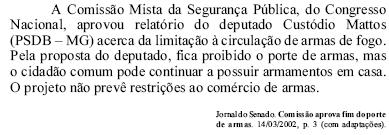
Relativamente ao texto e ao tema que ele focaliza, julgue os itens seguintes.
Em meio à onda de violência atual, uma notícia se destacou por seu aspecto positivo: no Rio de Janeiro e em São Paulo, o número de seqüestros desabou nos últimos meses, tornando-se estatisticamente irrelevante.
Provas
Disciplina: Atualidades e Conhecimentos Gerais
Banca: CESPE / CEBRASPE
Orgão: BANESE
Relativamente ao texto e ao tema que ele focaliza, julgue os itens seguintes.
Embora se desconheça a existência de lobby da indústria de armas junto ao Congresso Nacional, o deputado optou por não prever restrições ao comércio de armas, provavelmente atendendo aos apelos da área econômica do governo federal.
Provas
Relativamente ao texto e ao tema que ele focaliza, julgue os itens seguintes.
Pela proposta do deputado, tal como citada no texto, os policiais ficarão impedidos de portar armas em seu trabalho de rotina, o que gerou controvérsia e a cerrada oposição de parlamentares ligados aos setores militares e policiais.
Provas
Relativamente ao texto e ao tema que ele focaliza, julgue os itens seguintes.
O assassinato de dois prefeitos petistas no estado de São Paulo foi um dos fatores decisivos para que a questão da violência passasse a ser tratada pelo mundo político, mobilizando as atenções de governantes e parlamentares.
Provas
Relativamente ao texto e ao tema que ele focaliza, julgue os itens seguintes.
A questão da violência ganhou maior destaque no Brasil, nos últimos meses, entre outras razões, pelo recrudescimento da ação do chamado "crime organizado" e pelo fato de ter atingido pessoas de grande projeção na vida do país.
Provas
Caderno Container