Foram encontradas 70 questões.
Uma obra recebeu um concreto para fins estruturais com a classificação C40 S180 ± 20. Para o engenheiro receber esse material, foi realizado um ensaio de consistência e aceito aquele que obteve abatimento, em centímetros, de
Provas
Questão presente nas seguintes provas

A questão refere-se ao desempenho de edifícios habitacionais de até 5 pavimentos, em conformidade com a NBR 15575/2008.
Contando unicamente com iluminação natural, o iluminamento geral para o nível mínimo de desempenho, em lux, da(o)
Contando unicamente com iluminação natural, o iluminamento geral para o nível mínimo de desempenho, em lux, da(o)
Provas
Questão presente nas seguintes provas
239315
Ano: 2010
Disciplina: Inglês (Língua Inglesa)
Banca: CESGRANRIO
Orgão: BR Distribuidora
Disciplina: Inglês (Língua Inglesa)
Banca: CESGRANRIO
Orgão: BR Distribuidora
Provas:
Fossil Fuels
The twentieth century has been called the hydrocarbon century due to the abundance of fossil fuels, and their contribution to human development. Fossil fuels were formed over millions of years by the decomposing remains of plants and animals under immense heat and pressure. This process resulted in energy laden fuels coal, petroleum, and natural gas, which together have generated most of the energy consumed globally for over a century, paving the way for continued advancement and new inventions.
Fossil fuels are currently the most economically available source of power for both personal and commercial uses. Petroleum fuels our cars and thirst for plastics, while natural gas and coal heat and electrify our homes. Mass transportation is also largely propelled by fossil fuels. In 2005, more than 3/4 of total world energy consumption was through the use of fossil fuels. Petroleum led with over 43.4 percent of the world’s total energy consumption, followed by natural gas (15.6 percent) and coal (8.3 percent). North America is the largest consumer of fossil fuels, utilizing nearly 25 percent of the world’s resources.
Long thought to be inexhaustible, fossil fuels have been used extensively since the Industrial Revolution. However, many believe that the world is using fossil fuels at an unsustainable rate. Some experts believe that the world has already reached its peak for oil extraction and production, and that it is only a matter of time before natural gas and coal follow suit. These near-term concerns about oil supply have led to increasing focus on, and exploration of, alternative sources of petroleum, such as in tar sands and oil shale.
To release their stored energy, fossil fuels must be burned. It is during this combustion process that a variety of emissions and particulates, including ash, are released into the atmosphere. Primary releases are sulfur, nitrogen, and carbon, which can be harmful to the environment. They can combine with water vapor in the air to form acidic compounds that create acid rain, and burning fossil fuels releases carbon dioxide, a greenhouse gas that scientists believe is key factor in global climate change.
There are also environmental risks associated with extracting, transporting, and utilizing fossil fuels. Mining for coal and drilling for oil are especially hazardous because the digging of massive mines and wells can change the surrounding landscapes and bring massive amounts of salt water to the surface which can damage nearby ecosystems without proper treatment and sequestration. Natural gas extraction is somewhat safer, but can also be hazardous. While there are regulations in place that attempts to minimize the risks, it is impossible to eliminate them completely. However, regulation is not sufficient; there must be continued research in developing new technologies for both fossil fuel and renewable energy, in addition to increasing conservation measures. Environmental Literacy Council
http://www.enviroliteracy.org/subcategory.php/21.html, access on March 14th, 2010.
Paragraph 3 introduces the idea thatProvas
Questão presente nas seguintes provas
O gráfico a seguir mostra um diagrama de tensões totais com a profundidade de uma seção de solo completamente seco.
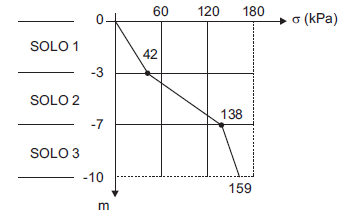
Para essas condições, o peso específico dos solos 1, 2 e 3 vale, em kN/m3, respectivamente,
Provas
Questão presente nas seguintes provas
Durante a digitação de dados em uma planilha do Microsoft Excel 2003, o funcionário de uma determinada empresa sentiu a necessidade de incluir algumas informações contidas em uma apresentação do Microsoft PowerPoint 2003 e resolveu abrir o arquivo referente à apresentação, acionando o comando Abrir no menu Arquivo do Excel. Após a execução desse procedimento, o programa Excel
Provas
Questão presente nas seguintes provas
239019
Ano: 2010
Disciplina: Engenharia Ambiental e Sanitária
Banca: CESGRANRIO
Orgão: BR Distribuidora
Disciplina: Engenharia Ambiental e Sanitária
Banca: CESGRANRIO
Orgão: BR Distribuidora
Provas:
Em relação a um projeto de rede coletora de esgoto sanitário, considere as seguintes condições para o posicionamento de poços de visita.
I - No início de coletores
II - Nas mudanças de direção
III - A cada 10 metros
De acordo com as normas da ABNT, é(são) obrigatória(s) a(s) condição(ões)
Provas
Questão presente nas seguintes provas
Considere os dados a seguir para responder à questão.
| Serviço | Valor (R$) | Percentual Financeiro | Percentual Físico | ||||||||||
| M1 | M2 | M3 | M4 | M5 | M6 | M1 | M2 | M3 | M4 | M5 | M6 | ||
| S1 | 300.000,00 | 40 | 30 | 20 | 10 | - | - | 20 | 20 | 30 | 30 | - | - |
| S2 | 200.000,00 | 10 | 10 | 30 | 40 | 10 | - | 40 | 20 | 10 | 10 | 20 | - |
| S3 | 400.000,00 | 20 | 20 | 20 | 10 | 10 | 20 | 20 | 20 | 20 | 20 | 10 | 10 |
| S4 | 500.000,00 | - | - | 40 | 20 | 20 | 20 | - | 30 | 30 | 10 | 10 | 20 |
| S5 | 600.000,00 | - | - | 10 | 60 | 20 | 10 | - | - | 20 | 40 | 20 | 20 |
Dados:
• M1, M2... M6 – Meses
• S1, S2... S6 – Serviços
• A correspondência físico-financeira não é linear.
• Não considerar qualquer outro dado não fornecido.
Ao atingir 70% da parte física do serviço S2, o faturamento correspondente até esse percentual é, em reais, de
Provas
Questão presente nas seguintes provas
A construção abaixo esquematizada precisa obedecer a uma legislação que exige que, no mínimo, 20% da área do terreno seja permeável. O projetista optou por criar jardins J1, J2, J3 e J4, conforme indicado na figura abaixo esquematizada.
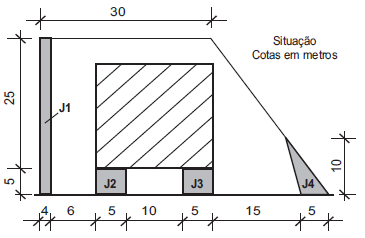
Analisando-se o projeto, conclui-se que, para atender à legislação, essas áreas são
Provas
Questão presente nas seguintes provas
236761
Ano: 2010
Disciplina: Inglês (Língua Inglesa)
Banca: CESGRANRIO
Orgão: BR Distribuidora
Disciplina: Inglês (Língua Inglesa)
Banca: CESGRANRIO
Orgão: BR Distribuidora
Provas:
Fossil Fuels
The twentieth century has been called the hydrocarbon century due to the abundance of fossil fuels, and their contribution to human development. Fossil fuels were formed over millions of years by the decomposing remains of plants and animals under immense heat and pressure. This process resulted in energy laden fuels coal, petroleum, and natural gas, which together have generated most of the energy consumed globally for over a century, paving the way for continued advancement and new inventions.
Fossil fuels are currently the most economically available source of power for both personal and commercial uses. Petroleum fuels our cars and thirst for plastics, while natural gas and coal heat and electrify our homes. Mass transportation is also largely propelled by fossil fuels. In 2005, more than 3/4 of total world energy consumption was through the use of fossil fuels. Petroleum led with over 43.4 percent of the world’s total energy consumption, followed by natural gas (15.6 percent) and coal (8.3 percent). North America is the largest consumer of fossil fuels, utilizing nearly 25 percent of the world’s resources.
Long thought to be inexhaustible, fossil fuels have been used extensively since the Industrial Revolution. However, many believe that the world is using fossil fuels at an unsustainable rate. Some experts believe that the world has already reached its peak for oil extraction and production, and that it is only a matter of time before natural gas and coal follow suit. These near-term concerns about oil supply have led to increasing focus on, and exploration of, alternative sources of petroleum, such as in tar sands and oil shale.
To release their stored energy, fossil fuels must be burned. It is during this combustion process that a variety of emissions and particulates, including ash, are released into the atmosphere. Primary releases are sulfur, nitrogen, and carbon, which can be harmful to the environment. They can combine with water vapor in the air to form acidic compounds that create acid rain, and burning fossil fuels releases carbon dioxide, a greenhouse gas that scientists believe is key factor in global climate change.
There are also environmental risks associated with extracting, transporting, and utilizing fossil fuels. Mining for coal and drilling for oil are especially hazardous because the digging of massive mines and wells can change the surrounding landscapes and bring massive amounts of salt water to the surface which can damage nearby ecosystems without proper treatment and sequestration. Natural gas extraction is somewhat safer, but can also be hazardous. While there are regulations in place that attempts to minimize the risks, it is impossible to eliminate them completely. However, regulation is not sufficient; there must be continued research in developing new technologies for both fossil fuel and renewable energy, in addition to increasing conservation measures. Environmental Literacy Council
http://www.enviroliteracy.org/subcategory.php/21.html, access on March 14th, 2010.
The text “Fossil fuels” can be classified as a
Provas
Questão presente nas seguintes provas
Nas especificações técnicas do telhado de uma obra, consta uma determinada subcobertura. Trata-se
Provas
Questão presente nas seguintes provas
Cadernos
Caderno Container