Foram encontradas 70 questões.
A gerência de um projeto recebe orientações do escritório de projetos (PMO) para utilizar, nesse projeto, um gráfico RACI cuja finalidade é, segundo o PMBOK 4ª Edição,
Provas
Questão presente nas seguintes provas

Considere o diagrama de entidades e relacionamentos, a seguir, na terceira forma normal, em que as chaves estão indicadas e as chaves estrangeiras não foram migradas, para responder à questão.
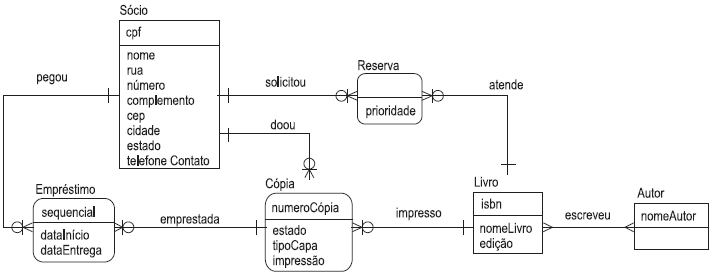
A partir das informações dadas, conclui-se que um sócio
Provas
Questão presente nas seguintes provas
Considere o diagrama de entidades e relacionamentos, a seguir, na terceira forma normal, em que as chaves estão indicadas e as chaves estrangeiras não foram migradas, para responder à questão.
A partir das informações disponibilizadas pelo modelo, considere as afirmativas a seguir.
I - Um sócio pode pegar emprestado várias cópias de um mesmo livro.
II - Um sócio pode reservar um mesmo livro várias vezes.
III - Um sócio pode doar várias cópias de um mesmo livro.
II - Um sócio pode reservar um mesmo livro várias vezes.
III - Um sócio pode doar várias cópias de um mesmo livro.
Conforme o modelo fornecido, está correto o que se afirma em
Provas
Questão presente nas seguintes provas
Considere o diagrama de entidades e relacionamentos, a seguir, na terceira forma normal, em que as chaves estão indicadas e as chaves estrangeiras não foram migradas, para responder à questão.
A transformação direta desse diagrama para o modelo relacional, sem o uso de chaves artificiais, exigirá
Provas
Questão presente nas seguintes provas
1704291
Ano: 2011
Disciplina: TI - Gestão e Governança de TI
Banca: CESGRANRIO
Orgão: BR Distribuidora
Disciplina: TI - Gestão e Governança de TI
Banca: CESGRANRIO
Orgão: BR Distribuidora
- Gestão de ProcessosBPM: Gerenciamento de Processos de NegócioBPMN: Business Process Model and Notation
- Gestão de ProcessosModelagem de Processos de Negócio
Ao fazer a modelagem de negócio de uma empresa, um analista identificou a necessidade de realizar a modelagem dos processos.
As linguagens gráficas destinadas a essa tarefa são:
Provas
Questão presente nas seguintes provas
1704290
Ano: 2011
Disciplina: TI - Gestão e Governança de TI
Banca: CESGRANRIO
Orgão: BR Distribuidora
Disciplina: TI - Gestão e Governança de TI
Banca: CESGRANRIO
Orgão: BR Distribuidora
Segundo o COBIT 4.1, um indicador de performance de um serviço de TI mede o
Provas
Questão presente nas seguintes provas
1704289
Ano: 2011
Disciplina: TI - Gestão e Governança de TI
Banca: CESGRANRIO
Orgão: BR Distribuidora
Disciplina: TI - Gestão e Governança de TI
Banca: CESGRANRIO
Orgão: BR Distribuidora
Segundo as recomendações do ITIL, um analista de sistemas de desenvolvimento Java/Web deve armazenar as informações referentes aos componentes alterados de uma nova versão de software que corrige bugs da anterior nos programas que ele acabou de desenvolver na(o)
Provas
Questão presente nas seguintes provas
1704288
Ano: 2011
Disciplina: TI - Desenvolvimento de Sistemas
Banca: CESGRANRIO
Orgão: BR Distribuidora
Disciplina: TI - Desenvolvimento de Sistemas
Banca: CESGRANRIO
Orgão: BR Distribuidora
Analise o código de um programa Java a seguir.
public class TestaArgs {
public static void main(String[] args) {
System.out.println(args[5]);
}
}
public static void main(String[] args) {
System.out.println(args[5]);
}
}
Considere o seguinte comando:
java –hotspot TestaArgs um dois três quatro cinco seis sete
O que será impresso pelo programa ao executar esse comando?
Provas
Questão presente nas seguintes provas
1659864
Ano: 2011
Disciplina: Inglês (Língua Inglesa)
Banca: CESGRANRIO
Orgão: BR Distribuidora
Disciplina: Inglês (Língua Inglesa)
Banca: CESGRANRIO
Orgão: BR Distribuidora
Provas:
Skillset vs. Mindset: Which Will Get You the Job?
By Heather Huhman
There’s a debate going on among career experts about which is more important: skillset or mindset. While skills are certainly desirable for many positions, does having the right ones guarantee you’ll get the job?
What if you have the mindset to get the work accomplished, but currently lack certain skills requested by the employer? Jennifer Fremont-Smith, CEO of Smarterer, and Paul G. Stoltz, PhD, coauthor of Put Your Mindset to Work: The One Asset You Really Need to Win and Keep the Job You Love, recently sat down with U.S. News to sound off on this issue.
Heather: What is more important to today’s employers: skillset or mindset? Why?
Jennifer: For many jobs, skillset needs to come first. The employer absolutely must find people who have the hard skills to do whatever it is they are being hired to do. Programmers have to know how to program. Data analysts need to know how to crunch numbers in Excel. Marketers must know their marketing tools and software. Social media managers must know the tools of their trade like Twitter, Facebook, WordPress, and have writing and communication skills.
After the employers have identified candidates with these hard skills, they can shift their focus to their candidates’ mindsets - attitude, integrity, work ethic, personality, etc.
Paul: Mindset utterly trumps skillset.
Heather: Do you have any data or statistics to back up your argument?
Jennifer: Despite record high unemployment, many jobs sit empty because employers can’t find candidates with the right skills. In a recent survey cited in the Wall Street Journal, over 50 percent of companies reported difficulty finding applicants with the right skills. Companies are running lean and mean in this economy – they don’t have the time to train for those key skills.
Paul: [Co-author James Reed and I] asked tens of thousands of top employers worldwide this question: If you were hiring someone today, which would you pick, B) the person with the perfect skills and qualifications, but lacking the desired mindset, or A) the person with the desired mindset, but lacking the rest? Ninety-eight percent pick A. Add to this that 97 percent said it is more likely that a person with the right mindset will develop the right skillset, rather than the other way around.
Heather: How do you define skillset?
Jennifer: At Smarterer, we define skillset as the set of digital, social, and technical tools professionals use to be effective in the workforce. Professionals are rapidly accumulating these skills, and the tools themselves are proliferating and evolving – we’re giving people a simple, smart way for people to validate their skillset and articulate it to the world.
Heather: How do you define mindset?
Paul: We define mindset as “the lens through which you see and navigate life.” It undergirds and affects all that you think, see, believe, say, and do.
Heather: How can job seekers show they have the skillset employers are seeking throughout the entire hiring process?
Jennifer: At the beginning of the process, seekers can showcase the skills they have by incorporating them, such as their Smarterer scores, throughout their professional and personal brand materials. They should be articulating their skills in their resume, cover letter, LinkedIn profile, blog, website - everywhere they express their professional identity.
Heather: How can job seekers show they have the mindset employers are seeking throughout the entire hiring process?
Paul: One of the most head-spinning studies we did, which was conducted by an independent statistician showed that, out of 30,000 CVs/resumes, when you look at who gets the job and who does not:
A. The conventional wisdom fails (at best). None of the classic, accepted advice, like using action verbs or including hobbies/interests actually made any difference.
B. The only factor that made the difference was that those who had one of the 72 mindset qualities from our master model, articulated in their CV/resume, in a specific way, were three times as likely to get the job. Furthermore, those who had two or more of these statements, were seven times more likely to get the job, often over other more qualified candidates.
Available at: <http://money.usnews.com/money/blogs/outside-voices- -
careers/2011/08/26/skillset-vs-mindset-which-will-get-you-the-job>. Retrieved on: 17 Sept. 2011. Adapted.
In “Furthermore, those who had two or more of these statements were seven times more likely to get the job”, Furthermore can be substituted, without change in meaning, by
Provas
Questão presente nas seguintes provas
1654754
Ano: 2011
Disciplina: Inglês (Língua Inglesa)
Banca: CESGRANRIO
Orgão: BR Distribuidora
Disciplina: Inglês (Língua Inglesa)
Banca: CESGRANRIO
Orgão: BR Distribuidora
Provas:
Skillset vs. Mindset: Which Will Get You the Job?
By Heather Huhman
There’s a debate going on among career experts about which is more important: skillset or mindset. While skills are certainly desirable for many positions, does having the right ones guarantee you’ll get the job?
What if you have the mindset to get the work accomplished, but currently lack certain skills requested by the employer? Jennifer Fremont-Smith, CEO of Smarterer, and Paul G. Stoltz, PhD, coauthor of Put Your Mindset to Work: The One Asset You Really Need to Win and Keep the Job You Love, recently sat down with U.S. News to sound off on this issue.
Heather: What is more important to today’s employers: skillset or mindset? Why?
Jennifer: For many jobs, skillset needs to come first. The employer absolutely must find people who have the hard skills to do whatever it is they are being hired to do. Programmers have to know how to program. Data analysts need to know how to crunch numbers in Excel. Marketers must know their marketing tools and software. Social media managers must know the tools of their trade like Twitter, Facebook, WordPress, and have writing and communication skills.
After the employers have identified candidates with these hard skills, they can shift their focus to their candidates’ mindsets - attitude, integrity, work ethic, personality, etc.
Paul: Mindset utterly trumps skillset.
Heather: Do you have any data or statistics to back up your argument?
Jennifer: Despite record high unemployment, many jobs sit empty because employers can’t find candidates with the right skills. In a recent survey cited in the Wall Street Journal, over 50 percent of companies reported difficulty finding applicants with the right skills. Companies are running lean and mean in this economy – they don’t have the time to train for those key skills.
Paul: [Co-author James Reed and I] asked tens of thousands of top employers worldwide this question: If you were hiring someone today, which would you pick, B) the person with the perfect skills and qualifications, but lacking the desired mindset, or A) the person with the desired mindset, but lacking the rest? Ninety-eight percent pick A. Add to this that 97 percent said it is more likely that a person with the right mindset will develop the right skillset, rather than the other way around.
Heather: How do you define skillset?
Jennifer: At Smarterer, we define skillset as the set of digital, social, and technical tools professionals use to be effective in the workforce. Professionals are rapidly accumulating these skills, and the tools themselves are proliferating and evolving – we’re giving people a simple, smart way for people to validate their skillset and articulate it to the world.
Heather: How do you define mindset?
Paul: We define mindset as “the lens through which you see and navigate life.” It undergirds and affects all that you think, see, believe, say, and do.
Heather: How can job seekers show they have the skillset employers are seeking throughout the entire hiring process?
Jennifer: At the beginning of the process, seekers can showcase the skills they have by incorporating them, such as their Smarterer scores, throughout their professional and personal brand materials. They should be articulating their skills in their resume, cover letter, LinkedIn profile, blog, website - everywhere they express their professional identity.
Heather: How can job seekers show they have the mindset employers are seeking throughout the entire hiring process?
Paul: One of the most head-spinning studies we did, which was conducted by an independent statistician showed that, out of 30,000 CVs/resumes, when you look at who gets the job and who does not:
A. The conventional wisdom fails (at best). None of the classic, accepted advice, like using action verbs or including hobbies/interests actually made any difference.
B. The only factor that made the difference was that those who had one of the 72 mindset qualities from our master model, articulated in their CV/resume, in a specific way, were three times as likely to get the job. Furthermore, those who had two or more of these statements, were seven times more likely to get the job, often over other more qualified candidates.
Available at: <http://money.usnews.com/money/blogs/outside-voices- -
careers/2011/08/26/skillset-vs-mindset-which-will-get-you-the-job>. Retrieved on: 17 Sept. 2011. Adapted.
According to Jennifer Fremont-Smith,
Provas
Questão presente nas seguintes provas
Cadernos
Caderno Container