Foram encontradas 70 questões.
Metrics of uncertainty and risk
The Guidance Note (GN) indicates that author teams should evaluate the associated evidence and agreement with respect to specific findings that involve risk and uncertainty of climate changes. The amount of evidence available can range from small to large, and can vary in quality and consistency. The GN recommends reporting the degree of certainty and/or uncertainty of a given topic as a measure of the consensus or agreement across the scientific community. Confidence expresses the extent to which the Intergovernmental Panel on Climate Change (IPCC) authors do in fact support a key finding. If confidence is sufficiently high, the GN suggests specifying the key finding in terms of probability. The evaluation of evidence and degree of agreement of any key finding is labelled a traceable account in the GN.
The GN also recommends taking a risk-management perspective by stating that “sound decision making that anticipates, prepares for, and responds to climate change depends on information about the full range of possible consequences and associated probabilities.” The GN also notes that, “low-probability outcomes can have significant impacts, particularly when characterized by large magnitude, long persistence, broad prevalence, and/or irreversibility.” For this reason, the GN encourages the presentation of information on the extremes of the probability distributions of key variables, reporting quantitative estimates when possible and supplying qualitative assessments and evaluations when appropriate.
Capítulo 2: Integrated Risk and Uncertainty Assessment of Climate Change
Response Policies, In: Climate Change 2014, p. 157 (adaptado)
Assinale a alternativa cuja palavra NÃO se encaixa na mesma classe gramatical das demais.
certainty - community - sufficiently - probability
Provas

Metrics of uncertainty and risk
The Guidance Note (GN) indicates that author teams should evaluate the associated evidence and agreement with respect to specific findings that involve risk and uncertainty of climate changes. The amount of evidence available can range from small to large, and can vary in quality and consistency. The GN recommends reporting the degree of certainty and/or uncertainty of a given topic as a measure of the consensus or agreement across the scientific community. Confidence expresses the extent to which the Intergovernmental Panel on Climate Change (IPCC) authors do in fact support a key finding. If confidence is sufficiently high, the GN suggests specifying the key finding in terms of probability. The evaluation of evidence and degree of agreement of any key finding is labelled a traceable account in the GN.
The GN also recommends taking a risk-management perspective by stating that “sound decision making that anticipates, prepares for, and responds to climate change depends on information about the full range of possible consequences and associated probabilities.” The GN also notes that, “low-probability outcomes can have significant impacts, particularly when characterized by large magnitude, long persistence, broad prevalence, and/or irreversibility.” For this reason, the GN encourages the presentation of information on the extremes of the probability distributions of key variables, reporting quantitative estimates when possible and supplying qualitative assessments and evaluations when appropriate.
Capítulo 2: Integrated Risk and Uncertainty Assessment of Climate Change
Response Policies, In: Climate Change 2014, p. 157 (adaptado)
No texto acima, Guidance Note (GN) faz algumas recomendações para pessoas que avaliam o grau de incerteza e risco de mudanças climáticas.
Assinale a alternativa que apresenta um procedimento recomendado pela GN:
Provas
Quantifying Uncertainty
Natural language is not adequate for propagating and communicating uncertainty. To illustrate, consider the U.S. National Research Council 2010 report Advancing the Science of Climate Change America’s Climate Choices: Panel on Advancing the Science of Climate Change; National Research Council, 2010). Using the AR4 calibrated uncertainty language, the NRC is highly confidente that (1) the Earth is warming and that (2) most of the recente warming is due to human activities.
What does the second statement mean? Does it mean the NRC is highly confident that the Earth is warming and the recent warming is anthropogenic or that, given the Earth is warming, are they highly confident humans cause this warming? The latter seems most natural, as the warming is asserted in the first statement. In that case the ‘high confidence’ applies to a conditional statement. The probability of both statements being true is the probability of the condition (Earth is warming) multiplied by the probability of this warming being caused by humans, given that warming is taking place. If both statements enjoy high confidence, then in the calibrated language of AR4 where high confidence implies a probability of 0.8, the statement that both are true would only be “more likely than not” (0.8 x 0.8 = 0.64).
Qualitative uncertainty analysis easily leads the unwary to erroneous conclusions. Interval analysis is a semiqualitative method in which ranges are assigned to uncertain variables without distributions and can mask the complexities of propagation, as attested by the following statement in an early handbook on risk analysis: “The simplest quantitative measure of variability in a parameter or a measurable quantity is given by an assessed range of the values the parameter or quantity can take. This measure may be adequate for certain purposes (e. g., as input to a sensitivity analysis), but in general it is not a complete representation of the analyst’s knowledge or state of confidence and generally will lead to an unrealistic range of results if such measures are propagated through na analysis”, (U. S. NRC, 1983, Chapter 12, p.12).
The sum of 10 independent variables each ranging between zero and ten, can assume any value between zero and 100. The upper (lower) bound can be attained only if ALL variables take their maximal (minimal) values, whereas values near 50 can arise through many combinations. Simply stating the interval [0, 100] conceals the fact that very high (low) values are much more exceptional than central values. These same concepts are widely represented throughout the uncertainty analysis literature. According to Morgan and Henrion (1990): “Uncertainty analysis is the computation of the total uncertainty induced in the output by quantified uncertainty in the inputs and models […] Failure to engage in systematic sensitivity and uncertainty analysis leaves both analysts and users unable to judge the adequacy of the analysis and the conclusions reached”, (Morgan and Henrion, 1990, p. 39).
Capítulo 2: Integrated Risk and Uncertainty Assessment of Climate
Change Response Policies, In: Climate Change 2014, p. 174
A expressão “much more exceptional than”, utilizada no texto, é uma estrutura comparativa para demonstrar que um ser é superior a outro.
Assinale a alternativa em que o comparativo está CORRETO de acordo com a norma culta da língua inglesa:
Provas
Quantifying Uncertainty
Natural language is not adequate for propagating and communicating uncertainty. To illustrate, consider the U.S. National Research Council 2010 report Advancing the Science of Climate Change America’s Climate Choices: Panel on Advancing the Science of Climate Change; National Research Council, 2010). Using the AR4 calibrated uncertainty language, the NRC is highly confidente that (1) the Earth is warming and that (2) most of the recente warming is due to human activities.
What does the second statement mean? Does it mean the NRC is highly confident that the Earth is warming and the recent warming is anthropogenic or that, given the Earth is warming, are they highly confident humans cause this warming? The latter seems most natural, as the warming is asserted in the first statement. In that case the ‘high confidence’ applies to a conditional statement. The probability of both statements being true is the probability of the condition (Earth is warming) multiplied by the probability of this warming being caused by humans, given that warming is taking place. If both statements enjoy high confidence, then in the calibrated language of AR4 where high confidence implies a probability of 0.8, the statement that both are true would only be “more likely than not” (0.8 x 0.8 = 0.64).
Qualitative uncertainty analysis easily leads the unwary to erroneous conclusions. Interval analysis is a semiqualitative method in which ranges are assigned to uncertain variables without distributions and can mask the complexities of propagation, as attested by the following statement in an early handbook on risk analysis: “The simplest quantitative measure of variability in a parameter or a measurable quantity is given by an assessed range of the values the parameter or quantity can take. This measure may be adequate for certain purposes (e. g., as input to a sensitivity analysis), but in general it is not a complete representation of the analyst’s knowledge or state of confidence and generally will lead to an unrealistic range of results if such measures are propagated through na analysis”, (U. S. NRC, 1983, Chapter 12, p.12).
The sum of 10 independent variables each ranging between zero and ten, can assume any value between zero and 100. The upper (lower) bound can be attained only if ALL variables take their maximal (minimal) values, whereas values near 50 can arise through many combinations. Simply stating the interval [0, 100] conceals the fact that very high (low) values are much more exceptional than central values. These same concepts are widely represented throughout the uncertainty analysis literature. According to Morgan and Henrion (1990): “Uncertainty analysis is the computation of the total uncertainty induced in the output by quantified uncertainty in the inputs and models […] Failure to engage in systematic sensitivity and uncertainty analysis leaves both analysts and users unable to judge the adequacy of the analysis and the conclusions reached”, (Morgan and Henrion, 1990, p. 39).
Capítulo 2: Integrated Risk and Uncertainty Assessment of Climate
Change Response Policies, In: Climate Change 2014, p. 174
“This measure may be adequate for certain purposes (e. g., as input to a sensitivity analysis), but in general it is not a complete representation of the analyst’s knowledge or state of confidence and generally will lead to an unrealistic range of results if such measures are propagated through na analysis”, (U. S. NRC, 1983, Chapter 12, p.12).”
Assinale a alternativa que contém o sujeito do verbo destacado no trecho acima:
Provas
Quantifying Uncertainty
Natural language is not adequate for propagating and communicating uncertainty. To illustrate, consider the U.S. National Research Council 2010 report Advancing the Science of Climate Change America’s Climate Choices: Panel on Advancing the Science of Climate Change; National Research Council, 2010). Using the AR4 calibrated uncertainty language, the NRC is highly confidente that (1) the Earth is warming and that (2) most of the recente warming is due to human activities.
What does the second statement mean? Does it mean the NRC is highly confident that the Earth is warming and the recent warming is anthropogenic or that, given the Earth is warming, are they highly confident humans cause this warming? The latter seems most natural, as the warming is asserted in the first statement. In that case the ‘high confidence’ applies to a conditional statement. The probability of both statements being true is the probability of the condition (Earth is warming) multiplied by the probability of this warming being caused by humans, given that warming is taking place. If both statements enjoy high confidence, then in the calibrated language of AR4 where high confidence implies a probability of 0.8, the statement that both are true would only be “more likely than not” (0.8 x 0.8 = 0.64).
Qualitative uncertainty analysis easily leads the unwary to erroneous conclusions. Interval analysis is a semiqualitative method in which ranges are assigned to uncertain variables without distributions and can mask the complexities of propagation, as attested by the following statement in an early handbook on risk analysis: “The simplest quantitative measure of variability in a parameter or a measurable quantity is given by an assessed range of the values the parameter or quantity can take. This measure may be adequate for certain purposes (e. g., as input to a sensitivity analysis), but in general it is not a complete representation of the analyst’s knowledge or state of confidence and generally will lead to an unrealistic range of results if such measures are propagated through na analysis”, (U. S. NRC, 1983, Chapter 12, p.12).
The sum of 10 independent variables each ranging between zero and ten, can assume any value between zero and 100. The upper (lower) bound can be attained only if ALL variables take their maximal (minimal) values, whereas values near 50 can arise through many combinations. Simply stating the interval [0, 100] conceals the fact that very high (low) values are much more exceptional than central values. These same concepts are widely represented throughout the uncertainty analysis literature. According to Morgan and Henrion (1990): “Uncertainty analysis is the computation of the total uncertainty induced in the output by quantified uncertainty in the inputs and models […] Failure to engage in systematic sensitivity and uncertainty analysis leaves both analysts and users unable to judge the adequacy of the analysis and the conclusions reached”, (Morgan and Henrion, 1990, p. 39).
Capítulo 2: Integrated Risk and Uncertainty Assessment of Climate
Change Response Policies, In: Climate Change 2014, p. 174
“The upper (lower) bound can be attained only if ALL variables take their maximal (minimal) values, whereas values near 50 can arise through many combinations.”
Assinale a alternativa cuja palavra ou expressão substitui, com menor prejuízo de sentido, a palavra destacada no trecho acima.
Provas
“When stakeholders are given information about mitigation and adaptation measures to reduce climate change risks, they make the following judgments and choices: How serious is the risk? Is any action required? Which options are ruled out because the costs seem prohibitive? Which option offers the greatest net expected benefits?”
Capítulo 2: Integrated Risk and Uncertainty Assessment of Climate
Change Response Policies, In: Climate Change 2014, p. 161
Levando em consideração as noções de agente, paciente, voz passiva e voz ativa, assinale a alternativa cuja frase é impossível na voz ativa, mantendo-se o mesmo verbo e sem prejuízo de sentido:
Provas
“Renting an apartment in the city versus buying a house in the suburbs. When families and households face this choice, it is likely to be driven by factors other than climate change concerns. The decision, however, can have major consequences on CO2 emissions as well as on the impacts of climate change on future disasters such as damage from flooding due to sea level rise. Hence, governments may seek to influence these decisions as part of their portfolio of climate change policies through measures such as land-use regulations or the pricing of local transportation options.
The final choice is thus likely to be sensitive to uncertainties in market behaviour as well as actions undertaken by individuals and firms.”
Capítulo 2: Integrated Risk and Uncertainty Assessment of Climate
Change Response Policies, In: Climate Change 2014, p. 158
A tradução mais aproximada para o português dos dois conectivos em destaque no texto (hence e thus) é, respectivamente,
Provas
“Renting an apartment in the city versus buying a house in the suburbs. When families and households face this choice, it is likely to be driven by factors other than climate change concerns. The decision, however, can have major consequences on CO2 emissions as well as on the impacts of climate change on future disasters such as damage from flooding due to sea level rise. Hence, governments may seek to influence these decisions as part of their portfolio of climate change policies through measures such as land-use regulations or the pricing of local transportation options.
The final choice is thus likely to be sensitive to uncertainties in market behaviour as well as actions undertaken by individuals and firms.”
Capítulo 2: Integrated Risk and Uncertainty Assessment of Climate
Change Response Policies, In: Climate Change 2014, p. 158
Na frase “When families and households face this choice, it is likely to be driven by factors other than climate change concerns”, a expressão em destaque pode ser substituída, com menor prejuízo de sentido, por
Provas
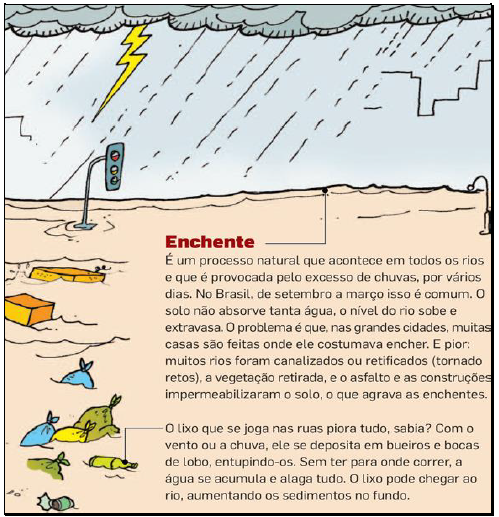
(http://goo.gl/YFqvH0. Acesso: 11/12/2014. Adaptado.)
A relação de consequência está adequadamente destacada neste trecho do texto:
Provas
(http://goo.gl/YFqvH0. Acesso: 11/12/2014. Adaptado.)
Entre as estratégias usadas na construção do texto, destaca-se a
Provas
Caderno Container