Foram encontradas 50 questões.
Can Art Improve Your Health?

It’s not news to most of us that our environment can have an impact on our mood. A cloudy day. Working in a cubicle farm. Growing up in poverty.(a)
But can it also impact our health? There’s a growing body of research that suggests the beneficial effects of picking and hanging(b) the “right” artwork in hospitals, to help healing and improve patients’ mood:
Upali Nanda, who has a doctorate in architecture with a specialization in health-care systems and design, says scientific studies show that art can aid(c) in the recovery of patients, shorten hospital stays and help manage pain.
But she says it has to be the right art – vivid paintings of landscapes, friendly faces and familiar objects can lower(d) blood pressure and heart rate, while abstract pictures can have the opposite effect.
Nanda and two university professors did a study at Houston’s St. Luke’s Episcopal Hospital using two types of art. In the first group were images that had been proved to calm patients, including green landscapes, water scenes, cultural artifacts and emotionally expressive pictures of people. The second group contained abstract pieces. When asked which they preferred, most patients chose images from the first group.
Not surprising, since that opinion reflects most people’s opinion about those two groups of artwork in the real world. Ambiguous artwork, such as many abstract paintings, provokes anxiety in many people, while familiar scenes of people and the outdoors are more serene and something most people can identify with. The article theorizes that people feel more at ease(e) with paintings of trees, flowers and fields, allowing them to project their own feelings of uneasiness or anxiety onto them.
Can you imagine how simple and inexpensive making hospitals look, well, hospitable is, compared to all the fancy imaging equipment and latest micro-surgery tools? And yet, these components can be just as important to a patient’s recovery as taking the right pills at the right time. Sterile white hallways might make for a clean environment, but it does nothing for the needs of being human in such places. After all, hospitals aren’t technology clean-rooms — they are where we treat people. And people are emotional and social creatures who value the familiar.
Of course artwork isn’t going to heal anybody’s wounds, but it can help speed the healing process after-the-fact.
GROHOL, J. (2009). Pode Art melhorar sua saúde? Psych Central. Disponível em: <http:// psychcentral.com/blog/archives/2009/09/01/can_art_melhorar_seu_health/>. Acesso em: 10 out. 2014.
The only alternative in which the word or expression from the text has not been correctly defined is
Provas

Can Art Improve Your Health?
It’s not news to most of us that our environment can have an impact on our mood. A cloudy day. Working in a cubicle farm. Growing up in poverty.
But can it also impact our health? There’s a growing body of research that suggests the beneficial effects of picking and hanging the “right” artwork in hospitals, to help healing and improve patients’ mood:
Upali Nanda, who has a doctorate in architecture with a specialization in health-care systems and design, says scientific studies show that art can aid in the recovery of patients, shorten hospital stays and help manage pain.
But she says it has to be the right art – vivid paintings of landscapes, friendly faces and familiar objects can lower blood pressure and heart rate, while abstract pictures can have the opposite effect.
Nanda and two university professors did a study at Houston’s St. Luke’s Episcopal Hospital using two types of art. In the first group were images that had been proved to calm patients, including green landscapes, water scenes, cultural artifacts and emotionally expressive pictures of people. The second group contained abstract pieces. When asked which they preferred, most patients chose images from the first group.
Not surprising, since that opinion reflects most people’s opinion about those two groups of artwork in the real world. Ambiguous artwork, such as many abstract paintings, provokes anxiety in many people, while familiar scenes of people and the outdoors are more serene and something most people can identify with. The article theorizes that people feel more at ease with paintings of trees, flowers and fields, allowing them to project their own feelings of uneasiness or anxiety onto them.
Can you imagine how simple and inexpensive making hospitals look, well, hospitable is, compared to all the fancy imaging equipment and latest micro-surgery tools? And yet, these components can be just as important to a patient’s recovery as taking the right pills at the right time. Sterile white hallways might make for a clean environment, but it does nothing for the needs of being human in such places. After all, hospitals aren’t technology clean-rooms — they are where we treat people. And people are emotional and social creatures who value the familiar.
Of course artwork isn’t going to heal anybody’s wounds, but it can help speed the healing process after-the-fact.
GROHOL, J. (2009). Pode Art melhorar sua saúde? Psych Central. Disponível em: <http:// psychcentral.com/blog/archives/2009/09/01/can_art_melhorar_seu_health/>. Acesso em: 10 out. 2014.
According to Upali Nanda, the wrong kind of artwork to be hung in a hospital is the one depicting images of
Provas
Can Art Improve Your Health?
It’s not news to most of us that our environment can have an impact on our mood. A cloudy day. Working in a cubicle farm. Growing up in poverty.
But can it also impact our health? There’s a growing body of research that suggests the beneficial effects of picking and hanging the “right” artwork in hospitals, to help healing and improve patients’ mood:
Upali Nanda, who has a doctorate in architecture with a specialization in health-care systems and design, says scientific studies show that art can aid in the recovery of patients, shorten hospital stays and help manage pain.
But she says it has to be the right art – vivid paintings of landscapes, friendly faces and familiar objects can lower blood pressure and heart rate, while abstract pictures can have the opposite effect.
Nanda and two university professors did a study at Houston’s St. Luke’s Episcopal Hospital using two types of art. In the first group were images that had been proved to calm patients, including green landscapes, water scenes, cultural artifacts and emotionally expressive pictures of people. The second group contained abstract pieces. When asked which they preferred, most patients chose images from the first group.
Not surprising, since that opinion reflects most people’s opinion about those two groups of artwork in the real world. Ambiguous artwork, such as many abstract paintings, provokes anxiety in many people, while familiar scenes of people and the outdoors are more serene and something most people can identify with. The article theorizes that people feel more at ease with paintings of trees, flowers and fields, allowing them to project their own feelings of uneasiness or anxiety onto them.
Can you imagine how simple and inexpensive making hospitals look, well, hospitable is, compared to all the fancy imaging equipment and latest micro-surgery tools? And yet, these components can be just as important to a patient’s recovery as taking the right pills at the right time. Sterile white hallways might make for a clean environment, but it does nothing for the needs of being human in such places. After all, hospitals aren’t technology clean-rooms — they are where we treat people. And people are emotional and social creatures who value the familiar.
Of course artwork isn’t going to heal anybody’s wounds, but it can help speed the healing process after-the-fact.
GROHOL, J. (2009). Pode Art melhorar sua saúde? Psych Central. Disponível em: <http:// psychcentral.com/blog/archives/2009/09/01/can_art_melhorar_seu_health/>. Acesso em: 10 out. 2014.
Scientific study has shown that the right art can
Provas
Can Art Improve Your Health?
It’s not news to most of us that our environment can have an impact on our mood. A cloudy day. Working in a cubicle farm. Growing up in poverty.
But can it also impact our health? There’s a growing body of research that suggests the beneficial effects of picking and hanging the “right” artwork in hospitals, to help healing and improve patients’ mood:
Upali Nanda, who has a doctorate in architecture with a specialization in health-care systems and design, says scientific studies show that art can aid in the recovery of patients, shorten hospital stays and help manage pain.
But she says it has to be the right art – vivid paintings of landscapes, friendly faces and familiar objects can lower blood pressure and heart rate, while abstract pictures can have the opposite effect.
Nanda and two university professors did a study at Houston’s St. Luke’s Episcopal Hospital using two types of art. In the first group were images that had been proved to calm patients, including green landscapes, water scenes, cultural artifacts and emotionally expressive pictures of people. The second group contained abstract pieces. When asked which they preferred, most patients chose images from the first group.
Not surprising, since that opinion reflects most people’s opinion about those two groups of artwork in the real world. Ambiguous artwork, such as many abstract paintings, provokes anxiety in many people, while familiar scenes of people and the outdoors are more serene and something most people can identify with. The article theorizes that people feel more at ease with paintings of trees, flowers and fields, allowing them to project their own feelings of uneasiness or anxiety onto them.
Can you imagine how simple and inexpensive making hospitals look, well, hospitable is, compared to all the fancy imaging equipment and latest micro-surgery tools? And yet, these components can be just as important to a patient’s recovery as taking the right pills at the right time. Sterile white hallways might make for a clean environment, but it does nothing for the needs of being human in such places. After all, hospitals aren’t technology clean-rooms — they are where we treat people. And people are emotional and social creatures who value the familiar.
Of course artwork isn’t going to heal anybody’s wounds, but it can help speed the healing process after-the-fact.
GROHOL, J. (2009). Pode Art melhorar sua saúde? Psych Central. Disponível em: <http:// psychcentral.com/blog/archives/2009/09/01/can_art_melhorar_seu_health/>. Acesso em: 10 out. 2014.
According to the text, fill in the parentheses with T (True) or F (False).
( ) People’s feelings may be significantly influenced by their surroundings.
( ) Such artwork as paintings of landscapes have been recognized as a powerful tool for speeding up a patient’s healing process.
( ) It has been noticed that patients in hospitals can benefit from any kind of artwork.
( ) Unpleasant and gloomy hospital hallways can cause physical distress and affect patients’ health.
The correct sequence, from top to bottom, is
Provas
O sulfeto de mercúrio(II), HgS(s), densidade de 8,1g cm-3, a 25°C, é tóxico e insolúvel em água, decompõe-se a 580°C, e, devido a sua cor vermelha, constitui um dos pigmentos usados nas pinturas rupestres atribuídas aos primeiros hominídeos.
Atualmente, sabe-se que a extração, o uso e o descarte inadequado de compostos de mercúrio contribuem para a poluição ambiental devido a vários fatores, dentre os quais, o efeito acumulativo desses compostos nas cadeias alimentares.
Considerando-se essas informações e admitindo-se a densidade da água igual a 1,0gcm-3, a 25°C, é correto afirmar:
Provas
O colorido dos luminosos de neônio e as cores observadas depois da queima dos fogos de artifícios estão associados às transições eletrônicas, realizadas na eletrosfera de átomos, presentes nas substâncias químicas constituintes desses materiais, a exemplo dos compostos de cobre - de cor azul - e dos compostos de estrôncio - de cor vermelha - adicionados aos fogos de artifícios.
Com base nessas informações e no modelo atômico de Rutherford-Böhr, é correto afirmar:
Provas
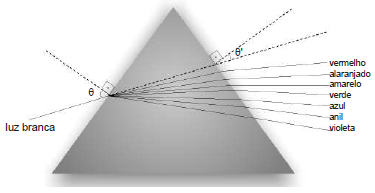
A figura representa um dos experimentos realizados por Isaac Newton, no século XVII, a decomposição da luz solar em várias cores ao atravessar um prisma de vidro.
Considerando-se a velocidade de propagação da luz no vácuo igual a 3,0.105km/s, o índice de refração do vidro para a luz vermelha igual a 1,513, o ângulo de incidência da luz, !$ \theta !$, e os conhecimentos de Física, é correto afirmar:
Provas
Napoleão Bonaparte tinha o hábito de dormir pouco. Acordava no meio da noite para trabalhar. Ele afirmava: “Seis horas de sono para um homem, sete para mulheres e oito para um tolo”. No início da Revolução Industrial, o sono deixou de ser visto como uma atividade intelectual, e as pessoas que dormiam demais passaram a ser consideradas fúteis e preguiçosas.
CUMINALE, Natalia. O despertar das boas noites de sono. Veja. São Paulo: Abril, a. 47,
e. 2388, n. 35, 27 ago. 2014, p. 96-101. Adaptado.
A Revolução Industrial além de alterar as concepções de sono e lazer existentes entre as classes dominantes, como aludido no texto, atingiu também os hábitos cotidianos das classes trabalhadoras
Provas
O caráter, as emoções, a experiência literária e artística, a filosofia e o envolvimento político formam uma parte integral da personalidade. Já que(a) os cientistas são humanos,(c) todos estes fatores(b) determinam suas reações,(c) sua maneira de pensar, e devem ser elementos essenciais na formação das ideias científicas, motivos e atitudes. O conhecimento científico, numa área específica, ainda que(d) profundo e sólido, provê apenas(e) as ferramentas.(e) O que é alcançado com estas ferramentas depende, em larga extensão, dos fatores complexos da personalidade.
NACHMANSOHN, David. In: SOUZA, Álvaro N. de. As duas faces de Apolo: A íntima
relação entre a medicina e as artes. Salvador: Casa da Qualidade, 2000, p. 165.
Considerando-se os elementos linguísticos do texto, é correto afirmar:
Provas
O caráter, as emoções, a experiência literária e artística, a filosofia e o envolvimento político formam uma parte integral da personalidade. Já que os cientistas são humanos, todos estes fatores determinam suas reações, sua maneira de pensar, e devem ser elementos essenciais na formação das ideias científicas, motivos e atitudes. O conhecimento científico, numa área específica, ainda que profundo e sólido, provê apenas as ferramentas. O que é alcançado com estas ferramentas depende, em larga extensão, dos fatores complexos da personalidade.
NACHMANSOHN, David. In: SOUZA, Álvaro N. de. As duas faces de Apolo: A íntima
relação entre a medicina e as artes. Salvador: Casa da Qualidade, 2000, p. 165.
Para o enunciador desse discurso, os resultados de um conhecimento científico
Provas
Caderno Container