Foram encontradas 80 questões.
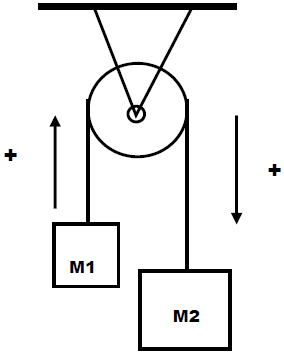
Na máquina de Atwood representada na figura M1 = 2,0 kg e M2 3,0 kg . Assumindo que o fio é inextensível e tem massa desprezível, assim como a polia, a tração no fio, em newtons, é
Dado: g=10 m/s2.
Provas

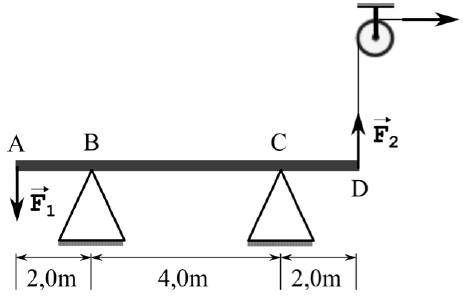
Uma viga metálica uniforme de massa 50 Kg e 8,0 m de comprimento repousa sobre dois apoios nos pontos B e C. Duas forças verticais estão aplicadas nas extremidades A e D da viga: a força !$ \overrightarrow{F_1} !$ de módulo 20 N para baixo e a força !$ \overrightarrow{F_2} !$ de módulo 30N, para cima, de acordo com a figura. Se a viga se encontra em equilíbrio estável, o módulo, em
newtons, da reação !$ \overrightarrow{F_B} !$ no apoio B vale
Dado: g = 10 m/s2.
Provas
Se tgx + sec x = !$ \dfrac{3}{2} !$ , o valor de senx + cos x vale:
Provas
Reading Comprehension
Shipping industry faces new risks, says Allianz.
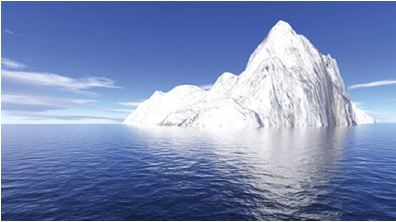
Increasing ship sizes, human error and the challenge of shipping in arctic waters are among the biggest risks facing the modern maritime industry, according to Allianz Global Corporate and Speciality.
The challenge of shipping in arctic waters is among the biggest challenges facing the modern maritime industry, the report said.
Marking 100 years since the sinking of Titanic, the insurers yesterday published a report which noted that, while the world commercial shipping fleet has trebled to over 100,000 vessels over that period, overall shipping loss rates have declined significantly. In 1912, they were one ship per 100 per year; in 2009 they had fallen to one ship per 670 per year.
Despite this, Safety and shipping 1912-2012: from Titanic to Costa Concordia, based on research from Cardiff University, said the industry faced several key challenges. These include the growing trend to ‘super-size’ ships and cost pressures which are forcing ship-owners to source crews from emerging economies where training standards can be inconsistent.
Other emerging risks include reduced crew numbers, which can compromise safety and encourage human error, increasing bureaucracy on board ships and the increased threat of piracy in Somalia and elsewhere. The emergence of ‘ice shipping’ and its associated navigational and environmental complications also poses a risk, the report said.
Dr Sven Gerhard, AGCS’s global product leader for hull & marine liabilities, said the industry needed to address the new risks facing them proactively.
‘For example, ultra-large ships pose challenges for insurers due to their sheer size and value, while others raise concerns on structural integrity and failure. While scale alone does not make these ships riskier, the increased sizes introduce specific risks that need to be addressed, such as salvage and recovery considerations and emergency handling,’ he said.
AGCS noted that, despite hundreds of years of improvements in safety, human error remained a challenge. According to the report, over 75% of marine losses can be attributed to a wide range of ‘human error’ factors, including fatigue, inadequate risk management and competitive pressures, as well as potential deficiencies in training and crewing levels.
Dr Gerhard said: ‘As technological improvements reduce risk, so does the weakest link in the system – the human factor – become more important. This is where the industry should focus most closely, so that best practice risk management and a culture of safety becomes second nature across the world fleet.’
Allianz did, however, note that major accidents have often been the catalysts for key changes in maritime industry safety. In light of this, Dr Gerhard said the Costa Concordia disaster earlier this year was likely to be ‘no different’, regardless of the outcome of investigations into the incident itself.
(The Actuary Newsdesk: Nick Mann 27/Mar 2012)
In lines 58-59: ‘(…) major accidents have often been the catalysts for key changes(…)’, the underlined word can be replaced by:
Provas
Dois recipientes A e B, termicamente isolados e idênticos, contêm, respectivamente, 2,0 litros e 1,0 litro de água à temperatura inicial de 20°C. Utilizando, durante 80 segundos, um aquecedor elétrico de potência constante, aquece-se a água do recipiente A até a temperatura de 60°C. A seguir, transfere-se 1,0 litro de água de A para B, que passa a conter 2,0 litros de água na temperatura T. Esse mesmo volume de água na temperatura T poderia ser obtido apenas com o recipiente A se, a partir das mesmas condições iniciais, utilizássemos o mesmo
aquecedor ligado durante um tempo aproximado de
Dado: massa específica da água !$ \mu !$H2O = 1,0 kg L .
Provas
When Martin ________the car, he took it out for a drive.
Provas
Um recipiente cilíndrico fechado contém 60,0 litros de oxigênio hospitalar (O2) a uma pressão de 100 atm e temperatura de 300 K. Considerando o O2 um gás ideal, o número de mols de O2 presentes no cilindro é
Dado: constante gás ideal R !$ \approx !$ 8,0 x 10⁻² !$ \dfrac{atm.L}{mol.K}. !$
Provas
Um muro será construído para isolar a área de uma escola que está situada a 2km de distância da estação do metrô. Esse muro será erguido ao longo de todos os pontos P, tais que a razão entre a distância de P à estação do metrô e a distância de P à escola é constante e igual a !$ \sqrt{2}. !$
Em razão disso, dois postes, com uma câmera cada, serão fixados nos pontos do muro que estão sobre a reta que passa pela escola e é perpendicular à reta que passa pelo metrô e pela escola. Então, a distância entre os postes, em km, será:
Provas
‘John’s birthday is tomorrow.’‘__________________ I known about it, I would have bought him a gift.’
Provas
I can remember ____________ voices in the middle of the night.
Provas
Caderno Container