Foram encontradas 48 questões.
1238591
Ano: 2019
Disciplina: Inglês (Língua Inglesa)
Banca: DIRENS Aeronáutica
Orgão: EPCAR
Disciplina: Inglês (Língua Inglesa)
Banca: DIRENS Aeronáutica
Orgão: EPCAR
Provas:
Direction: Read the text below and answer question according to the text.
TEXT
The search for life beyond Earth
We have always been fascinated by the thought of alien life elsewhere in the universe. The idea has provided the basis(A) for a huge wealth of science fiction stories that have been limited only by our imaginations. But can other creatures exist in the vast reaches of space or on other planets or moons? And are there other intelligent forms of life out there—or are we more likely to find something much simpler?
Where are all the aliens?
Our Sun is just one star among billions in our galaxy(B). In the last few years, scientists have detected thousands of planets around other stars and it seems that most stars have planetary systems. It’s therefore likely that there will be large numbers of habitable planets in the Milky Way galaxy and beyond that are capable of supporting intelligent life. Some of these intelligent civilisations, if they’re out there, may have even developed interstellar travel.
Are there other intelligent forms of life out there—or are we more likely to find something much simpler?
But Earth hasn’t been visited by any intelligent aliens (yet?). This apparent high probability of life, combined with a lack of evidence for its existence, is called the Fermi Paradox, named for the physicist Enrico Fermi who first outlined 1 the argument back in 1950. This begs the question: where is everybody?
Back in 1961, astronomer Francis Drake tried to rationalise this question by developing an equation that takes into account 2 all the factors relevant to finding alien civilisations and gives an estimate of the number of civilisations out there in the galaxy that should be able to communicate with us. It considers factors such as the rate 3 of new star formation, how many planets around those new and existing stars might be able to support life, the number of planets supporting intelligent life(C), how many of those civilisations might have technology we can detect, whether they’re likely to communicate with us here on Earth, and so on.
The search(D) for extraterrestrial intelligence
Scientists and radio astronomers have started the search for extraterrestrial intelligence (SETI) in a systematic manner. Several international organisations, including the SETI Institute and the SETI League, are using radio telescopes to detect signals that might have been produced by intelligent life.
In 1995, the SETI Institute started Project Phoenix, which used three of the most powerful radio telescopes in the world: the Green Bank radio telescope in West Virginia, USA; the Arecibo telescope in Puerto Rico; and the Parkes radio telescope in NSW, Australia. During its initial phase, Project Phoenix used the Parkes telescope to search for signals coming from 202 Sun-like stars as distant as 155 light years away. By the end of its operations, Project Phoenix had scanned a total of 800 ‘nearby’ 4 (up to 240 light years away) stars for signs of life. The project detected some cosmic noises, but none of that could be attributed to aliens.
These days, anyone can become involved in the search for extraterrestrial intelligence through their personal computer.
While there’s currently excitement about sending human crews to Mars, missions beyond the Red Planet are at this stage pretty much not feasible 5 the distances and travel times involved are simply too great. Basically, all exploration for life beyond Earth will need to be done using robotic space probes 6 and landing rovers. These instruments can provide a huge wealth of information and are capable of exploring as far away as Pluto, perhaps even beyond our solar system. But as for life beyond the solar system, the nearest stars are several light years away, and even communications by electromagnetic waves (which all travel at the speed of light) are essentially going to be a one-way message.
While we probably won’t find intelligent life too close to home, there’s a chance we may still find much simpler life forms. Do we have neighbours beyond Earth? Time will tell—and the search continues.
(Adapted from https://www.science.org.au/curious/space-time/search-lifebeyond- earth – Access on 16/02/19)
Glossary:
1. to outline – describe or give the main fact about something
2. to take into account – consider something
3. rate – expansion
4. nearby – short distance away
5. feasible – appropriate; suitable
6. space probe – spy satellite
1. to outline – describe or give the main fact about something
2. to take into account – consider something
3. rate – expansion
4. nearby – short distance away
5. feasible – appropriate; suitable
6. space probe – spy satellite
Considering the plural form of the nouns, mark the correct alternative.
Provas
Questão presente nas seguintes provas

TEXTO I
Cadê o papel- carbono?
Outro dia tive saudade do papel carbono. E tive saudade também do mimeógrafo a álcool. E tive saudade da velha máquina de escrever. E tive saudade de quando, no dizer de Rubem Braga, a geladeira era branca e o telefone era preto.
Os mais jovens não sabem nem o que é papel carbono ou mimeógrafo a álcool. Mas tive saudade deles, ou melhor, de um tempo em que eu não dependia eletronicamente de outros para fazer as mínimas tarefas. Uma torneira, por exemplo, era algo simples. Eu sabia abrir uma torneira e fazê-la jorrar água. Hoje tomar um banho é uma peripécia tecnológica. Hoje até para tomar um elevador tenho que inserir um cartão eletrônico para ele se mover. Claro que tem o Google, essa enciclopédia no computador que facilita as pesquisas (para quem não precisa ir fundo nos assuntos), mas muita coisa me intriga: por que cada aparelho de televisão de cada casa, de cada hotel tem um controle remoto diferente e a gente não consegue usá-los sem pedir socorro a alguém?
Olha, tanta tecnologia!...Mas além de não terem descoberto como curar uma simples gripe, os elevadores dos hotéis ainda não chegaram a uma conclusão de como assinalar no mostrador que letra deve indicar a portaria. Será necessária uma medida provisória do presidente para uniformizar tal diversidade analfabética.
Outro dia, li que houve uma reunião em Baku, lá no Azerbaijão, congregando cérebros notáveis para decifrarem nosso presente e nosso futuro. Pois Jean Baudrillard andou dizendo, com aquela facilidade que os franceses têm para fazer frases que parecem filosóficas, que o que caracteriza essa época que está vindo por aí é que o homem, leia-se corretamente homens e mulheres, ou seja, o ser humano, foi descartado pela máquina. (Isso a gente já sabe quando tenta ligar para uma firma qualquer e uma voz eletrônica fica mandando a gente discar isto e aquilo e volta tudo a zero e não obtemos a informação necessária.)
Deste modo estão se cumprindo dois vaticínios. O primeiro era de um vate mesmo – Vinícius de Moraes, que naquele poema “Dia da Criação”, fazendo considerações irônicas sobre o dia de “sábado” e os desígnios divinos, diz: “Na verdade, o homem não era necessário”. É isto, já não somos necessários.
E a outra frase metida nessa encrenca é aquela da Bíblia, que dizia que o “sábado foi feito para o homem e não o homem para o sábado”. Isso foi antigamente. Pois achávamos que a máquina havia sido feita para o homem, mas Baudrillard, as companhias aéreas e as telefônicas mais os servidores de informática nos convenceram de que “o homem é que foi feito para a máquina”. Ao telefone só se fala com máquinas, e algumas empresas – esses servidores de informática – nem seus telefones disponibilizam. Estou, por exemplo, há quatro meses tentando falar com alguém no “hotmail” e lá não tem viv’alma, só fantasmas eletrônicos sem rosto e sem voz.
Permita-me, eventual e concreto leitor, lhe fazer uma pergunta indiscreta. Quanto tempo diariamente você está gastando com e-mails? Quanto tempo para apagar o lixo e responder bobagens? Faça a conta, some.
Drummond certa vez escreveu: “Ao telefone perdeste muito tempo de semear”. Ele é porque não conheceu a internet, que, tanto quanto o celular, usada desregradamente é a grande sorvedora de tempo da pós-modernidade.
Por estas e por outras é que estou pensando seriamente em voltar às cartas, quem sabe ao pergaminho. E a primeira medida é reencontrar o papel carbono.
Cadê meu papel carbono?
(SANT’ANNA, Affonso Romano de. Tempo de delicadeza. Porto Alegre: L&PM, 2009)
Assinale a alternativa que possua informações INCORRETAS relacionadas a aspectos discursivos e gramaticais.
Provas
Questão presente nas seguintes provas
TEXTO II
Ladainha II
Por que o raciocínio,
os músculos, os ossos?
A automação, ócio dourado.
O cérebro eletrônico, o músculo
mecânico
mais fáceis que um sorriso.
os músculos, os ossos?
A automação, ócio dourado.
O cérebro eletrônico, o músculo
mecânico
mais fáceis que um sorriso.
Por que o coração?
O de metal não tornará o homem
mais cordial, (A)
dando-lhe um ritmo extra-corporal?
O de metal não tornará o homem
mais cordial, (A)
dando-lhe um ritmo extra-corporal?
Por que levantar o braço
para colher o fruto?
A máquina o fará por nós.
Por que labutar no campo, na cidade?
A máquina o fará por nós.(B)
Por que pensar, imaginar?
A máquina o fará por nós.
Por que fazer um poema?
A máquina o fará por nós. (C)
Por que subir a escada de Jacó?
A máquina o fará por nós.(D)
Ó máquina, orai por nós.
para colher o fruto?
A máquina o fará por nós.
Por que labutar no campo, na cidade?
A máquina o fará por nós.(B)
Por que pensar, imaginar?
A máquina o fará por nós.
Por que fazer um poema?
A máquina o fará por nós. (C)
Por que subir a escada de Jacó?
A máquina o fará por nós.(D)
Ó máquina, orai por nós.
(RICARDO, Cassiano. Jeremias sem-chorar. Rio de Janeiro: José Olympio, 1964.)
A máquina substitui vários trabalhos feitos pelo homem. Mesmo o ofício do artista da palavra pode ser substituído por algum aparelho. Assinale a alternativa em cujo trecho se verifica essa queixa.
Provas
Questão presente nas seguintes provas
Considere as expressões P e Q, com os números a, b e c reais positivos e distintos entre si.
!$ P = { \Large { \left ( a^6 + b^6 + c^6 \right )^2 - \left ( a^6 - b^6 - c^6 \right)^2 \over b^6 + c^6}} !$
!$ Q = { \Large { \left ( b^{-1} - a^{-1} \right )^{-1} - \left ( b^{-1} + a^{-1} \right)^{-1} \over \left ( a^{-1} + b^{-1} \right )^{-1} - \left ( a^{-1} - b^{-1} \right )^{-1}}} !$
A expressão !$ \sqrt{ Q \sqrt{P}} !$ é representada por
Provas
Questão presente nas seguintes provas
TEXTO I
Cadê o papel- carbono?
Outro dia tive saudade do papel carbono. E tive saudade também do mimeógrafo a álcool. E tive saudade da velha máquina de escrever. E tive saudade de quando, no dizer de Rubem Braga, a geladeira era branca e o telefone era preto.
Os mais jovens não sabem nem o que é papel carbono ou mimeógrafo a álcool. Mas tive saudade deles, ou melhor, de um tempo em que eu não dependia eletronicamente de outros para fazer as mínimas tarefas. Uma torneira, por exemplo, era algo simples. Eu sabia abrir uma torneira e fazê-la jorrar água. Hoje tomar um banho é uma peripécia tecnológica. Hoje até para tomar um elevador tenho que inserir um cartão eletrônico para ele se mover. Claro que tem o Google, essa enciclopédia no computador que facilita as pesquisas (para quem não precisa ir fundo nos assuntos), mas muita coisa me intriga: por que cada aparelho de televisão de cada casa, de cada hotel tem um controle remoto diferente e a gente não consegue usá-los sem pedir socorro a alguém?
Olha, tanta tecnologia!(D)...Mas além de não terem descoberto como curar uma simples gripe, os elevadores dos hotéis ainda não chegaram a uma conclusão de como assinalar no mostrador que letra deve indicar a portaria. Será necessária uma medida provisória do presidente para uniformizar tal diversidade analfabética.
Outro dia, li que houve uma reunião em Baku, lá no Azerbaijão, congregando cérebros notáveis para decifrarem nosso presente e nosso futuro. Pois Jean Baudrillard andou dizendo, com aquela facilidade que os franceses têm para fazer frases que parecem filosóficas, que o que caracteriza essa época que está vindo por aí é que o homem, leia-se corretamente homens e mulheres, ou seja, o ser humano, foi descartado pela máquina. (Isso a gente já sabe quando tenta ligar para uma firma(B) qualquer e uma voz eletrônica fica mandando a gente discar isto e aquilo e volta tudo a zero e não obtemos a informação necessária.)
Deste modo estão se cumprindo dois vaticínios. O primeiro era de um vate mesmo – Vinícius de Moraes, que naquele poema “Dia da Criação”, fazendo considerações irônicas sobre o dia de “sábado” e os desígnios divinos, diz: “Na verdade, o homem não era necessário”. É isto, já não somos necessários.
E a outra frase metida nessa encrenca é aquela da Bíblia, que dizia que o “sábado foi feito para o homem e não o homem para o sábado”. Isso foi antigamente. Pois achávamos que a máquina havia sido feita para o homem, mas Baudrillard, as companhias aéreas e as telefônicas mais os servidores de informática nos convenceram de que “o homem é que foi feito para a máquina”. Ao telefone só se fala com máquinas, e algumas empresas – esses servidores de informática – nem seus telefones disponibilizam. Estou, por exemplo, há quatro meses tentando falar com alguém no “hotmail” e lá não tem viv’alma, só fantasmas eletrônicos sem rosto e sem voz(A).
Permita-me, eventual e concreto leitor, lhe fazer uma pergunta indiscreta. Quanto tempo diariamente você está gastando com e-mails? Quanto tempo para apagar o lixo e responder bobagens? Faça a conta, some.
Drummond certa vez escreveu: “Ao telefone perdeste muito tempo de semear”. Ele é porque não conheceu a internet, que, tanto quanto o celular, usada desregradamente é a grande sorvedora de tempo da pós-modernidade.
Por estas e por outras é que estou pensando seriamente em voltar às cartas, quem sabe ao pergaminho. E a primeira medida é reencontrar o papel carbono.
Cadê meu papel carbono?(C)
(SANT’ANNA, Affonso Romano de. Tempo de delicadeza. Porto Alegre: L&PM, 2009)
Observando trechos do texto, percebe-se que o uso coloquial da linguagem NÃO está presente em
Provas
Questão presente nas seguintes provas
1474013
Ano: 2019
Disciplina: Inglês (Língua Inglesa)
Banca: DIRENS Aeronáutica
Orgão: EPCAR
Disciplina: Inglês (Língua Inglesa)
Banca: DIRENS Aeronáutica
Orgão: EPCAR
Provas:
Direction: Read the text below and answer question according to the text.
TEXT
The search for life beyond Earth
We have always been fascinated by the thought of alien life elsewhere in the universe. The idea has provided the basis for a huge wealth of science fiction stories that have been limited only by our imaginations. But can other creatures exist in the vast reaches of space or on other planets or moons? And are there other intelligent forms of life out there—or are we more likely to find something much simpler?
Where are all the aliens?
Our Sun is just one star among billions in our galaxy. In the last few years, scientists have detected thousands of planets around other stars and it seems that most stars have planetary systems. It’s therefore likely that there will be large numbers of habitable planets in the Milky Way galaxy and beyond that are capable of supporting intelligent life. Some of these intelligent civilisations, if they’re out there, may have even developed interstellar travel.
Are there other intelligent forms of life out there—or are we more likely to find something much simpler?
But Earth hasn’t been visited by any intelligent aliens (yet?). This apparent high probability of life, combined with a lack of evidence for its existence, is called the Fermi Paradox, named for the physicist Enrico Fermi who first outlined 1 the argument back in 1950. This begs the question: where is everybody?
Back in 1961, astronomer Francis Drake tried to rationalise this question by developing an equation that takes into account 2 all the factors relevant to finding alien civilisations and gives an estimate of the number of civilisations out there in the galaxy that should be able to communicate with us. It considers factors such as the rate 3 of new star formation, how many planets around those new and existing stars might be able to support life, the number of planets supporting intelligent life, how many of those civilisations might have technology we can detect, whether they’re likely to communicate with us here on Earth, and so on.
The search for extraterrestrial intelligence
Scientists and radio astronomers have started the search for extraterrestrial intelligence (SETI) in a systematic manner. Several international organisations, including the SETI Institute and the SETI League, are using radio telescopes to detect signals that might have been produced by intelligent life.
In 1995, the SETI Institute started Project Phoenix, which used three of the most powerful radio telescopes in the world: the Green Bank radio telescope in West Virginia, USA; the Arecibo telescope in Puerto Rico; and the Parkes radio telescope in NSW, Australia. During its initial phase, Project Phoenix used the Parkes telescope to search for signals coming from 202 Sun-like stars as distant as 155 light years away. By the end of its operations, Project Phoenix had scanned a total of 800 ‘nearby’ 4 (up to 240 light years away) stars for signs of life. The project detected some cosmic noises, but none of that could be attributed to aliens.
These days, anyone can become involved in the search for extraterrestrial intelligence through their personal computer.
While there’s currently excitement about sending human crews to Mars, missions beyond the Red Planet are at this stage pretty much not feasible 5 the distances and travel times involved are simply too great. Basically, all exploration for life beyond Earth will need to be done using robotic space probes 6 and landing rovers. These instruments can provide a huge wealth of information and are capable of exploring as far away as Pluto, perhaps even beyond our solar system. But as for life beyond the solar system, the nearest stars are several light years away, and even communications by electromagnetic waves (which all travel at the speed of light) are essentially going to be a one-way message.
While we probably won’t find intelligent life too close to home, there’s a chance we may still find much simpler life forms. Do we have neighbours beyond Earth? Time will tell—and the search continues.
(Adapted from https://www.science.org.au/curious/space-time/search-lifebeyond- earth – Access on 16/02/19)
Glossary:
1. to outline – describe or give the main fact about something
2. to take into account – consider something
3. rate – expansion
4. nearby – short distance away
5. feasible – appropriate; suitable
6. space probe – spy satellite
1. to outline – describe or give the main fact about something
2. to take into account – consider something
3. rate – expansion
4. nearby – short distance away
5. feasible – appropriate; suitable
6. space probe – spy satellite
Mark the alternative that is grammatically correct.
Provas
Questão presente nas seguintes provas
Para decorar uma parede no interior de sua casa, Marisa comprou quadros conforme figura abaixo.
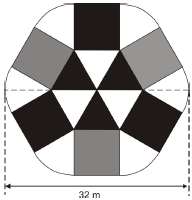
Cada quadro contém:
• um hexágono regular;
• seis quadrados, cada um com um lado coincidente com um dos lados do hexágono;
• seis setores circulares idênticos de centro nos vértices do hexágono e cuja medida do raio é igual à medida do lado do quadrado.
• seis quadrados, cada um com um lado coincidente com um dos lados do hexágono;
• seis setores circulares idênticos de centro nos vértices do hexágono e cuja medida do raio é igual à medida do lado do quadrado.
As figuras foram pintadas de três cores diferentes: preto, branco e cinza.
Para cada 500 cm2 pintados no quadro, cobra-se 50 reais.
Cada quadro foi comprado pelo custo da pintura mais 77 reais.
Considere !$ \pi = 3 !$ e !$ \sqrt{3} = 1,7 !$
Pode-se afirmar que Marisa pagou, por um quadro, em reais, mais de
Provas
Questão presente nas seguintes provas
Seja !$ S \subset \mathsf{IR} !$ conjunto solução, na variável x, da equação irracional dada por !$ \sqrt[4]{ \left ( x^2 + x \right )}^4 + \sqrt[8]{ \left ( x^2 + x \right )}^4 = 420 !$ Sugestão: use !$ \left ( x^2 +x \right ) = y !$
Analise as alternativas e marque a FALSA.
Provas
Questão presente nas seguintes provas
Cadernos
Caderno Container